
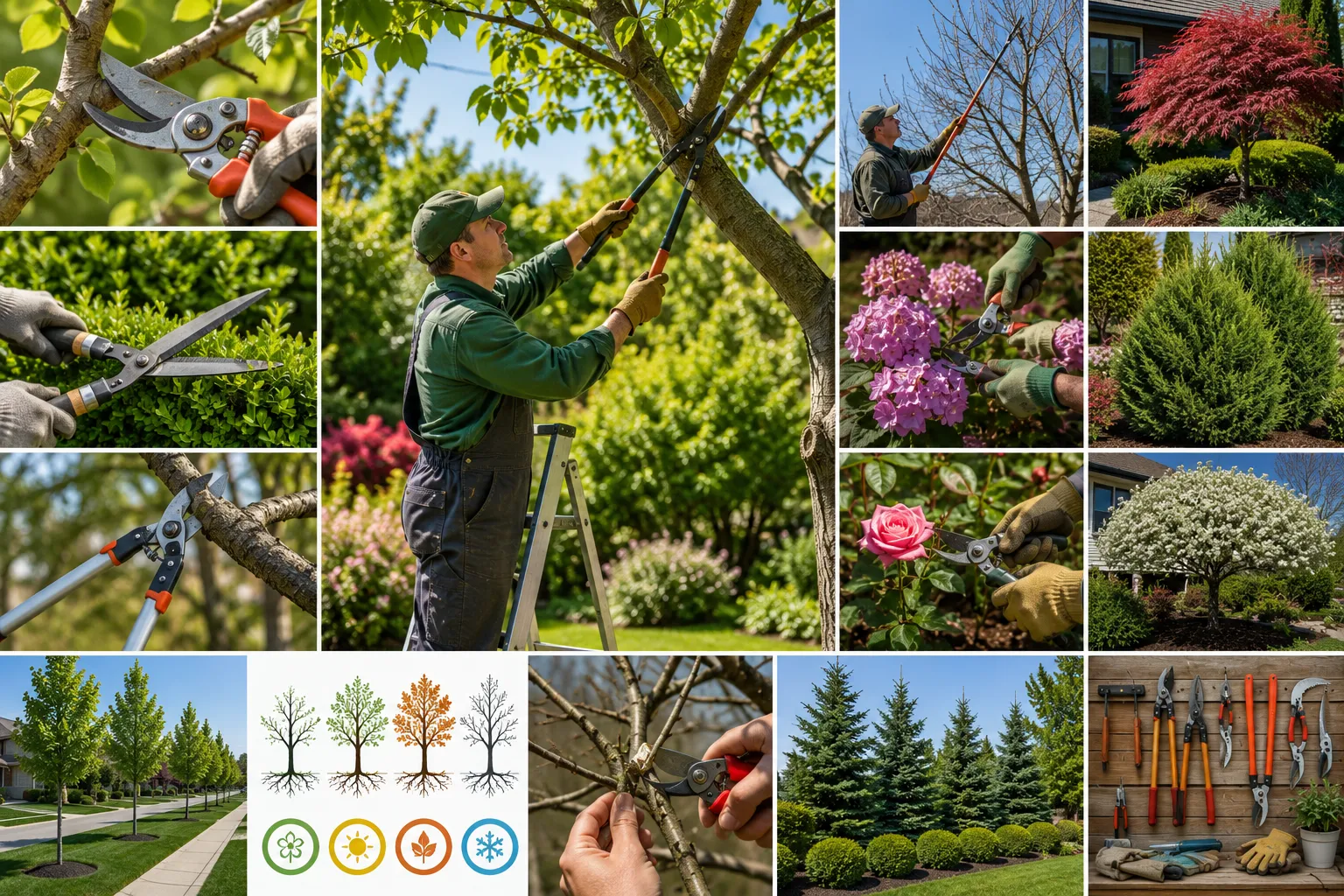
Prune trees and shrubs during late winter or early spring dormancy for most species, with exceptions for spring bloomers and sap-heavy trees. Correct timing and clean cuts prevent disease, protect next season’s flowers, and keep woody plants structurally sound for decades.
This guide gives you the exact timing rules, cut types, and tool specifications you need for tree and shrub pruning on 6 plant categories, plus a zone-by-zone schedule you can follow without guesswork.
What Is Tree and Shrub Pruning?
Tree and shrub pruning means removing specific branches, stems, or buds to control plant health, shape, and flower or fruit production. Arborists classify 4 goals for this work: health maintenance, safety, shape control, and flower or fruit improvement.
Each cut redirects a plant’s energy. Remove a branch and the plant sends growth hormones to nearby buds instead. This single mechanism explains why cut location matters more than cut volume.
Three growth-control hormones drive this response: terminal buds suppress nearby growth, lateral buds activate once that suppression lifts, and latent buds wait beneath the bark for damage signals. Understanding this hormone chain lets you predict exactly where new growth will appear before you make a single cut.
Untrained cutting causes 3 common problems: disease entry through torn bark, weak regrowth from topped branches, and reduced flowering from poor timing. Each problem traces back to one of two errors — wrong cut location or wrong cut season.
Plants respond differently to maintenance work depending on age. Young trees and shrubs need structural training cuts to build a strong branch framework, while mature specimens need periodic health cuts to remove dead or crossing wood.
Skipping early structural work costs more later. A tree left untrained for 5-10 years often needs heavy corrective cutting that a few light cuts each year would have prevented entirely.
When Should You Prune Trees and Shrubs?
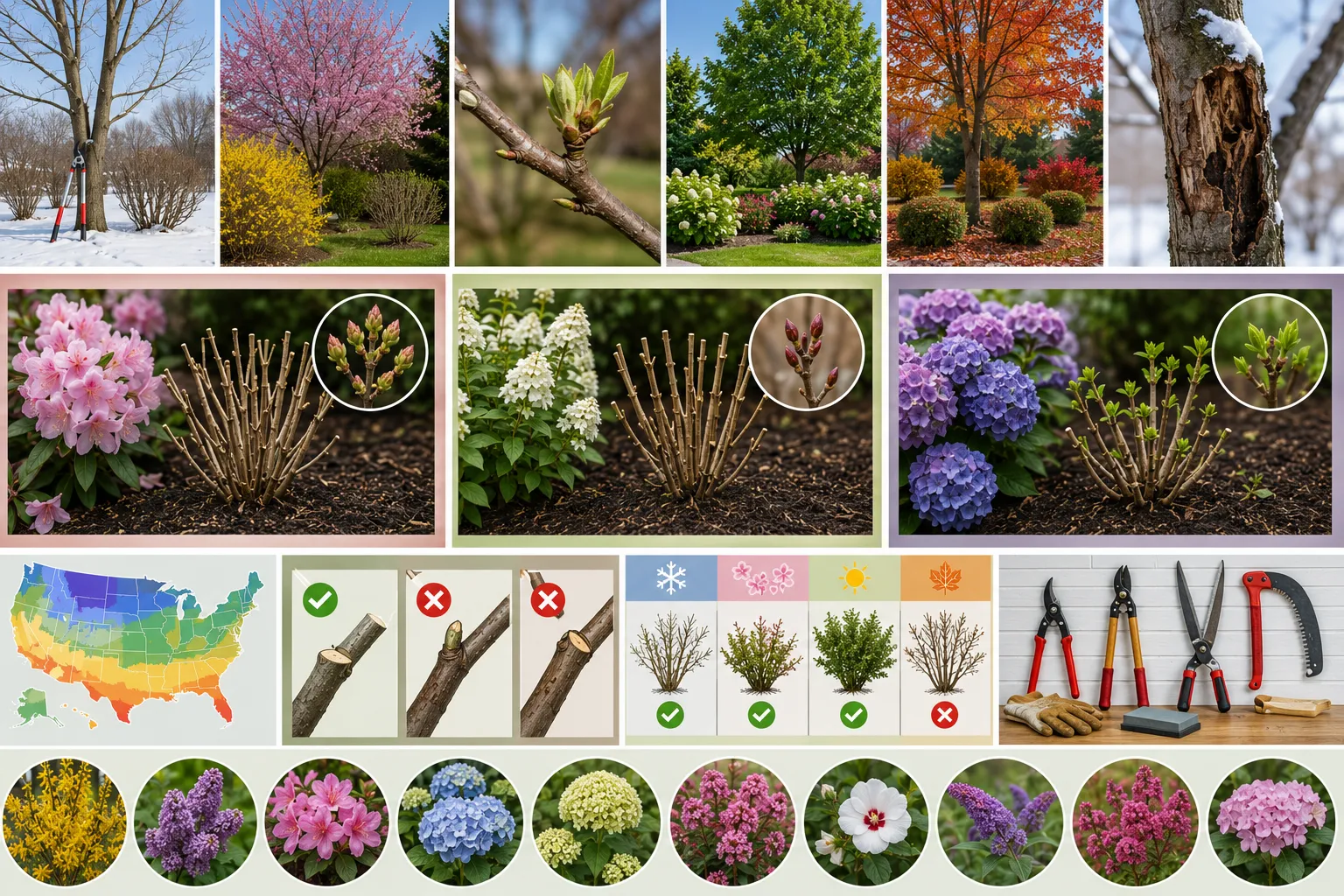
Cut back most deciduous trees and shrubs in late winter or early spring, before new growth starts. Bare branches at this stage reveal the full structure, and fresh wounds heal fast once spring growth begins.
3 exceptions override the dormant-season rule: spring-flowering shrubs, sap-bleeding trees, and disease-prone species. Match your plant to one of the categories below before you cut.
Regional climate shifts these windows by several weeks. Gardeners in USDA zones 8-10 often start dormant-season cutting in January, while zone 4-5 gardeners wait until March to avoid late frost damage to fresh wounds.
Fall cutting carries the highest risk of any season. Wounds made in autumn close slowly because growth has already slowed, leaving tissue exposed through winter freeze-thaw cycles that crack bark and invite decay organisms.
How to Time Pruning Around Flower Buds
To time cuts around flower buds, identify whether your plant blooms on old wood or new wood first. Old-wood bloomers set next year’s flower buds shortly after this year’s bloom ends.
Cut back old-wood bloomers within 2-3 weeks after their flowers fade. Named examples include forsythia (Forsythia spp.), lilac (Syringa spp.), azalea, and bigleaf hydrangea.
Cut new-wood bloomers in late winter, 4-6 weeks before spring growth resumes. Named examples include panicle hydrangea, rose of Sharon, butterfly bush, and crape myrtle. Our complete crape myrtle guide covers exact pruning windows by region for this specific tree.
A third group splits the difference: reblooming hydrangeas flower on both old and new wood. Limit cuts on this group to dead stems only, since heavy cutting removes blooms from both flowering cycles at once.
How to Prune Evergreens on a Different Schedule
To handle evergreens on a different schedule, separate broadleaf evergreens from needled conifers first. The two groups respond to cutting in opposite ways.
Cut broadleaf evergreens such as boxwood, camellia, and rhododendron in late winter or right after bloom. Trim pines only in spring, while candles measure 2-3 inches (5-7.5cm) and before needles expand.
Spruce, fir, and arborvitae tolerate cutting any time except midsummer heat. Pines cannot regenerate from old wood, so trim only new growth on this species.
Junipers fall into a third category among conifers. Trim junipers from the bottom up, shortening any branch that extends beyond the desired outline back to a lower lateral branch hidden beneath the canopy.
How to Make a Proper Pruning Cut
To make a proper cut, locate the branch collar first, then cut just outside it at a 45-degree angle. A clean cut at the correct angle seals 3 times faster than a flat or torn cut.
Cut direction matters as much as cut angle. Always cut above a bud facing outward, away from the plant’s center, so new growth extends outward instead of crossing back through the canopy.
How to Identify the Branch Collar
To identify the branch collar, look for the raised ring of bark where a branch meets the trunk or a larger limb. This swollen tissue contains the cells responsible for wound closure.
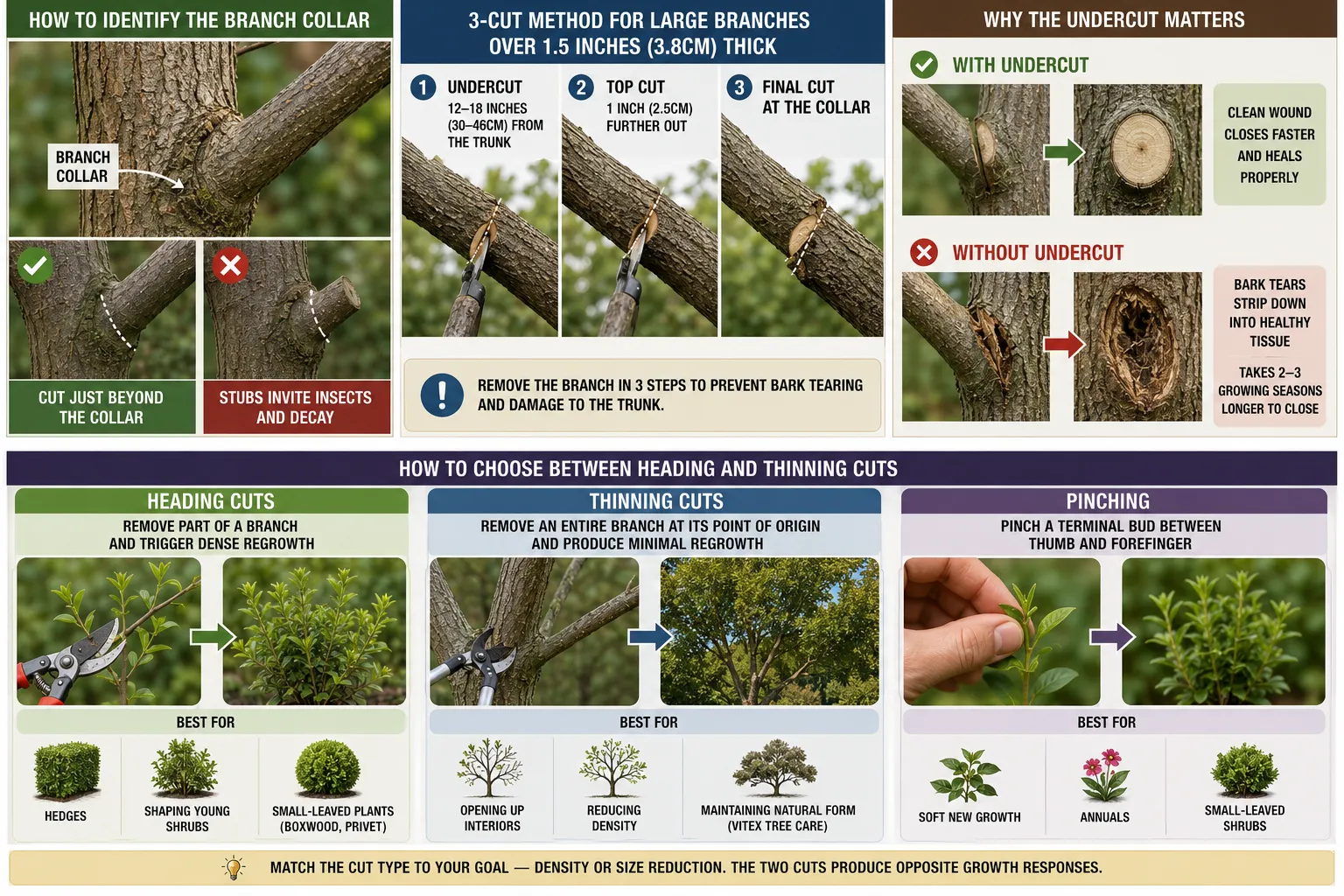
Cut just beyond the collar without leaving a stub. A stub longer than 0.5 inches (1.3cm) invites insects and decay fungi into the wound.
For branches over 1.5 inches (3.8cm) thick, use 3 cuts to prevent bark tearing: an undercut 12-18 inches (30-46cm) from the trunk, a top cut 1 inch (2.5cm) further out, and a final cut at the collar.
Skip the undercut on small branches and you risk a bark tear that strips down into healthy trunk tissue. This single torn strip can take 2-3 growing seasons longer to close than a clean collar cut.
How to Choose Between Heading and Thinning Cuts
To choose between heading and thinning cuts, match the cut type to your goal — density or size reduction. The two cuts produce opposite growth responses.
Heading cuts remove part of a branch and trigger dense regrowth below the cut. Use heading cuts for hedges, shaping young shrubs, and small-leaved plants such as boxwood or privet.
Thinning cuts remove an entire branch at its point of origin and produce minimal regrowth. Use thinning cuts to open up plant interiors, reduce density, and maintain a natural form on trees such as Vitex tree care specimens, where heading cuts would disrupt the natural canopy shape.
A third option, pinching, suits soft new growth on annuals and small-leaved shrubs. Pinch a terminal bud between thumb and forefinger to stop elongation and encourage bushier growth without tools.
Which Pruning Tools Do You Need?
You need 4 core tools to handle 95% of tree and shrub maintenance: bypass hand pruners, loppers, a pruning saw, and hedge shears. Each tool matches a specific branch diameter range.
| Tool | Branch Diameter | Best Use | Type to Buy |
| Bypass hand pruners | Up to 0.75 in (1.9cm) | Precision cuts on small stems | Bypass blade, not anvil |
| Loppers | 0.75-1.5 in (1.9-3.8cm) | Medium branches, extra reach | Bypass with long handles |
| Pruning saw | 1.5-4 in (3.8-10cm) | Thick limbs, clean cuts | Curved blade, tri-cut teeth |
| Pole pruner | 1-2 in (2.5-5cm), high reach | Branches beyond arm’s reach | Telescoping handle |
| Hedge shears | Small stems, broad surfaces | Shaping hedges and topiary | Manual or powered |
Bypass blades outperform anvil blades for live wood. Bypass tools use 2 curved blades that slide past each other like scissors, while anvil tools press a single blade against a flat plate and crush stem tissue instead of slicing it cleanly.
Sterilize blades with rubbing alcohol before and after each plant. This single step stops disease transfer between specimens during the same session, especially when working on plants with known fungal or bacterial issues.
How to Prune Overgrown or Neglected Shrubs
To restore overgrown or neglected shrubs, remove no more than 30% of total branches in a single season. Exceeding this limit stresses the root system and triggers excessive watersprout growth.
Renewal cutting works for most overgrown shrubs: remove the oldest one-third of stems at ground level each year for 3 years. This staged approach restores shape without sacrificing the entire bloom cycle.
Rejuvenation cutting suits multi-stemmed shrubs only. Cut all canes back to 6 inches (15cm) from the ground in early spring on species such as spirea, forsythia, and viburnum. Named flowering shrubs that tolerate this hard cutback include weigela and red-twig dogwood.
Expect a full growing season before a rejuvenated shrub regains its mature shape. Flowers may be sparse or absent the first year, but the plant returns to normal blooming within 12-24 months. Our Eclipse hydrangea care guide covers the exact recovery timeline for that dark-foliage cultivar after a hard cutback.
What Mistakes Ruin Trees and Shrubs During Pruning?
5 mistakes account for most cutting damage in home landscapes. Each one is preventable with the correct technique covered above.
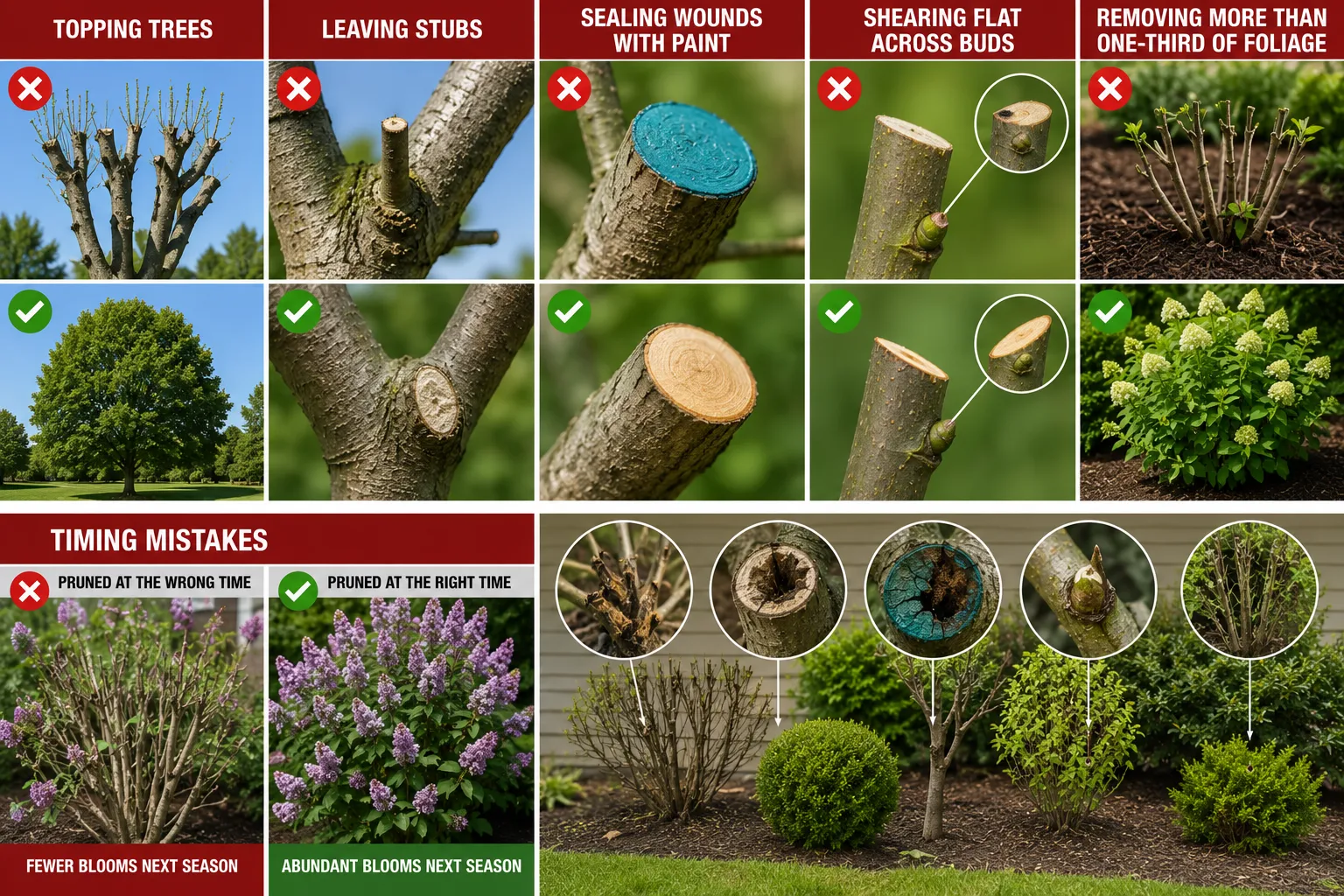
- Topping trees: cutting the main leader creates weak vertical regrowth and permanent structural damage.
- Leaving stubs: any stub over 0.5 inches (1.3cm) becomes an entry point for decay fungi.
- Sealing wounds with paint: wound dressing traps moisture and slows natural healing.
- Shearing flat across buds: cuts made without an angled slope collect water and rot the bud beneath.
- Removing more than one-third of foliage: heavy single-season cuts reduce a plant’s ability to photosynthesize and recover.
Timing mistakes cause silent damage that surfaces months later. A shrub cut at the wrong point in its bloom cycle still survives, but produces few or no flowers the following season, leading many gardeners to wrongly suspect disease or poor soil instead.
Quick-Reference Pruning Schedule
Use this schedule to match your plant category to the correct cutting window without checking individual species guides.
Climate zone shifts every date range in this table by 2-4 weeks. Treat the schedule as a starting point, then adjust earlier for zones 8-10 or later for zones 3-5 based on your local last-frost date.
| Plant Category | Best Pruning Time | Cut Method | Difficulty |
| Spring-flowering shrubs (lilac, forsythia) | Within 3 weeks after bloom | Thinning + light heading | Easy |
| Summer-flowering shrubs (panicle hydrangea) | Late winter, before growth | Heading cuts | Easy |
| Deciduous shade trees | Late winter dormancy | Thinning cuts | Moderate |
| Evergreen broadleaf (boxwood) | Late winter or post-bloom | Shearing or heading | Easy |
| Pines and spruce | Spring, candle stage only | Candle pinching | Moderate |
| Sap-bleeding trees (maple, birch) | Early summer, full leaf-out | Thinning cuts | Moderate |
| Overgrown multi-stem shrubs | Early spring | Rejuvenation pruning | Moderate |
| Formal hedges | Spring + mid-summer | Shearing | Easy |
When Should You Call a Professional Arborist?
Call a professional arborist for any branch near power lines, any cut requiring a ladder above 10 feet (3m), and any tree showing decay, hollow wood, or root damage. These 3 conditions account for most home maintenance injuries each year.
A certified arborist also carries the equipment and insurance needed for large-limb removal. DIY removal of limbs over 4 inches (10cm) in diameter risks property damage and personal injury.
Check for 4 warning signs before climbing any tree yourself: peeling bark in patches, soft or hollowed wood, roots raised above grade, and visible cracks running into the trunk. Any one of these signs means the structural integrity is already compromised, and a trained eye should assess the full extent before you cut.
Frequently Asked Questions
Can you cut back trees and shrubs in summer?
Yes, but only for specific purposes. Summer work suits sap-bleeding trees like maple and birch, plus light shaping on hedges. Avoid summer cutting within 1 month of your first expected frost.
Does cutting hurt a tree or shrub?
No, correct technique does not harm a plant. A clean cut at the branch collar heals within one growing season. Damage occurs only from incorrect technique or wrong-season timing, not from the activity itself.
How much can you safely remove in one session?
Remove no more than 30% of total branches in a single season. Exceeding 30% stresses root reserves and triggers excessive regrowth instead of healthy recovery.
Should you paint or seal cut wounds?
No, wound sealants are not recommended for most cuts. Sealants trap moisture against the wound and slow natural healing. The only exception is oak trees cut during oak wilt season, which need a thin latex coating to mask the cut’s scent.
What is the difference between pruning and trimming?
Pruning targets specific branches for plant health and structure using thinning or heading cuts at precise points. Trimming shapes a plant’s outer surface, typically with shears, and focuses on appearance rather than internal structure.
Prune With Purpose, Not Guesswork
Correct tree and shrub pruning comes down to 2 decisions: the right season and the right cut location. Match your plant to its bloom-wood category, choose heading or thinning based on your goal, and stop at the 30% removal limit.
These 3 rules prevent the disease, weak regrowth, and lost blooms that ruin most home cutting attempts. Apply them this season and your trees and shrubs will reward you with stronger structure and fuller blooms next year.
Build a simple yearly habit instead of treating this as a once-a-decade emergency project. A 20-minute walk through your yard each season, removing dead wood and crossing branches as you find them, prevents the kind of overgrowth that demands a hard rejuvenation cutback later.