
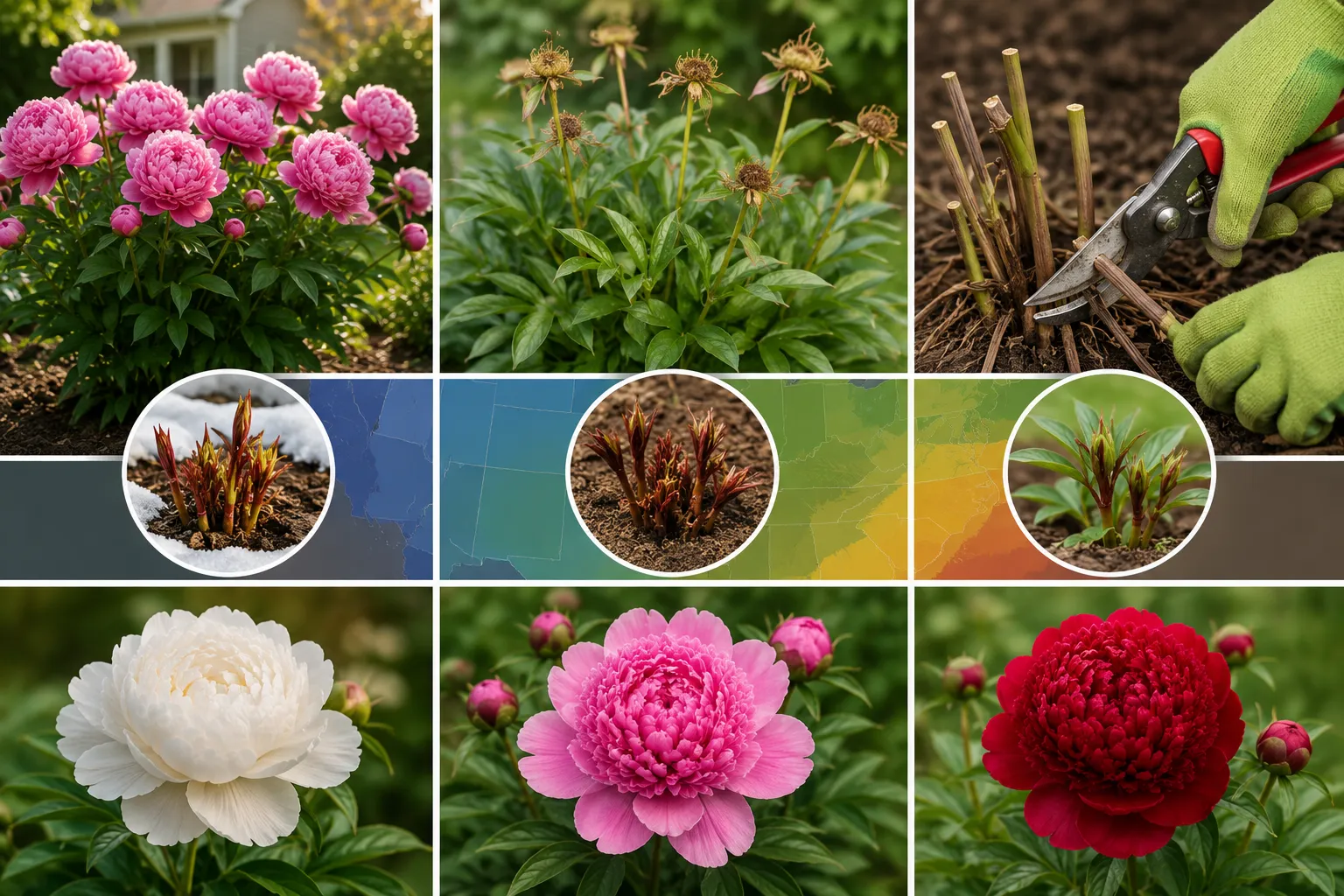
Prune peonies in fall, after the first hard frost, when at least 50% of leaves have turned yellow or brown. For most home gardeners in USDA (United States Department of Agriculture) Zones 4–6, that pruning window falls between mid-October and early November. Cut herbaceous stems to 2–3 inches (5–7.5 cm) above ground level. Tree peonies are the one exception — those never get cut in fall.
That is the short answer. Keep reading for exact timing by zone, step-by-step cuts for all 3 peony types, the 5 gardening mistakes that reduce next year’s blooms, and a post-pruning lawn and garden care checklist no other guide covers.
When Exactly Should You Prune Peonies?
Watch the leaves, not the calendar. Peony leaves give the most reliable pruning signal in the garden. Once leaves fall below 50% green, the plant stops photosynthesis and pulls stored nutrients back into the root system for winter.
Cut too early — while leaves are still mostly green — and you interrupt that nutrient transfer. The result is a weaker root system and fewer blooms the following spring. Cut too late and disease spores overwinter on dead foliage left in the garden bed.
The ideal pruning window: leaves are 50% or more yellow or brown, and at least one hard frost has reached your garden. Both conditions matter. Frost alone does not confirm dormancy. Leaf color does.
One exception applies immediately: if your peony carries heavy botrytis blight, powdery mildew, or any spreading fungal disease, cut the plant back right away regardless of leaf color. Diseased foliage causes more damage by staying on the plant than the small photosynthesis benefit it provides.
Peony Pruning Schedule by USDA Zone
Pruning timing shifts by roughly 3–4 weeks across growing zones. This gardening calendar removes the guesswork for home gardeners across North America.
| USDA Zone | States / Regions | Target Pruning Window |
| Zone 3 | Minnesota, North Dakota, Montana | Late September – early October |
| Zone 4 | Wisconsin, Michigan, Wyoming | Early – mid-October |
| Zone 5 | Ohio, Illinois, Colorado | Mid – late October |
| Zone 6 | Virginia, Kansas, Oregon coast | Late October – mid-November |
| Zone 7 | Tennessee, North Carolina, Oklahoma | Mid – late November |
| Zone 8 | Georgia, Texas, Pacific Northwest | Late November – early December |
| Zone 9 | Florida panhandle, Southern California | December |
Use this table as your starting point, then let leaf color make the final garden call. A warm fall in Zone 5 may push your window to early November. A cold snap in Zone 7 may pull it back to October. The leaf — not the date — confirms when the plant is ready.
How to Prune 3 Types of Peonies in Your Garden
Not all peonies follow the same pruning rules. Applying herbaceous pruning methods to a tree peony destroys flowering wood that took years to develop in your garden bed.
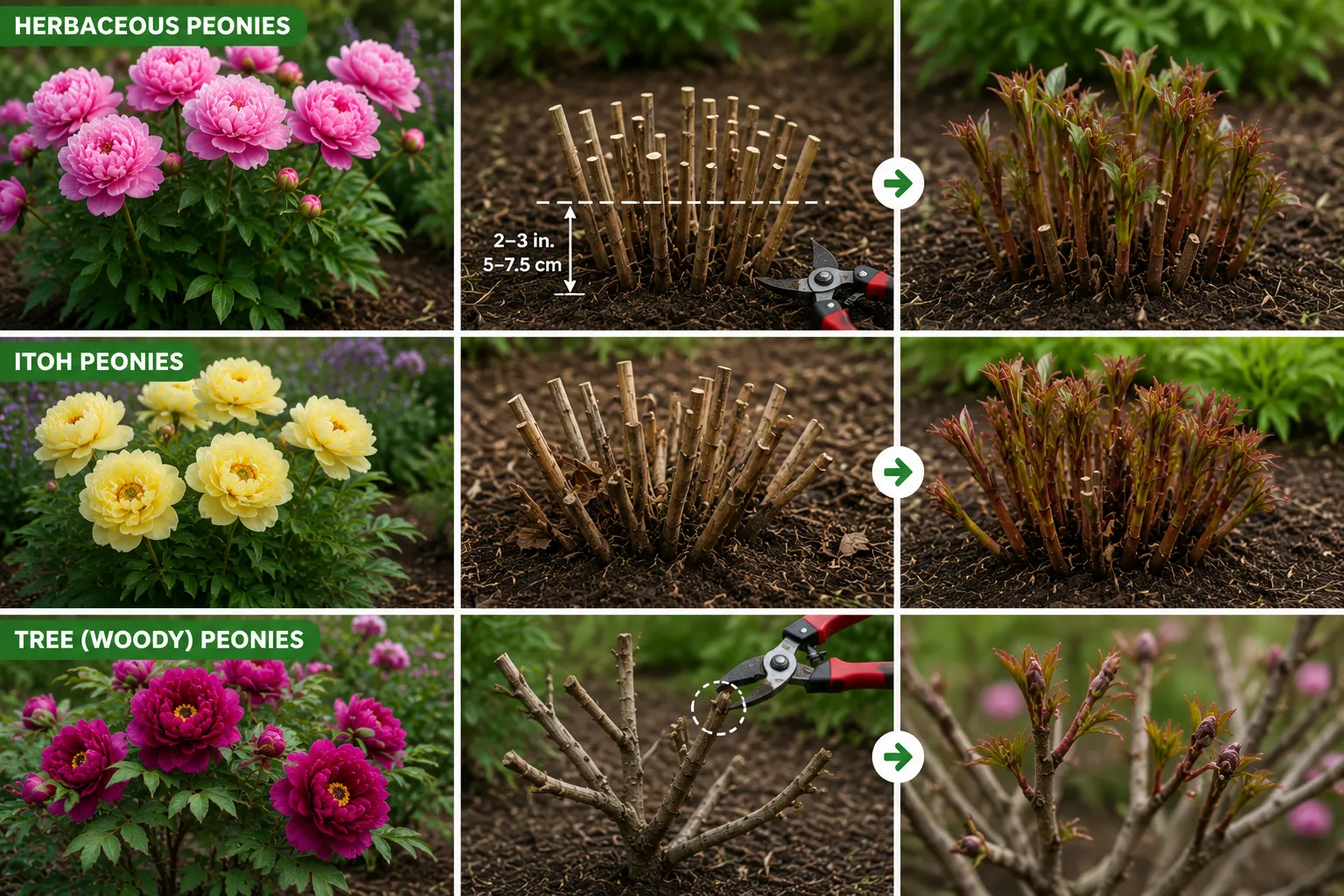
Herbaceous Peonies
Herbaceous peonies (Paeonia lactiflora) die back completely to the soil every year. All new growth emerges fresh from underground roots each spring. To prune herbaceous peonies correctly:
Cut every stem to 2–3 inches (5–7.5 cm) above ground level after the first hard frost. Remove all cut material from the garden bed immediately. Do not leave trimmings on the soil surface and do not add peony foliage to your compost pile. Peony trimmings carry fungal spores that survive standard composting temperatures and return to your lawn and garden soil the following season.
Itoh (Intersectional) Peonies
Itoh peonies cross herbaceous and tree peony varieties. The stems die back like a herbaceous peony but occasionally form small dormant buds at the base of woody growth above ground. Cut all dead herbaceous growth down to the woody base — or to ground level entirely. Leaving old woody stumps in the garden bed creates lopsided plant shapes over time. Cut clean to ground level each fall and the plant structures itself correctly the following spring.
Tree (Woody) Peonies
Never prune tree peonies in fall. Tree peony stems are permanent woody structures that carry next year’s flower buds. Cutting them in fall removes an entire bloom season from your garden. The correct approach for tree peonies: remove only dead or damaged wood in early spring, just before buds break open. Remove any suckers growing from the base at ground level. A light spring cleanup — not a fall cutback — keeps tree peonies productive in your patio garden for decades.
Newly Planted Peonies — Year 1 Rule
Do not prune peonies during their first fall after planting. Year-1 peonies need every green leaf for as long as possible to build root mass in the garden bed. The root system is small at planting and has not stored enough energy to survive a full winter combined with early pruning. Let first-year foliage die back naturally. Remove completely dead material only after it collapses on its own — make no cuts above the crown.
5 Gardening Tools You Need Before You Start Pruning
Starting with the wrong gardening tools tears peony stem tissue rather than cutting it cleanly. Torn tissue opens direct entry points for botrytis blight and peony leaf blotch in your garden.
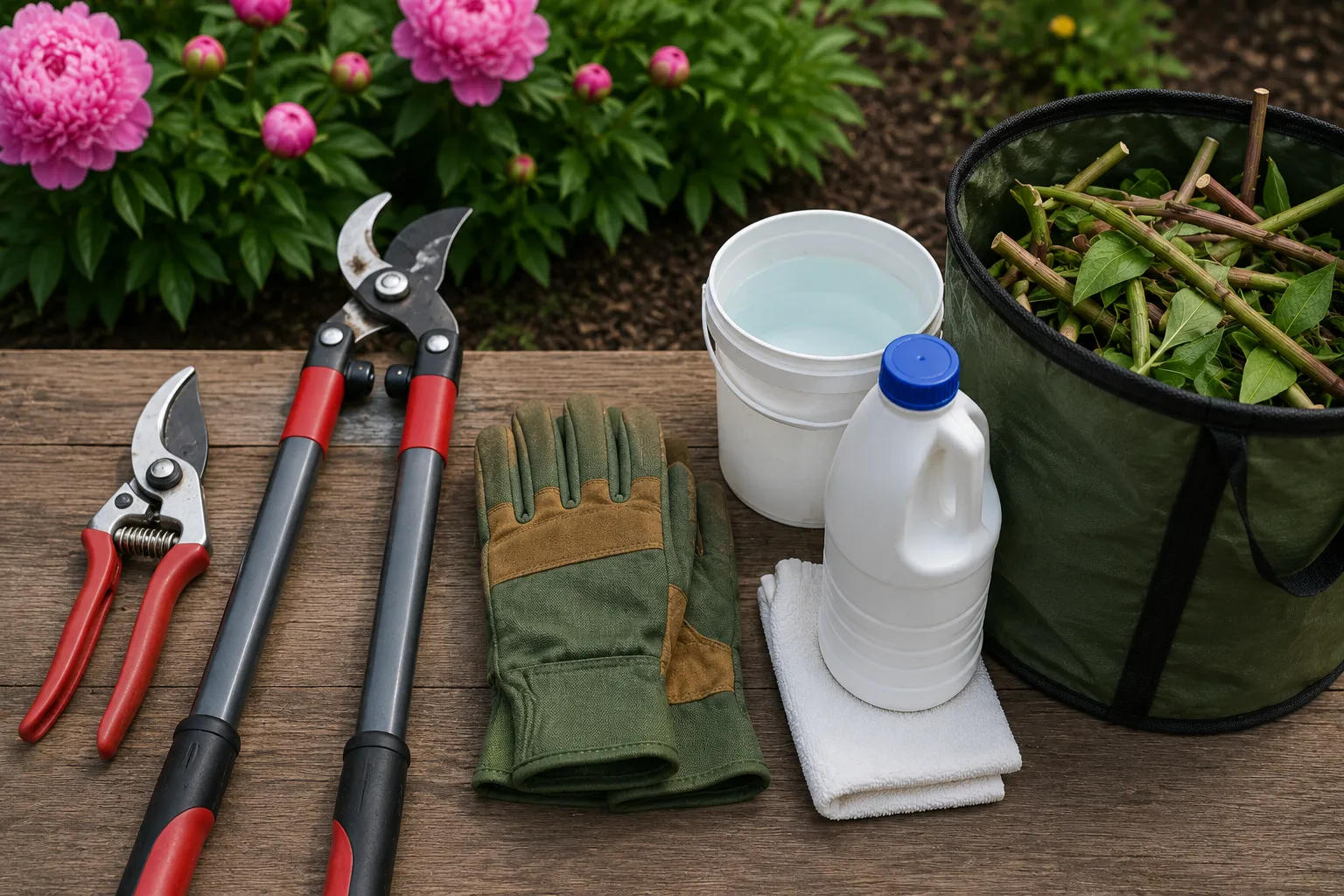
- Bypass pruning shears — bypass style only, not anvil-style. Bypass blades cut like scissors and leave clean stem edges. Anvil blades crush stems and create ragged wounds that invite disease.
- Long-handled garden loppers — for peony stems thicker than 3/4 inch (1.9 cm) on older, established garden plants.
- Heavy gardening gloves — peony sap causes skin irritation on extended contact during garden cleanup.
- 10% bleach solution — mix 1 part household bleach (sodium hypochlorite) with 9 parts water in a small bucket. Wipe both blades between plants to stop disease moving between root systems in your garden bed.
- Garden waste bags or a garden cart — collect and dispose of all trimmings directly into household trash. Do not use yard waste bins or lawn and garden composting services for peony material.
How to Prune Peonies: 6-Step DIY Process
Follow these 6 steps in order. Skipping any step — especially blade disinfection — undoes the disease-prevention benefit of the entire garden pruning session.
Step 1: Check leaf color first. Confirm at least 50% of leaves are yellow or brown before picking up any gardening tool. Pruning before this point reduces next year’s blooms.
Step 2: Mix your disinfection solution. Combine 1 part bleach with 9 parts water in a garden bucket. Place the bucket beside your work area before making the first cut.
Step 3: Cut every herbaceous stem to 2–3 inches (5–7.5 cm). Use one clean bypass cut per stem. Do not saw back and forth — one decisive cut per stem produces the cleanest wound.
Step 4: Wipe garden tool blades after every plant. Dip a clean cloth into the bleach solution and wipe both blades. Let the blade air-dry for 30 seconds before moving to the next plant in your garden.
Step 5: Remove every piece of plant material from the garden bed. Pick up every fallen leaf, cut stem, and old petal. Bag all garden debris into household trash — not lawn and garden compost.
Step 6: Apply mulch in cold-climate gardens. In Zone 4 and colder, spread 2–3 inches (5–7.5 cm) of shredded leaves or pine needles over the root zone. Keep mulch away from direct contact with cut stubs to prevent crown rot in the garden over winter.
5 Peony Pruning Mistakes That Reduce Garden Blooms
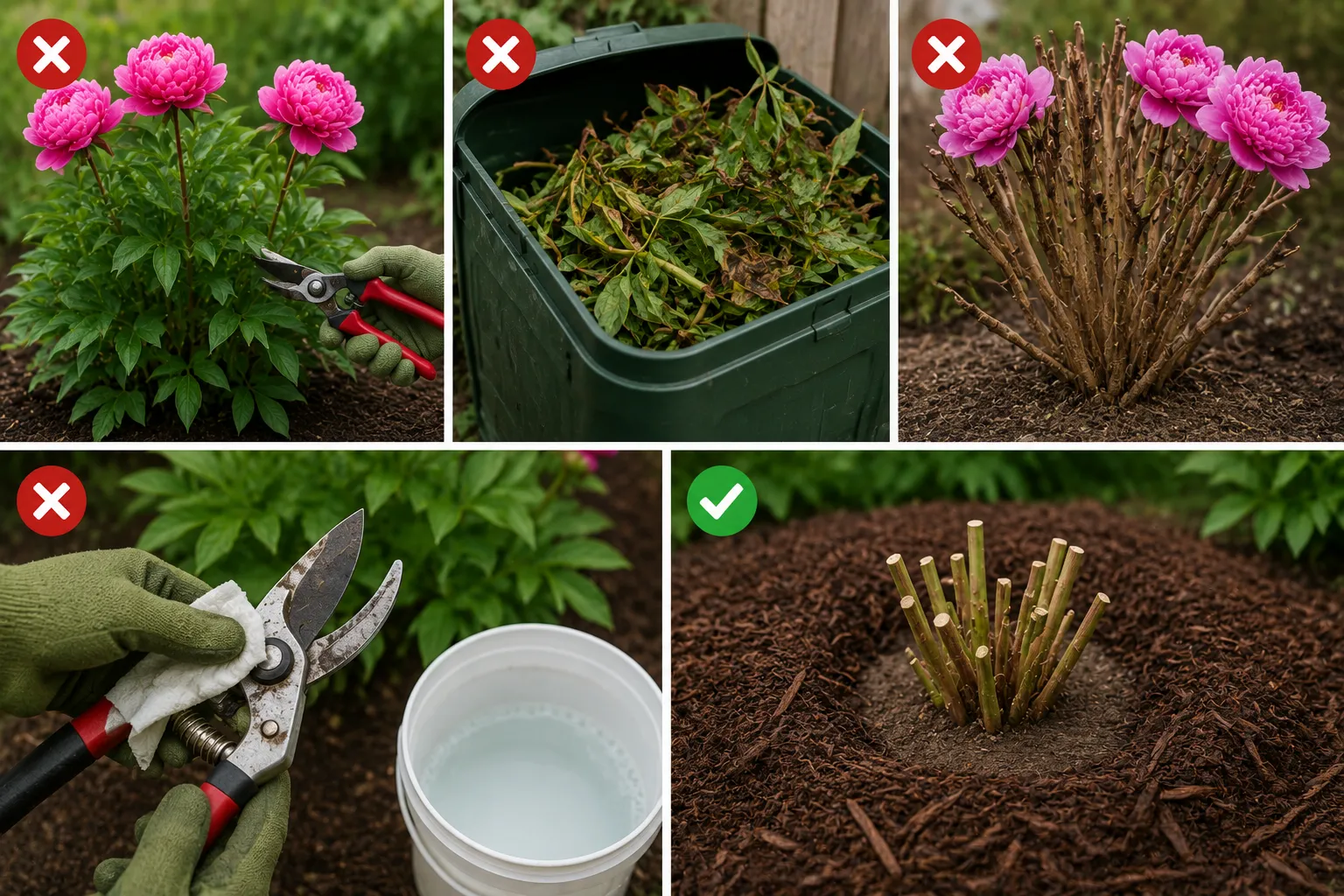
Mistake 1: Cutting while leaves are still green. Green leaves feed the root system through photosynthesis. Early cuts interrupt stored energy transfer and directly lower bloom count in the following garden season. Wait until leaf color confirms full dormancy.
Mistake 2: Composting peony trimmings. Peony foliage carries powdery mildew spores and botrytis blight pathogens. Standard lawn and garden compost piles do not reach temperatures high enough — at least 140°F (60°C) — to kill these fungi. Spores survive in the compost and return to your garden soil the following spring. Bag all trimmings in household trash or burn them if local regulations permit open burning.
Mistake 3: Pruning tree peonies in fall. Tree peony stems store next year’s flower buds through winter. Fall pruning removes the entire next bloom season from your patio garden. Prune tree peonies in early spring only, removing just dead wood.
Mistake 4: Skipping blade disinfection between garden plants. One plant infected with botrytis blight spreads the pathogen to every peony you cut next using the same unwashed gardening tool. A 30-second bleach wipe between plants prevents disease spreading across the entire garden bed.
Mistake 5: Piling garden mulch directly on the crown. Crown rot develops when organic garden mulch sits in direct contact with cut peony stubs through winter. Apply mulch around the perimeter of the root zone — not on top of cut stubs — and keep a 2-inch (5 cm) gap between mulch and the base of each stem.
After-Pruning Garden Care Checklist
Most gardening guides stop at the cut. These 4 post-pruning steps directly determine how well peonies perform in your lawn and garden the following spring.
- Fertilize the garden perimeter — apply a balanced slow-release fertilizer (10-10-10 N-P-K ratio) around the drip line of each plant, not directly on the crown. Fall garden feeding supports active root development through early winter soil temperatures.
- Amend garden soil with compost — work finished compost into the top 2 inches (5 cm) of garden bed soil around the plant perimeter. Peonies perform best in well-draining garden soil with a pH of 6.5–7.0. Test soil pH with an inexpensive garden pH meter before amending.
- Apply mulch in cold-climate gardens — home gardeners in Zones 3–4 benefit from 2–3 inches (5–7.5 cm) of shredded leaves or pine needle mulch over the root zone. Remove all garden mulch in early spring before new red shoots emerge from the soil.
- Mark plant locations in the garden bed — peonies disappear completely underground through winter. Place a small garden stake at each crown location to avoid accidentally slicing roots during spring garden preparation and lawn care.
Peony Pruning Do’s and Don’ts — Quick Reference
| Do | Don’t |
| Cut herbaceous stems to 2–3 in (5–7.5 cm) | Cut while leaves remain more than 50% green |
| Dispose of all trimmings in household trash | Compost peony foliage — spores survive |
| Disinfect garden tool blades between every plant | Reuse a dirty blade across multiple garden plants |
| Apply garden mulch around the crown perimeter | Pile mulch directly on cut stubs |
| Prune tree peonies lightly in early spring | Cut tree peony stems in fall |
| Let year-1 plants die back naturally | Prune newly planted peonies in their first fall |
| Wait for hard frost + 50% yellow leaves | Base pruning timing only on calendar dates |
Frequently Asked Questions About Pruning Peonies
Do peonies need pruning every single year?
Yes. Herbaceous peonies die back to the soil each fall and require annual pruning to 2–3 inches (5–7.5 cm) above ground. Skipping one year leaves hollow dead stems standing above the crown, which trap winter moisture and give botrytis blight a direct path into the root zone of your garden plant.
What actually happens if you never prune peonies?
Dead stems stack up above the garden crown year after year. Moisture collects inside the hollow dried stalks. Within 2–3 seasons, unpruned garden peonies show 30–50% fewer blooms and visible fungal disease at the base of the plant.
Can home gardeners prune peonies in spring instead of fall?
No — not for herbaceous or Itoh types. Spring pruning removes emerging growth and sets the garden plant back 4–6 weeks, eliminating that season’s blooms entirely. Fall remains the correct pruning time for both types. Tree peonies are the only exception and receive light dead-wood removal in early spring only.
How far down do you actually cut peony stems?
Cut to 2–3 inches (5–7.5 cm) above ground level — roughly the height of a standard garden marking stake. This height protects the crown from direct soil contact while removing enough stem to stop moisture pooling in the garden bed over winter.
Is deadheading peonies different from fall pruning?
Yes — these are 2 separate gardening tasks. Deadheading removes spent flowers during the bloom season by cutting the flower stem back to the first healthy set of leaves. Fall pruning removes all above-ground stems after dormancy. Deadheading does not replace fall pruning and does not trigger a second bloom — peonies flower once per garden season — but deadheading redirects energy from seed pod formation back into root storage for next year.
The Bottom Line for Home Gardeners
Prune herbaceous peonies in fall, after the first hard frost, when leaves reach 50% yellow or brown. Cut to 2–3 inches (5–7.5 cm), bag all garden debris into household trash, disinfect your gardening tools between plants, and your peonies will produce stronger blooms every spring for 20–50 years in your lawn and garden. Tree peonies get a light spring trim only. Year-1 peonies get no pruning at all.
The difference between a garden peony that produces 40 blooms and one that produces 12 comes down to one fall afternoon of proper cleanup. The cut takes 10 minutes. The blooms fill your garden for a full month.