Most people buy shrubs the wrong way. They see something blooming at the nursery, buy three of them, plant them in whatever spot is open, and wonder why they look half-dead by August.
The right shrub in the wrong location fails. Every time.
This list covers 12 shrubs that earn their place in a landscape. Each one offers either multi-season interest, low maintenance, or structural value — and several deliver all three. Before the list, there are 4 site factors to check. Skip those and you’ll repeat the same mistake.
4 Site Factors to Check Before Buying a Single Shrub
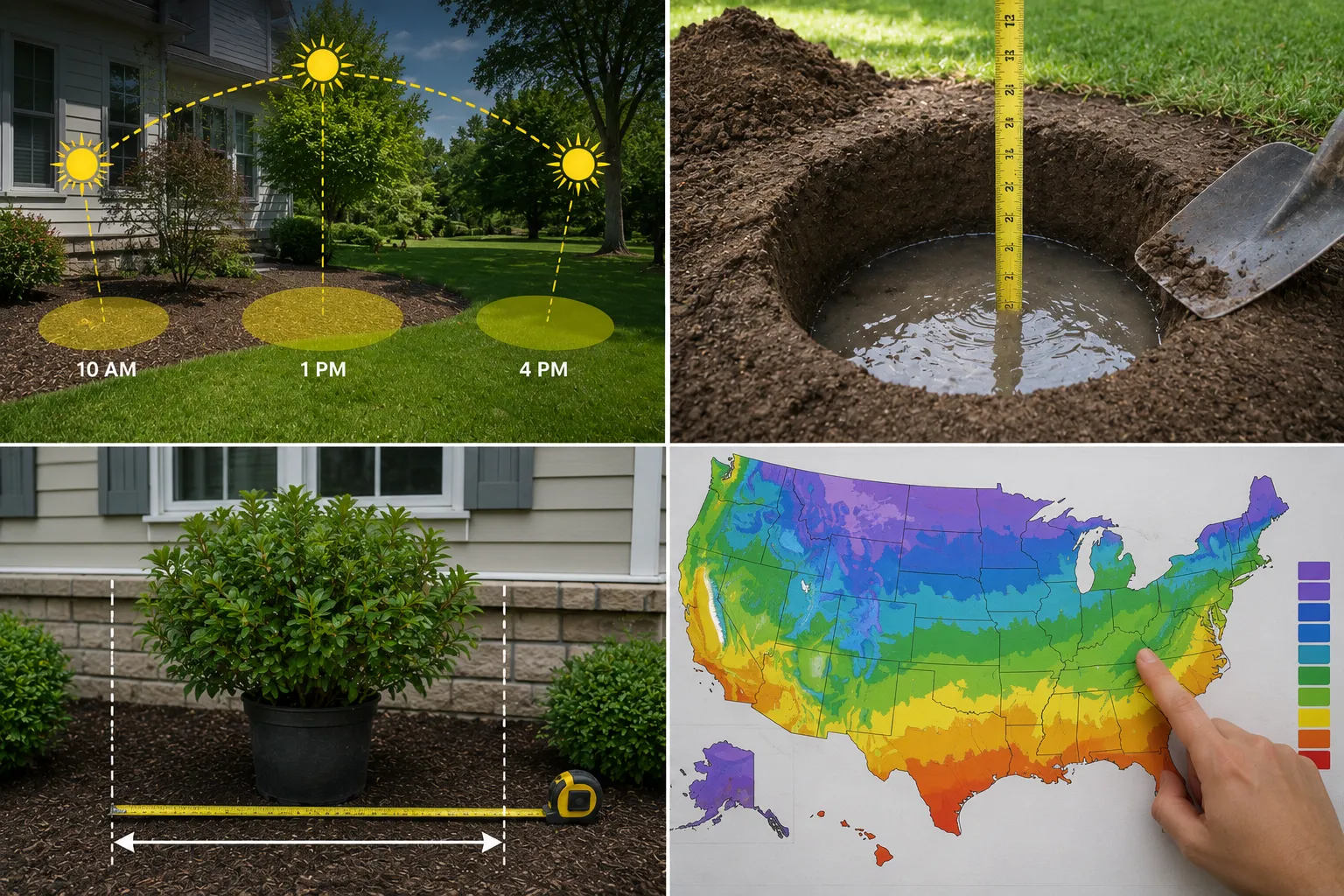
Buying a shrub without knowing your site is the leading cause of plant failure in residential landscapes.
Sun exposure determines everything about flowering performance. Full sun means 6 or more hours of direct light daily. Part shade means 3 to 6 hours. Full shade means under 3 hours. Walk your planting area at 10 AM, 1 PM, and 4 PM to map actual light — not estimated light.
Soil drainage separates plants that thrive from plants that drown. Dig a 12-inch (30 cm) hole and fill it with water. If the water drains in under 2 hours, drainage is good. If it sits for 4 or more hours, you have clay — adjust your plant selection accordingly.
Mature size is where most landscaping mistakes happen. That compact-looking 2-gallon shrub at the garden center may reach 8 feet tall and 6 feet wide in 5 years. Always check the mature height and spread on the plant tag and measure your available space before purchasing.
USDA Hardiness Zone tells you what survives winter. Check your zone at the USDA Plant Hardiness Zone Map before buying anything. A Zone 6 plant grown in Zone 4 dies in January. A Zone 9 plant in Zone 7 struggles every winter and never performs well.
Best Evergreen Shrubs for Year-Round Structure
Evergreen shrubs hold their foliage through winter. They provide structure when everything else is dormant and give your yard a finished look in every season.
1. Boxwood (Buxus)
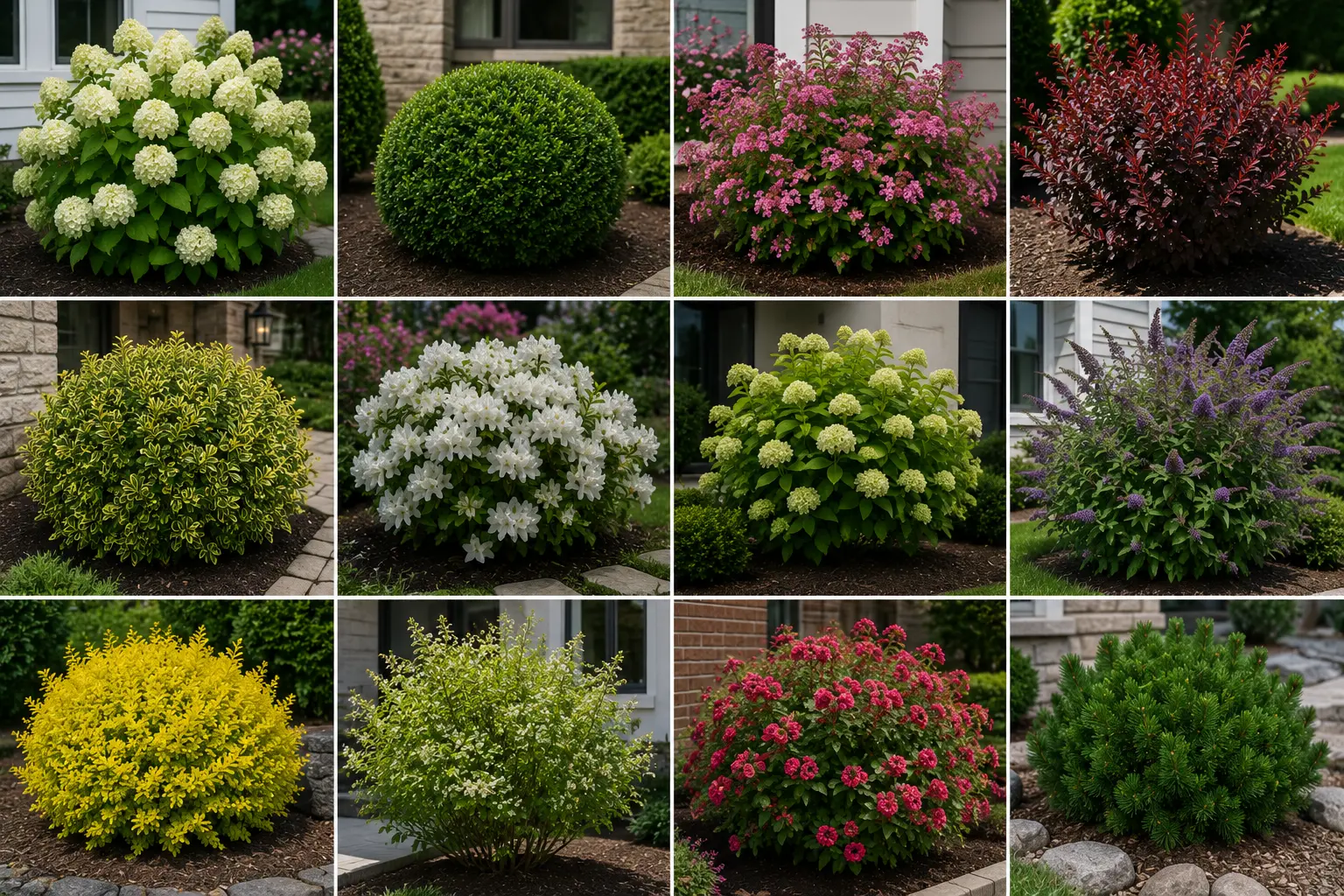
Boxwood is the most widely planted foundation shrub in the United States. It stays dense and compact with minimal pruning, tolerates both full sun and part shade, and works with nearly any architectural style.
Best varieties: ‘Green Velvet’ reaches 3 to 4 feet (0.9 to 1.2 m). ‘Winter Gem’ reaches 4 to 6 feet (1.2 to 1.8 m). ‘Sprinter’ stays at 2 to 4 feet (0.6 to 1.2 m) and shows better resistance to boxwood blight than older American boxwood cultivars.
Key care note: Plant boxwood in well-drained soil. In clay-heavy yards, plant it slightly elevated or in raised beds to prevent root rot.
2. Arborvitae (Thuja)
Arborvitae is the top choice for fast-growing privacy screens across USDA Zones 3 to 8. ‘Green Giant’ grows 3 to 5 feet (0.9 to 1.5 m) per year and reaches 40 to 60 feet (12 to 18 m) at maturity — the fastest natural privacy screen available.
For smaller yards, ‘Emerald Green’ tops out at 12 to 15 feet (3.6 to 4.5 m) with a narrow 3 to 4 foot (0.9 to 1.2 m) spread. Plant in full sun with good air circulation. In areas where bagworm pressure is high, inspect plants each May and remove egg cases by hand before they hatch.
3. Inkberry Holly (Ilex glabra)
Inkberry holly is the best evergreen shrub for wet or poorly drained areas. Most evergreens rot in consistently moist soil. Inkberry handles it without complaint, grows in full sun to full shade, and produces small black berries that birds feed on through winter.
Mature size: 5 to 8 feet (1.5 to 2.4 m) tall, 5 to 8 feet wide. Hardy in Zones 4 to 9.
4. Dwarf Mugo Pine (Pinus mugo)
Dwarf Mugo Pine delivers genuine four-season structure with no leaf drop, no flowers to deadhead, and no pest problems. It grows slowly — roughly 3 to 6 inches (7.5 to 15 cm) per year — reaching 3 to 5 feet (0.9 to 1.5 m) in 10 years.
Plant it in full sun in well-drained soil. Mugo pine tolerates salt spray, wind, and rocky soil. It is the most reliable low-maintenance evergreen for difficult exposed sites. Hardy in Zones 2 to 7.
Best Flowering Shrubs for Seasonal Color
Flowering shrubs add the color and visual interest that make a landscape feel designed rather than planted. These 4 deliver reliable bloom seasons with minimal care.
5. Knockout Rose (Rosa ‘Radrazz’)
Knockout roses bloom continuously from late spring through the first hard frost — a 6 to 7 month bloom season that no other landscape rose matches. They resist black spot disease, require no deadheading, and need only a single hard cut in late winter.
Available colors: red, pink, coral, yellow, white, and bicolor. Plant in full sun (6 or more hours). Space 3 to 4 feet (0.9 to 1.2 m) apart in mass plantings. Mature size: 3 to 4 feet (0.9 to 1.2 m) tall and wide. Hardy in Zones 5 to 9.
6. Oakleaf Hydrangea (Hydrangea quercifolia)
Oakleaf hydrangea offers 4-season interest in a single plant: large white cone-shaped blooms in early summer, blooms aging to pink and burgundy in fall, oak-leaf shaped foliage turning deep red in autumn, and peeling cinnamon-colored bark providing winter texture.
It is one of the few flowering shrubs that actively prefers part shade — ideal under tall deciduous trees or on the north side of a building. Grows 4 to 6 feet (1.2 to 1.8 m) tall and wide. Hardy in Zones 5 to 9.
7. Japanese Spirea (Spiraea japonica)
Spirea blooms in late spring to early summer and often reblooms in late summer if cut back after the first flush. It grows in poor soil, tolerates drought once established, and asks for nothing beyond an occasional trim.
Best varieties: ‘Goldflame’ offers foliage that transforms from orange-red in spring to gold in summer, with pink blooms. ‘Little Princess’ stays compact at 2 to 3 feet (0.6 to 0.9 m). Plant in full sun for best bloom and foliage color. Hardy in Zones 3 to 8.
8. Forsythia (Forsythia × intermedia)
Forsythia blooms in late February to early March — bright yellow flowers on bare branches before any other shrub wakes up. It is one of the most cold-hardy flowering shrubs available, performing in Zones 5 to 8.
Standard forsythia reaches 8 to 10 feet (2.4 to 3 m) tall and wide. For smaller spaces, ‘Magical Gold‘ grows 2 to 3 feet (0.6 to 0.9 m) and stays compact. Plant in full sun. Forsythia tolerates clay soil better than most flowering shrubs.
Best Shrubs for Privacy Screening
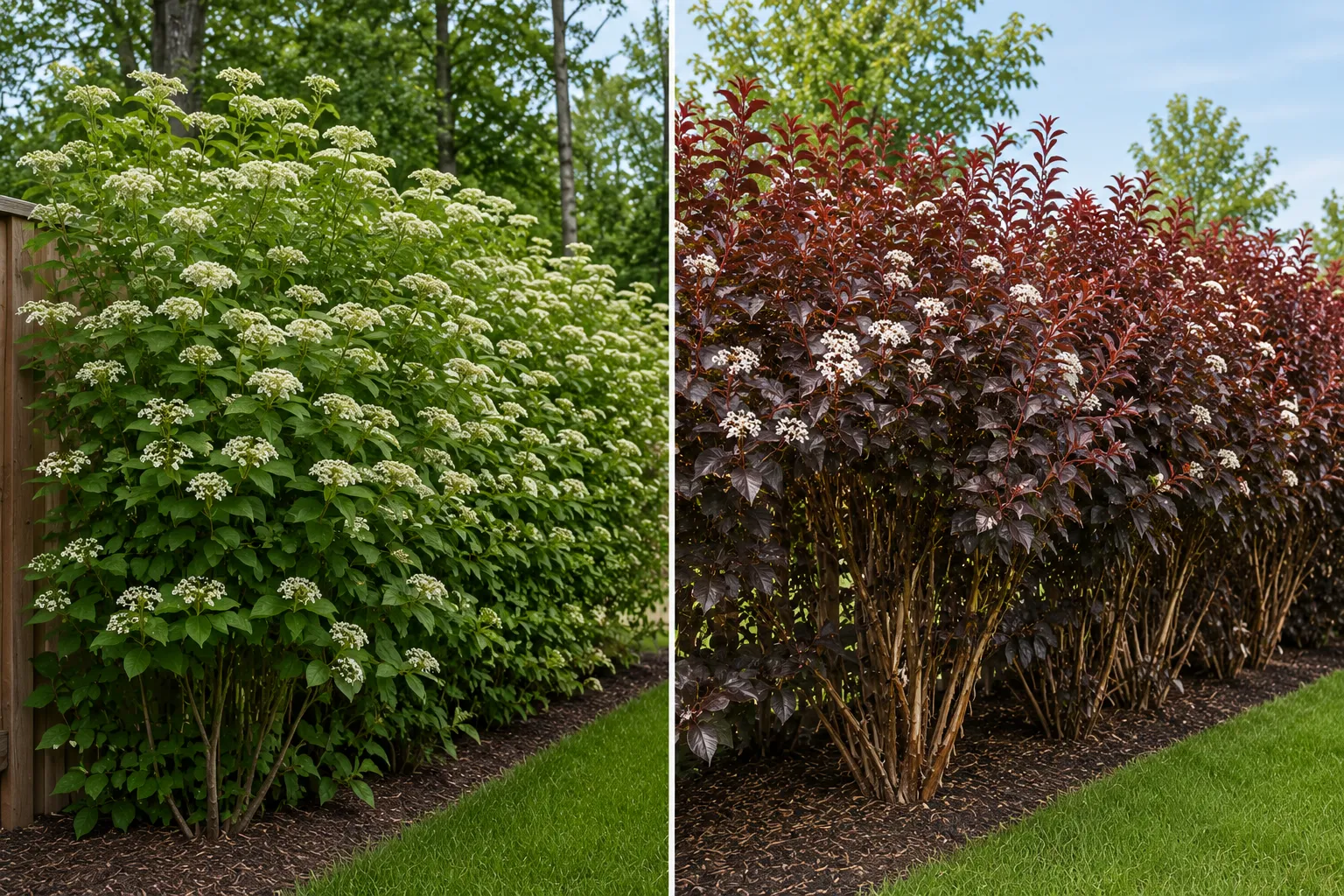
9. Viburnum (Viburnum dentatum)
Arrowwood viburnum is a native shrub that delivers 4-season value: white flower clusters in spring, deep blue berries in late summer through fall (attracting over 35 bird species), red-purple fall foliage, and dense multi-stem structure for winter screening.
It grows 6 to 10 feet (1.8 to 3 m) tall and adapts to full sun, part shade, wet soil, dry soil, and clay. It is one of the most versatile native shrubs for privacy planting in the eastern and central United States. Hardy in Zones 3 to 8.
10. Ninebark (Physocarpus opulifolius)
Ninebark grows 5 to 10 feet (1.5 to 3 m) tall and provides 3-season interest: white flower clusters in spring, colorful foliage through summer, and exfoliating bark that peels in layers through winter. The foliage color depends on variety — ‘Diabolo’ has deep burgundy leaves; ‘Coppertina’ has copper-orange new growth.
It tolerates full sun to part shade, clay soil, drought, and poor drainage. Hardy in Zones 2 to 7. For fast privacy in a difficult site, ninebark is one of the top 3 choices available.
Best Shrubs for Specific Conditions
11. Loropetalum (Loropetalum chinense) — Best for Warm Climates
Loropetalum, or Chinese fringe flower, is the top evergreen shrub for Zones 7 to 10. It produces burgundy-purple foliage year-round and hot pink fringe-like flowers in spring, often with a second flush in fall.
It grows 6 to 10 feet (1.8 to 3 m) tall depending on variety. Dwarf selections like ‘Purple Pixie’ stay under 2 feet (0.6 m) and work as ground cover. Plant in full sun to part shade in well-drained, slightly acidic soil. Zero deer resistance issues — deer rarely touch it.
12. Sweetshrub (Calycanthus floridus) — Best for Shade
Sweetshrub is a native shrub that flowers in shade when almost nothing else does. The reddish-brown flowers smell strongly of strawberries or cinnamon — a genuine fragrance in a part-shade location is rare.
It grows 6 to 9 feet (1.8 to 2.7 m) tall and wide, and tolerates full shade to full sun. The yellow fall foliage extends the visual season. Hardy in Zones 4 to 9. Plant it near a seating area or walkway where the fragrance can be experienced up close.
Quick Reference: 12 Best Landscaping Shrubs
| Shrub | Type | Mature Size | Sun | Zones | Best For |
| Boxwood | Evergreen | 2–6 ft | Full/Part | 5–8 | Foundation planting |
| Arborvitae | Evergreen | 12–60 ft | Full sun | 3–8 | Privacy screen |
| Inkberry Holly | Evergreen | 5–8 ft | Full–Shade | 4–9 | Wet soil areas |
| Dwarf Mugo Pine | Evergreen | 3–5 ft | Full sun | 2–7 | Exposed/rocky sites |
| Knockout Rose | Flowering | 3–4 ft | Full sun | 5–9 | Long bloom season |
| Oakleaf Hydrangea | Flowering | 4–6 ft | Part shade | 5–9 | Shade + 4-season |
| Japanese Spirea | Flowering | 2–4 ft | Full sun | 3–8 | Mass plantings |
| Forsythia | Flowering | 2–10 ft | Full sun | 5–8 | Early spring color |
| Viburnum | Native | 6–10 ft | Full/Part | 3–8 | Birds + privacy |
| Ninebark | Native | 5–10 ft | Full/Part | 2–7 | Colorful foliage |
| Loropetalum | Evergreen | 2–10 ft | Full/Part | 7–10 | Warm climates |
| Sweetshrub | Native | 6–9 ft | Full–Shade | 4–9 | Fragrance in shade |
3 Shrub Planting Mistakes That Fail Every Time
These are the 3 errors that competitors don’t cover — and the ones that cost homeowners the most money.
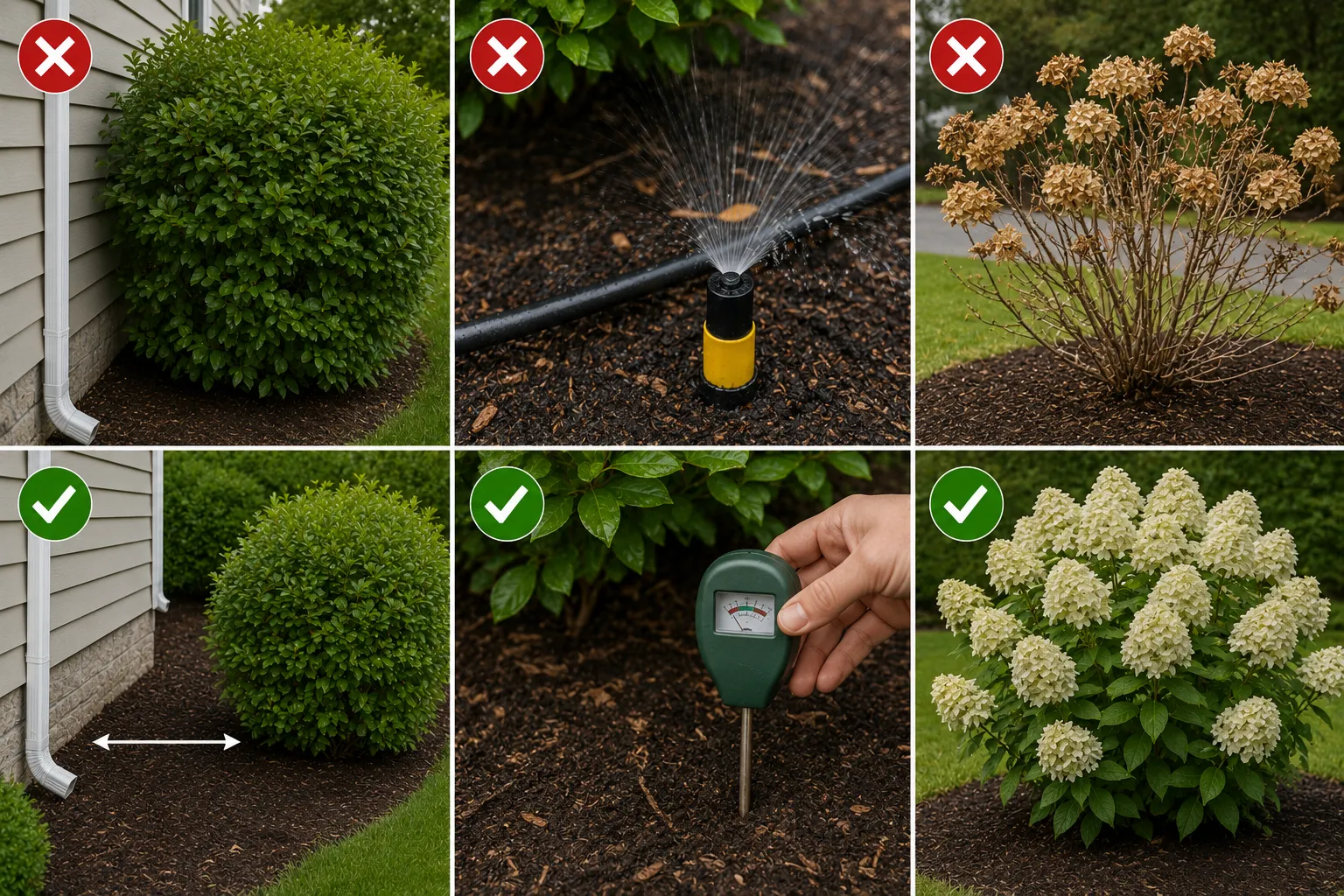
Planting too close to the foundation. A shrub that matures at 6 feet wide planted 18 inches from a foundation destroys gutters, traps moisture against siding, and uproots itself by year 4. Always plant at a distance equal to half the mature spread, at minimum.
Watering on a schedule instead of checking soil. Most landscape shrubs die from overwatering in their first summer, not drought. Check soil moisture 2 inches (5 cm) deep before watering. Water when it is dry at that depth — not because it is Tuesday.
Pruning at the wrong time. Spring-flowering shrubs like forsythia and oakleaf hydrangea set their flower buds on old wood the previous summer. Pruning in late fall or early spring removes all the buds. Prune spring bloomers immediately after they finish flowering — never in fall or winter.
Shrub Selection by USDA Zone: Quick Guide
| USDA Zone | Temperature Range | Top Shrub Picks |
| Zone 3–4 | -40 to -20°F (-40 to -29°C) | Arborvitae, Ninebark, Forsythia ‘Magical Gold’, Dwarf Mugo Pine |
| Zone 5–6 | -20 to 0°F (-29 to -18°C) | Boxwood, Knockout Rose, Spirea, Oakleaf Hydrangea, Viburnum |
| Zone 7–8 | 0 to 20°F (-18 to -7°C) | Loropetalum, Inkberry Holly, Sweetshrub, Arborvitae ‘Emerald Green’ |
| Zone 9–10 | 20 to 40°F (-7 to 4°C) | Loropetalum, Knockout Rose, Indian Hawthorn, Texas Sage |
Frequently Asked Questions
What shrubs look good in front of a house all year?
Boxwood, Dwarf Mugo Pine, and Inkberry Holly provide year-round structure because they are evergreen. Pair them with one flowering shrub — Knockout Rose or Spirea — to add seasonal color. That combination gives the front foundation a finished look in all 4 seasons.
Which shrubs grow fastest for privacy?
‘Green Giant’ Arborvitae grows fastest at 3 to 5 feet (0.9 to 1.5 m) per year. Ninebark adds 2 to 3 feet (0.6 to 0.9 m) per year. Forsythia adds 2 to 4 feet (0.6 to 1.2 m) per year. For a dense privacy screen in 3 to 4 years, plant ‘Green Giant’ arborvitae 5 to 6 feet (1.5 to 1.8 m) apart in a staggered double row.
What is the easiest shrub to maintain?
Knockout Rose and Dwarf Mugo Pine are the 2 lowest-maintenance landscaping shrubs available. Knockout Rose needs one hard cut in late winter. Dwarf Mugo Pine needs nothing — no pruning, no fertilizing, and produces no leaf litter. Both work in full sun and tolerate a wide range of soil conditions.
Are native shrubs better than non-native for landscaping?
Yes, for wildlife and long-term resilience. Native shrubs like Viburnum, Ninebark, Oakleaf Hydrangea, and Sweetshrub are adapted to local soil and rainfall patterns, support native pollinators and birds, and require less fertilizer and supplemental watering once established. Non-native shrubs like Boxwood and Forsythia can perform well but offer fewer ecological benefits
When is the best time to plant shrubs?
Fall is the best time to plant shrubs in most of the United States — from September through November. Soil temperatures stay warm enough for root establishment while air temperatures cool, reducing transplant stress. Spring planting (March to May) is the second-best window. Avoid planting in July and August when heat stress peaks.
Build a Landscape That Works for Your Zone
The 12 shrubs above cover every major landscaping need — structure, color, privacy, shade, drought tolerance, and wet soil tolerance. Pick shrubs that match your USDA zone, your sun exposure, and your soil drainage. That combination produces a landscape that performs without constant intervention.
The right shrub in the right place takes care of itself. The wrong one fights you every season.
| Ready to find the right plants for your specific zone and conditions? Explore plant guides, zone-specific picks, and care calendars at ZonedGarden.com. Start with your USDA zone and let the zone do the work. |