

The most reliable way to get rid of moles in lawn areas is trapping them on an active tunnel within 24 to 48 hours of confirming the runway is still in use. Scissor traps and harpoon-style traps, set directly into a straight, well-used tunnel, remain the only removal method that university extension researchers consistently rate as effective. Repellents and home remedies can push moles toward the neighbor’s yard, but they rarely solve the problem for good. Speed matters here. A single mole can dig up to 100 feet (30 meters) of new tunnel in one day, and a lawn that looked fine on Monday can look like a minefield by Friday.
This guide walks through every method that actually works, the ones that don’t (despite what half the internet claims), what each option costs, and how to stop moles from moving back in once you’ve cleared them out.
What’s Actually Digging Up Your Yard? Moles vs. Voles vs. Gophers
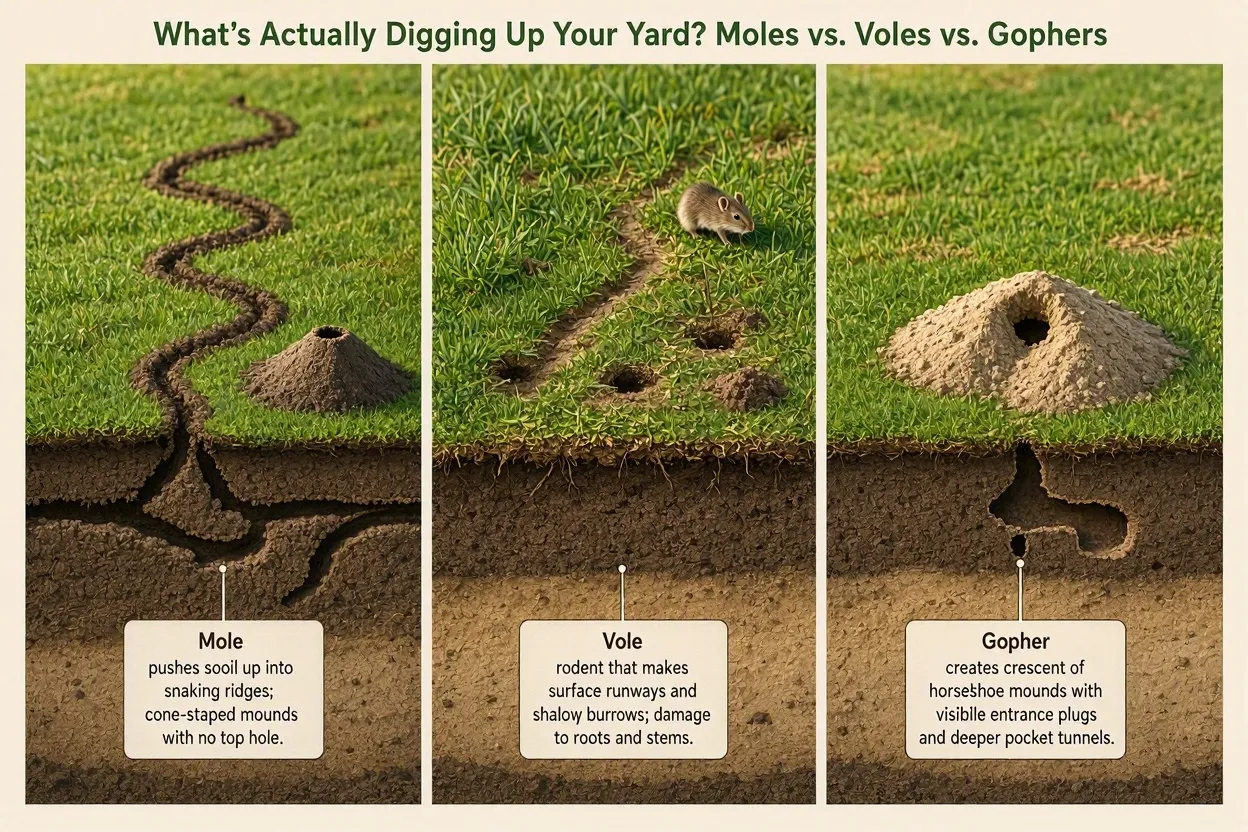
Not every ridge or mound in a lawn comes from a mole. Misidentifying the pest wastes money on the wrong control method, so start here.
Moles push soil up from below as they tunnel, leaving raised, snaking ridges with no visible entry hole. Their mounds look like small volcanoes, dirt piled in a cone with no opening at the top. Voles, on the other hand, are rodents that live above ground part-time. They leave small burrow openings about an inch (2.5 cm) wide, plus worn grass trails where they’ve been running back and forth. Gophers dig deeper, wider tunnels and leave crescent or fan-shaped mounds with a distinct plug of soil off to one side.
| Feature | Mole | Vole | Gopher |
| Animal type | Insectivore | Rodent | Rodent |
| Diet | Earthworms, grubs, insects | Grass roots, seeds, bark | Roots, tubers, bulbs |
| Mound shape | Cone-shaped, no visible hole | No mound; surface runways instead | Crescent-shaped, plugged opening |
| Typical damage | Raised ridges, spiderweb tunnel pattern | Chewed grass, bare patches under snow | Mounds scattered along a shallow network |
| Season most active | Year-round, slower in deep frost | Worst in winter under snow cover | Year-round |
| Common US regions | Widespread across eastern and midwestern lawns | Nationwide, especially colder climates | Western and southern states |
Purdue University’s Plant and Pest Diagnostic Lab points out something a lot of homeowners get backward: moles aren’t rodents at all. That single fact explains why rodent-style baits and grain poisons marketed for “mice and moles” rarely work. Moles don’t eat seeds or grain, so those baits sit untouched underground.
Two other species worth knowing: the eastern mole, the most common lawn-tunneling species across the US, and the star-nosed mole, found more often in wetter soil near the Northeast and Midwest. Both cause the same type of surface damage, so identification method and removal steps don’t change between them.
Why Moles Choose Your Lawn (The Earthworm Truth)
Grubs get blamed constantly, but earthworms are the real draw. A mole eats close to its own body weight, roughly 3 ounces (85 grams), in food every single day, and earthworms make up the bulk of that diet. Even a completely grub-free lawn keeps drawing moles in as long as the soil stays moist enough to support a healthy worm population.
That’s why Purdue researchers call grub-control products an “old wives tale” when it comes to mole prevention. Treating for grubs might improve turf health in other ways, but it won’t touch the earthworm supply that’s actually feeding the moles underneath your grass.
Moist, loose, well-drained soil is the ideal environment, both for earthworms and for the moles hunting them. Lawns that get watered heavily, or sit in low-lying areas that stay damp after rain, tend to see far more mole activity than lawns kept on the drier side.
How to Spot an Active Mole Tunnel
Not every tunnel in a yard is currently in use, and treating a dead tunnel wastes time. To check, flatten a section of the ridge with your foot, mark the spot with a flag or a stick, then check back the next day. If the ridge has been pushed back up, that tunnel is active and it’s your best target for a trap.
Two tunnel types exist, and they behave differently. Straight tunnels, often running alongside a fence line, curb, or garden bed, tend to be main travel routes between a mole’s nest and its feeding grounds, used daily. Squiggly, winding tunnels are usually foraging routes, dug once while hunting for food and then abandoned. Set traps on the straight ones. Bait the winding ones if you’re going the poison route, since moles pass through those less predictably.
How to Get Rid of Moles in Lawn: 7 Methods Ranked by Effectiveness

Trapping and baiting outperform every other method for actually removing moles, not just discouraging them. Below are seven approaches, ranked from most to least effective based on university extension data and real-world results.
- Scissor traps. Placed inside a subsurface tunnel, these use spring-loaded blades to kill instantly. They work best in deeper runs, six inches (15 cm) or more below the surface.
- Harpoon and plunger traps. Easier to set than scissor traps since they require less digging. A spring-loaded spike drives down into the tunnel when triggered, making these a solid pick for shallow, near-surface runs.
- Worm-shaped bromethalin baits. These mimic a mole’s natural earthworm diet, and the active ingredient kills within 12 to 24 hours of ingestion. Because they’re shaped and scented like food a mole actually eats, uptake rates run higher than older grain-based rodenticides ever managed.
- Castor oil repellent. Mix three parts castor oil with one part dish soap, then dilute four tablespoons of that mixture into a gallon (3.8 liters) of water. Pour it into active tunnel entrances. Moles find the taste and smell unbearable and typically relocate within a few days, though they aren’t killed by it.
- Physical barriers. For garden beds specifically, dig a trench 2 to 3 feet (60 to 90 cm) deep around the perimeter and line it with hardware cloth or wire mesh, extending the mesh 6 to 12 inches (15 to 30 cm) above ground. This stops tunneling moles from reaching prized plants, though it does nothing for open lawn.
- Humane trap-and-release. Catches moles alive for relocation elsewhere. Slower than lethal trapping and less reliable, since a live mole in a box trap can sometimes chew or dig its way out before you check it.
- Ultrasonic and vibration stakes. Listed last for a reason. Purdue’s research is blunt about this one: these devices, along with mothballs, human hair, and chewing gum stuffed into tunnels, simply don’t work, no matter how often they show up in gardening forums or on product packaging.
Step-by-Step: Setting a Mole Trap Correctly
To set a trap that actually catches something, start by identifying an active, straight runway using the flatten-and-check method described above. Once you’ve confirmed activity, dig gently down to the tunnel roof without collapsing the whole structure, then set the trap so its trigger mechanism sits directly over the open tunnel path. Cover any light gaps with sod or soil; moles avoid disturbed, light-exposed sections and will simply reroute around a poorly hidden trap.
Check the trap daily. If nothing has been caught after 48 to 72 hours, move it to a different active section of the runway rather than leaving it in place indefinitely. Before any digging, call 811. Utility lines sit closer to the surface in many yards than people expect, and striking one turns a pest problem into a genuinely dangerous situation.
Do Natural and Home Remedies Actually Work?
Yes, castor oil repellent measurably reduces mole activity in most yards, though it rarely eliminates an established population on its own. It works by upsetting a mole’s digestive system rather than killing it, so treated moles tend to shift a few yards over instead of leaving the property entirely. For it to hold, reapply monthly throughout the active season, typically spring through fall in most US climates.
Skip the folklore fixes. Mothballs, human hair clippings, razor blades, and chewing gum stuffed into tunnels all show up constantly in gardening advice columns, and none of them work according to controlled research from Purdue’s diagnostic lab. Pet urine near tunnel entrances gets mentioned occasionally as a low-cost deterrent, and while it lacks formal research backing, it costs nothing to try alongside a proven method.
Cost and Timeline: What to Expect From Each Method
| Method | Average Cost | Time to Results |
| DIY scissor/harpoon traps | $15 to $40 per trap | 2 to 7 days |
| Bromethalin bait | $20 to $30 per package | 1 to 3 days after uptake |
| Castor oil repellent | $10 to $25 | 3 to 10 days, needs reapplication |
| Physical barrier (garden bed) | $50 to $200 depending on size | Immediate for new tunneling |
| Professional wildlife removal | $100 to $500 per visit | 1 to 2 visits typically |
Homeowners dealing with one or two active mounds usually see faster, cheaper results with DIY trapping. Yards with tunnel networks spread across multiple zones tend to justify the higher cost of professional removal, since a technician can identify and treat several runways in a single visit rather than one trap at a time.
Is It Legal to Trap or Poison Moles in Your State?
Rules on mole control vary by state, and this is a gap most articles on this topic skip entirely. Some states restrict lethal trapping methods or require a license for certain wildlife control activities, particularly where a species has protected status or where pesticide use near waterways falls under stricter oversight. Bromethalin-based baits are Environmental Protection Agency (EPA) registered for consumer use, but a handful of states limit sale or application to licensed pest control applicators.
Trap-and-kill methods using mechanical traps face fewer restrictions nationwide compared to chemical baiting, which explains why scissor and harpoon traps remain the default recommendation across most university extension programs. Before buying bait products, check with a state wildlife agency or local county extension office. A five-minute phone call beats finding out after the fact that a method wasn’t permitted in your area.
How to Keep Moles From Coming Back
There’s no such thing as permanently mole-proofing a lawn. New moles move in from neighboring properties as territories open up, so treat control as ongoing management rather than a one-time fix.
That said, a few habits cut down reinvasion significantly. Keep watering to roughly 1 inch (2.5 cm) per week, whether from rainfall or irrigation, and let the top layer of soil dry out between waterings. Moles and the earthworms feeding them both prefer consistently damp ground, so a drier lawn simply becomes less attractive. Dogs and cats patrolling the yard help too; their scent and movement alone discourage new moles from settling into a territory that’s already being watched.
Removing excess mulch and thatch buildup also reduces the moist, insect-rich layer moles favor near the surface. None of these steps guarantee a mole-free yard forever, but together they make a property noticeably less appealing compared to the lawn next door.
Repairing Lawn Damage After Removal
Once tunnels stop refilling, flatten remaining ridges by hand or with a lawn roller, pressing firmly enough that grass roots can reestablish contact with the soil. Bare patches left behind from heavy tunneling need reseeding, matched to the existing grass type and regional climate for the best germination odds. Water consistently after reseeding, and keep foot traffic off the repaired sections until new growth is well established.
Most lawns bounce back within a single growing season once mole activity has actually stopped, though severely damaged areas with extensive ridge networks sometimes need a full season of recovery before they blend back into the surrounding turf.
Common Mistakes That Waste Time and Money
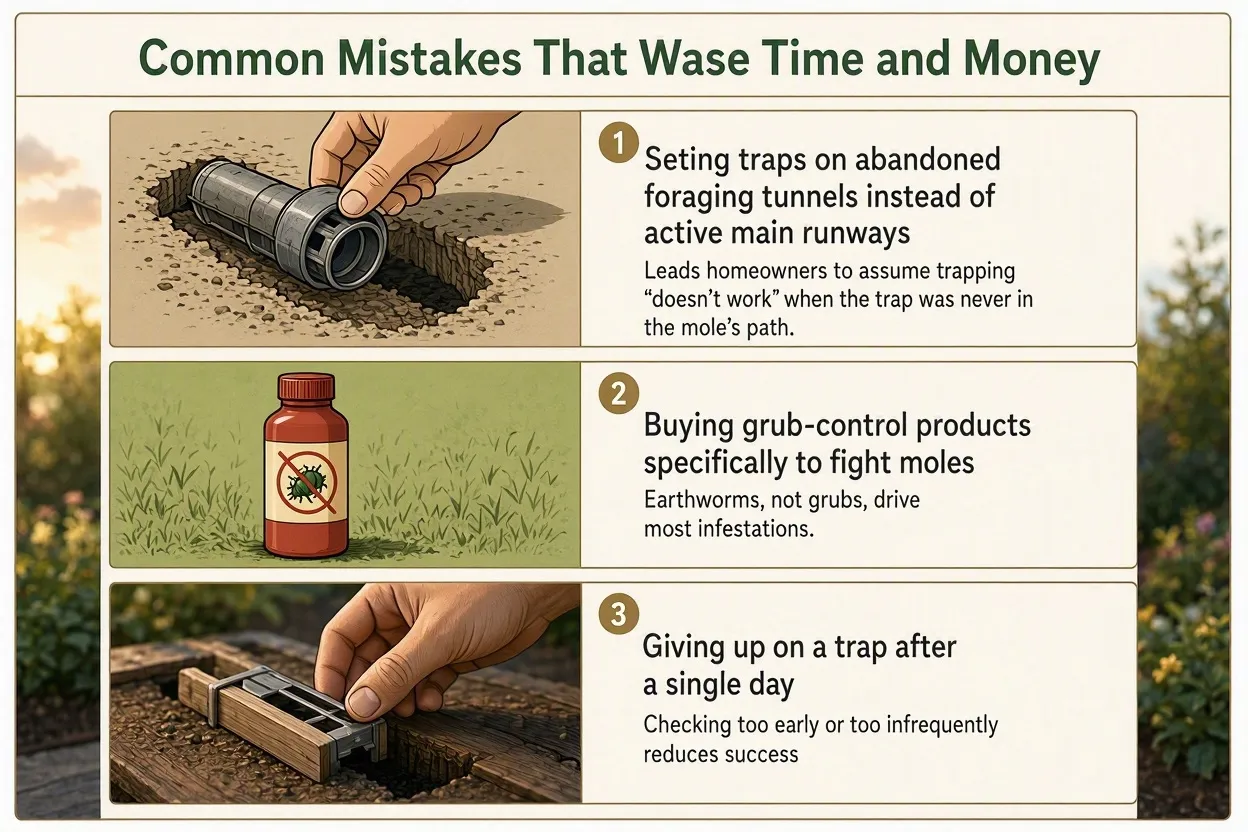
Setting traps on abandoned foraging tunnels instead of active main runways ranks as the most frequent mistake, since it leads people to assume trapping “doesn’t work” when really the trap was never in the mole’s path. Buying grub-control products specifically to fight moles is the second most common error, given that earthworms, not grubs, drive most infestations. Giving up on a trap after a single day is another one; checking too early and moving the trap before a mole has had time to encounter it resets progress unnecessarily.
Relying solely on ultrasonic stakes or mothballs, expecting them to solve an active infestation, wastes weeks that could have gone toward trapping or baiting instead.
When to Call a Wildlife Professional
DIY methods handle most single-mole situations within a lawn. Once damage spans multiple zones of a property, or traps sit untouched for over a week despite being placed on confirmed active runways, that’s the signal to bring in a wildlife control professional. Technicians carry access to commercial-grade bait products, broader trapping experience across tunnel patterns, and in some states, the licensing required to use certain chemical controls that aren’t available over the counter. For persistent, large-scale infestations, professional intervention often costs less in the long run than months of ineffective DIY attempts.
FAQs
Do moles hibernate in winter?
No. Moles slow down and tunnel deeper as the ground freezes, following earthworms below the frost line, but they remain active year-round.
Are moles dangerous to pets or people?
No. Moles rarely bite unless directly handled and don’t carry diseases that spread through casual yard contact with pets.
Will grub control alone remove moles from my lawn?
No. Earthworms make up most of a mole’s diet, so a grub-free lawn can still support an active mole population.
How quickly do moles reproduce?
Moles produce one litter yearly, usually 3 to 5 young born in spring, a modest rate compared to rodents like voles.
What’s the best time of year to trap moles?
Spring and fall offer the highest success rates, since moles tunnel closer to the surface during these milder, moister seasons.
Conclusion
Getting rid of moles in a lawn comes down to correct identification, fast action on active tunnels, and picking a method that matches the size of the problem. Trapping wins for reliability, castor oil works as a lower-effort deterrent, and professional help makes sense once damage spreads across multiple zones of a yard. Skip the mothballs and ultrasonic gadgets; research from Purdue and Cornell extension programs confirms they don’t move the needle. Stay consistent with watering habits and tunnel checks, and a lawn that’s been cleared of moles is far less likely to see them return in force.