
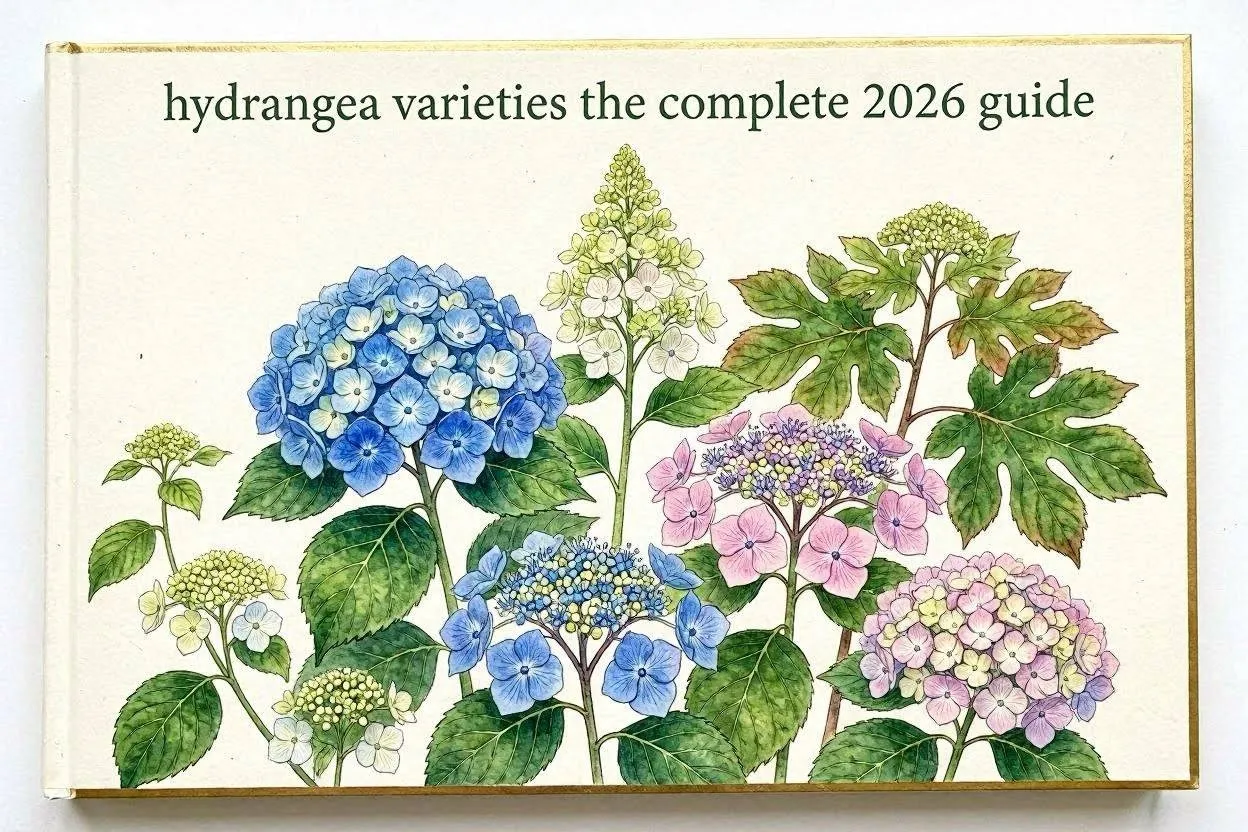
6 hydrangea varieties grow widely across U.S. gardens: bigleaf, smooth, panicle, oakleaf, mountain, and climbing. Each variety differs in bloom time, cold hardiness, mature size, and whether it blooms on old wood or new wood — the single detail that controls your pruning schedule and determines whether you get flowers next year.
This guide gives you exact zone ranges, size data in feet and meters, named cultivar examples, and a quick-reference table so you can match the right hydrangea variety to your climate and garden space without guessing.
What Are the 6 Main Hydrangea Varieties?
The 6 main hydrangea varieties are bigleaf (Hydrangea macrophylla), smooth (Hydrangea arborescens), panicle (Hydrangea paniculata), oakleaf (Hydrangea quercifolia), mountain (Hydrangea serrata), and climbing (Hydrangea anomala subsp. petiolaris). All 6 belong to the Hydrangeaceae plant family. Their growth habits range from compact 2-foot (0.6 m) shrubs to vines that reach 80 feet (24 m) on a wall.
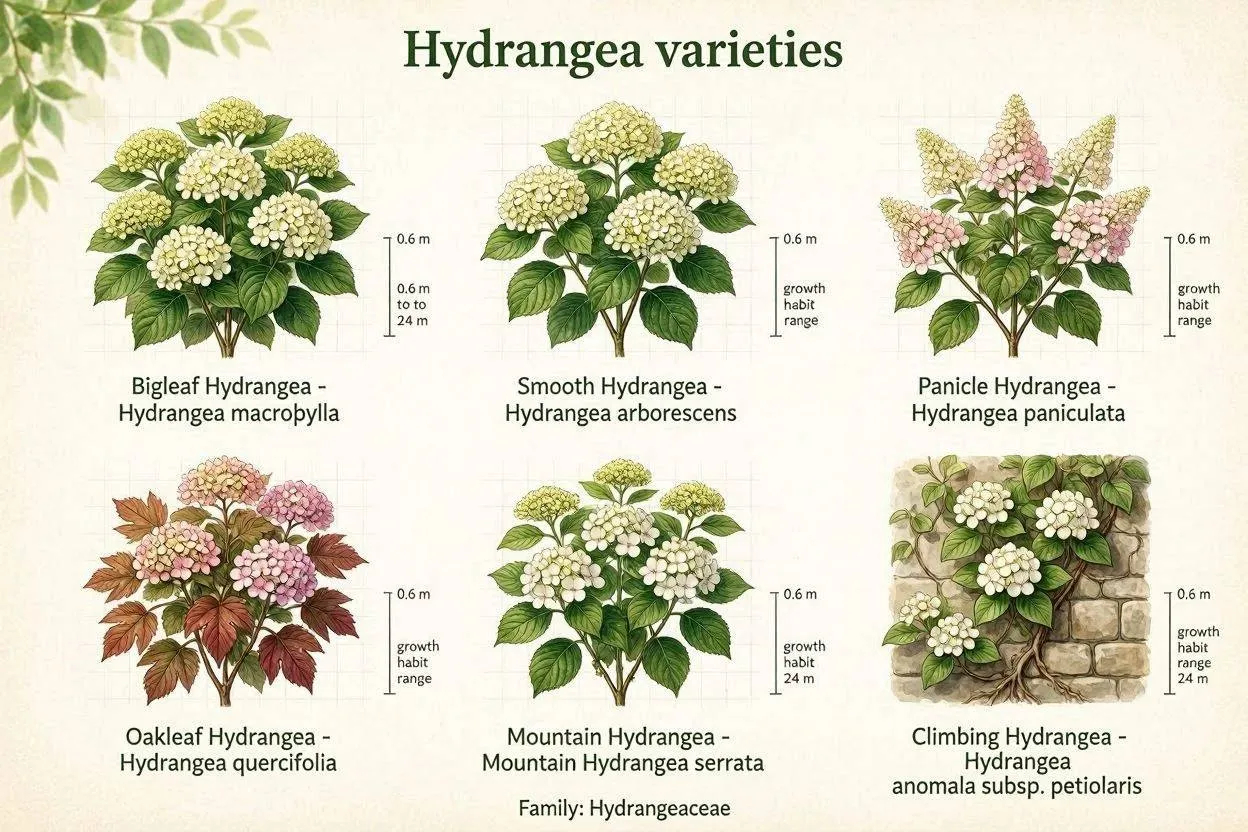
The table below compares all 6 varieties by bloom wood, bloom time, USDA hardiness zones, mature size, and difficulty level.
| Variety | Blooms On | Bloom Time | USDA Zones | Mature Size | Difficulty |
| Bigleaf (H. macrophylla) | Old wood (newer cultivars: both) | June–Oct | 6–9 (4–5 w/ protection) | 2–6 ft (0.6–1.8 m) H&W | Moderate |
| Smooth (H. arborescens) | New wood | June–Sept | 3–9 | 3–5 ft (0.9–1.5 m) H&W | Easy |
| Panicle (H. paniculata) | New wood | July–Sept | 3–8 | 8–15 ft (2.4–4.5 m) tall | Easy |
| Oakleaf (H. quercifolia) | Old wood | July–Sept | 5–9 | 3–8 ft (0.9–2.4 m) H&W | Moderate |
| Mountain (H. serrata) | Old wood (some: both) | June–Sept | 6–9 | 2–4 ft (0.6–1.2 m) H&W | Moderate |
| Climbing (H. anomala) | Old wood | June–July | 4–8 | 30–80 ft (9–24 m) on support | Easy once established |
Bigleaf Hydrangea Varieties (Hydrangea macrophylla)
Bigleaf hydrangea varieties are the most widely recognized group, producing round mophead clusters or flat lacecap flower rings in shades of blue, pink, purple, and white. Flower color in bigleaf varieties depends on soil pH: acidic soil (pH 4.5–5.5) produces blue flowers; alkaline soil (pH 6.5+) produces pink flowers. Aluminum availability in the soil drives this color change, not the pH value itself.
Bigleaf Hydrangea USDA Zones and Size
Standard bigleaf hydrangea varieties grow in USDA Zones 6–9 and reach 2–6 feet (0.6–1.8 m) tall and wide. In Zones 4–5, gardeners grow them with winter protection — burlap wraps and mulching over the crown keep buds alive through hard freezes. Most older cultivars bloom on old wood only, which means late-spring frost or incorrect fall pruning removes the flower buds entirely.
Reblooming cultivars including the Endless Summer series, Let’s Dance series, and ‘Twist-n-Shout’ form buds on both old wood and new wood. Reblooming bigleaf varieties give gardeners in colder zones a reliable second flower flush even when old-wood buds die back. See the full care guide for Eclipse hydrangea care for a detailed breakdown of a reblooming bigleaf cultivar with dark purple foliage.
How to Change Bigleaf Hydrangea Flower Color
To shift bigleaf hydrangea flowers toward blue, apply aluminum sulfate at 1 tablespoon (15 ml) per gallon (3.8 liters) of water 3 times in early spring. To shift flowers toward pink, work agricultural lime into the soil in fall to raise pH above 6.5. Color change takes 1–2 full growing seasons — a single application does not produce immediate results. White-flowering bigleaf cultivars such as ‘Blushing Bride’ do not change color regardless of soil pH.
Smooth Hydrangea Varieties (Hydrangea arborescens)
Smooth hydrangea varieties bloom on new wood each summer, making them the most cold-tolerant and pruning-forgiving hydrangeas available for northern gardens. USDA Zones 3–9 support smooth hydrangeas. Even when stems die to the ground in a harsh winter, the plant regrows from the roots and blooms the same season.
Popular smooth hydrangea cultivars include ‘Annabelle’ (white globes, 3–5 feet / 0.9–1.5 m), Incrediball (larger flower heads than ‘Annabelle’, stronger stems), and Invincibelle Spirit II (pink flowers, 3–4 feet / 0.9–1.2 m). Prune smooth hydrangea varieties in late winter or early spring before growth starts — cutting in fall is not harmful but cutting in spring gives you a cleaner size reset.
Smooth hydrangeas tolerate more shade than panicle varieties but produce their best flower size in at least 4 hours of direct sun. Plant in moist, well-draining soil with a pH of 5.5–7.0 for optimal growth.
Panicle Hydrangea Varieties (Hydrangea paniculata)
Panicle hydrangea varieties produce cone-shaped flower clusters on new wood and tolerate full sun better than any other hydrangea group. They grow in USDA Zones 3–8 and reach 8–15 feet (2.4–4.5 m) tall at maturity, though dwarf panicle cultivars stay under 4 feet (1.2 m).
Panicle flowers open white in mid-summer and age to pink, rose, or burgundy as temperatures drop in fall. Named cultivars include ‘Limelight’ (chartreuse-white flowers, 6–8 feet / 1.8–2.4 m), Pinky Winky (two-tone pink and white panicles, 6–8 feet / 1.8–2.4 m), Bobo (dwarf, 2.5–3 feet / 0.75–0.9 m), Little Quick Fire (compact, blooms 2–3 weeks earlier than standard types), and ‘Grandiflora’ — the original PeeGee [Panicle Grandiflora] hydrangea that can reach tree form at 20 feet (6 m) when limbed up.
Prune panicle hydrangea varieties in late winter or early spring by cutting all main stems back by one-third to one-half. Hard pruning produces fewer but larger flower heads. Light pruning produces more numerous, smaller clusters.
Oakleaf Hydrangea Varieties (Hydrangea quercifolia)
Oakleaf hydrangea varieties are the only major hydrangea group native to North America, originating in the southeastern United States from North Carolina to Louisiana. Oakleaf hydrangeas grow in USDA Zones 5–9 and deliver 4-season interest: white panicle flowers in summer, orange-red fall foliage, peeling cinnamon-colored bark in winter, and large lobed leaves up to 12 inches (30 cm) long.
Oakleaf hydrangeas bloom on old wood. Prune immediately after flowering ends in late summer — cutting in fall or late winter removes the following year’s buds. For full planting steps, watering schedules, and a 6-variety comparison, visit the oakleaf hydrangea care guide on this site.
Standard oakleaf cultivars include ‘Snowflake’ (double-flowered, 5–8 feet / 1.5–2.4 m), ‘Alice’ (large panicles, 8–12 feet / 2.4–3.6 m), ‘Pee Wee’ (dwarf, 3–4 feet / 0.9–1.2 m), and Gatsby Moon (white flowers, dense habit, 5–6 feet / 1.5–1.8 m). Oakleaf hydrangea flower color does not respond to soil pH — the white-to-pink aging sequence is genetically fixed.
Mountain Hydrangea Varieties (Hydrangea serrata)
Mountain hydrangea varieties closely resemble bigleaf hydrangeas but grow smaller and tolerate more cold. Standard cultivars reach 2–4 feet (0.6–1.2 m) tall and wide, fitting naturally into small-space gardens and containers. USDA Zones 6–9 support most mountain hydrangea cultivars; a handful of newer selections survive in Zone 5 with winter protection.
Mountain hydrangeas produce lacecap flower clusters with a ring of sterile florets surrounding a center of small fertile flowers. Like bigleaf varieties, flower color in mountain hydrangeas shifts between blue and pink based on soil pH and aluminum availability. Named cultivars include ‘Bluebird’ (deep blue lacecap in acidic soil, Zone 6–9, 3–4 feet / 0.9–1.2 m), ‘Preziosa’ (pink-to-red mophead aging in sun, 3–4 feet / 0.9–1.2 m), and Tuff Stuff (reblooming, 2–3 feet / 0.6–0.9 m, Zone 5–9 with protection).
Most mountain hydrangea varieties bloom on old wood. Prune immediately after the first flower flush fades — typically late July or early August — and stop all pruning by mid-August. Fall pruning removes next season’s buds.
Climbing Hydrangea Varieties (Hydrangea anomala subsp. petiolaris)
Climbing hydrangea varieties grow as self-clinging deciduous vines, attaching to brick, stone, fences, and trees with root-like holdfasts. A mature climbing hydrangea reaches 30–80 feet (9–24 m) on a suitable support structure. USDA Zones 4–8 support climbing hydrangeas, making them one of the hardier large-flowered vines for northern gardens.
Climbing hydrangeas produce flat lacecap flower clusters — white fertile centers surrounded by large white sterile florets — in June and July. Flowers form on old wood, so prune only to remove dead growth immediately after flowering. The vine tolerates shade better than any other hydrangea variety, making it the correct choice for north-facing walls and shaded fence lines.
Climbing hydrangea establishes slowly — expect 3–5 years before vigorous growth begins. Once established, the vine grows 2–3 feet (0.6–0.9 m) per year. Climbing hydrangea requires no supplemental support once the holdfasts attach to a masonry surface. On wooden structures, use a trellis or wire framework during the first 2 years of establishment.
How to Match Hydrangea Varieties to Your USDA Zone
To match hydrangea varieties to your USDA zone, identify your zone first using the official USDA Plant Hardiness Zone Map, then select a variety rated for that zone or colder. A hydrangea rated Zone 5 grows successfully in Zones 5, 6, 7, 8, and 9 — plants tolerate conditions warmer than their hardiness minimum but not colder.

Best Hydrangea Varieties for Cold Climates (Zones 3–5)
Smooth hydrangea varieties — including ‘Annabelle’ and Incrediball — survive Zone 3 and bloom reliably on new wood each year. Panicle hydrangea varieties including ‘Limelight’ and Bobo also grow in Zone 3. Both groups bloom on new wood, so winter dieback does not eliminate flowers. Reblooming bigleaf cultivars such as Endless Summer grow in Zone 4 with 4 inches (10 cm) of mulch over the root zone and burlap protection on the crown.
Best Hydrangea Varieties for Warm Climates (Zones 7–9)
Bigleaf, mountain, and oakleaf hydrangea varieties perform best in Zones 7–9, where winters stay mild enough to protect old-wood buds. Plant in a location with morning sun and afternoon shade — afternoon heat in Zones 8–9 scorches foliage and reduces bloom size on bigleaf and mountain types. Panicle hydrangea varieties also grow in Zone 7–8 but require consistent watering during summer heat.
How to Prune Hydrangea Varieties Without Losing Blooms
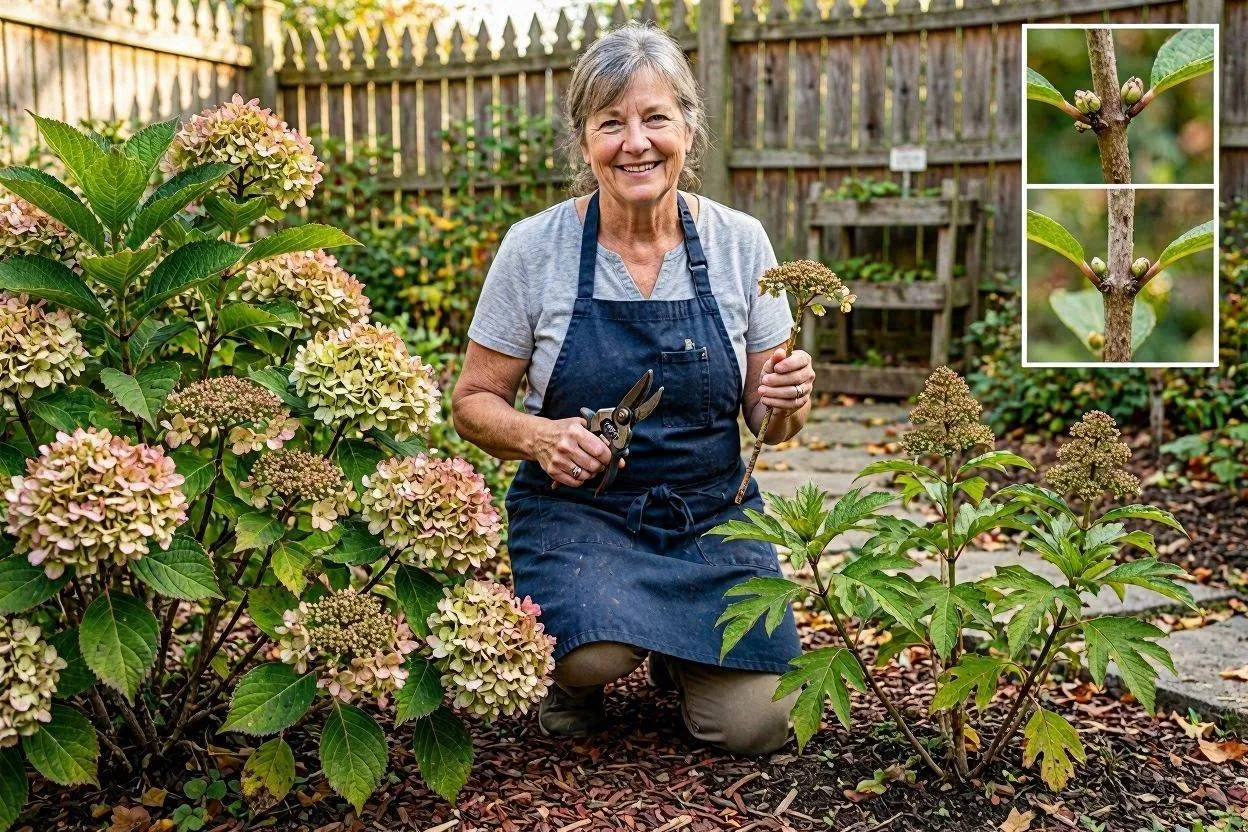
To prune hydrangea varieties without losing blooms, identify whether your plant blooms on old wood or new wood before making any cuts. Wrong pruning timing removes the following season’s flower buds — the most common reason a healthy hydrangea fails to bloom.
Pruning Old-Wood Hydrangeas (Bigleaf, Oakleaf, Mountain, Climbing)
Old-wood hydrangeas set their flower buds in late summer and fall on the previous season’s stems. Prune only immediately after flowering ends — typically July or August. Never prune in fall, winter, or spring. Dead or damaged wood is the only exception: remove dead stems back to living tissue at any time of year.
Late-fall garden cleanup presents the highest risk for old-wood types. If you winterize your garden each October, leave old-wood hydrangea stems uncut and note the pruning date on your garden calendar for the following summer.
Pruning New-Wood Hydrangeas (Smooth, Panicle)
New-wood hydrangeas form flower buds on growth produced in the same season. Prune smooth and panicle hydrangea varieties in late winter or early spring — February through March in most U.S. zones — before growth begins. Cut smooth hydrangea stems back to 12–18 inches (30–45 cm) above the ground for the largest flower clusters. Cut panicle hydrangea stems back by one-third to one-half for large, well-supported panicles.
Which Hydrangea Varieties Grow Well in Containers?
Dwarf hydrangea varieties grow successfully in containers when planted in a minimum 15-gallon (57-liter) pot with drainage holes. Suitable container varieties include Bobo panicle hydrangea (2.5–3 feet / 0.75–0.9 m), Tuff Stuff mountain hydrangea (2–3 feet / 0.6–0.9 m), Pee Wee oakleaf hydrangea (3–4 feet / 0.9–1.2 m), and the Invincibelle Spirit II smooth hydrangea (3–4 feet / 0.9–1.2 m).
Container plants dry out 2–3 times faster than ground-planted shrubs. Water container hydrangeas every 2–3 days in summer and check soil moisture daily during heat waves above 90°F (32°C). In Zones 5–6, move containers to an unheated garage or shed for winter — container roots freeze at temperatures that in-ground roots survive easily.
Frequently Asked Questions About Hydrangea Varieties
Do all hydrangea varieties change flower color?
No. Only bigleaf (H. macrophylla) and mountain (H. serrata) hydrangea varieties change flower color with soil pH. Smooth, panicle, oakleaf, and climbing hydrangea varieties hold genetically fixed flower colors that do not respond to aluminum sulfate or lime applications.
Which hydrangea variety is easiest to grow?
Smooth and panicle hydrangea varieties are the easiest to grow. Both bloom on new wood, tolerate hard pruning, and survive winters in USDA Zones 3–8 without losing the following year’s flowers. Panicle hydrangeas additionally tolerate full sun and dry spells better than any other hydrangea group.
Which hydrangea variety has the longest blooming season?
Reblooming bigleaf hydrangea varieties — including the Endless Summer series and Let’s Dance series — produce flowers from June through October in Zones 6–9. Standard bigleaf and mountain hydrangeas bloom for 4–6 weeks in summer. Panicle hydrangeas bloom July through September and hold dried flower heads through winter.
Can I grow hydrangea varieties in full shade?
No. All hydrangea varieties require a minimum of 3 hours of direct sun to bloom. Climbing hydrangea tolerates the most shade and grows on north-facing walls. Bigleaf and oakleaf hydrangeas prefer morning sun with afternoon shade. Smooth and panicle hydrangeas need 4–6 hours of direct sun for maximum flower production.
When should I plant hydrangea varieties?
Plant hydrangea varieties in spring or fall. Spring planting (April–May in most zones) gives roots a full growing season to establish before winter. Fall planting works in Zones 6–9 if you complete it 6 weeks before the first hard frost. Water newly planted hydrangeas deeply 2–3 times per week for the first 8 weeks regardless of rainfall.
Choosing the Right Hydrangea Variety for Your Garden
The 6 hydrangea varieties — bigleaf, smooth, panicle, oakleaf, mountain, and climbing — each suit a specific combination of zone, sun exposure, and maintenance style. Match bloom wood type to your pruning habits first, then filter by USDA zone and mature size. Gardeners in Zones 3–5 get reliable results from smooth and panicle varieties that bloom on new wood. Gardeners in Zones 6–9 can grow all 6 types and benefit most from the color-changing bigleaf and mountain varieties in acidic soil.
Select a named cultivar rather than an unnamed seedling — named selections like ‘Limelight’, Incrediball, and Endless Summer carry predictable sizes, zone ratings, and bloom habits verified through commercial trials. Plant at the right depth, water consistently during the first 8 weeks, and prune on the correct schedule for your variety’s bloom wood. Those 3 steps account for 90% of hydrangea success.