
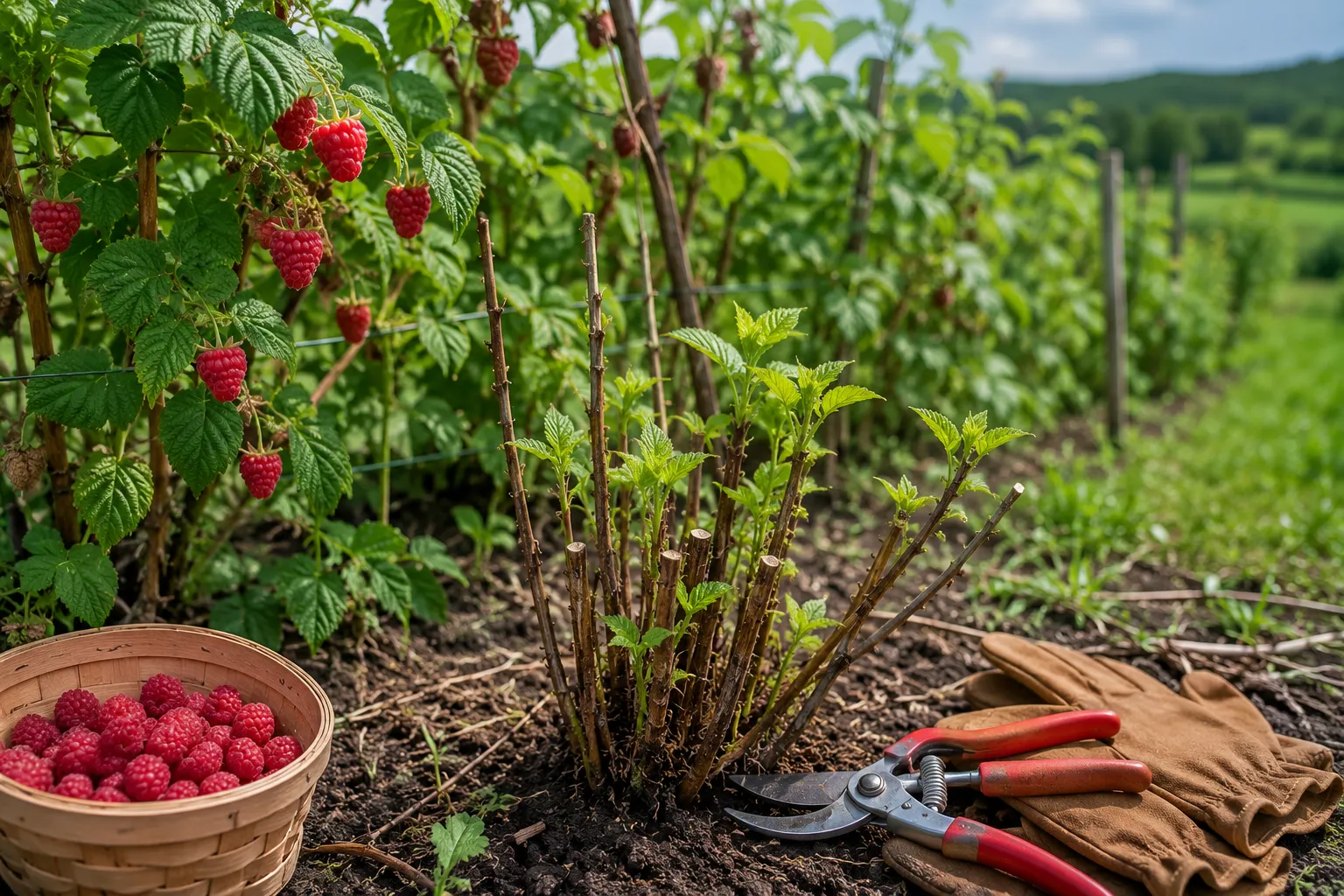
Prune summer-bearing raspberries twice a year: remove spent floricanes immediately after the summer harvest, then thin and head back primocanes in early spring. Everbearing varieties need different treatment depending on whether you want 1 crop or 2. Get the timing or technique wrong and you lose half your berry yield — sometimes for an entire season.
Raspberry pruning sounds complicated because raspberries grow on biennial canes — each cane lives for exactly 2 years, then dies. Once you understand that, every pruning decision becomes logical. This guide covers red, black, purple, and everbearing varieties with zone-specific timing and exact measurements.
Why Raspberry Pruning Determines Your Berry Yield
Unpruned raspberry patches produce 40–60% fewer berries than properly managed ones within 3 growing seasons. Overcrowded canes compete for sunlight, nutrients, and water. Shaded lower canes die before producing lateral shoots — those short side branches that carry most of the fruit.
Dense canes also trap moisture and restrict air movement. That creates ideal conditions for 3 common fungal diseases: spur blight, anthracnose, and gray mold. All 3 spread through the patch when dead canes are left standing.
Consistent raspberry pruning does 4 things: removes dead and diseased wood, improves air circulation, directs the plant’s energy into new productive canes, and keeps the patch narrow enough to harvest without injury.
Understanding Raspberry Canes Before You Prune
Raspberry plants (Rubus idaeus) have perennial roots but biennial canes. Every spring, new shoots emerge from the root system. Those shoots grow through their first full season, then fruit and die in their second year. Knowing which cane is which tells you exactly what to cut.
Primocanes — First-Year Canes
A primocane is a green, actively growing first-year cane that will NOT fruit until next season — except on everbearing varieties, where primocane tips fruit in late summer or fall. Primocanes are green and pliable. Never remove healthy primocanes from summer-bearing varieties: they are next year’s entire fruit crop.
Thin primocanes to 6–8 strong canes per 1 linear foot (30cm) of row in early spring. Remove the thinnest and weakest, keeping canes spaced roughly 6 inches (15cm) apart for best air circulation.
Floricanes — Second-Year Canes
A floricane is a brown, woody second-year cane that fruits once, then dies. After a floricane finishes fruiting, it serves no further purpose. Leaving dead floricanes standing blocks light, traps moisture, and hosts disease spores. Cut every floricane to ground level within 2 weeks of the last berry pick.
Floricanes are easy to identify: they are brown, dry, and often still carry dried fruit stalks. Green canes growing alongside them are primocanes — leave those untouched.
When to Prune Raspberry Canes: Timing by Type and Zone
Raspberry pruning timing depends on 2 factors: the raspberry type (summer-bearing or everbearing) and your USDA hardiness zone. Getting the timing right determines whether you gain or lose flowers for the upcoming season.
Summer-Bearing Raspberries
Prune summer-bearing raspberries in 2 sessions: July–August after harvest, then again in early spring.
- After-harvest pruning (July–August): cut all fruited floricanes to ground level immediately after the last berry pick. The window is important — early removal gives primocanes more light and growing time before fall.
- Spring pruning (March–April in zones 5–7, February–March in zones 8–9): thin primocanes to 6 per linear foot (30cm), remove winter-damaged tips, and head back remaining canes to 5 feet (1.5m) tall.
Popular summer-bearing varieties — Tulameen, Boyne, Canby, and Willamette — all follow this schedule. Never prune summer-bearing raspberries in fall: fall cuts remove dormant buds that produce next year’s fruit.
Everbearing (Fall-Bearing) Raspberries
Everbearing raspberries — Heritage, Caroline, Autumn Bliss, Polka — need timing adjusted to your chosen pruning system. Two systems exist, and each produces a different result:
- One-crop system: cut all canes to ground level in late winter (February–March). No summer crop that year. The fall crop on new primocanes arrives 1–2 weeks earlier and yields more total berries.
- Two-crop system: follow the same spring schedule as summer-bearing varieties. You get a small summer crop on second-year canes and a fall crop on first-year cane tips.
Raspberry Pruning Tools: 3 You Actually Need
Using the wrong tool leaves crushed, torn cuts that heal slowly and invite disease. Match the tool to the cane diameter on every cut.
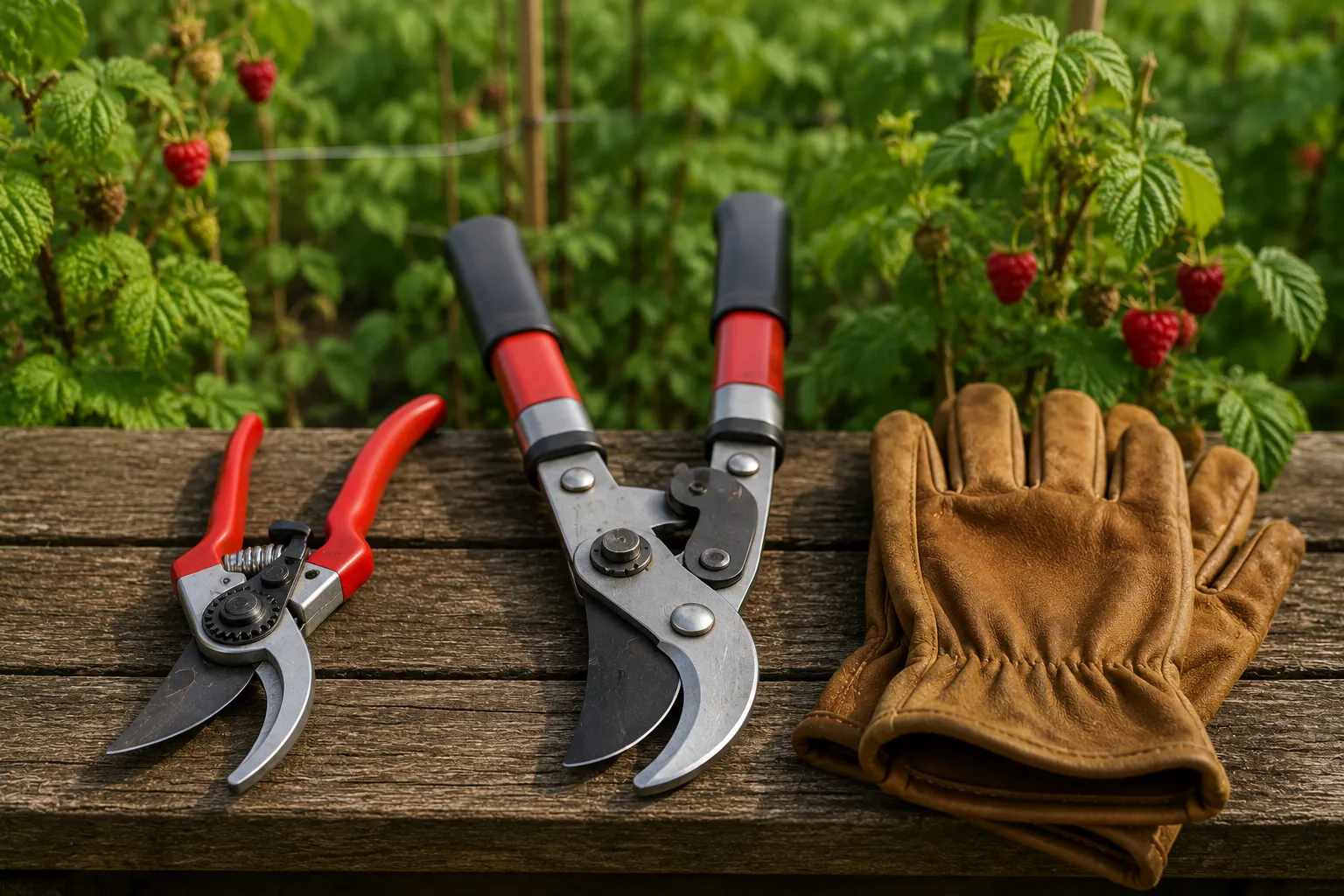
- Bypass hand pruners: use on canes up to 1/2 inch (12mm) thick — the majority of raspberry cane work. Bypass blades make a clean, close cut. Avoid anvil pruners: the flat blade crushes cane tissue.
- Loppers: use on canes 1/2 inch to 1.5 inches (12–38mm) thick. Long handles give the leverage needed to cut mature floricanes cleanly at ground level without damaging nearby primocanes.
- Heavy leather gloves: raspberry thorns are fine but plentiful. Standard garden gloves tear. Use gloves rated for thorny plants.
Clean blades with a 10% bleach solution between rows — or at minimum between different plants. Spur blight and anthracnose travel directly from infected tissue to healthy canes on unsterilized blades.
How to Prune Summer-Bearing Raspberries — Step by Step
To prune summer-bearing raspberries correctly, work through these 5 steps in order. Completing them out of sequence damages productive canes or leaves disease-carrying wood in the row.
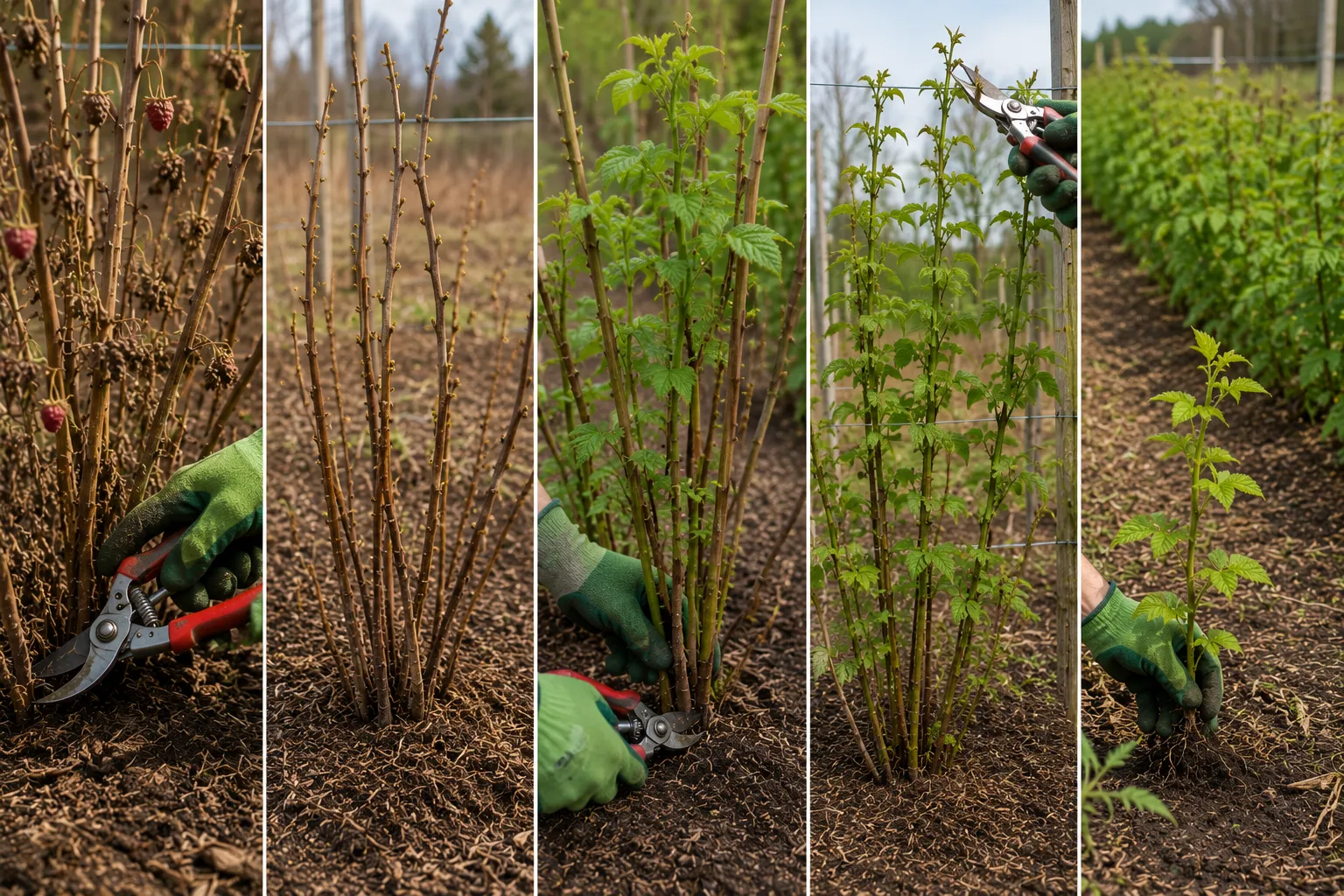
- Remove all floricanes after harvest. Cut every brown, fruited cane to ground level within 2 weeks of the last berry pick. Leave no stubs — cut flush with the soil. Remove all cut material from the patch and destroy it or bag it for waste collection. Do not compost diseased canes.
- Wait for dormancy before spring pruning. In zones 5–7, begin spring pruning in March when canes are fully dormant but before buds swell. In zones 8–9, start in late February. In zone 4 (northern Minnesota, Wisconsin), wait until early April when the worst freeze risk passes.
- Thin primocanes to 6 per linear foot (30cm). Pull or cut any canes growing outside the 12-inch-wide (30cm) hedgerow. Within the row, cut the thinnest, weakest primocanes at ground level until 6 strong canes remain per foot of row. Remaining canes should have a diameter of at least 1/4 inch (6mm) at 30 inches (76cm) above the ground.
- Head back canes to 5 feet (1.5m) tall. Cut each remaining cane 1/4 inch (6mm) above a healthy bud. If winter dieback is visible — dry, gray tissue above a healthy green section — cut back to the live green tissue regardless of height. Weak, thin canes rarely recover from winter damage; remove them entirely.
- Remove suckers outside the hedgerow. Red raspberries send roots laterally and produce suckers up to 3 feet (90cm) from the main row. Cut or dig every sucker outside the designated hedgerow. Left unmanaged, suckers spread disease from older canes to new growth and make the patch impossible to harvest cleanly.
Well-known summer-bearing varieties that benefit directly from this schedule include Tulameen (zones 5–9), Boyne (zones 3–8), and Canby (zones 5–9). For gardeners growing dwarf crape myrtle varieties alongside berry canes in smaller spaces, the same early-spring timing window works well for both plants.
How to Prune Everbearing Raspberries: One-Crop vs Two-Crop System
Choose the one-crop system if maximum berry yield is the priority. Choose the two-crop system if an earlier summer harvest matters more than total volume. The pruning method commits the plant to one path for the entire season — switching mid-year is not possible.
One-Crop System — Higher Yield
To prune everbearing raspberries for a single large fall crop, cut every cane in the patch to ground level in late winter (February–March in zones 5–8). No canes remain.
New primocanes grow through spring and summer. Fruit forms on primocane tips from August through first frost — roughly 6 to 10 weeks of continuous harvest. Total yield with the one-crop system exceeds the two-crop system by 15–25% in most documented trials from Iowa State University Extension.
Heritage, Caroline, and Polka all produce well on this system. After the fall harvest ends, cut all canes to ground level again. The cycle repeats each year with zero floricane management — the simplest raspberry pruning method available.
Two-Crop System — Earlier Harvest
To prune everbearing raspberries for two crops, follow the identical spring pruning steps used for summer-bearing varieties. Thin primocanes to 6 per linear foot (30cm). Head back to 5 feet (1.5m). Remove winter-damaged tips.
The summer crop arrives in June–July on the lower sections of second-year canes. The fall crop follows in August–October on the tips of new primocanes growing that same season. After the summer crop finishes, cut the fruited upper sections of second-year canes back to the point where the fall crop begins — roughly 18–24 inches (45–60cm) from the cane tip.
How to Prune Black and Purple Raspberries
Black raspberries (Rubus occidentalis) and purple raspberries need 3 pruning sessions per year — more than red raspberries. Black raspberries do not sucker from roots. New canes grow from the crown only, so every cane that forms is valuable and must be managed carefully.
Summer Tipping for Black Raspberries
Tip black raspberry primocanes when they reach 3 feet (90cm) tall — typically June or July. Cut the top 2–3 inches (5–8cm) of each cane with bypass pruners. Tipping stops vertical growth and forces the cane to push energy into lateral branches, where fruit develops.
Without tipping, black raspberry canes grow 6–8 feet (1.8–2.4m) tall and produce few lateral branches. Tipped canes produce 8–12 lateral branches each, compared to 2–4 on untipped canes. The yield difference per plant is significant.
Spring Pruning for Black and Purple Canes
To prune black and purple raspberries in spring, remove all dead floricanes at ground level — identical to red raspberry practice. Then prune lateral branches from the previous season’s tipping. Cut each lateral back to 10–12 inches (25–30cm) for black raspberries and 14–18 inches (35–45cm) for purple raspberries. Leave 4–5 of the strongest canes per plant.
Popular black raspberry varieties — Jewel and Bristol (both zones 5–8) — respond best to this schedule. For gardeners researching fruit-bearing plant care across different genera, the Lagerstroemia floribunda care guide on Zoned Garden covers similar seasonal pruning principles applied to flowering trees.
4 Raspberry Pruning Mistakes That Cut Your Harvest in Half
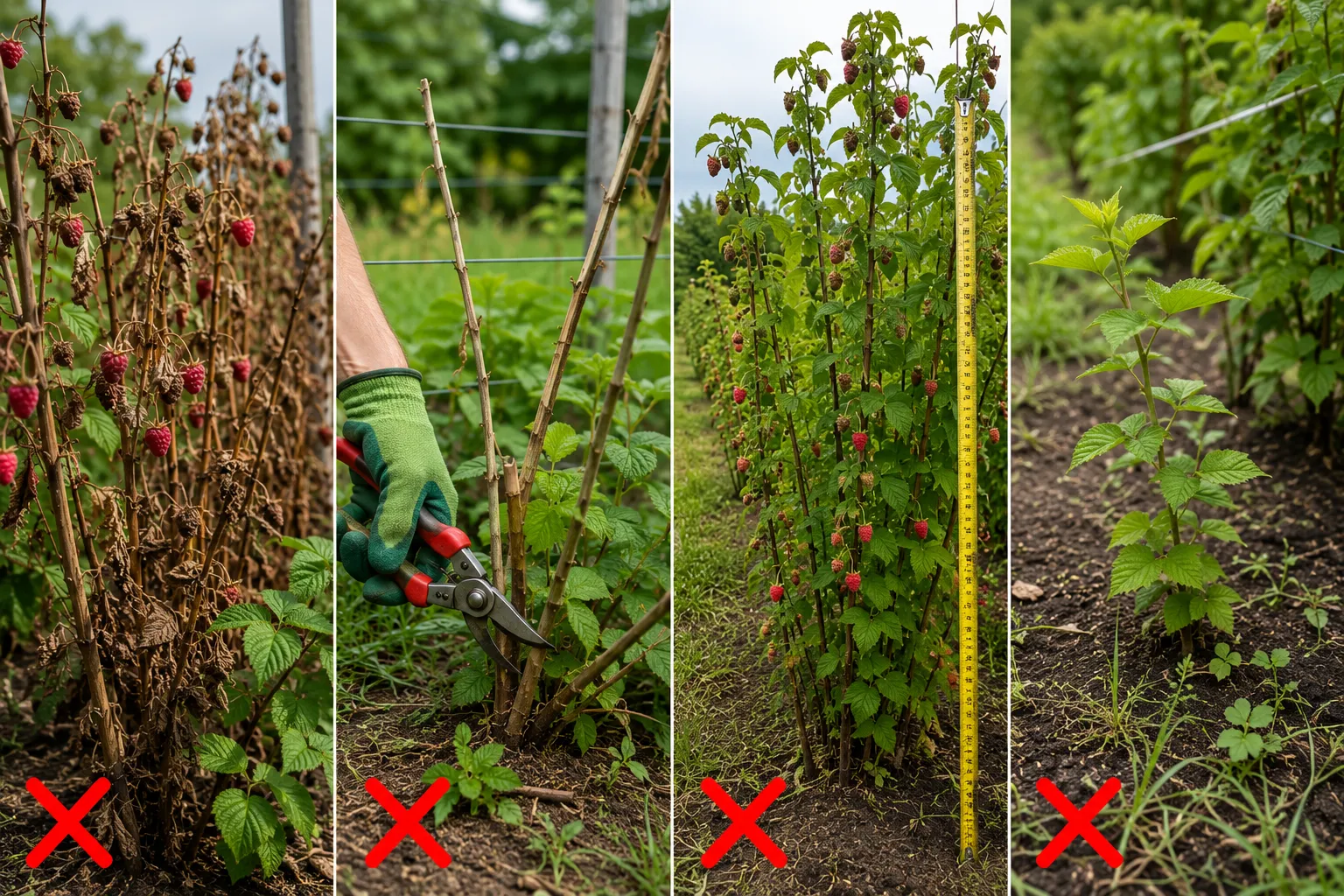
Mistake 1: Leaving Floricanes Standing After Harvest
Dead floricanes left in the row for more than 4 weeks after harvest release spur blight spores onto nearby primocanes. Spur blight enters through the same leaf scars and buds that produce fruiting laterals the following year. Infected primocanes produce fewer laterals and smaller berries. Cut floricanes within 2 weeks of final harvest, remove from the patch, and destroy.
Mistake 2: Cutting Primocanes in Fall
Fall pruning of summer-bearing raspberries removes the dormant buds that produce next year’s entire crop. Raspberries form flower buds on primocanes in late summer and early fall. Those buds stay dormant through winter and open as fruiting laterals the following spring. Cutting primocanes in September or October removes 100% of next year’s fruit before winter even begins.
Mistake 3: Heading Back Canes Too Short
Cutting summer-bearing canes below 4 feet (1.2m) reduces the number of fruiting lateral positions available on each cane. Lateral branches develop from the buds distributed along the cane length. A cane headed back to 2 feet (60cm) has half as many bud sites as one left at 5 feet (1.5m). Leave canes at 4.5–5 feet (1.35–1.5m) unless significant winter dieback forces shorter cuts.
Mistake 4: Skipping Sucker Removal
Red raspberry suckers growing 2–3 feet (60–90cm) outside the hedgerow carry disease from older infected tissue into clean soil. Suckers also compete with named varieties, reduce air circulation, and make harvesting difficult. Remove every sucker outside the 12-inch (30cm) hedgerow using a spade or bypass pruners. Repeat every 3–4 weeks during the growing season.
Quick-Reference Raspberry Pruning Table
Use this table as a season-by-season checklist. Match your raspberry type to the correct row before making any cuts.
| Pruning Task | Best Time | Tool | Difficulty |
| Remove floricanes after summer harvest | July–August (after fruiting) | Loppers or pruning saw | Easy |
| Remove floricanes — fall-bearing varieties | After fall harvest or late winter | Loppers | Easy |
| Thin primocanes to 6 per foot | Early spring (March–April) | Hand pruners (bypass) | Easy |
| Head back canes to 5 ft height | Early spring before bud swell | Hand pruners (bypass) | Easy |
| Tip black raspberry canes at 3 ft | Summer when canes reach 3 ft | Hand pruners (bypass) | Easy |
| Shorten lateral shoots — black raspberries | Early spring (March–April) | Hand pruners (bypass) | Moderate |
| Cut all canes to ground — one-crop system | Late winter (February–March) | Loppers | Easy |
| Remove suckers outside hedgerow | Any time during growing season | Spade or pruners | Easy |
Frequently Asked Questions
Can I prune raspberries in fall?
No — fall pruning removes flower buds on primocanes and eliminates next year’s fruit on summer-bearing varieties. The only fall pruning permitted is removing floricanes on everbearing varieties after the fall harvest ends. Never cut live, green primocanes in fall.
How many canes should I leave per raspberry plant?
Leave 6 to 8 healthy primocanes per 1 linear foot (30cm) of row for red raspberries. For black raspberries, leave 4 to 5 canes per plant or hill. Canes spaced 6 inches (15cm) apart produce better air circulation and larger individual berries than crowded rows.
Do I need to prune raspberries in the first year?
Yes — remove all flower buds from first-year plants to redirect energy into root establishment. First-year plants that fruit produce smaller yields in years 2 and 3. Pinch off flower clusters as they appear. In fall of year 1, remove any canes that show disease symptoms or died back from the tip.
What do I do with the cut raspberry canes?
Remove all cut canes from the patch and bag or burn them — never compost raspberry prunings. Spur blight, anthracnose, and cane blight all survive on cut cane tissue and reinfect the patch from compost. Leaving cut canes on the ground between rows spreads disease spores onto nearby healthy canes during rain events.
How do I know if a cane is dead or just dormant?
Scratch the bark with a fingernail: a green layer under the bark means the cane is dormant and alive; brown or dry tissue means the cane is dead. Test from the tip downward. Cut dead sections back to the first point where green tissue appears. If the entire cane is brown to the base, remove it fully at ground level.
Conclusion
Raspberry pruning comes down to one principle: remove what fruited, protect what hasn’t fruited yet, and thin what remains to 6 per foot. Summer-bearing varieties need 2 sessions — one immediately after harvest, one in early spring. Everbearing varieties need a choice: cut everything to the ground in late winter for a single large fall crop, or manage canes like summer-bearing plants for two smaller crops.
Black and purple raspberries add a summer tipping step. Everything else — cane spacing, lateral pruning, tool hygiene, sucker removal — applies to all raspberry types. The patch that gets consistent annual attention outproduces a neglected one within 2 seasons and continues doing so for 10 to 15 years.
If you are deciding which raspberry variety to plant — or expanding your fruiting garden beyond berries — the complete crape myrtle guide at Zoned Garden covers variety selection and pruning timing for one of the most widely planted flowering trees in American landscapes. The same seasonal approach applies: right timing, minimal cuts, maximum results.