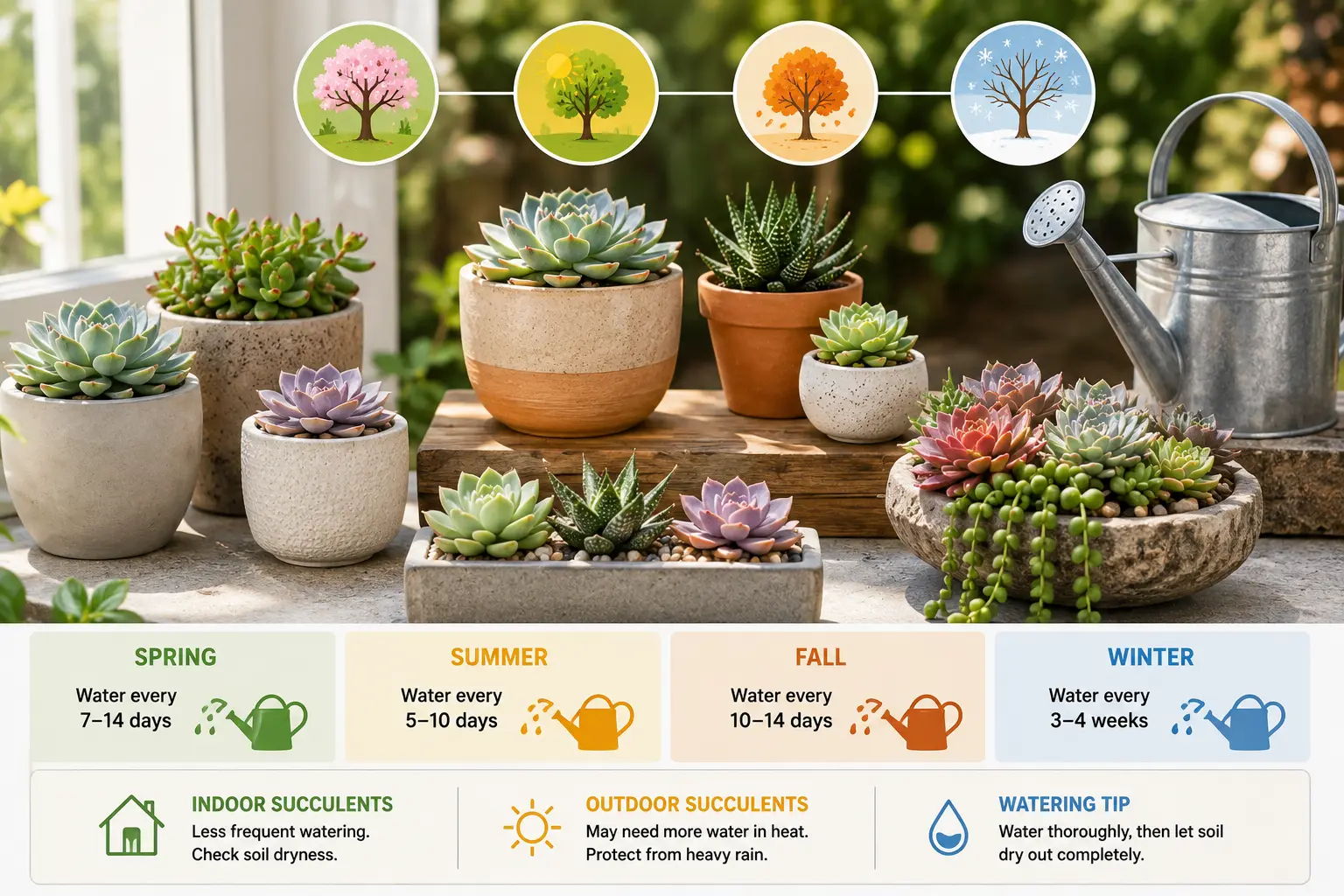
Water succulents every 7-42 days depending on the season, whether they grow indoors or outdoors, and the type of succulent. In peak summer, some varieties need water every 7 days. In winter dormancy, 6 weeks between waterings is completely normal.
Most succulent deaths trace back to one mistake: watering too often. These plants store water in their leaves, stems, and roots. Wet soil sitting around those roots for more than 2-3 days begins breaking down the tissue from below.
This guide gives exact frequencies for every season, separate schedules for indoor and outdoor growing, and a type-by-type breakdown covering Echeveria, Sedum, Haworthia, Aloe, Lithops, and String of Pearls — the 6 categories competitors skip entirely.
Why the Soak-and-Dry Method Works
Soak the soil completely, then let it dry fully before watering again. That is the entire method. Every reliable succulent grower uses this approach because it matches how succulents receive water in their native habitats — flash rains followed by weeks of dry soil.
A shallow sprinkle every few days creates a shallow, weak root system. Roots stay near the surface chasing moisture instead of pushing deep into the soil. Deep watering forces roots downward, building a stronger system that handles dry periods better.
Pour water slowly until it flows freely from the drainage holes. Then wait. Do not water again until the soil passes a dryness test. This one rule prevents 90% of succulent root rot cases.
Complete Succulent Watering Schedule by Season
The table below covers most common indoor succulents — Echeveria, Sedum, Haworthia — in well-draining cactus mix with a pot that has drainage holes. Outdoor frequencies assume a sunny spot with good airflow.
| Season | Indoor Frequency | Outdoor Frequency | Soil Check Depth | Key Rule |
| Spring (Mar-May) | Every 14-21 days | Every 7-10 days | Top 2 in (5 cm) fully dry | Ramp up slowly from winter |
| Summer (Jun-Aug) | Every 7-14 days | Every 5-7 days | Top 2 in (5 cm) dry | High heat = check at day 7 |
| Fall (Sep-Nov) | Every 21-28 days | Every 14-21 days | Top 3 in (7.5 cm) dry | Cut back before dormancy |
| Winter (Dec-Feb) | Every 28-42 days | Minimal / rain only | Full pot nearly dry | Skipping 6 weeks is fine |
Pot material adjusts every range above. Terracotta dries 30-40% faster than plastic. Add 5-7 days to each range if your succulents grow in glazed ceramic or plastic pots.
Spring Watering (March-May)
Succulents wake from dormancy in spring. Watering every 14-21 days indoors matches the pace of gradually warming temperatures and increasing light. Start at the longer end of the range in March and shorten toward 14 days by May.
Outdoor succulents in spring need water every 7-10 days once nighttime temperatures stay above 50 degrees F (10 degrees C) consistently. Check soil at 2 inches (5 cm) before every watering — spring soil holds moisture longer than summer soil.
Summer Watering (June-August)
Summer is peak watering season. Indoor succulents on a bright windowsill need water every 7-14 days. Outdoor succulents in direct sun can dry out in 5-7 days during heat waves above 90 degrees F (32 degrees C).
Check the soil at day 7 every time in summer regardless of the schedule. High temperatures evaporate soil moisture faster than expected. A pot that usually lasts 12 days may hit dry at day 8 during a heat spike.
Fall Watering (September-November)
Cut back watering the moment nights cool below 55 degrees F (13 degrees C). Growth slows and the plant stops pulling water at its summer rate. Most growers keep their summer schedule through September, which causes overwatering — the soil simply stops drying fast enough.
Water every 21-28 days indoors in fall. Let the top 3 inches (7.5 cm) go completely dry, not just the top 1-2 inches. The deeper check prevents water from sitting in the lower root zone where it causes the most damage.
Winter Watering (December-February)
Water every 28-42 days in winter. Many succulents need water only once every 6 weeks during their dormant period. Growth stops, water uptake slows dramatically, and wet roots in cold soil rot faster than at any other time of year.
Central heating dries indoor air, which speeds soil evaporation slightly. Use the skewer test rather than a calendar in winter — the test accounts for your specific home temperature and humidity. Never assume summer frequency applies just because a room feels warm.
Watering Frequency by Succulent Type
This is the section every competitor skips. Not all succulents dry at the same rate. Leaf thickness determines how much water a plant stores and how long it survives between waterings.
| Succulent Type | Examples | Summer Frequency | Winter Frequency | Thirst Level |
| Thin-leaved | Sedum, Crassula | Every 7-10 days | Every 21-28 days | Higher |
| Medium-fleshy | Echeveria, Aloe vera | Every 10-14 days | Every 28-35 days | Medium |
| Very thick-leaved | Haworthia, Gasteria, Lithops | Every 14-21 days | Every 35-45 days | Lower |
| Trailing / epiphytic | String of Pearls, Christmas Cactus | Every 7-10 days | Every 14-21 days | Higher than most |
Echeveria and Aloe Vera
Echeveria stores moderate amounts of water in its rosette leaves. Water every 10-14 days in summer and every 28-35 days in winter. Aloe vera has thick, gel-filled leaves and tolerates slightly longer dry periods — water every 14 days in summer, 35 days in winter.
Never let water sit in the center rosette of an Echeveria. Water collected in the leaf cup causes crown rot within days, especially indoors where airflow is limited. The same principle applies to rubber plants — crown and stem moisture causes rot faster than any watering mistake.
Haworthia and Gasteria
Haworthia and Gasteria are the most drought-tolerant common succulents. Both tolerate shade and store significant water in their thick, firm leaves. Water every 14-21 days in summer and every 35-45 days in winter.These two are the best choice for beginners who tend to forget watering. A Haworthia left dry for 6 weeks in summer will survive. Left wet for 2 weeks in winter, it will not.
Lithops (Living Stones)
Lithops need almost no water. Water every 14-21 days in summer only during their active growing phase. From November through March, do not water Lithops at all unless the leaves show severe shriveling. Watering during dormancy causes the old leaves to split and rot instead of properly shedding.This is the most misunderstood succulent watering requirement. Lithops die from winter watering far more than summer drought.
String of Pearls and Trailing Succulents
String of Pearls (Senecio rowleyanus) has smaller water-storage capacity than rosette succulents. Water every 7-10 days in summer and every 14-21 days in winter. The small round leaves wrinkle and flatten noticeably when the plant needs water — the clearest visual signal of any common succulent.
String of Pearls grows well in hanging pots, which dry out faster due to increased airflow. Plants in hanging or elevated positions always need more frequent water checks than ground-level plants.
Sedum and Sempervivum
Sedum and Sempervivum are the hardiest succulent types for outdoor growing, tolerating USDA zones 4-9 and surviving frost. Both need water every 7-10 days outdoors in summer. In-ground plants in zones 6-8 often survive entirely on rainfall from September through May without any supplemental watering.
Indoor vs Outdoor: Key Differences
Indoor succulents need water less often than outdoor succulents — not because they use less water, but because soil dries slower indoors. Lower light levels, still air, and stable temperatures mean soil holds moisture 40-60% longer than the same pot placed outdoors in summer.
Indoor Succulent Watering
Indoor succulents in bright indirect light (a south or west-facing window) follow the seasonal schedule in the table above. Plants in dim corners need water even less frequently — low light slows growth and reduces water consumption significantly.
Use a narrow-spout watering can indoors. Pour directly onto the soil surface and avoid wetting leaves. Wet leaves in still indoor air stay damp for hours, which promotes fungal growth and rot on the leaf surface.
Outdoor Succulent Watering
Outdoor succulents in full sun dry out 2-3 times faster than indoor plants. In hot climates above 90 degrees F (32 degrees C), check soil every 5 days in summer. Wind accelerates drying further — outdoor plants in windy spots may need water every 4-5 days at peak summer.
Small pots outdoors (under 4 inches / 10 cm in diameter) need 2-4 oz (60-120 ml) of water per watering. Medium pots (4-8 inches / 10-20 cm) need 4-6 oz (120-180 ml). Large pots (over 8 inches / 20 cm) need 6-10 oz (180-300 ml) — always water until it flows from the drainage holes regardless of volume.
5 Tests to Know When to Water
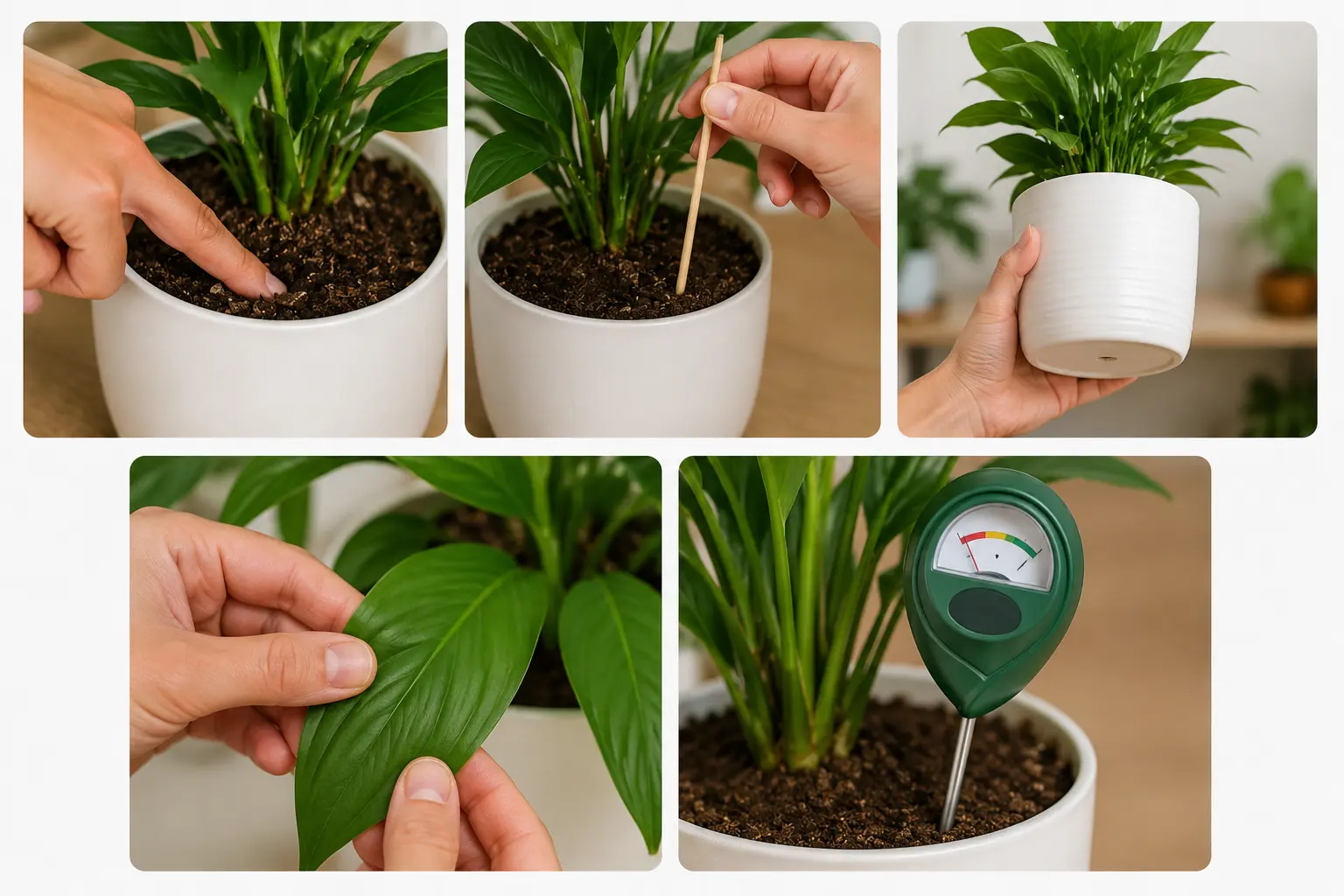
Never water by calendar alone. These 5 tests confirm whether your specific plant actually needs water on a given day.
Test 1: The Finger Test
Push your finger 2 inches (5 cm) into the soil. Dry and room-temperature means water. Cool or damp means wait 2-3 more days. This test takes 5 seconds and catches 80% of overwatering before it happens.
Test 2: The Wooden Skewer Test
Insert a clean wooden skewer or chopstick all the way to the pot bottom. Leave it 10 seconds. A skewer that comes out clean and dry means the entire root zone is dry. Soil clinging to the skewer means moisture remains at root level — wait regardless of surface dryness.
Test 3: The Lift Test
A dry pot weighs noticeably less than a watered one. Lift the pot after watering and memorize the weight. Lift it again before the next scheduled watering. If it feels significantly lighter, the soil has dried. If it still feels heavy, wait.
Test 4: The Leaf Firmness Test
Gently squeeze a lower leaf between two fingers. Firm and plump means water is stored. Slightly soft or with visible wrinkling means the plant has used its water reserves and is ready to drink. Do not wait for severe wrinkling — that signals stress, not just thirst.
Test 5: The Moisture Meter
A basic soil moisture meter ($10-15 USD) eliminates guesswork entirely. Insert the probe to the pot’s midpoint. A reading below 2 on a standard scale means water. A reading above 3 means wait. Moisture meters work best for larger pots where finger and skewer tests do not reach the full root zone.
How to Water Succulents Correctly
Top Watering
Pour water slowly around the entire soil surface — not in one spot. Water channels down a single path and leaves the rest of the root zone dry if poured in one place. Continue until water flows steadily from the drainage holes. Empty the saucer 10-15 minutes after watering. Never leave a succulent pot sitting in standing water.
Do not water the leaves. Water on succulent leaves indoors leads to rot. Point the watering can directly at the soil. Use a narrow-spout can or squeeze bottle for small pots and tight arrangements.
Bottom Watering
Bottom watering is the most effective method for succulents. Place the pot in a tray with 1-2 inches (2.5-5 cm) of water. Soil absorbs moisture upward through the drainage holes at its own pace over 15-20 minutes. The leaves stay completely dry, the root zone saturates evenly, and waterlogging is nearly impossible.
Remove the pot once the top surface of soil feels barely damp. Drain fully for 5 minutes before returning to its spot.
Water Type and pH
Room-temperature water prevents root shock from cold tap water. Let tap water sit overnight before use — this allows chlorine to evaporate. The ideal water pH for succulents is 5.5-6.5 (slightly acidic). Most tap water runs alkaline at pH 7-8, which inhibits nutrient uptake over time.
Hard water (high mineral content) causes white crusty deposits on soil and pot surfaces. These mineral salt buildups block root absorption. Flush the soil with filtered or rainwater every 3-4 months to clear buildup. The same pH and mineral considerations apply to all garden plants that prefer well-drained, slightly acidic conditions.
Right Soil and Pot Setup
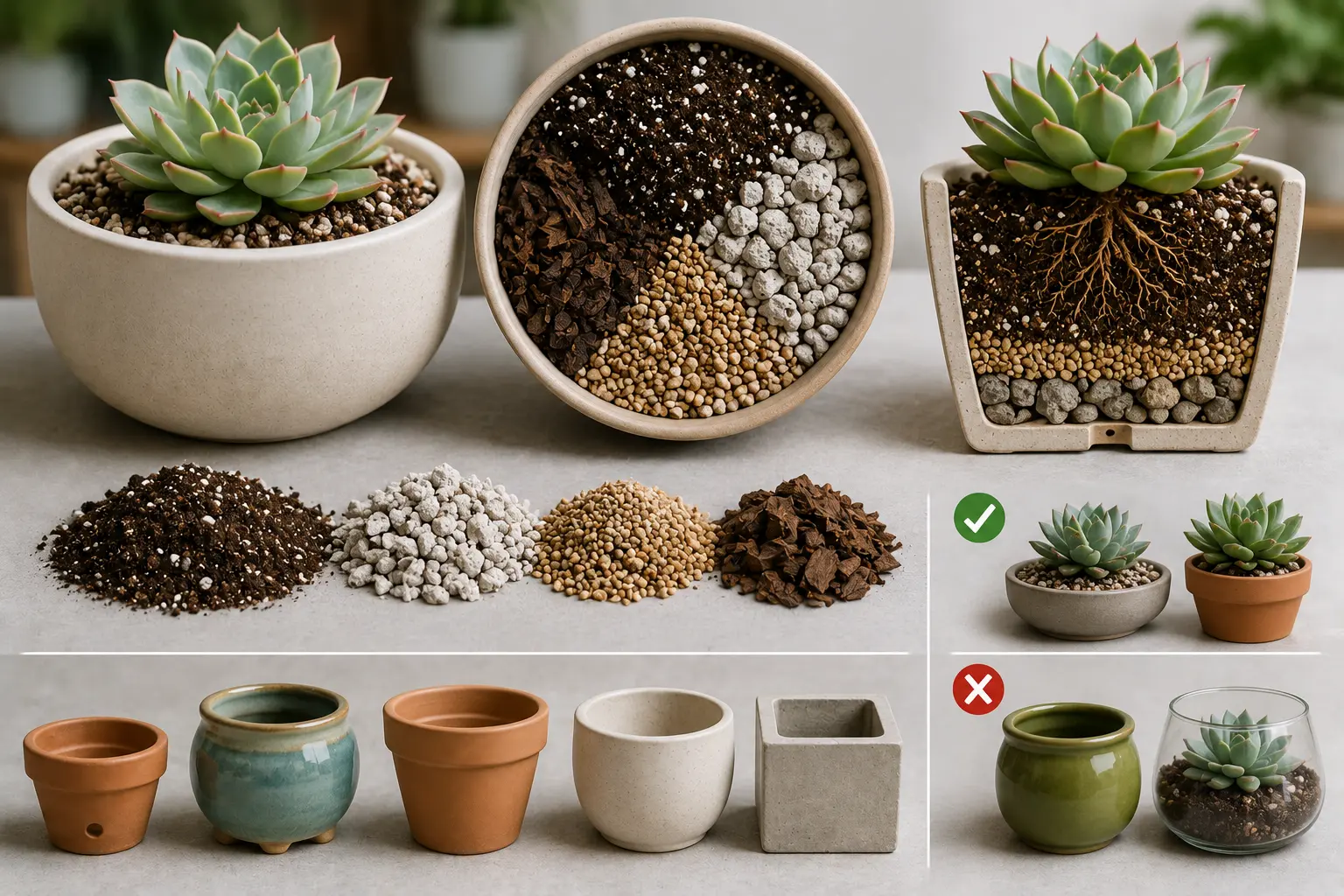
The best watering schedule fails in the wrong soil. Succulent soil must drain fast enough to be mostly dry within 2-3 days of watering.
Ideal Soil Mix
Use a commercial cactus or succulent mix as the base. Add 30% perlite by volume to improve drainage and aeration. Perlite keeps air pockets open around roots as the soil dries. Avoid mixes with large amounts of peat — peat compacts over time and retains moisture far longer than succulents tolerate.
A simple test: wet a handful of your soil mix and squeeze it hard. It should crumble apart within seconds of opening your hand. Soil that stays clumped holds too much moisture for succulents.
Pot Selection
Terracotta and unglazed ceramic pots are the best choice. Porous walls release moisture through evaporation, cutting drying time by 30-40% compared to plastic. Every pot needs at least one drainage hole. Pots without drainage holes cause root rot — no watering schedule compensates for trapped water.
Avoid glass containers and terrariums for succulents. No drainage plus no airflow equals dead roots. Decorative pots without drainage holes can work only if you plant in a smaller draining pot inside them and lift the inner pot out when watering.
Signs of Overwatering vs Underwatering
6 Signs of Overwatering
- Leaves turn yellow or pale, starting from the base
- Leaf base feels soft or mushy when pressed gently
- Soil smells sour or musty — active root rot signal
- Brown spots that feel wet, not dry and crispy
- Plant looks droopy despite damp soil
- Roots appear black and slimy when inspected
Action: Stop watering immediately. Let soil dry completely. Remove the plant from the pot and inspect roots. Cut off any black or mushy root sections with clean scissors. Repot into fresh, dry cactus mix if rot covers more than 30% of roots.
5 Signs of Underwatering
- Leaves wrinkle, shrivel, or flatten — especially String of Pearls
- Leaves feel soft when squeezed but not mushy
- Leaf tips turn brown and dry, not wet
- Pot feels very light when lifted
- Soil pulls away from pot edges when fully dry
Action: Give a thorough soak-and-dry watering immediately. Underwatered succulents recover within 48-72 hours. Leaves firm up, color returns, and wrinkling resolves. Do not overcompensate by watering daily — one deep watering is enough.
5 Mistakes That Kill Succulents
- Watering on a fixed schedule. A Tuesday reminder on your phone does not account for seasonal changes, temperature spikes, or pot type. Always check the soil first.
- Misting instead of soaking. Misting creates constant surface moisture that encourages fungal growth and weak roots. It does not count as watering. Mist only when propagating leaf cuttings.
- Watering in the evening. Water in the morning. Evening watering leaves moisture on leaves and at the soil surface overnight, where cooler temperatures slow evaporation and increase rot risk.
- Using pots without drainage holes. No drainage hole means trapped water at the bottom of every pot. Root rot follows within weeks regardless of watering frequency.
- Watering dormant succulents normally. Lithops especially must not receive water during their November-March dormancy period. Other succulents need 50-70% less water in winter than summer.
Frequently Asked Questions
How often should I water succulents indoors?
Every 10-14 days in summer, every 28-42 days in winter for most common indoor succulents like Echeveria and Aloe. Always confirm soil is fully dry before each watering — the schedule is a starting range, not a fixed rule.
Can I water succulents once a week?
Yes, but only in peak summer for sun-facing outdoor plants or fast-draining small pots indoors. Indoor succulents in standard conditions need at minimum 10 days between summer waterings. Weekly watering year-round causes root rot in 4-6 weeks.
How do I know if my succulent needs water?
Squeeze a lower leaf gently. Soft and slightly wrinkled means water now. Firm and plump means wait. Confirm with the skewer test before watering — leaf texture alone is not always enough for pot-level assessment.
Should I mist my succulents?
No — except when propagating leaf cuttings. Misting adult succulents encourages surface fungal growth, attracts fungus gnats, and produces weak root systems. Water the soil directly, always.
Why are my succulent leaves turning yellow?
Overwatering causes yellow leaves 8 out of 10 times. Yellow leaves that feel soft at the base confirm it. Check soil moisture immediately. If soil is wet and has been wet for over a week, the pot likely has poor drainage or the watering schedule is too frequent.
Do succulents need water in winter?
Yes, but rarely — every 28-42 days for most indoor varieties. Lithops need zero water from November through March. Other dormant succulents still need occasional watering but half the frequency of their summer schedule.
Is tap water safe for succulents?
Yes, with 2 conditions. Let tap water sit overnight to release chlorine. Use it at room temperature, not cold. In areas with hard or alkaline water, flush soil with filtered or rainwater every 3-4 months to prevent mineral salt buildup that blocks nutrient absorption.
Final Thoughts
Succulent watering comes down to 3 rules: test before you water, use the soak-and-dry method every time, and cut back dramatically in winter.
The seasonal schedule gives you the right frequency range. The 5 tests tell you whether your specific plant in its specific pot actually needs water on a given day. Know your succulent type — a Haworthia and a String of Pearls in the same window need completely different schedules.
Want zone-specific plant care guides for every season? Visit Zoned Garden for honest, experience-based growing advice across all USDA hardiness zones.