
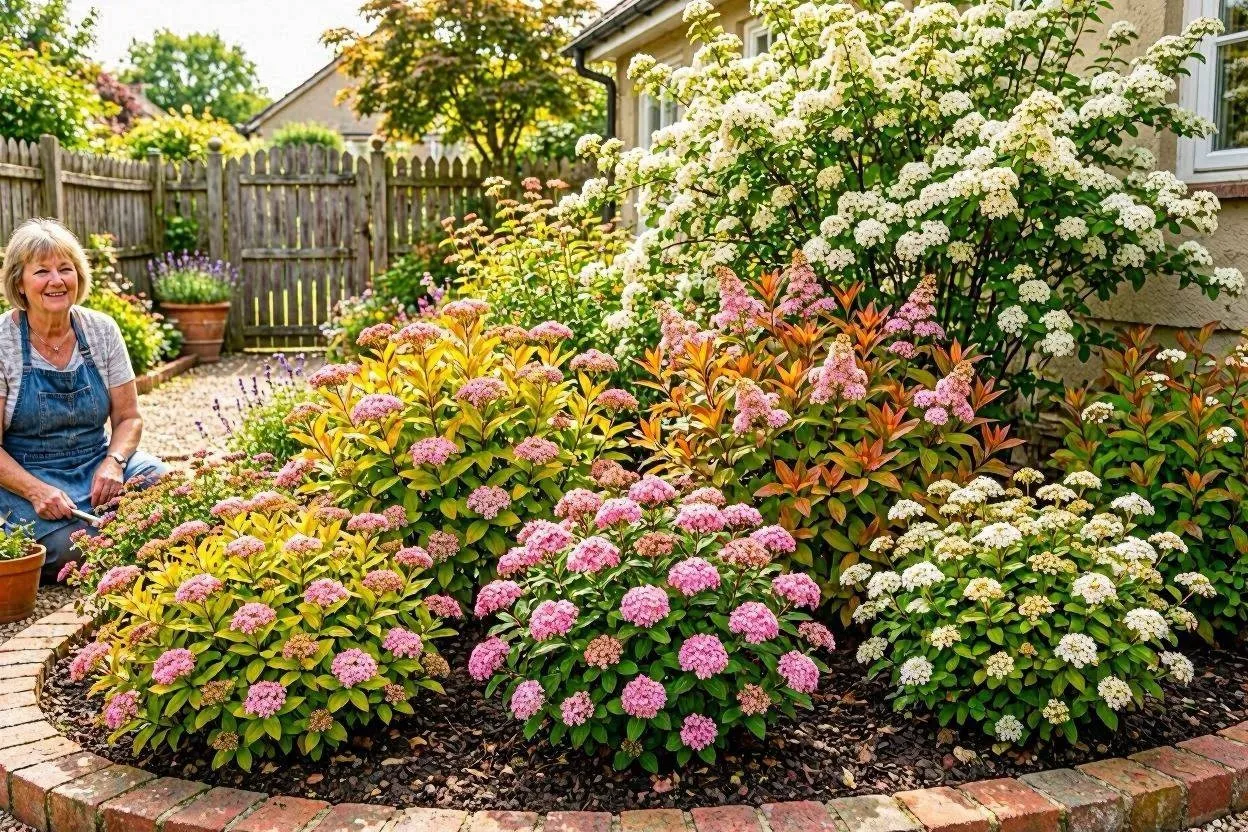
Spirea offers gardeners over 70 species and hundreds of cultivars, ranging from 2-foot (60 cm) dwarf mounds to 9-foot (2.7 m) arching hedges. The right spirea variety delivers 3 seasons of color from spring blooms through fall foliage, with almost no maintenance after establishment.
Spiraea belongs to the Rosaceae (rose) family and thrives in USDA Hardiness Zones 3–9. Varieties split into 2 major bloom groups: spring-bloomers on old wood, and summer-bloomers on new wood. Knowing which group your chosen cultivar belongs to determines your entire pruning schedule.
What Are the Main Spirea Variety Groups?
Spirea varieties fall into 4 primary species groups, each with distinct size, bloom time, and landscape use. Identifying the group tells you exactly how to care for the plant.
Japanese Spirea (Spiraea japonica) — Summer-Blooming
Japanese spirea produces flat-topped flower clusters in shades of pink, red, or white from June through August. Flowers form on new wood, so you prune these in late winter or early spring before growth begins. Cultivars include Little Princess, Magic Carpet, Goldmound, Goldflame, and the Double Play series (Doozie, Big Bang, Blue Kazoo, Candy Corn, Red).
Mature height ranges from 1–4 feet (30–120 cm). Most cultivars suit USDA Zones 4–9. Note: Several older Japanese spirea cultivars — Anthony Waterer and Little Princess — seed aggressively and are considered invasive in parts of the Mid-Atlantic and New England states. Choose labeled sterile cultivars such as Double Play Doozie if invasiveness is a concern in your region.
Bridalwreath Spirea (Spiraea x vanhouttei and Spiraea prunifolia) — Spring-Blooming
Bridalwreath varieties bloom in early to mid-spring on old wood from the previous season’s growth. Prune these immediately after flowers fade — never in fall or winter — or you remove next year’s flower buds. Cultivars include Bridal Wreath (Spiraea prunifolia), Firegold (Spiraea x vanhouttei), and the Renaissance Bridalwreath.
These shrubs reach 4–9 feet tall (1.2–2.7 m) with graceful arching branches and white cascading flowers. Firegold adds brilliant lemon-lime foliage for additional seasonal interest. For more guidance on pruning old-wood shrubs correctly, see the shrub pruning timing principles used across multiple deciduous species.
Birchleaf Spirea (Spiraea betulifolia) — Spring-Blooming with Outstanding Fall Color
Birchleaf spirea produces small white flowers in late spring and delivers some of the best fall foliage color of any spirea — turning from green to orange and finally to reddish-purple by November. Key cultivars include Tor, Tor Gold, Pink Sparkler, and Glow Girl.
Tor and Glow Girl are native to North America and non-invasive. Mature height stays compact at 2–4 feet (60–120 cm), making birchleaf varieties excellent choices for small gardens and mass plantings.
Top 8 Spirea Varieties Ranked by Landscape Use
These 8 cultivars appear most frequently in landscapes across Zones 4–9 and represent the full range of size, color, and bloom time available in the genus Spiraea.
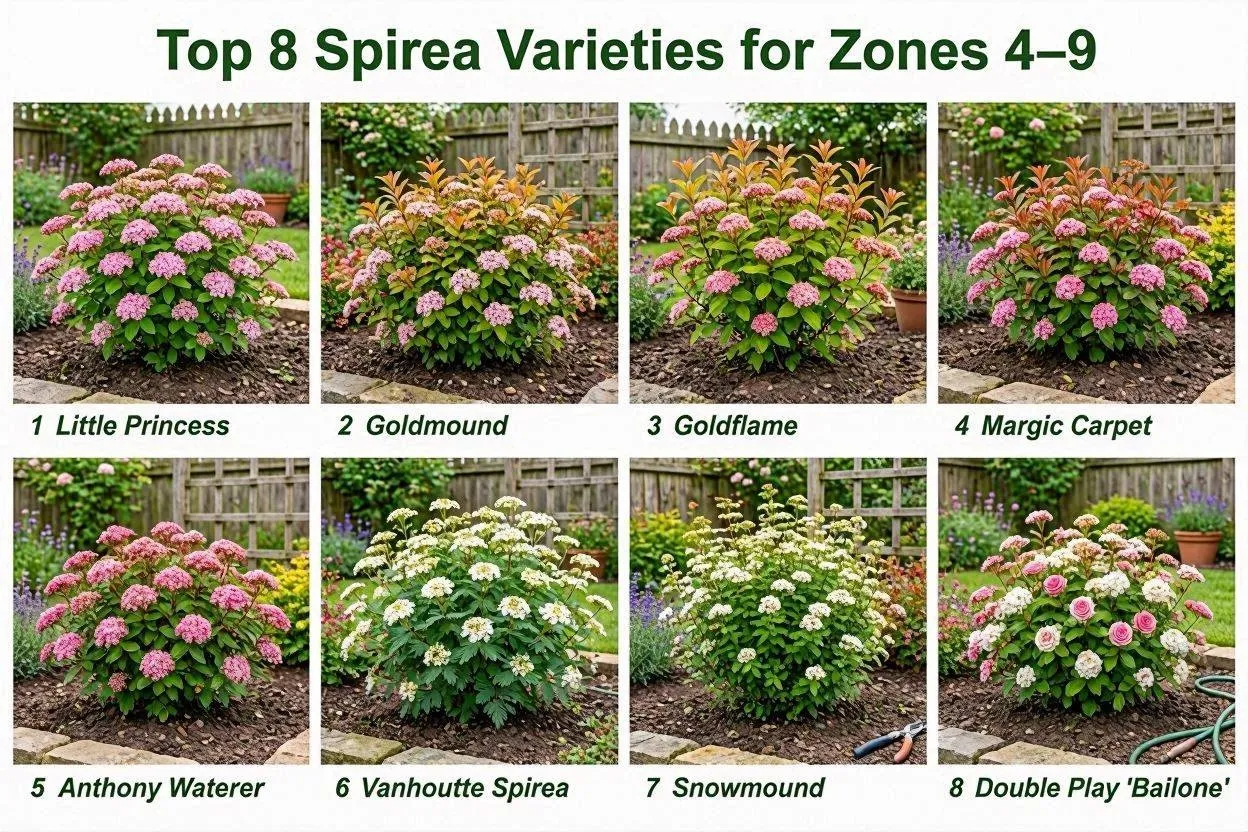
1. Little Princess — Best for Low Borders
Little Princess (Spiraea japonica ‘Little Princess’) grows 2 feet tall and 3 feet wide (60 × 90 cm). Flat-topped clusters of bright pink flowers cover the plant in early summer. The mint-green foliage stays tidy and compact throughout the season without aggressive pruning.
Plant Little Princess along the front edge of a foundation garden or as a low hedge bordering a walkway. Bloom on new wood — prune in late winter.
2. Magic Carpet — Best for Containers and Small Spaces
Magic Carpet (Spiraea japonica ‘Walbuma’) reaches 2 feet tall and 2 feet wide (60 × 60 cm). The primary draw is the foliage: new leaves emerge bright red, shift to yellow, and return to russet red in fall. Pink flowers appear in summer but take a secondary role to the color-changing leaves.
Magic Carpet performs well in large containers on patios or along mailbox plantings. Zones 3–8.
3. Goldflame — Best for Hot Climates
Goldflame (Spiraea x bumalda ‘Goldflame’) produces coppery-orange new foliage that ages to lime-green in summer, then returns to orange in fall. Pink-red flower clusters bloom in July and August. Mature size: 3–4 feet tall and 4–5 feet wide (90–120 cm × 120–150 cm). Goldflame tolerates heat and humidity better than most Japanese spirea cultivars and suits Zones 4–9.
4. Double Play Doozie — Best Reblooming Spirea
Double Play Doozie (Spiraea japonica ‘NCSX2’) is the only labeled sterile spirea cultivar, meaning it produces no viable seed and poses zero invasiveness risk. Red blooms appear continuously from late spring through first frost without deadheading. New spring foliage emerges red before settling to mid-green for summer. Mature size: 2–3 feet tall and 2–3 feet wide (60–90 cm). Zones 3–9.
5. Snowmound — Best White-Flowering Spirea
Snowmound (Spiraea nipponica ‘Snowmound’) produces gracefully arching branches completely covered in white flowers from mid-to-late spring. Mature height reaches 3–5 feet (90–150 cm) with a matching spread. Plant Snowmound at the back of a border or as a foundation anchor where the spring bloom creates maximum visual impact. Zones 4–8.
6. Bridal Wreath — Best for Hedges and Specimen Planting
Bridal Wreath (Spiraea prunifolia) features long arching branches that fill with white double flowers resembling baby’s breath in early to mid-spring. Mature height: 4–9 feet tall (1.2–2.7 m). Fall foliage turns orange, red, and yellow for a second season of interest.
Plant Bridal Wreath in groups of 3 for maximum impact along a woodland edge, or train a row into a flowering privacy hedge. Prune immediately after bloom — this variety blooms on old wood. Zones 3–8.
7. Goldmound — Best Foliage Spirea
Goldmound (Spiraea japonica ‘Goldmound’) maintains bright golden-yellow foliage from spring through summer, turning warm orange in fall. Pink flowers bloom in midsummer. Mature size: 2–3 feet tall and 3–4 feet wide (60–90 cm × 90–120 cm).
Goldmound works beautifully as a contrasting foliage plant next to deep-green evergreen shrubs such as boxwood or Japanese holly. For a complete guide to pairing spirea with other shrubs, the deciduous shrub care guide covers companion planting principles that apply across most mounding shrubs in the Rosaceae family.
8. Firegold Vanhoutte — Best Large Arching Spirea
Firegold (Spiraea x vanhouttei ‘Firegold’) combines the classic arching form of Vanhoutte spirea with brilliant lemon-lime spring foliage and cascading white flowers. Mature size: 4–6 feet tall and 5–7 feet wide (1.2–1.8 m × 1.5–2.1 m). Plant Firegold as a flowering hedge or mass planting on a slope for erosion control. Zones 4–8.
Spirea Variety Quick-Reference: Size, Bloom, and Difficulty
Use this table to select the right spirea based on available space, desired bloom time, and hardiness zone.
| Variety | Mature Height | Bloom Time | Zones | Best Use |
| Little Princess | 2 ft (60 cm) | Early summer | 4–9 | Border, low hedge |
| Magic Carpet | 2 ft (60 cm) | Summer | 3–8 | Container, pathway edge |
| Goldmound | 2–3 ft (60–90 cm) | Summer | 4–8 | Foundation, mixed border |
| Double Play Doozie | 2–3 ft (60–90 cm) | Late spring–fall | 3–9 | Perennial bed, mass planting |
| Goldflame | 3–4 ft (90–120 cm) | Summer | 4–9 | Border, warm-climate landscape |
| Snowmound | 3–5 ft (90–150 cm) | Mid–late spring | 4–8 | Back border, foundation |
| Bridal Wreath | 4–9 ft (1.2–2.7 m) | Early–mid spring | 3–8 | Hedge, specimen plant |
| Vanhoutte (Firegold) | 4–6 ft (1.2–1.8 m) | Spring | 4–8 | Privacy screen, arching hedge |
How to Choose Spirea Varieties by Garden Size
To choose the right spirea variety, match the plant’s mature width to the available bed space, not just the height.

Small Gardens Under 4 Feet (1.2 m) Wide
Dwarf cultivars such as Magic Carpet, Little Princess, and Double Play Candy Corn stay under 2 feet (60 cm) tall and wide. Place these in containers with a minimum 12-inch (30 cm) diameter, in narrow border strips, or along a pathway edge where they receive at least 6 hours of direct sunlight daily.
Medium Borders 4–8 Feet (1.2–2.4 m) Wide
Mid-sized cultivars such as Goldflame, Goldmound, and Snowmound fill 3–5-foot-wide (90–150 cm) spaces without crowding adjacent plants. Space medium spirea varieties 3–4 feet (90–120 cm) apart to allow air circulation and prevent powdery mildew.
Large Landscapes Over 8 Feet (2.4 m) Wide
Larger varieties including Bridal Wreath, Firegold, and Renaissance Bridalwreath suit open landscapes, sloped sites, and wide hedge rows. Plant these 5–6 feet (1.5–1.8 m) apart for a dense privacy screen that blooms fully across the entire hedge line by year 3.
How to Plant Spirea Varieties for Maximum Bloom
To plant spirea for maximum bloom, choose a site with at least 6 hours of direct sun daily and well-drained soil with a pH of 6.0–7.0.
Follow these 4 steps:
- Dig a hole twice the width of the root ball and exactly as deep.
- Set the plant so the top of the root ball sits level with or 1 inch (2.5 cm) above the surrounding soil.
- Backfill with native soil, water thoroughly, and apply 2–3 inches (5–7.5 cm) of organic mulch — keeping mulch 3 inches (7.5 cm) away from the stems.
- Water deeply twice weekly for the first 4 weeks, then transition to watering only during drought periods once established.
Plant spirea in spring or fall. Fall planting gives roots the longest possible establishment window before summer heat. For full seasonal preparation including mulching and pre-winter watering, the guide on how to winterize your garden covers the exact steps that apply to newly planted spirea in Zones 4–6.
How to Prune Spirea Varieties Without Losing Blooms
To prune spirea without losing blooms, identify whether your variety blooms on old wood or new wood before making any cut.
Old-wood bloomers — Bridal Wreath, Snowmound, Firegold, Grefsheim — produce flowers on stems grown the previous season. Prune old-wood types within 4 weeks after the last flower fades, typically May to June. Never prune in fall or winter or you remove the buds already set for next spring.
New-wood bloomers — all Spiraea japonica cultivars including Little Princess, Goldflame, Magic Carpet, Double Play series — form buds on current-season growth. Prune these in late February or early March before any growth begins. Cut back stems by one-third to one-half. Hard renovation pruning — removing up to two-thirds of the plant — rejuvenates overgrown spirea and produces more vigorous new shoots within a single season.
Which Spirea Varieties Are Invasive — and What to Plant Instead
Certain Spiraea japonica cultivars — specifically Anthony Waterer and older Little Princess selections — spread by fertile seed and have naturalized along roadsides in Connecticut, Pennsylvania, New Jersey, and neighboring states. These cultivars are not banned nationally but check your state’s noxious weed list before purchasing.
Plant these 3 non-invasive alternatives instead:
- Double Play Doozie — sterile cultivar, blooms spring through fall, Zones 3–9.
- Glow Girl Birchleaf Spirea (Spiraea betulifolia ‘Glow Girl’) — native North American species, white spring flowers, outstanding fall color, Zones 3–7.
- Tor Birchleaf Spirea (Spiraea betulifolia ‘Tor’) — compact 2–3-foot (60–90 cm) mound, white flowers in late spring, non-invasive, Zones 4–8.
Common Spirea Problems and How to Fix Them
Spirea resists most pests and diseases, but 3 problems appear consistently across all varieties in humid climates.
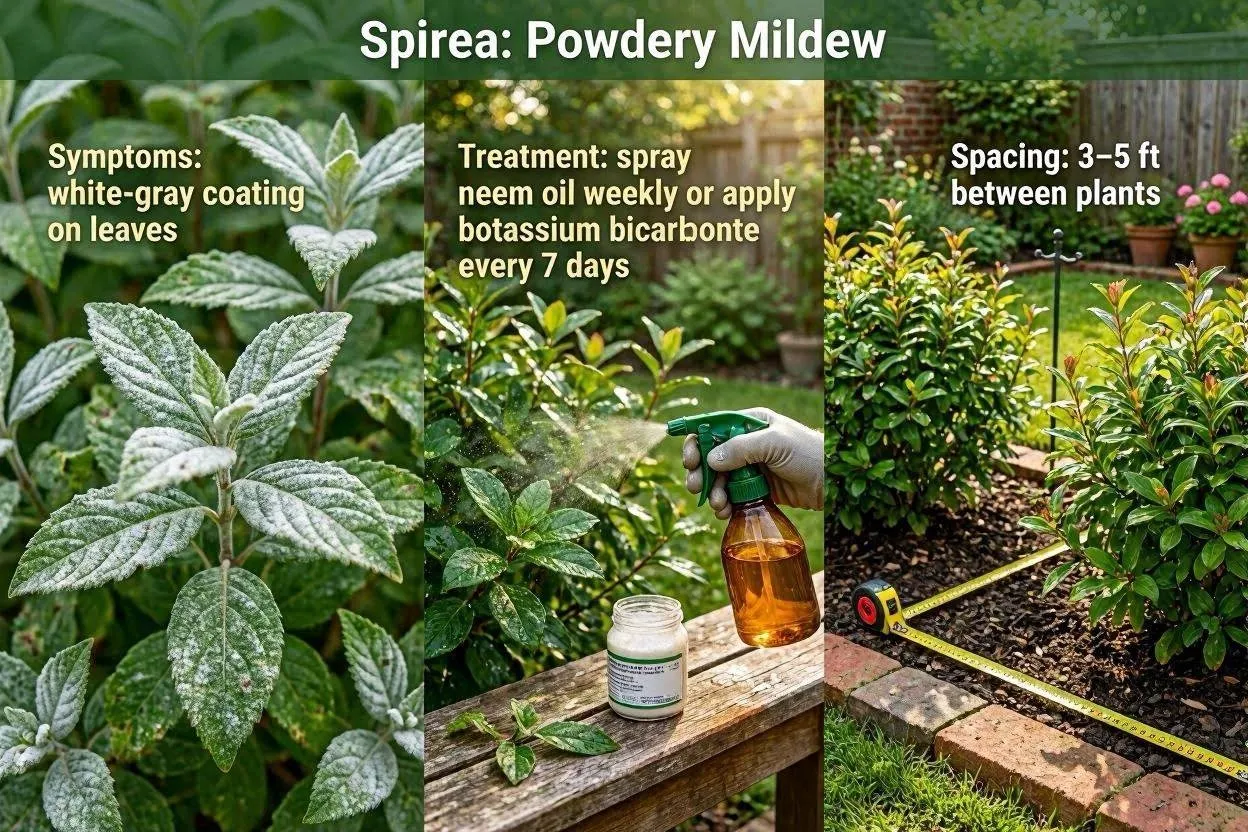
Powdery Mildew on Spirea Leaves
Powdery mildew appears as a white or gray coating on leaves in humid, low-airflow conditions. Treat with neem oil spray or a potassium bicarbonate fungicide applied to all leaf surfaces every 7 days until symptoms clear. Space plants at recommended distances — 3–5 feet (90–150 cm) apart — to maximize airflow and prevent recurrence.
Aphids on New Spirea Growth
Aphids cluster on soft new shoot tips in spring, causing distorted leaves and sticky honeydew residue. Spray affected stems directly with insecticidal soap solution — 2 tablespoons per gallon (30 mL per 3.8 L) of water — every 5 days for 3 applications. Natural predators including ladybugs and lacewings control light aphid pressure without intervention.
Spirea Failing to Bloom
Spirea that fails to bloom has 1 of 3 causes: too much shade (less than 4 hours of direct sun), pruning at the wrong time (removing flower buds from old-wood types), or over-fertilization with high-nitrogen products. Apply a balanced 10-10-10 fertilizer once per year in early spring and never fertilize after July 1. Nitrogen-heavy fertilizers push vegetative growth and suppress bloom.
Frequently Asked Questions About Spirea Varieties
Do all spirea varieties bloom at the same time?
No. Spring-blooming spirea varieties — Bridal Wreath, Snowmound, Firegold — flower from April to June on old wood. Summer-blooming varieties — all Spiraea japonica cultivars including Goldflame, Little Princess, and Magic Carpet — bloom from June through August on new wood. Some cultivars like Double Play Doozie bloom continuously from late spring through first frost.
Which spirea variety stays the smallest?
Magic Carpet and Double Play Candy Corn are the 2 smallest widely available spirea, both reaching only 1–2 feet tall and 1–2 feet wide (30–60 cm). Mini Gold Spirea and Butterscotch Baby also stay under 2 feet (60 cm) and suit containers or very narrow border strips.
Can spirea varieties grow in partial shade?
Yes. Spirea tolerates partial shade — 4 hours of direct sun — but flower production and foliage color both reduce in lower-light conditions. Full sun of 6 or more hours per day produces the densest bloom and most vivid foliage color. Varieties with colored foliage, such as Goldmound and Magic Carpet, lose their yellow or red tones faster in shade than green-leafed types.
Are spirea varieties deer resistant?
Yes. Rutgers University rates spirea as ‘Seldom Severely Damaged’ (Rating B) by deer, meaning deer generally avoid the plant. Spirea is not completely deer-proof — hungry deer in harsh winters may browse any shrub — but the genus performs well in deer-pressure landscapes compared to roses, hostas, and tulips.
How fast do spirea varieties grow each year?
Spirea grows at a moderate to fast rate. Most cultivars add 6–12 inches (15–30 cm) per year under good conditions. Dwarf varieties such as Magic Carpet and Little Princess grow more slowly, adding 4–6 inches (10–15 cm) annually. Larger varieties including Bridal Wreath and Firegold can add 12–18 inches (30–45 cm) per year in the first 3 years.
Final Thoughts: Picking the Right Spirea for Your Landscape
Spirea varieties give you one of the broadest selections available in the deciduous shrub category — from 1-foot (30 cm) dwarf containers to 9-foot (2.7 m) arching hedges, blooming from April through October depending on the cultivar. Match your selection to 3 factors: your USDA Zone (most spirea: Zones 3–9), available mature width, and whether you want spring or summer bloom.
Start with 1 of the 4 proven performers: Double Play Doozie for a non-invasive, reblooming shrub; Snowmound for white spring flowers; Goldflame for multi-season foliage; or Bridal Wreath for a dramatic flowering hedge. All 4 establish quickly, need minimal water after year 1, and attract bees and butterflies throughout the growing season.