
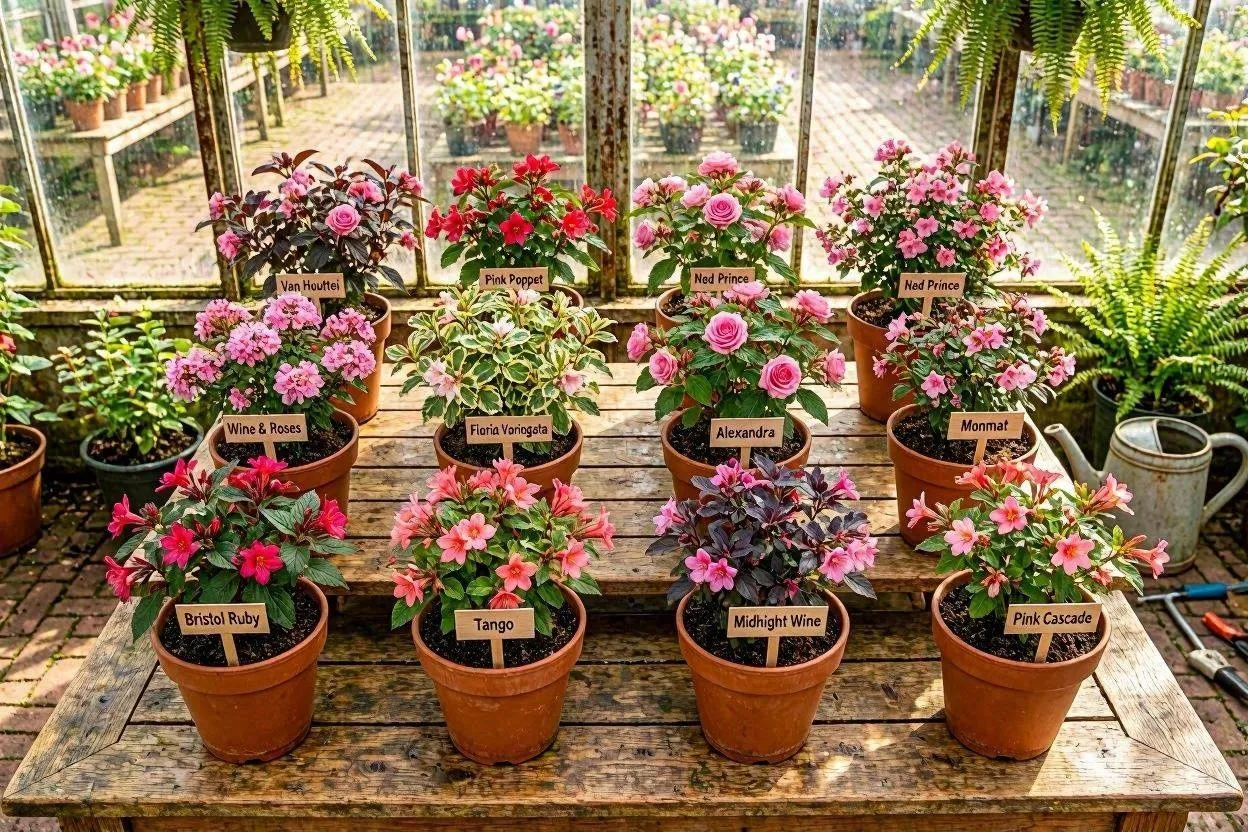
Weigela varieties fall into 4 main categories: red-flowered, pink-flowered, white-flowered, and foliage-first. The best variety for your garden depends on 3 factors: final size, USDA hardiness zone, and whether you need one flush of bloom or rebloom from May through September. This guide profiles 12 named cultivars with exact height, spread, zone rating, and pruning timing — so you pick the right plant the first time.
Weigela (Weigela florida) belongs to the honeysuckle family and is native to northern China, Korea, and Japan. Breeders have developed between 150 and 200 named cultivars from the original species. Hardy across USDA Zones 4 through 8, weigela grows in full sun to partial shade and attracts ruby-throated hummingbirds, bees, and butterflies through its trumpet-shaped flowers. Browse the full range of flowering shrub guides at Zoned Garden to find companion plants that pair well with weigela in every zone.
Weigela Varieties Quick-Reference Comparison Table
Use this table to match variety to garden need before reading the full profiles below.
| Variety | Height x Spread | Zones | Rebloom? |
| Bristol Ruby | 6 ft x 6 ft (1.8m x 1.8m) | 4-8 | Partial |
| Wine and Roses | 5 ft x 5 ft (1.5m x 1.5m) | 5-8 | Partial |
| Sonic Bloom Pink | 4-5 ft x 4-5 ft (1.2-1.5m) | 5-8 | Yes — full rebloom |
| Red Prince | 5-6 ft x 5-6 ft (1.5-1.8m) | 4-8 | Partial (August) |
| My Monet | 18-24 in x 18-24 in (45-60cm) | 4-6 | No |
| Candida | 5-6 ft x 5-6 ft (1.5-1.8m) | 5-8 | No |
| Golden Jackpot | 5-6 ft x 5-6 ft (1.5-1.8m) | 4-8 | No |
| Spilled Wine | 24-30 in x 36 in (60-75cm x 90cm) | 4-7 | No |
| Czechmark Sunny Side Up | 3-4 ft x 3-4 ft (90cm-1.2m) | 4-7 | No |
| Electric Love | 3-4 ft x 3-4 ft (90cm-1.2m) | 5-8 | No |
| Crimson Kisses | 2-3 ft x 2-3 ft (60-90cm) | 4-9 | Yes — periodic |
| Magical Fantasy | 4-5 ft x 4-5 ft (1.2-1.5m) | 4-8 | No |
Best Weigela Varieties with Red Flowers
Red-flowered weigela varieties deliver the highest visual impact from a distance and rank as the most effective hummingbird attractants of all cultivar groups.
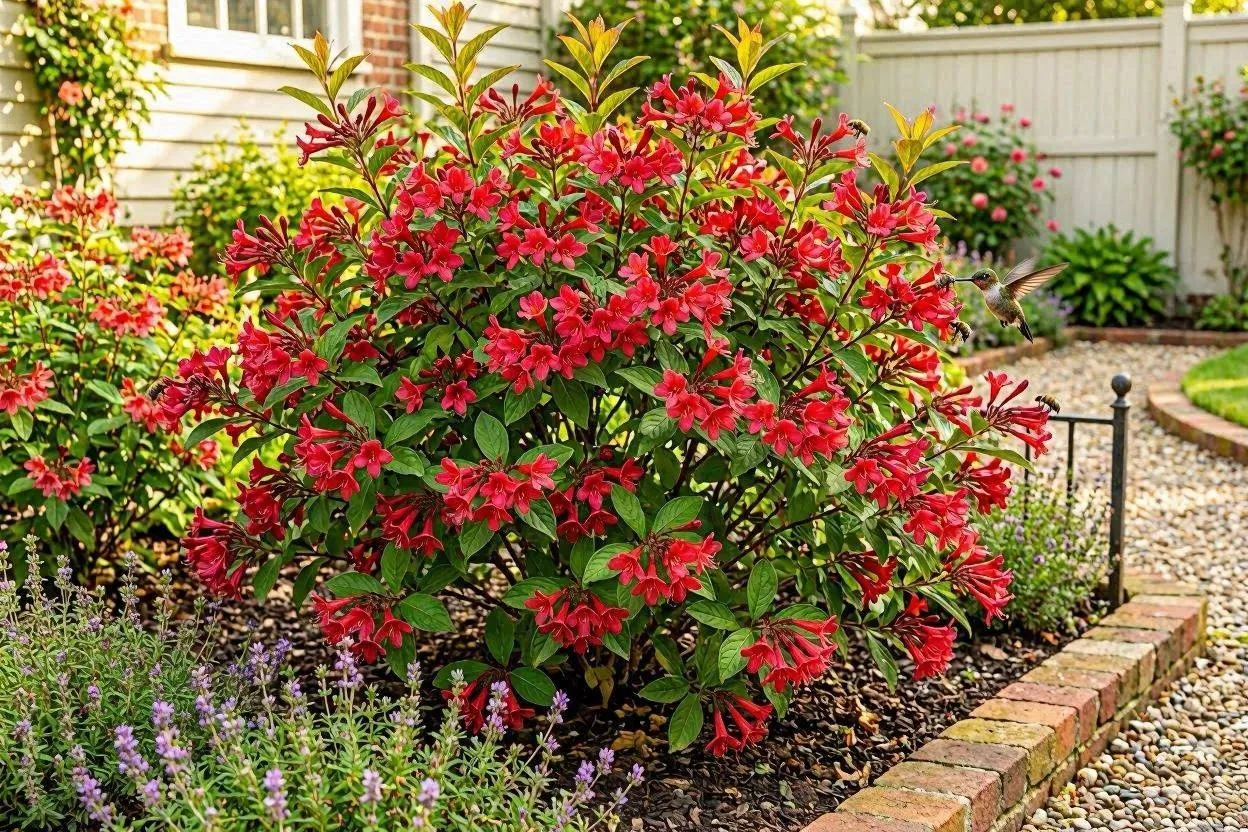
Bristol Ruby — the benchmark red-flowered weigela
Height x Spread: 6 ft x 6 ft (1.8m x 1.8m) | Zones 4-8 | Blooms on old wood
Bristol Ruby is the standard against which every red weigela gets measured. Developed at Bristol Nurseries in Bristol, Connecticut, and released in 1941, Bristol Ruby produces true ruby-red flowers — not the pink-red shade many competitors display. The flowers open in such density during May and June that the entire shrub appears to glow. At full size, Bristol Ruby reaches 6 ft (1.8m) in both height and spread within 5 to 7 years, so plant it only where that final footprint fits. Bristol Ruby blooms on old wood. Prune it immediately after the first flush ends in June — never in autumn — or you remove next year’s flower buds.
Best for: Cottage gardens, wildlife borders, informal hedging, and any garden where you need a reliable red-flowering shrub visible from 30 ft (9m) away.
Red Prince — the cold-climate red weigela
Height x Spread: 5-6 ft x 5-6 ft (1.5-1.8m) | Zones 4-8 | Partial rebloom in August
Iowa State University introduced Red Prince as a hardier alternative to Bristol Ruby for northern gardens. The flowers are a clean, true red with no pink undertone — an uncommon quality in any deciduous shrub. Red Prince produces a modest second flush in August without deadheading, giving it a longer season than most once-blooming weigela varieties. It is reliably hardy to Zone 4 and has proven itself in Midwestern gardens where winters reach -30°F (-34°C). Give Red Prince a sunny position and prune immediately after the main June flush to protect the August rebloom.
Crimson Kisses — compact with genuine rebloom
Height x Spread: 2-3 ft x 2-3 ft (60-90cm) | Zones 4-9 | Periodic rebloom all season
Crimson Kisses produces lipstick-red flowers in spring, then reblooms periodically through summer without deadheading. The compact size — 2 to 3 ft (60-90cm) in both dimensions — makes Crimson Kisses one of the few red weigela varieties suited to containers and small borders. The wide zone range (4 through 9) extends its use into warmer southern gardens where Bristol Ruby and Red Prince reach their heat tolerance limits. Grow Crimson Kisses in full sun for the densest rebloom performance.
Best Weigela Varieties with Purple or Dark Foliage
Dark-foliage weigela varieties deliver 7 months of visual interest — flowers last 3 to 4 weeks, but the burgundy or purple leaves remain ornamental from April through October.
Wine and Roses — most photographed weigela since 2000
Height x Spread: 5 ft x 5 ft (1.5m x 1.5m) | Zones 5-8 | Blooms on old wood
Wine and Roses — sold as ‘Alexandra’ in Europe — pairs near-black burgundy foliage with hot-pink flowers in May and June. The foliage color holds better through summer than most purple-leaf competitors, which often fade to green by August. Wine and Roses reaches 5 ft (1.5m) in both dimensions, making it a more manageable size for medium gardens than Bristol Ruby. Pair Wine and Roses with silver-leaf shrubs or lime-green ornamental grasses for strong seasonal contrast from spring through first frost. Prune immediately after flowering in June to maintain compact shape and protect the following year’s buds.
Spilled Wine — dwarf dark-foliage variety
Height x Spread: 24-30 in x 36 in (60-75cm x 90cm) | Zones 4-7 | Blooms on old wood
Spilled Wine delivers the same wine-dark foliage and pink-red flower combination as Wine and Roses in a container-sized package. At 24 to 30 in (60-75cm) tall with a spreading 36 in (90cm) habit, Spilled Wine works as an edging shrub, a container specimen, or a front-of-border accent. The spreading, mounding habit means Spilled Wine covers ground effectively when massed in groups of 3 or 5. Use Spilled Wine where Wine and Roses would overwhelm the space. Pair Spilled Wine with the
low-maintenance shrubs in your zone for a border that requires minimal intervention after establishment.
Electric Love — dark bronze foliage with red flowers
Height x Spread: 3-4 ft x 3-4 ft (90cm-1.2m) | Zones 5-8 | Blooms on old wood
Electric Love (Weigela x ‘ZR1’) produces carmine-red summer blooms against bronzy-purple foliage that holds its color all growing season. The contrast between the dark leaves and bright red flowers is more dramatic than Wine and Roses because the foliage has a bronze warmth that makes the red flowers read as vivid rather than clashing. Electric Love reaches 3 to 4 ft (90cm-1.2m) in both directions — a manageable mid-border size that doesn’t require annual intervention to stay in bounds.
Best Weigela Varieties with Variegated or Gold Foliage
Variegated and gold-foliage weigela varieties brighten shaded positions where flowering shrubs typically struggle and add year-round interest that pure-green types cannot deliver.
My Monet — best dwarf weigela for containers and borders
Height x Spread: 18-24 in x 18-24 in (45-60cm) | Zones 4-6 | Blooms on old wood
My Monet is the definitive dwarf variegated weigela. The creamy-white and green foliage develops strawberry-pink margins in full sun — giving the plant 3 distinct tones simultaneously. At 18 to 24 in (45-60cm) in both dimensions, My Monet fits in a 12 to 14 in (30-35cm) container and stays under windows without needing annual cutbacks. The My Monet series includes 3 additional cultivars: My Monet Purple Effect (green, purple, and white foliage with mauve-pink blooms), My Monet Sunset (golden leaves that turn fiery red in autumn), and the original cream-margined form. My Monet performs best in Zones 4 through 6 — it loses heat tolerance above Zone 6 and benefits from afternoon shade in Zone 6 summers.
Golden Jackpot — gold foliage with dark rose flowers
Height x Spread: 5-6 ft x 5-6 ft (1.5-1.8m) | Zones 4-8 | Blooms on old wood
Golden Jackpot produces brilliant yellow-gold foliage from spring through autumn, then dark rose flowers open across the canopy in May and June. The color contrast between the gold leaves and rose flowers is one of the most striking combinations in the weigela genus. Golden Jackpot reaches 5 to 6 ft (1.5-1.8m) in both dimensions within 5 to 6 years — similar to Wine and Roses in scale but with opposite foliage tone. Golden Jackpot works in both full sun and partial shade, though foliage color intensifies in full sun positions.
Best Weigela Varieties with White Flowers
White-flowering weigela varieties fill a specific gap in the shrub border — they reflect low light effectively in partially shaded positions and provide neutral contrast against darker companion plants.
Candida — the definitive white weigela
Height x Spread: 5-6 ft x 5-6 ft (1.5-1.8m) | Zones 5-8 | Once-blooming
Candida flowers open pale pink in bud and expand to pure white — an elegant two-stage sequence that extends the visual interest of the bloom period by 5 to 7 days. The pure white flowers reflect light effectively in woodland border situations where darker flowers recede into shadow. Candida reaches the same scale as Bristol Ruby — 5 to 6 ft (1.5-1.8m) — and works as a backdrop for dark-colored flowering perennials like dark-leaved heucheras or purple salvia. Candida is a once-bloomer only; prune immediately after June flowering and expect no rebloom.
Czechmark Sunny Side Up — white with yellow center
Height x Spread: 3-4 ft x 3-4 ft (90cm-1.2m) | Zones 4-7 | Blooms on old wood
Czechmark Sunny Side Up produces white flowers with a distinctive yellow center — a two-tone combination unique among white weigela varieties. The yellow eye gives the flower a warm quality that pure-white cultivars lack. At 3 to 4 ft (90cm-1.2m) in both dimensions, Czechmark Sunny Side Up sits between the dwarf My Monet and the full-sized Candida in scale. It suits mid-border positions and foundation plantings where a compact, clean-flowering shrub adds spring interest without overwhelming adjacent plants.
Best Reblooming Weigela Varieties
Only Sonic Bloom produces full, reliable rebloom from May through September without deadheading. All other weigela varieties produce either a single flush on old wood or a modest, irregular second flush — not a true second season of bloom.
Sonic Bloom Pink — the only true rebloomer
Height x Spread: 4-5 ft x 4-5 ft (1.2-1.5m) | Zones 5-8 | Full rebloom May through September
Sonic Bloom Pink is the standard-bearer for reblooming weigela. After the main May-June flush — which is as dense as any once-blooming variety — Sonic Bloom Pink continues producing trumpet-shaped flowers on new growth through the entire growing season without intervention. No deadheading is required. No special fertilizer triggers the rebloom. The plant simply continues. At 4 to 5 ft (1.2-1.5m) in both dimensions, Sonic Bloom Pink fits mid-border positions comfortably. The hot-pink flowers are an exceptionally effective hummingbird attractant because the extended bloom window means the plant stays relevant for the full migration season. Prune Sonic Bloom Pink lightly in late winter before new growth starts — unlike standard old-wood bloomers, cutting Sonic Bloom in late winter removes no viable buds because the new-wood rebloom cycle regenerates immediately.
To get the most from Sonic Bloom Pink, learn
how to prune flowering shrubs for both old-wood and new-wood bloomers — the technique differs significantly between the 2 types.
How to Choose Weigela Varieties by Garden Size
To match weigela variety to garden size, measure the available width before selecting a cultivar — weigela varieties range from 18 in (45cm) to 6 ft (1.8m) at full spread.

For small gardens and containers under 4 ft (1.2m)
3 varieties suit tight spaces: My Monet (18-24 in / 45-60cm), Spilled Wine (24-30 in / 60-75cm), and Crimson Kisses (24-36 in / 60-90cm). All 3 stay under 3 ft (90cm) at maturity and maintain their compact form without renovation pruning. My Monet and Spilled Wine are the 2 best container choices because both hold their foliage interest even when not in flower.
For medium gardens between 4-8 ft (1.2-2.4m)
5 varieties fit medium borders: Sonic Bloom Pink, Wine and Roses, Electric Love, Czechmark Sunny Side Up, and Magical Fantasy. All 5 reach 3 to 5 ft (90cm-1.5m) in both dimensions and suit mid-border positions where they have room to establish without overpowering adjacent plants within 3 years.
For large gardens with 6+ ft (1.8m+) of available space
4 varieties deliver large-scale impact: Bristol Ruby, Red Prince, Candida, and Golden Jackpot. Each reaches 5 to 6 ft (1.5-1.8m) in both directions within 5 to 7 years. Plant these as specimens, back-of-border anchors, or informal screens — but allow the full mature spread before planting any neighbor within 3 ft (90cm) of the center.
Weigela Varieties by USDA Hardiness Zone
Weigela varieties perform across USDA Zones 4 through 9, but not every cultivar works in every zone.
- Zones 4-5 (coldest): Bristol Ruby, Red Prince, My Monet, Golden Jackpot, Crimson Kisses, Spilled Wine, Czechmark Sunny Side Up. All survive -30°F (-34°C) without winter protection.
- Zones 5-6 (cool temperate): All 12 varieties in this guide perform well. Wine and Roses, Sonic Bloom, and Candida reach their best performance in Zone 5-6 conditions.
- Zones 7-8 (warm temperate): Provide afternoon shade for all variegated varieties including My Monet and Golden Jackpot. Full-sun positions in Zone 8 can bleach variegated foliage by midsummer.
- Zone 9 (hot/warm): Crimson Kisses is the most heat-tolerant cultivar, rated to Zone 9. All other varieties in this guide top out at Zone 8 — check zone tolerance before planting in the Deep South or Southwest.
How to Plant and Care for Weigela Varieties
To plant weigela correctly, choose a position with 6 hours of direct sun daily and well-drained soil. Weigela tolerates partial shade but produces fewer flowers in positions with under 4 hours of direct sun.

Soil and planting depth
Weigela grows in any well-drained soil with a pH of 5.5 to 7.0. Dig the planting hole 2 times the width of the root ball and the same depth — no deeper. Set the crown at or just above the surrounding soil level. Backfill with native soil; no amendments are needed in average garden soil. Apply 2-3 in (5-8cm) of organic mulch in a ring extending to the drip line, keeping mulch 3 in (8cm) clear of the main stem.
Watering schedule
Water newly planted weigela twice per week for the first 8 weeks. Established weigela — after the first full growing season — is drought tolerant and needs supplemental watering only during dry periods exceeding 3 consecutive weeks. Overwatering established weigela causes root rot faster than drought does; let the top 2 in (5cm) of soil dry between waterings once the plant is established.
Fertilizing
Apply a balanced slow-release granular fertilizer (10-10-10) once in early spring as new growth emerges. Established weigela in reasonable garden soil needs no additional feeding through the season. Avoid high-nitrogen feeds that push soft leafy growth at the expense of flower buds.
When and How to Prune Weigela Varieties
Prune weigela immediately after the first flush of flowers ends in June. Weigela blooms on old wood — cutting in autumn or early spring removes the buds that formed on last year’s growth, resulting in zero flowers the following season.
- Remove up to one-third of the oldest stems at ground level each year after flowering.
- Cut all remaining stems back by one-third of their length to shape the plant.
- Do not prune after July — new growth after midsummer will not harden before winter in Zones 4-6.
- For Sonic Bloom specifically: prune lightly in late winter before growth starts, since Sonic Bloom reblooms on new wood and tolerates winter pruning that would destroy standard weigela flowering.
Weigela Varieties FAQs
Do all weigela varieties bloom only once per year?
No. Most weigela varieties bloom once on old wood in May and June. Sonic Bloom Pink produces full, reliable rebloom from May through September. Red Prince and Crimson Kisses produce a modest second flush in late summer without deadheading, but neither matches the continuous output of Sonic Bloom.
Which weigela variety stays the smallest?
My Monet is the smallest named weigela variety at 18 to 24 in (45-60cm) in both height and spread. Spilled Wine reaches 24 to 30 in (60-75cm) tall and is the next smallest option with a wider 36 in (90cm) spread.
Can weigela varieties grow in shade?
Yes, weigela tolerates partial shade with 3 to 4 hours of direct sun daily. Flower production decreases by roughly 50% in partial shade compared to full sun. Foliage color on variegated varieties like My Monet fades in low light — variegated types hold color best in 6+ hours of direct sun.
Are weigela varieties deer resistant?
Yes, weigela is generally deer resistant across all 12 varieties in this guide. Deer consistently pass over weigela in favor of more palatable shrubs. During severe winter food shortages in Zones 4-5, deer may browse branch tips, but this level of damage is minor and the plant recovers quickly in spring.
When is the best time to plant weigela varieties?
Spring or fall are the 2 best planting windows. Spring planting — once soil reaches 50°F (10°C) — allows roots to establish before summer heat. Fall planting in Zones 5-8 works well with 6 or more weeks before first hard frost. Avoid planting in midsummer in Zones 7-9 where heat stress can prevent root establishment in the first season.
Which Weigela Variety Should You Grow?
Pick Bristol Ruby if you need a large, proven red-flowering shrub for a Zone 4-8 garden with space for a 6 ft (1.8m) specimen. Pick Wine and Roses if foliage interest matters as much as flowers. Pick Sonic Bloom Pink if you want color from May through September without deadheading. Pick My Monet if your garden is small or you need a container-sized plant that stays ornamental all season.
All 12 weigela varieties in this guide thrive in the conditions covered across Zoned Garden’s low-maintenance shrubs resources — each one zone-matched and tested for real-world garden performance. Select your variety, confirm your USDA zone, and plant in spring or fall for the fastest establishment.