
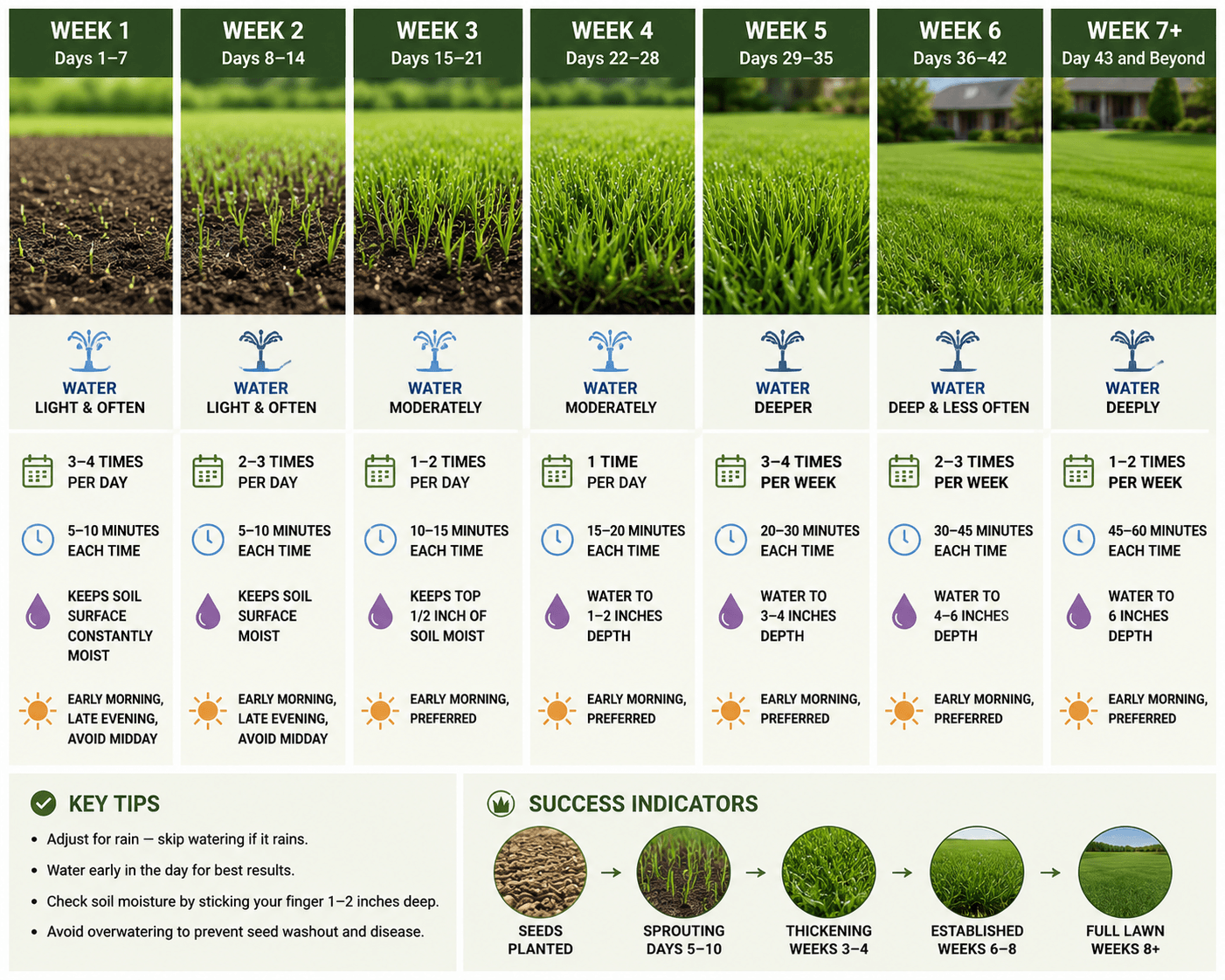
Quick Answer: Water new grass seed 2–3 times daily for 5–10 minutes during germination (weeks 1–2). Cut to once daily in weeks 3–4. Shift to deep watering every other day in weeks 5–6. After week 8, water 1–2 times per week with 1 inch (25 mm) of water total. Never let the seedbed dry out during germination.
Watering is where most new lawn projects succeed or fail. Get the seedbed dry once during germination and the seeds die — no second chance. Water too heavily and seeds wash away or rot before sprouting. The margin for error is narrow in the first two weeks.
This guide gives you the exact week-by-week watering schedule from day one through your first mow. It covers cool-season and warm-season grasses, different soil types, and the specific signs that tell you when you are overwatering or underwatering.
Step 1: Water the Soil Before You Plant
Moisten the soil 2–3 days before seeding. The goal is to soak the ground 6–8 inches (15–20 cm) deep. Dry soil below the surface will pull moisture away from seeds the moment they make contact.
Screwdriver test: Push a flat-head screwdriver into the ground. It should slide in to 6 inches with light pressure. If it stops at 3–4 inches, water more and test again the next day.
Do not plant on soggy, muddy soil. Seed-to-soil contact is critical for germination. Muddy soil causes seeds to clump, sink too deep, or wash away with the first watering. Moist and firm is the target, not wet and soft.
Grass Seed Watering Schedule: Week by Week
| Stage | Frequency | Duration per Session | Depth Goal | Goal |
| Pre-seeding | Once, 2–3 days before | Until 6–8 in. deep | 6–8 in. (15–20 cm) | Moist seedbed |
| Weeks 1–2 (Germination) | 2–3x daily | 5–10 minutes | Top 1–1.5 in. (2.5–4 cm) | Seed stays moist |
| Weeks 3–4 (Early sprouts) | 1–2x daily | 15–20 minutes | 2–3 in. (5–7 cm) | Shallow root growth |
| Weeks 5–6 (Establishment) | Every other day | 30–40 minutes | 4–6 in. (10–15 cm) | Deeper root training |
| Weeks 7–8 (Near mowing) | 2–3x per week | 30–40 minutes | 6 in. (15 cm) | Root depth |
| Week 9+ (Mature lawn) | 1–2x per week | As needed | 6–8 in. (15–20 cm) | 1 in. water per week |
Weeks 1–2: Germination Phase — Most Critical Period
Water 2–3 times daily for 5–10 minutes each session. The top 1–1.5 inches (2.5–4 cm) of soil must stay consistently moist. Seeds that dry out during germination do not recover. One missed watering on a hot afternoon can kill seeds already mid-germination.
Best times to water: Early morning (6–10 AM), midday if the surface looks dry, and late afternoon (4–6 PM). Do not water in the evening. Moisture sitting on soil overnight encourages fungal disease and seed rot.
Use a mist or oscillating sprinkler on the lowest pressure setting. High-pressure water dislodges seeds and creates bare patches. The soil surface should look dark and damp for at least 1–2 hours after each session.
Weeks 3–4: First Sprouts Visible
Most seeds have germinated by week 3. Cut watering to once daily, with a second session added on hot or windy days. Increase duration to 15–20 minutes per session so water penetrates 2–3 inches (5–7 cm). Seedlings have shallow roots at this stage and cannot handle drought stress yet.
Do not walk on the lawn in weeks 3 and 4. Seedling roots are fragile. Foot traffic compacts wet soil and crushes emerging blades.
Weeks 5–6: Root Training Begins
Shift to deep watering every other day. Soak the area for 30–40 minutes per session, pushing moisture 4–6 inches (10–15 cm) deep. This forces roots to follow moisture downward instead of staying at the surface. Shallow roots create a lawn that cannot survive drought or heat.
If a session produces puddles or runoff, reduce duration by 10 minutes and add a second cycle separated by 30 minutes. This cycle-and-soak method allows water to absorb without oversaturating.
Weeks 7–8: Transition to Mature Lawn Schedule
Water 2–3 times per week with 30–40 minute sessions. The lawn is close to first mowing height. Watering every other day or less builds root resilience. Continue to check soil moisture 3–4 inches (8–10 cm) deep before each session.
Week 9 and Beyond: Established Lawn Schedule
Water 1–2 times per week, applying 1 inch (25 mm) total per week from irrigation or rainfall combined. Deep, infrequent watering is the long-term standard. Measure output by placing an empty tuna can in the sprinkler zone — when it collects 1 inch of water, stop.
Cool-Season vs. Warm-Season Grass: Schedule Differences
The 2 categories of turfgrass have different germination windows, soil temperature requirements, and watering needs. Using the wrong schedule for your grass type is one of the most common causes of failed lawn establishment.
| Grass Type | Ideal Soil Temp | Germination Time | Best Planting Season | Watering Notes |
| Perennial Ryegrass | 50–65°F (10–18°C) | 5–10 days | Early fall or spring | Fastest germinator; monitor closely |
| Tall Fescue | 50–65°F (10–18°C) | 7–14 days | Early fall or spring | Drought-tolerant once established |
| Kentucky Bluegrass | 50–65°F (10–18°C) | 14–30 days | Late summer to early fall | Needs longest germination moisture |
| Fine Fescue | 50–65°F (10–18°C) | 10–14 days | Early fall | Tolerates shade; less water needed |
| Bermuda Grass | 65–75°F (18–24°C) | 10–30 days | Late spring to early summer | Needs heat; water daily in early weeks |
| Zoysia Grass | 65–75°F (18–24°C) | 14–21 days | Late spring | Slow grower; consistent moisture critical |
| Centipede Grass | 65–75°F (18–24°C) | 14–21 days | Late spring to early summer | Low maintenance; avoid overwatering |
Cool-Season Grass Watering (Zones 3–7)
Cool-season grasses germinate best when soil temperature sits between 50–65°F (10–18°C). Plant in early fall (late August to September) or early spring. Fall is the better window because cooler temperatures reduce evaporation and weeds compete less aggressively.
Perennial ryegrass sprouts in 5–10 days and gives you visible progress quickly. Kentucky bluegrass takes 14–30 days — do not reseed or give up before the full window has passed. Maintain 2–3 daily waterings for the entire germination period.
Warm-Season Grass Watering (Zones 7–10)
Warm-season grasses need soil at 65–75°F (18–24°C) to germinate. Plant in late spring through early summer when soil has warmed consistently. Bermuda grass germinates in 10–30 days under ideal conditions. Zoysia takes 14–21 days but establishes slowly — expect 2–3 growing seasons before full density.
Water warm-season grass 2–3 times daily during germination the same as cool-season types. The difference is heat: on days above 90°F (32°C), add a 4th short session at midday to prevent surface drying.
Adjust Your Schedule for 4 Soil Types
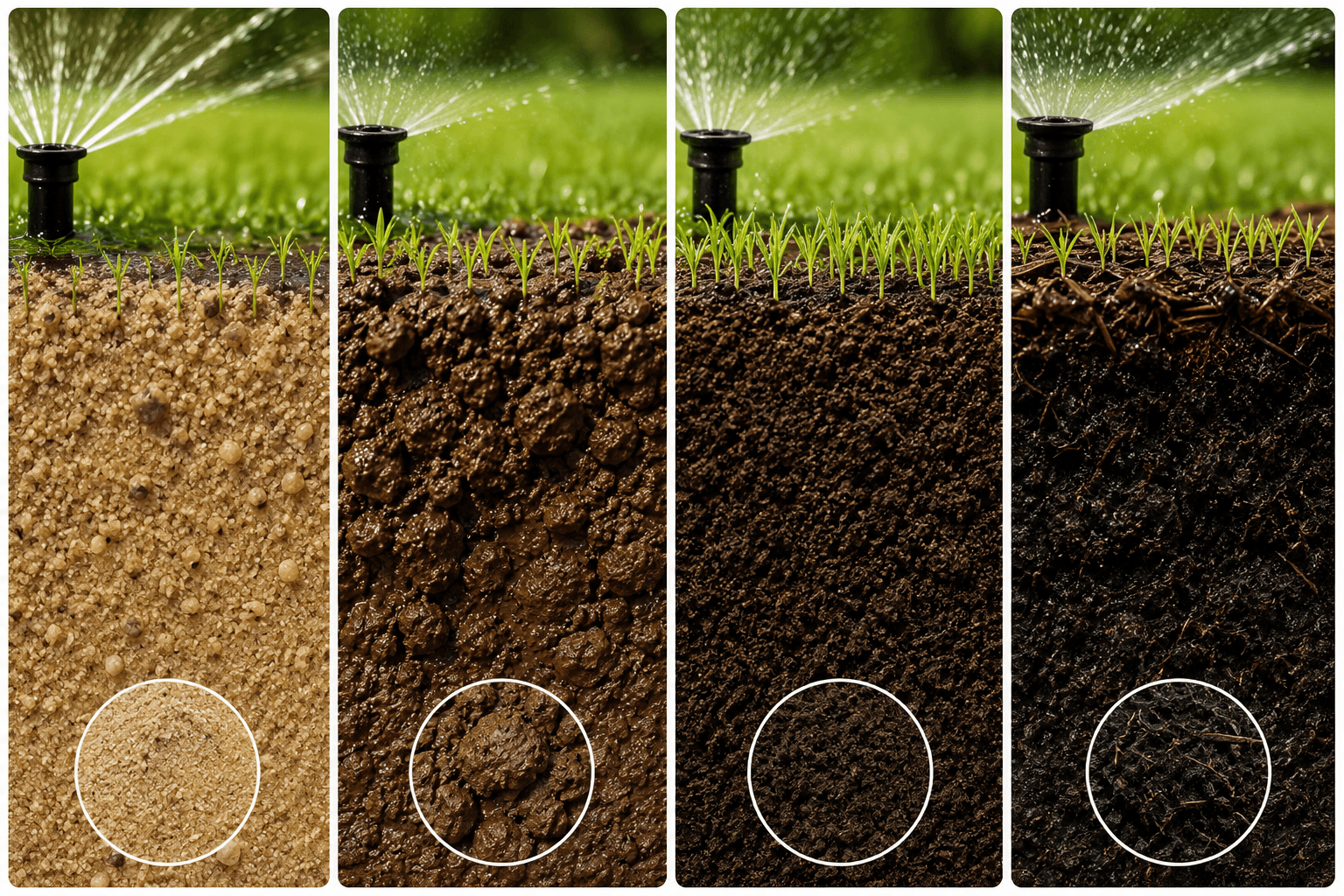
Soil type changes how quickly water drains and how long moisture stays available to seeds. The same watering duration produces different results depending on what is under the seedbed.
Sandy Soil
Water more frequently. Sandy soil drains water within hours. Increase daily sessions to 3–4 during germination. Shorten each session to 5–7 minutes to avoid runoff. Add a thin layer of straw mulch (one layer thick, not packed) to reduce evaporation between sessions.
Clay Soil
Water less frequently, more gently. Clay holds moisture for days. Overwatering clay soil causes waterlogging, oxygen loss, and seed rot. Reduce to 2 sessions daily during germination. Check that no puddles remain 30 minutes after watering. If puddles persist, the soil is compacted — aerate before reseeding.
Loam Soil
Loam is the ideal lawn soil — balanced drainage and moisture retention. The standard schedule (2–3 times daily for 5–10 minutes) applies without adjustment. Loam supports the fastest, most even germination.
Silty or Peat-Rich Soil
Silty soils retain moisture well but can become compacted under heavy watering. Monitor for surface crusting, which blocks seedling emergence. If a crust forms, use a mist setting to break the surface without further compacting it. Peat-heavy soils stay wet: reduce session frequency by one per day compared to the standard schedule.
Best Time of Day to Water Grass Seed
Water between 6 AM and 10 AM for the primary session. Morning watering allows moisture to absorb into the soil before peak evaporation hours. Any water on new seedlings dries naturally by midday, reducing fungal risk.
The second session belongs in late afternoon, between 4 PM and 6 PM. Soil surface that dried during the afternoon gets re-moistened before overnight temperatures drop. Avoid watering after 7 PM. Moisture sitting on soil all night creates the conditions for damping-off (a fungal seedling disease that kills young grass before it establishes).
Midday watering is acceptable for new seed. Unlike an established lawn, where midday watering wastes water to evaporation, new seed needs the surface to stay moist. On days above 85°F (29°C) or with strong wind, add a midday session without hesitation.
Best Sprinkler for New Grass Seed
Equipment choice affects how evenly water lands and whether seeds stay in place. Use the wrong sprinkler and you create bare patches from the first day.
- Oscillating sprinkler: Best overall choice for new seed. Distributes water in a fan pattern with light, even coverage. Move it every 2–3 days to cover the full seeded area.
- Mist nozzle on a hose: Best for small patches or bare spot repairs. Full control over direction and pressure. Mist setting keeps seeds in place and soil surface evenly damp.
- In-ground sprinkler system: Reliable and consistent for large lawns. Set timers for early morning and late afternoon. Check output with a tuna can test: place 3–4 cans across the lawn and measure collected water after one cycle.
- Impact sprinklers: Avoid for new seed. The hard stream can dislodge seeds and create uneven wet and dry zones.
Water pressure matters. High pressure washes seeds into clumps and leaves bare spots. If using a hose, open the valve halfway. The ideal flow produces large, soft drops — not a strong stream and not a fine fog that evaporates before reaching the soil.
6 Signs You Are Overwatering New Grass Seed
Overwatering is the most common mistake homeowners make after seeding. It causes seed rot, fungal disease, and shallow root development. Watch for these 6 signs.
- Puddles or standing water after watering: Water is being applied faster than the soil can absorb it. Reduce each session by 3–5 minutes and add a 20-minute gap between back-to-back sessions.
- Soggy, spongy soil surface: Press the soil lightly with one finger. Wet soil that squishes or holds a depression is oversaturated. Skip the next watering session and recheck before resuming.
- Mushrooms or algae on the soil: Fungal growth appears when surface moisture stays consistently high. Reduce frequency by one session daily and improve airflow if possible.
- Yellow or pale seedlings: Yellowing in new grass that has already sprouted signals waterlogged roots and oxygen starvation. Let the surface dry before watering again.
- Seeds washing into lines or piles: Visible seed movement after watering means pressure is too high or water volume is too great. Switch to a mist setting and reduce session duration.
- Slow or patchy germination despite regular watering: Seeds sitting in constantly wet soil rot instead of germinating. Reduce to 2 sessions daily and check that drainage is adequate across the entire seeded area.
5 Signs You Are Underwatering New Grass Seed
Underwatering is less forgiving than overwatering during germination. Seeds that fully dry out mid-germination die. Seedlings that dry out in weeks 3–4 may survive but become patchy and thin.
- Dry, light-colored soil surface: Healthy germinating seedbed stays dark and damp. A pale, dusty surface means the top layer has dried completely. Water immediately and add an extra session that day.
- No germination after the expected window: Perennial ryegrass should show green in 5–10 days. If nothing appears by day 14 and conditions are warm, check soil moisture at 1 inch deep. Dry soil below the surface stops germination.
- Patchy, uneven sprouting: Uneven germination often means uneven watering. High spots or areas near pavement dry faster. Add targeted extra sessions to dry zones.
- Seedlings wilting or lying flat: Young grass that sprouts and then lies flat against the soil is dehydrated. Increase daily sessions by one and extend duration by 5 minutes.
- Footprints or marks remain visible in new grass: When grass blades do not spring back after being pressed, they lack the moisture needed for turgid cell structure. Water immediately and increase frequency.
Watering Schedule for Overseeding an Existing Lawn
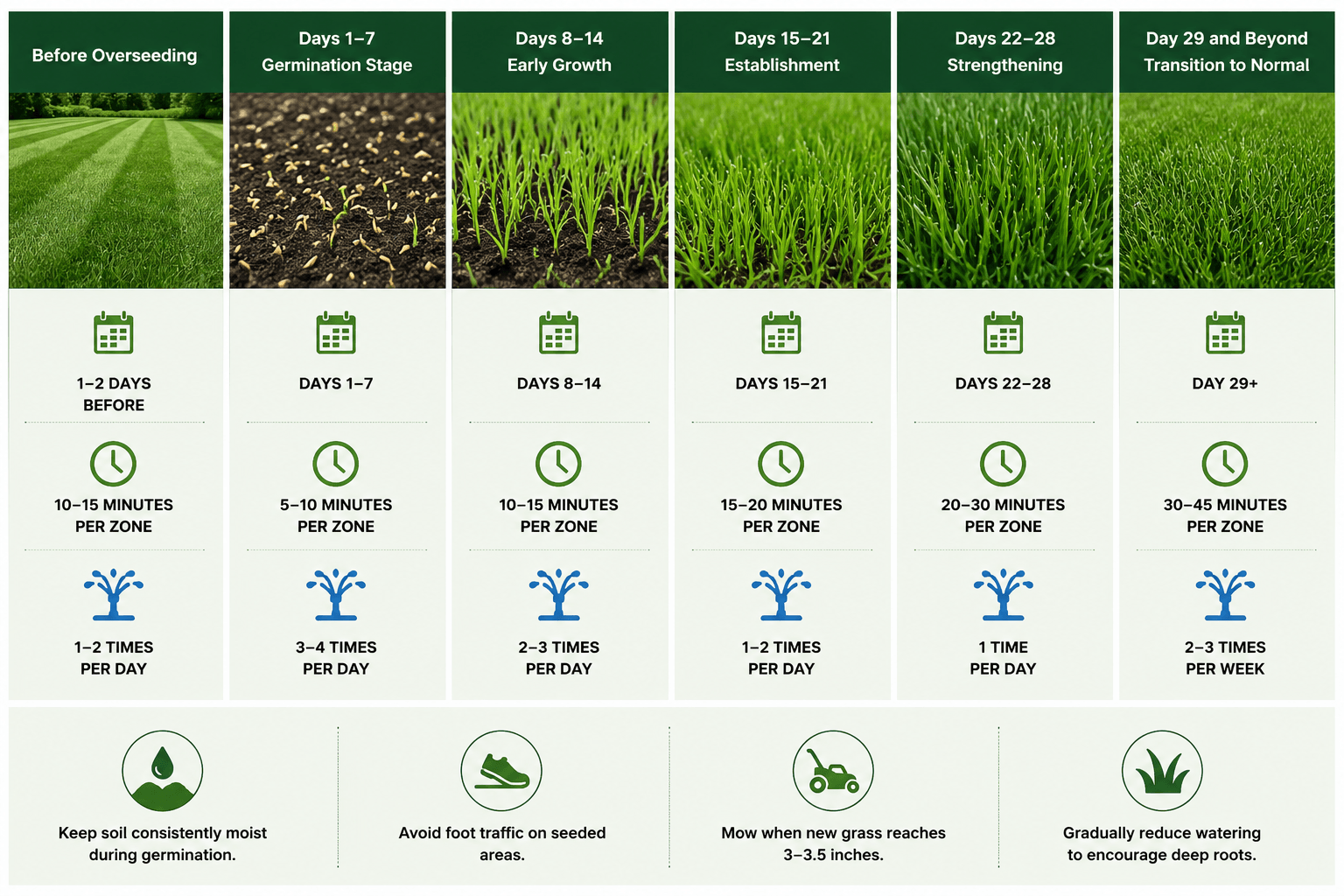
Overseeding adds new seed to an existing lawn. This creates a watering conflict: new seeds need frequent light moisture at the surface, while established grass needs deep, infrequent watering for roots.
The compromise schedule: Water lightly twice daily for 5–10 minutes to keep new seeds moist. Once per week, give the entire lawn a deep 30–40 minute soak to support existing grass roots. As new seed germinates over 2–3 weeks, shift gradually toward deep watering for the whole lawn.
Mow the existing grass short (2–2.5 inches / 5–6 cm) before overseeding. Short blades reduce competition for light and allow more water to reach the soil surface where new seeds sit.
Watering Schedule for Bare Patch Repairs
Bare patch repairs require the same 2–3 times daily schedule as full lawn seeding. The challenge is that surrounding established grass shades patches and creates microclimates that dry differently.
Use a mist nozzle by hand for small patches (under 2 sq ft / 0.2 sq m). Precision watering prevents soaking the surrounding established lawn, which needs less frequent water. For patches above 2 sq ft, use a small portable oscillating sprinkler positioned directly over the patch.
Keep foot traffic away from repaired patches for a minimum of 4 weeks. Foot traffic on wet soil compacts the surface and crushes new seedlings that are not yet firmly rooted.
How to Adjust for Rain and Weather
After Rain
Skip your scheduled sessions after any rainfall above 0.25 inches (6 mm). Check soil moisture before resuming. Light rain (under 0.25 in.) may not penetrate deep enough to replace a full watering session — use the screwdriver test 1 inch deep to confirm before skipping.
Heavy storms can wash seeds into piles or damage bare soil. After any rain with runoff, inspect the seeded area and redistribute any clumped seeds by hand while the soil is still moist.
Heat and Wind
On days above 85°F (29°C) or with sustained wind above 15 mph (24 km/h), add one extra midday session of 5–8 minutes. Heat and wind both dry the soil surface faster than normal. Missing even one session on these days can cause germination failure in seeds that are mid-cycle.
Cold Snaps
Cool-season grass stops germinating below 50°F (10°C) soil temperature. Warm-season grass stops below 65°F (18°C). If a cold snap hits within the germination window, reduce watering to once daily. Cold, wet soil combined with low temperatures creates ideal conditions for damping-off fungus. The seeds will wait — they do not die in cold, they go dormant.
Use Straw Mulch to Reduce Watering Frequency
A thin layer of straw mulch over freshly seeded ground cuts moisture evaporation by 30–50%. This means the interval between required watering sessions extends from every 3–4 hours to every 4–5 hours on a hot day.
Apply one layer of straw, not two. A single layer through which you can still see soil is correct. Too thick a layer blocks light and traps moisture against the seed, causing rot. Weed-free straw is the safest choice. Hay contains viable weed seeds that will compete with your grass.
Leave the straw in place. It breaks down naturally and adds organic matter to the soil. Only remove it if it is preventing visible seedlings from emerging after 3–4 weeks.
Frequently Asked Questions
What happens if I miss a day of watering new grass seed?
During germination (weeks 1–2), missing one day in hot weather can kill seeds mid-cycle. In mild, cloudy weather, missing one session may not cause permanent damage. Resume immediately and add an extra session that day. After week 3, missing one day is less critical but still slows establishment.
Can I water new grass seed at night?
No. Nighttime watering keeps the soil and seedlings wet for hours without sunlight to dry the surface. This creates conditions for damping-off fungus, which kills new seedlings at the soil line. Water in early morning and late afternoon only.
How do I know my new grass has enough water?
Push a screwdriver into the soil after watering. During germination, it should penetrate 2 inches (5 cm) smoothly. By weeks 5–6, it should slide in 4–6 inches (10–15 cm). If it stops early, water deeper.
Can I use tap water for new grass seed?
Yes. Tap water is safe for lawn establishment. Chlorinated water at normal municipal concentrations does not harm grass seed. If your water is highly alkaline (pH above 8), consider having it tested — extremely hard water can affect soil pH over time on large lawns.
When can I mow new grass for the first time?
Mow when grass reaches 50% above the target height. For a lawn you plan to keep at 3 inches (7.5 cm), mow at 4.5 inches (11 cm). Wait at least 4–6 weeks after germination. Mow with a sharp blade and remove no more than one-third of the blade length in a single mow.
Does USDA hardiness zone affect my grass seed watering schedule?
Yes. In zones 3–5 (cold climates), soil temperatures take longer to reach cool-season germination range in spring. Water evaporates more slowly, so 2 sessions daily may suffice. In zones 8–10 (hot climates), plant warm-season grasses in late spring and add a midday watering session whenever temperatures exceed 90°F (32°C).
Related Lawn and Garden Guides on ZonedGarden.com
These guides cover every next step after your grass seed establishes:
- Best Starter Fertilizer for New Grass Seed — N-P-K ratios, timing, and how to apply without burning seedlings
- How to Overseed a Lawn: Complete Guide — Best season, preparation steps, and the right seed rate per 1,000 sq ft
- Cool-Season vs. Warm-Season Grass: Which Type is Right for Your Lawn? — Zone-by-zone breakdown with maintenance differences
- Lawn Watering Schedule for Established Grass — Seasonal deep-watering guide for mature turf
- How to Fix Bare Patches in Your Lawn — Soil prep, seed selection, and patch repair watering tips
Summary: 6 Grass Seed Watering Rules That Never Change
- Never let the seedbed dry out during germination. One dry afternoon kills mid-cycle seeds.
- Water 2–3 times daily for weeks 1–2, then step down gradually each fortnight.
- Shift to deep, infrequent watering by week 5. Shallow watering = shallow roots = weak lawn.
- Water in the morning. Never at night. Night moisture causes fungal disease.
- Use a mist or oscillating sprinkler, not a strong jet. High pressure displaces seeds.
- Apply 1 inch (25 mm) of water per week once the lawn matures. Measure with a tuna can.
Conclusion
New grass seed does not need more water than any other plant — it needs consistent water at exactly the right stage. The germination window is narrow. Miss it and you reseed. Nail it and you get a lawn that fills in thick and roots deep enough to handle summer heat and drought by its second season.
Stick to the week-by-week schedule, adjust for your soil type and grass variety, and shift to deep watering the moment seedlings are visibly established. The transition from frequent shallow sessions to infrequent deep soaks is the single most important move in building a lawn that lasts. Most homeowners skip that transition — and wonder why their grass thins out every summer.
Start the schedule right. Let the roots chase the water down. The lawn takes care of itself from there. ZonedGarden.com | Expert lawn and garden guides for every growing zone