
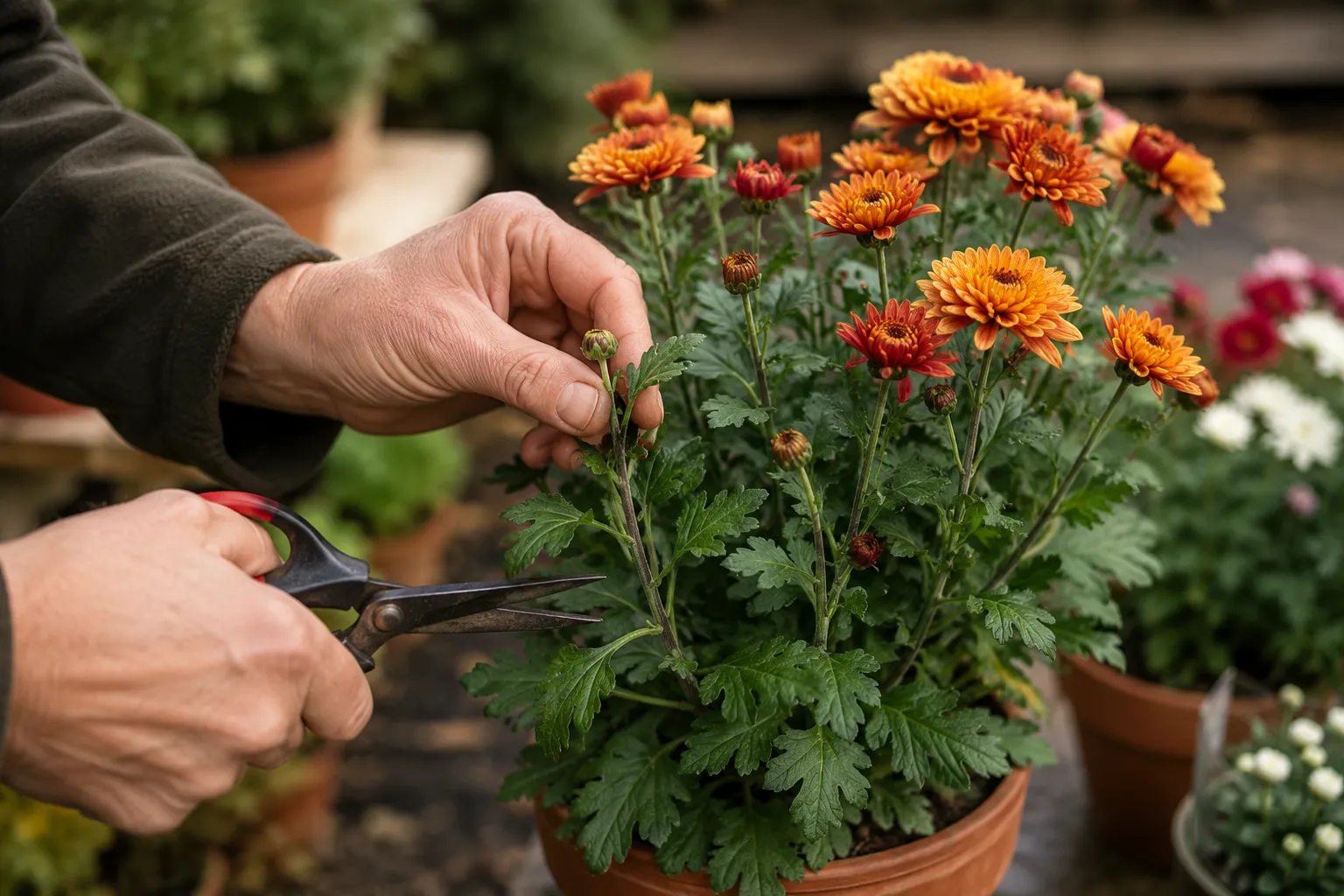
Prune chrysanthemums 3–5 times across the growing season — starting with the first pinch in late spring and ending with a hard cutback after the first frost. Every pruning step serves a different purpose and hits a different part of the plant’s growth cycle.
Most gardeners pinch once and wonder why their mums look thin by fall. The issue is timing and repetition. Chrysanthemums (Chrysanthemum morifolium) respond to pruning by branching harder — but only when cuts happen at the right growth stage. Cut too late, and you remove the very stems that carry fall buds.
This guide covers every pruning stage in order — when to start, when to stop, and what to do after bloom season ends.
Chrysanthemum Pruning Schedule by Season
The table below maps every pruning action to the correct season and USDA zone deadline.
| Season | Pruning Type | Action | Deadline |
| Early Spring | Hard cutback | Cut to 2–4 in (5–10 cm) above soil | Before new growth starts |
| Late Spring | First pinch | Remove top 1 in (2.5 cm) at 6 in (15 cm) height | When stems hit 6 in (15 cm) |
| Early Summer | Second pinch | Repeat every 2–3 weeks | Zones 5–7: stop July 15 / Zones 8–9: stop July 30 |
| Mid-Summer | Final pinch | Last pinch — hard deadline | No pinching after deadline |
| Bloom Season | Deadheading | Remove spent blooms to next healthy leaf | Ongoing during bloom |
| After First Frost | Post-season cutback | Cut to 4–6 in (10–15 cm) above soil | After foliage browns fully |
Spring Pruning: Hard Cutback and First Pinch
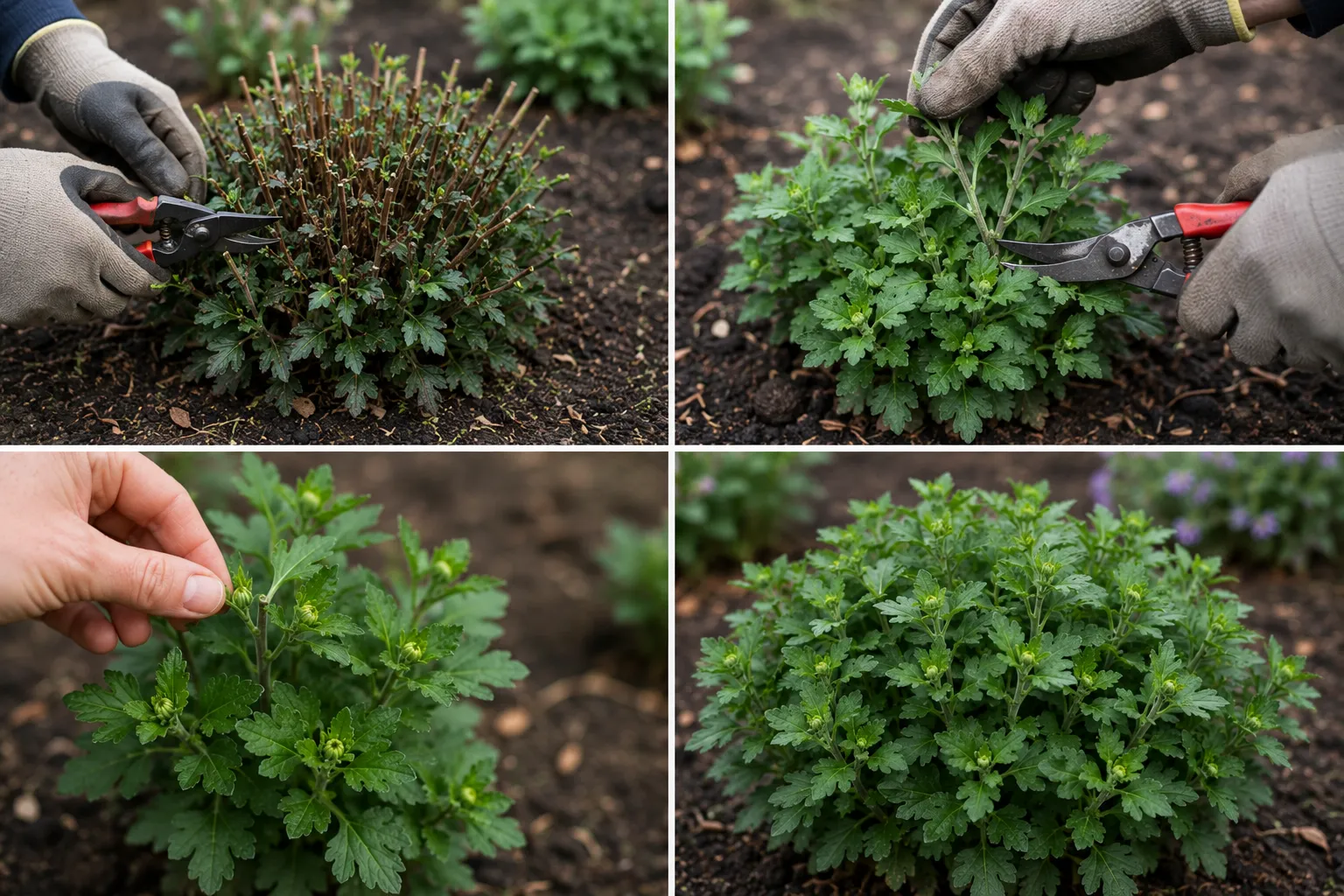
Early Spring: Cut Back Overwintered Plants
Cut overwintered chrysanthemums to 2–4 inches (5–10 cm) above soil level in early spring, before new growth emerges. This removes dead woody stems, opens the crown to airflow, and channels the plant’s energy into fresh shoots rather than old, tired wood.
Use clean, sharp bypass pruners wiped with isopropyl alcohol before touching each plant. Dirty blades spread chrysanthemum stunt viroid and fungal spores between crowns — a 10-second wipe prevents season-long disease problems.
Late Spring: First Pinch at 6 Inches (15 cm)
Start pinching when new stems reach 6 inches (15 cm) tall. Pinch off the top 1 inch (2.5 cm) of each stem, just above a leaf node. This one cut redirects energy from vertical growth to lateral branching — each pinched stem produces 2–4 side shoots, multiplying future flower sites.
You can pinch with your thumb and index finger or use snips for thicker stems. The method doesn’t matter; the timing and position above the leaf node do.
Pinching needs vary by chrysanthemum type. Pompon types need almost no pinching to stay compact. Irregular incurve exhibition types need precise disbudding, not general pinching. If you’re unsure which type you’re growing,
13 chrysanthemum types guide to identify your variety before starting any pruning program.
Summer Pruning: Repeat Pinching and the Hard Deadline
How Often to Pinch in Summer
Pinch every 2–3 weeks throughout early summer, repeating the same process — remove the top 1 inch (2.5 cm) of each new stem as side shoots reach 6 inches (15 cm). Each pinch adds another layer of branching and more potential flower sites for fall.
A standard garden mum pinched correctly 3–4 times produces 3–5 times more blooms than an unpinched plant by fall. The trade-off is that you delay flowering — each pinch pushes the bloom window back 2–3 weeks.
When to Stop Pinching: Zone-by-Zone Deadlines
Stop all pinching by July 15 in USDA Zones 5–7 and by July 30 in Zones 8–9. After these dates, chrysanthemums enter floral initiation — the physiological stage where shortening days trigger the plant to form flower buds rather than vegetative shoots.
Pinching after the deadline removes bud-forming stems directly. In trials, mums pinched after July 25 in Zone 6 bloomed 17–23 days later than deadline-compliant plants, and 60% produced deformed ray florets.
- Zone 3–4: stop by July 1 — short growing season, earlier initiation
- Zone 5–7: stop by July 15 — the standard US guideline
- Zone 8–9: stop by July 30 — warmer nights delay floral initiation
- Zone 10+: stop by August 1 — verify with local cooperative extension
What Happens If You Miss the Pinching Deadline
Missing the deadline by 1–2 weeks reduces bloom fullness but doesn’t eliminate flowering. Missing it by 3+ weeks produces blind stems — stems that form no buds at all — or extremely late, frost-vulnerable growth that opens in November instead of September or October.
If you realize you’ve missed the deadline, stop immediately and let the plant grow. Do not try to compensate with extra pinches — additional cuts after floral initiation starts only remove more bud sites.
Deadheading Chrysanthemums During Bloom Season
Deadhead chrysanthemums throughout the bloom period by removing spent flowers back to the next healthy leaf, side bud, or lateral shoot. This prevents the plant from putting energy into seed production and encourages the remaining buds to open fully.
How to Deadhead Correctly
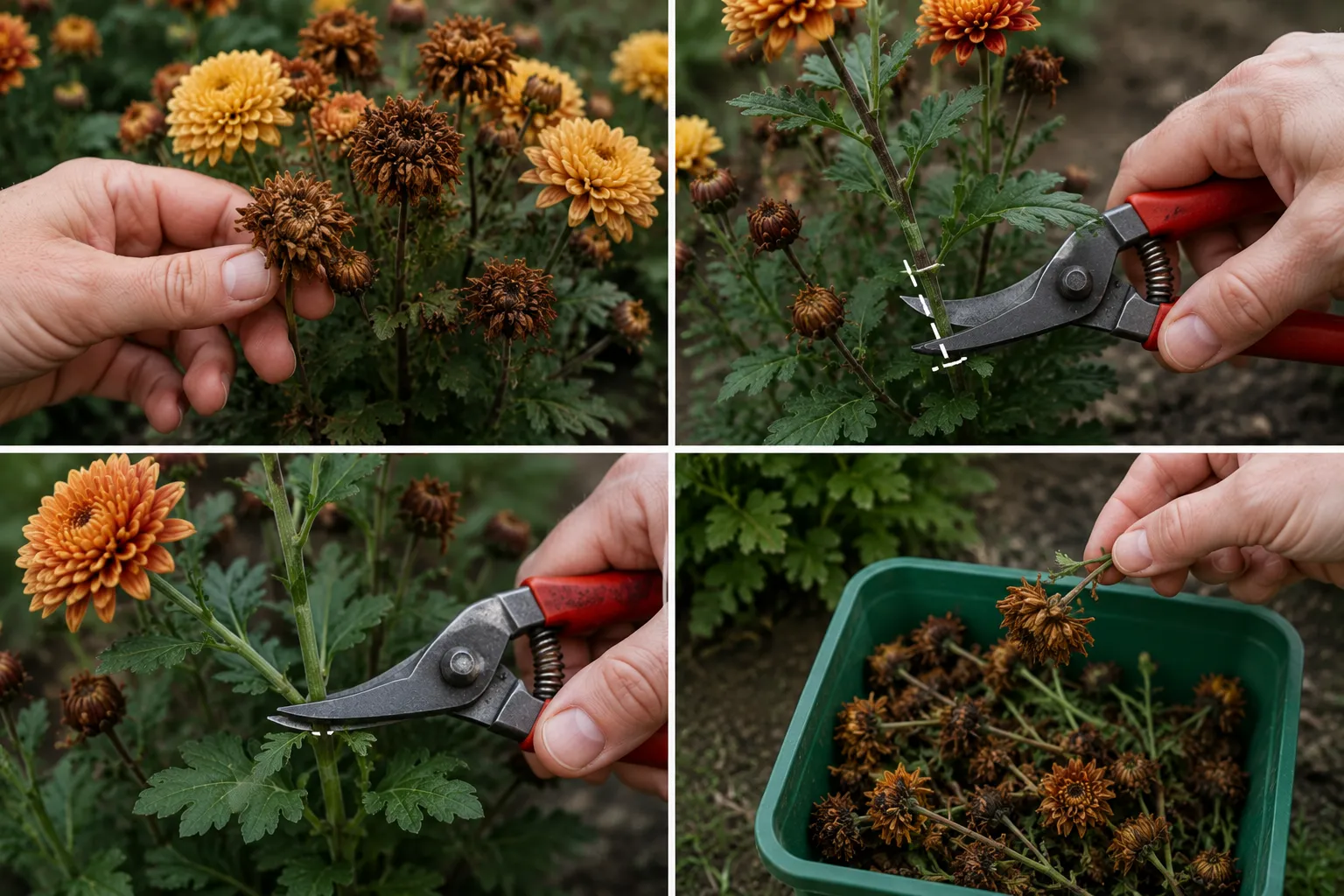
- Locate a spent bloom — petals browning, center darkening, no fragrance remaining
- Trace the stem down to the first healthy leaf or visible side bud
- Cut just above that leaf or bud at a 45-degree angle
- Dispose of spent blooms away from the plant — don’t leave them on soil
Deadheading extends the bloom window by 1–3 weeks in most garden mum varieties. It also improves airflow through the plant, which reduces the risk of Botrytis cinerea (gray mold) — the most common fungal disease in autumn-blooming chrysanthemums.
Deadheading vs Disbudding — The Difference
Deadheading removes spent flowers to extend blooming. Disbudding removes developing buds to concentrate energy into fewer, larger flowers. Disbudding is a show technique — exhibition growers remove all side buds on a stem, leaving just the terminal bud to grow into one large bloom. For garden display, deadhead rather than disbud.
Fall and Post-Frost Cutback
When to Cut Back After Blooming
Cut back garden chrysanthemums to 4–6 inches (10–15 cm) above soil level after the first hard frost kills the foliage. For most of the US, this falls between October and November depending on USDA zone:
- Zone 5–6: late October — first hard frost typically mid to late October
- Zone 7: mid-November — frost arrives later, foliage may stay green longer
- Zone 8–9: November to December — some years, full cutback may happen in December
Leave the cut stems at 4–6 inches (10–15 cm). These short stubs mark the crown’s location in winter, protect the crown from soil heaving, and help hold mulch in place over the root zone.
To Mulch or Not After Cutback
Apply 3–4 inches (7.5–10 cm) of loose mulch — straw, shredded leaves, or pine straw — over the crown after cutback in Zones 5 and colder. Mulch insulates the crown against freeze-thaw cycles that push roots out of soil.
In Zones 6 and warmer, mulching is optional but reduces winter injury risk. In Zone 4 and colder, mulch is essential — without it, most chrysanthemum crowns die over winter regardless of variety hardiness ratings.
Why You Should Not Cut Back Before Frost
Cutting back before the first hard frost removes stems that are still photosynthesizing and sending nutrients back into the crown for winter storage. Premature cutback weakens the root system and reduces the plant’s ability to survive winter and rebloom the following year.
Pruning Chrysanthemums by USDA Zone
USDA zone determines your pinching deadline and cutback timing — both the most critical scheduling decisions in chrysanthemum care.
Zone 3–4: Short Season, Early Deadline
Start pinching as soon as stems reach 6 inches (15 cm) — typically late May. Stop all pinching by July 1. Apply 4–6 inches (10–15 cm) of mulch after cutback. Choose early-season varieties that bloom in late August to avoid frost before full bloom.
Zone 5–7: Standard US Garden Mum Zone
First pinch in late May to early June. Final pinch deadline: July 15. Cutback after first hard frost in October to November. Most garden mum varieties sold in US nurseries are bred for this zone range.
Zone 8–9: Extended Season
First pinch in late May. Final pinch deadline: July 30. Bloom season runs September to November. Cutback in November to December. Choose heat-tolerant varieties — standard garden mums may bolt or fail to set buds properly in Zones 8–9 summers.
4 Pruning Mistakes That Kill Chrysanthemum Blooms
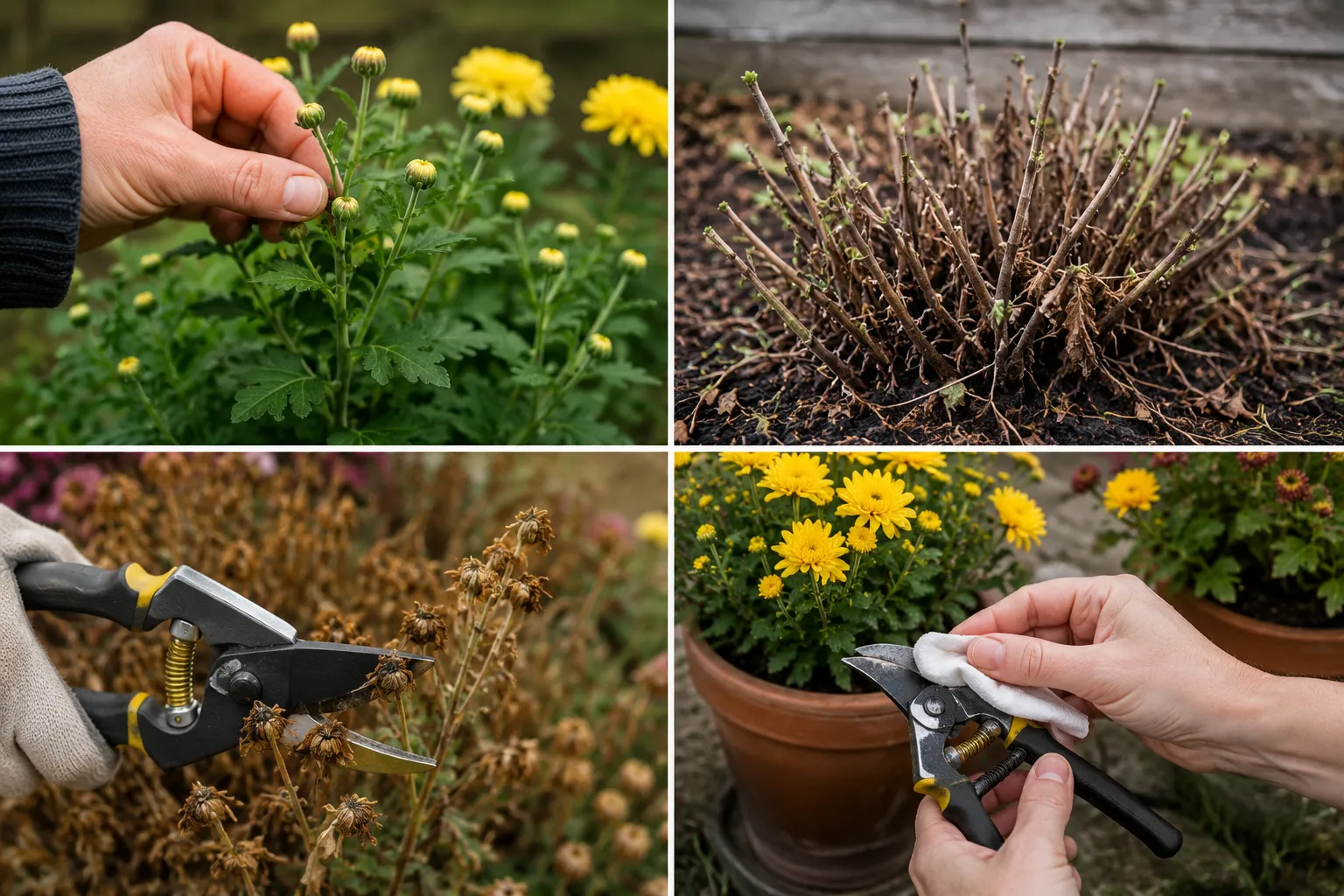
- Pinching after the zone deadline. Removes bud-forming stems. Produces blind stems or late, frost-vulnerable growth. Set a calendar reminder and mark the date with a colored stake in the bed.
- Skipping the spring hard cutback. Old woody stems compete with new growth for nutrients. Plants become leggy, weak-stemmed, and more susceptible to crown rot when old wood holds moisture against the base.
- Cutting back before frost. Removes stems still sending nutrients back to the crown. Weakens winter survival. Wait until foliage browns fully after a hard frost.
- Using dirty or dull pruners. Crushed stems slow healing and create entry points for Botrytis cinerea. Contaminated blades spread chrysanthemum stunt viroid between plants. Wipe blades with isopropyl alcohol before touching each new plant.
Frequently Asked Questions
When should I stop pinching chrysanthemums?
Stop pinching by July 15 in USDA Zones 5–7 and by July 30 in Zones 8–9. After these dates, the plant begins floral initiation — pinching removes the stems that carry fall buds.
Should I cut back chrysanthemums in spring or fall?
Do both. In early spring, cut to 2–4 inches (5–10 cm) above soil before new growth starts. In fall, cut to 4–6 inches (10–15 cm) above soil after the first hard frost kills the foliage.
How do I get more blooms on my chrysanthemums?
Pinch stems every 2–3 weeks from late spring through mid-July. Each pinch doubles the number of branching points and future flower sites. A plant pinched 3–4 times correctly produces 3–5 times more blooms than an unpinched plant.
Can I prune chrysanthemums in August?
No — do not pinch after mid-July in most US zones. August pinching removes buds already forming for fall bloom. Deadheading spent flowers during August is fine — only pinching and hard cutting cause damage at this stage.
Do florist mums come back every year?
No — florist mums sold in supermarkets do not reliably overwinter outdoors. Florist varieties bred for greenhouse production lack the cold hardiness of garden mums. Hardy garden mums (Chrysanthemum morifolium) bred for Zones 4–9 come back annually with correct cutback and mulching.
Conclusion
Chrysanthemum pruning follows a clear seasonal sequence — hard cutback in early spring, repeated pinching from late spring through mid-July, deadheading during bloom, and post-frost cutback in fall. The single most important rule is the pinching deadline: July 15 for Zones 5–7, July 30 for Zones 8–9. Missing that window costs you a full season of blooms.
Every other pruning step — the spring cutback, the frequency of summer pinching, the depth of fall cutback — builds on that central timing. Get the deadline right, use clean tools, and match your cutback timing to your zone’s first frost date. Mums reward that discipline with dense, bushy plants carrying 3–5 times more blooms than unpinched plants from the same variety.