Spirea bush care requires full sun, well-draining soil, and pruning timed to your variety’s bloom season. This deciduous shrub tolerates drought, poor soil, and urban pollution once established, making it one of the lowest-maintenance flowering shrubs available.
Gardeners plant spirea for its dense clusters of white, pink, or red flowers and its reliable performance across USDA zones 3 through 9. The plant asks for almost nothing once its roots take hold, but a handful of specific steps determine whether you get a sparse, leggy shrub or a full mound covered in blooms.
This guide covers sunlight, soil, watering, fertilizing, pruning by bloom type, pest management, and the seasonal tasks that keep a spirea bush thriving for decades.
What Growing Conditions Does Spirea Need?
Spirea needs at least 6 hours of direct sun daily, well-draining soil with a pH between 6.0 and 7.0, and protection from standing water. The shrub adapts to sandy, clay, or average garden soil as long as drainage is adequate.
This adaptability explains why landscapers use spirea so widely in commercial and residential settings. The plant tolerates heat, cold, humidity, and urban pollution better than most flowering shrubs, which makes it a dependable choice for street plantings, parking lot islands, and roadside borders where conditions are far from ideal.
Which Spirea Varieties Should You Plant?
Choose Japanese spirea (Spiraea japonica) for summer blooms in pink, red, or white with colorful foliage, or choose Bridal Wreath spirea (Spiraea prunifolia) for a dramatic one-time spring flower display on arching branches.
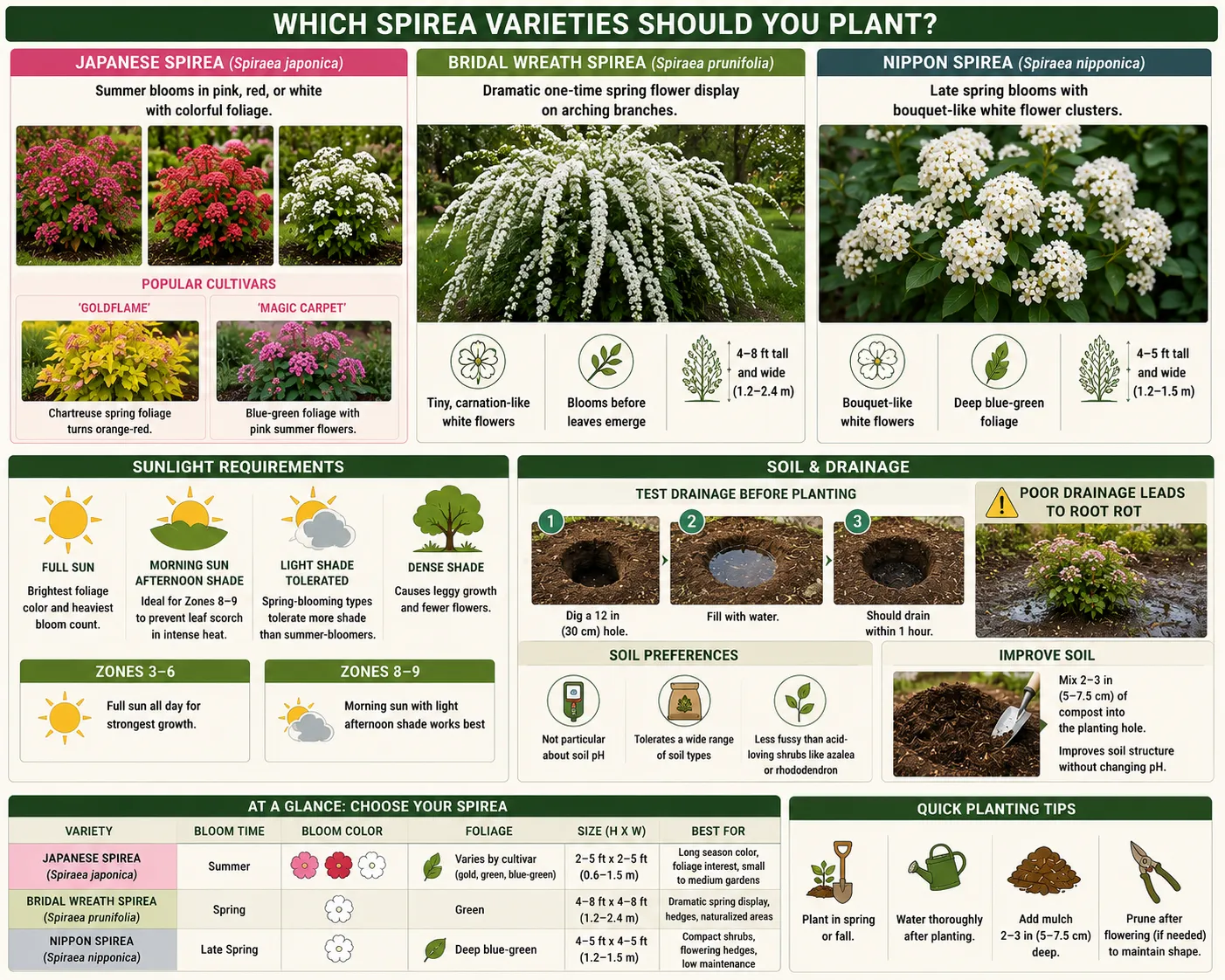
Japanese spirea cultivars range from ‘Goldflame’ with chartreuse spring foliage to ‘Magic Carpet’ with blue-green leaves and pink summer flowers. Bridal Wreath spirea grows 4-8 ft (1.2-2.4 m) tall and wide, producing tiny carnation-like white flowers that cover bare branches before the leaves emerge. Nippon spirea offers a third option, reaching 4-5 ft (1.2-1.5 m) with deep blue-green leaves and bouquet-like white flower clusters in late spring.
Sunlight Requirements
Full sun produces the brightest foliage color and the heaviest bloom count on a spirea bush. Plants grown in dense shade stretch toward available light, producing thin, leggy stems with fewer flowers. Spring-blooming varieties tolerate light shade better than summer-blooming types, but afternoon sun remains essential for both groups.
Morning sun followed by light afternoon shade works for spirea planted in zones 8 and 9, where intense afternoon heat can scorch foliage on hot, dry sites. In zones 3 through 6, full sun all day produces the strongest growth without risk of leaf burn.
Soil and Drainage
Test drainage before planting by digging a 12 in (30 cm) hole, filling it with water, and checking whether it empties within an hour. Spirea planted in soil that holds water develops root rot within a single wet season, so amend heavy clay with coarse grit or build a raised planting area if drainage tests poorly.
Spirea is not particular about soil pH or fertility compared to acid-loving shrubs like azalea or rhododendron, which makes site preparation simpler. Working 2-3 in (5-7.5 cm) of compost into the planting hole improves structure in both sandy and clay soils without altering pH significantly.
How Do You Plant a Spirea Bush?
Plant spirea in spring or early fall, digging a hole twice as wide as the root ball and just as deep, then backfilling with the excavated soil and watering thoroughly to settle air pockets.
- Choose a site receiving at least 6 hours of direct sun and confirm drainage
- Dig a hole 2 times the width of the container and equal to its depth
- Remove the plant from its container and loosen any tightly wound roots
- Place the root ball in the hole and backfill with the original soil
- Water thoroughly and apply 2-3 in (5-7.5 cm) of mulch around the base
Space individual plants 2-15 ft (0.6-4.5 m) apart depending on the mature width of your chosen variety. For a dense flowering hedge, plant closer together within that range; for specimen plantings, allow the full mature spread plus extra room for air circulation.
How Often Should You Water a Spirea Bush?
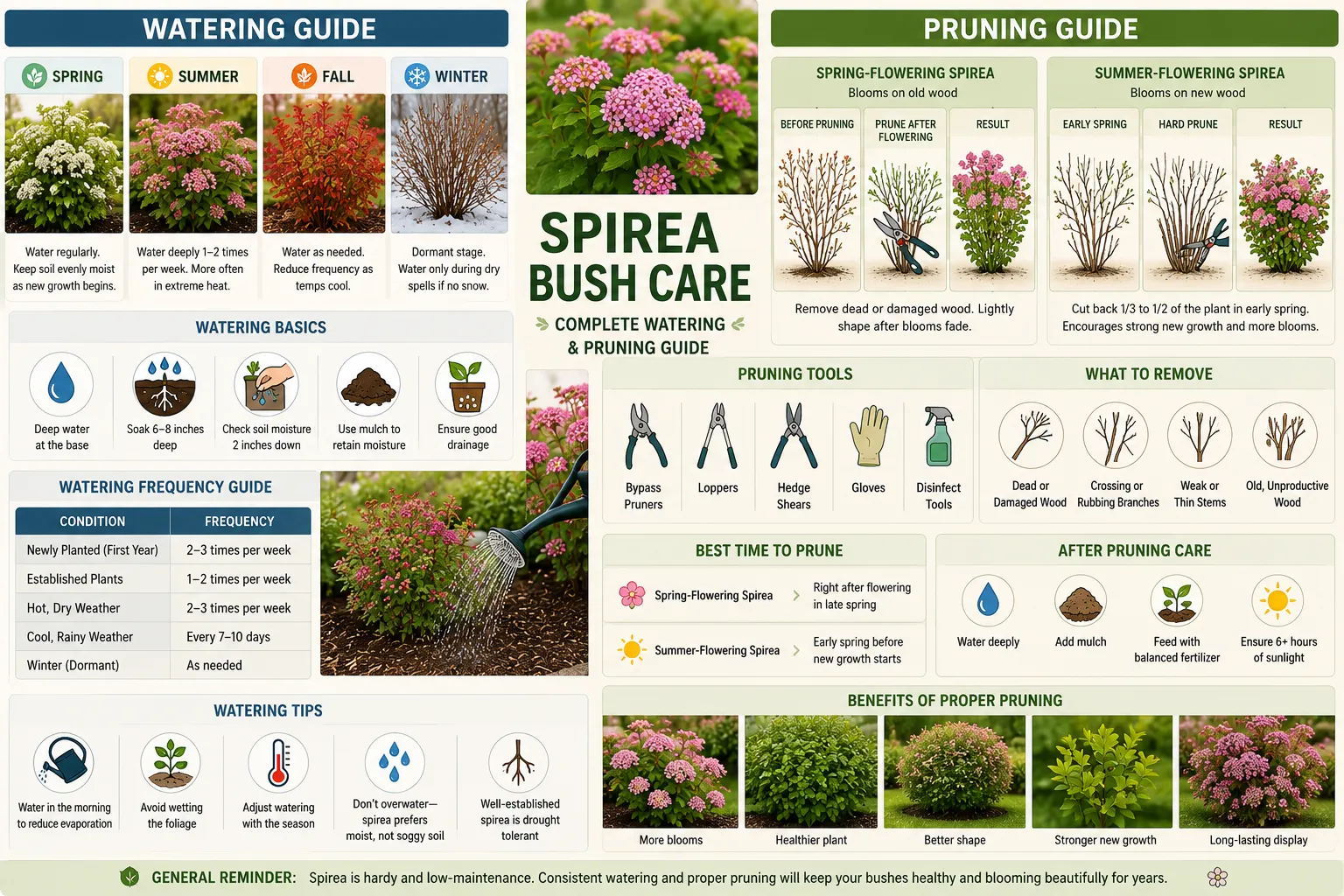
Water a newly planted spirea bush deeply twice a week for the first 8 weeks after planting. Once established, typically after the first full growing season, spirea needs supplemental water only during dry spells lasting 3 weeks or longer.
Soak the root zone slowly rather than sprinkling the surface, since shallow watering encourages roots to stay near the top of the soil where they dry out fastest. Spirea dislikes wet feet, so let the top 2 in (5 cm) of soil dry between waterings rather than keeping the bed constantly soggy.
When Should You Fertilize Spirea?
Fertilize spirea once in early spring with a controlled-release, balanced fertilizer such as a 10-10-10 or 20-20-20 formula. Skip fertilizing entirely during the first growing season after planting, since new roots need time to establish before being pushed toward top growth.
Granular fertilizer applied at a rate of 2 lb (0.9 kg) per 100 sq ft (9.3 sq m) of bed area supplies enough nutrition for the full growing season in most soils. Gardeners using liquid feeds can apply a diluted balanced mix 3 to 4 times between late April and mid July instead, following the product label for exact dilution rates.
Avoid heavy nitrogen applications, which trigger soft, fast growth that attracts aphids and increases susceptibility to fire blight. If you are designing a wider bed around your spirea, our Best Shrubs for Landscaping guide pairs flowering companions that share the same light fertilizer needs.
How Do You Prune Spirea Based on Bloom Type?
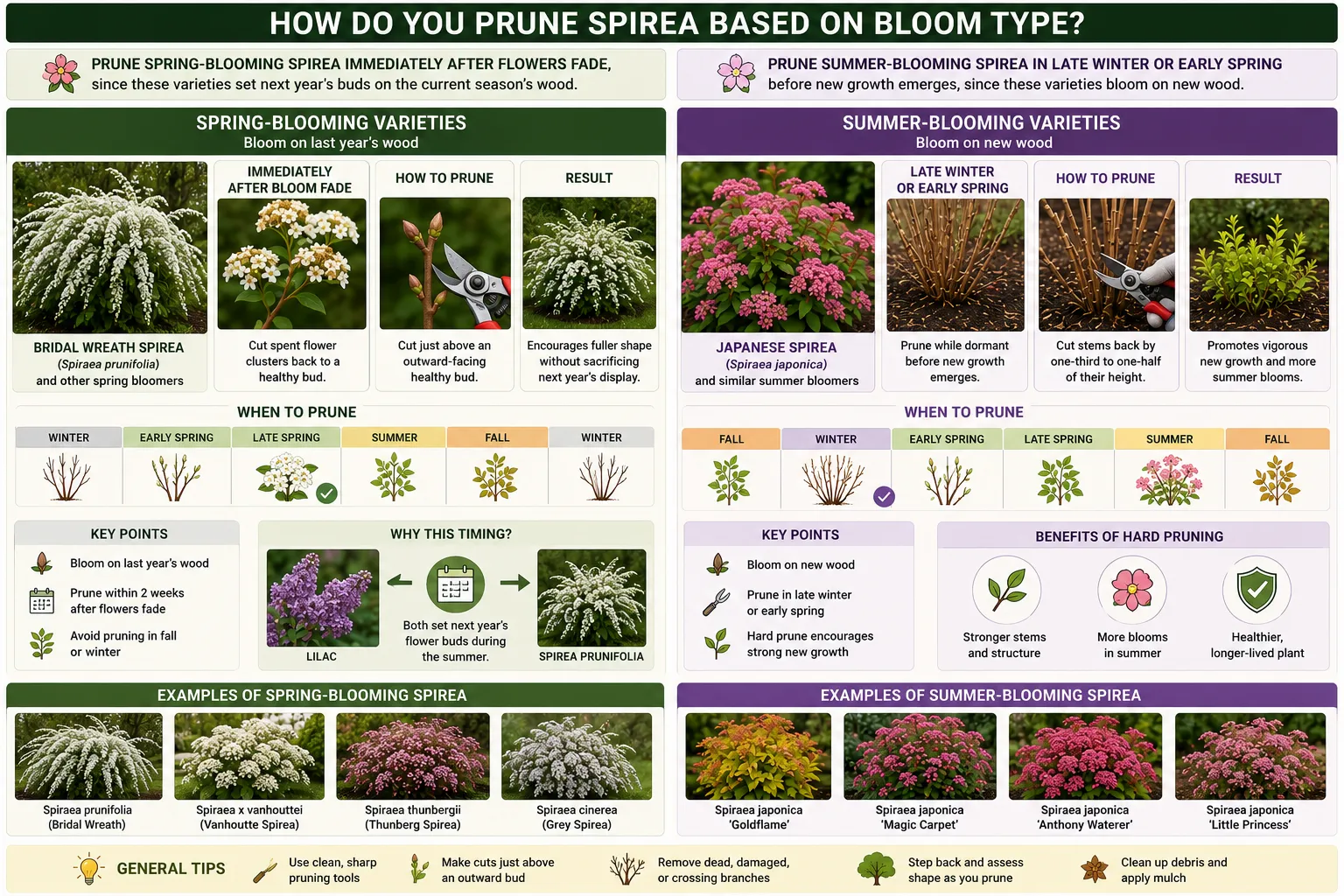
Prune spring-blooming spirea immediately after the flowers fade, since these varieties set next year’s buds on the current season’s wood. Prune summer-blooming spirea in late winter or early spring before new growth emerges, since these varieties bloom on new wood produced the same year.
Spring-Blooming Varieties
Bridal Wreath spirea (Spiraea prunifolia) and other spring bloomers flower on last year’s wood, so pruning in fall or winter removes the buds that would have opened the following spring. Cut spent flower clusters back to a healthy bud within 2 weeks of bloom drop to encourage a fuller shape without sacrificing next year’s display.
This timing rule mirrors the pruning logic used for lilac, since both shrubs set their flower buds during the summer following the current bloom. Mark your calendar for late May or early June in most regions, right after the white flower clusters finish their show.
Summer-Blooming Varieties
Japanese spirea (Spiraea japonica) and similar summer bloomers respond well to a hard prune while dormant. Cut stems back by one-third to one-half in late winter, which pushes the plant to send up vigorous new growth that carries that season’s flowers.
Rejuvenation Pruning for Overgrown Shrubs
Cut every step down to 4-6 in (10-15 cm) from the ground every 3 to 5 years to reset an overgrown, woody spirea. Perform this hard prune in late fall after leaf drop or in very early spring before buds break and reserve the technique for summer-blooming varieties only, since spring bloomers recover more slowly from a full reset.
If you want to expand your spirea planting without buying new stock, division works well on multi-stemmed types. Our How to Propagate Shrubs guide walks through softwood cuttings and division methods step by step.
| Task | Timing | Method | Difficulty |
| Watering new spirea | Twice a week for 8 weeks | Deep soak at the root zone | Easy |
| Pruning spring-blooming spirea | Immediately after flowering | Cut spent blooms and shape lightly | Easy |
| Pruning summer-blooming spirea | Late winter or early spring | Cut back before new growth starts | Easy |
| Rejuvenation pruning | Every 3 to 5 years | Cut all stems to 4-6 in (10-15 cm) | Moderate |
| Fertilizing | Early spring only | Apply controlled-release granular feed | Easy |
| Treating powdery mildew | At first white spots | Spray sulfur or copper fungicide | Moderate |
What Pests and Diseases Affect Spirea?
Aphids, powdery mildew, and fire blight are the 3 most common problems affecting spirea bushes, though the plant remains largely pest-free compared to other members of the rose family. Most issues arise from stress caused by poor drainage, overcrowding, or excess nitrogen rather than from the plant being inherently disease prone.
Aphids
Spirea aphid clusters form on tender new growth and buds, causing leaves to curl and yellow. Spray affected stems with insecticidal soap or horticultural oil, repeating every 5 to 7 days until the colony clears.
Powdery Mildew
Powdery mildew coats leaves and growing tips in a white film, favored by hot, humid weather and poor air circulation. Treat active infections with sulfur-based or copper-based fungicide and improve airflow by spacing plants at least 2 ft (0.6 m) apart and avoiding overhead watering.
Fire Blight
Fire blight is a bacterial infection that spreads through pruning cuts made during warm, wet weather. Prune only during dry conditions, sanitize tools by rubbing alcohol between cuts, and remove infected branches at least 12 in (30 cm) below visible damage.
Symptoms include blackened, scorched-looking shoot tips that curl into a shepherd’s crook shape. Burn or bag infected material rather than composting it, since the bacteria survive in plant debris and can reinfect the same bed the following season.
Is Spirea Invasive in Your Area?
Spiraea japonica is classified as invasive in several states, including Virginia, Georgia, South Carolina, Tennessee, and Kentucky, along with parts of the Great Smoky Mountains region. Check your state’s invasive plant council listing before planting this species, especially near natural areas.
Seedless cultivars such as the Double Play series avoid the self-seeding behavior that makes older Japanese spirea varieties problematic in wild areas. Native alternatives like ninebark, sweet spire, and summer sweet deliver similar low-maintenance flowering without the spread risk.
How to Mulch and Maintain Spirea Through the Seasons
Apply 2-3 in (5-7.5 cm) of shredded bark mulch around the base of your spirea, keeping it 2-3 in (5-7.5 cm) away from the stems to prevent fungal rot. Refresh the mulch layer each spring to retain moisture and suppress weeds through the growing season.
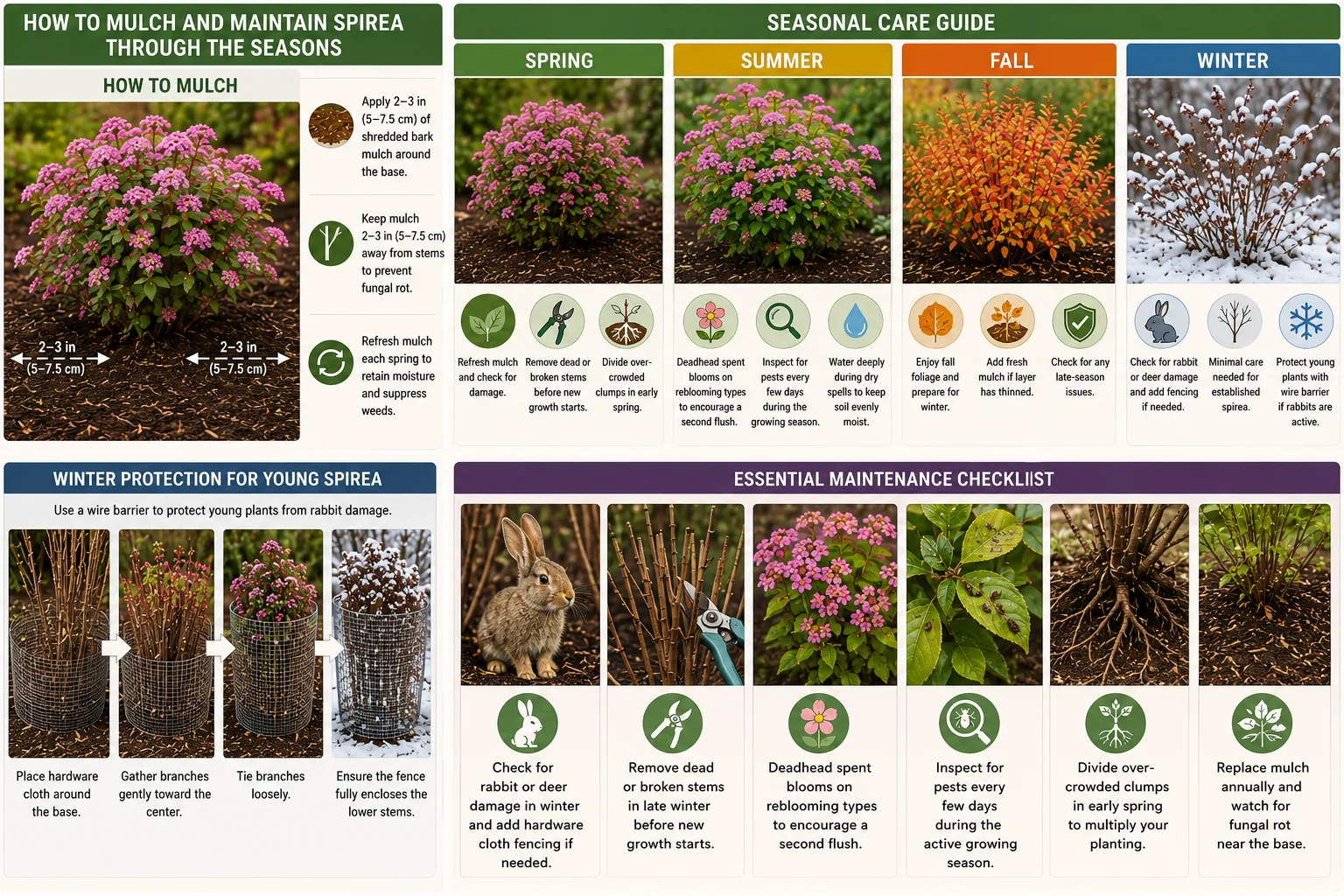
Winter care stays minimal for established spirea, but young plants benefit from a simple wire barrier if rabbits are active in your area. Wrap hardware cloth around the base in a loose circle, tying branches gently toward the center so the fencing fully encloses the lower stems through the dormant months.
- Check for rabbit or deer damage in winter and add hardware cloth fencing if needed
- Remove dead or broken stems in late winter before new growth starts
- Deadhead spent blooms on reblooming types to encourage a second flush
- Inspect for pests every few days during the active growing season
- Divide overcrowded clumps in early spring to multiply your planting
- Replace mulch annually and watch for fungal rot near the base
For a complete seasonal pruning calendar covering spirea alongside other flowering shrubs, see our How to Prune Shrubs guide for timing charts by shrub type.
Frequently Asked Questions
Does spirea come back every year?
Yes. Spirea is a hardy deciduous shrub that loses its leaves in fall and regrows from the same woody branches each spring, rather than dying back to the ground like a perennial.
Can you cut spirea back hard?
Yes, for summer-blooming varieties. Cut stems to 4-6 in (10-15 cm) from the ground every 3 to 5 years to rejuvenate the shrub, but avoid this technique on spring-blooming types.
Does spirea need full sun?
Yes, for the best blooms. Spirea needs at least 6 hours of direct sunlight daily, though spring-blooming varieties tolerate some light shade better than summer bloomers.
Is spirea deer resistant?
Yes, in most gardens. Japanese spirea shows good deer resistance, and the Double Play series is typically ignored by both deer and rabbits.
Why is my spirea not blooming?
Insufficient sunlight is the most common cause. Move the shrub to a location with 6 or more hours of direct sun, or prune at the wrong time, which removes the buds set for that season.
Grow a Healthier Spirea This Season
Spirea rewards correct timing more than constant attention, since matching your pruning schedule to your variety’s bloom type determines whether you see a full flush of flowers or a season of disappointment. Confirm your bloom type, schedule pruning around it, and watch your shrub fill out within a single growing season.
Pair your spirea with companion shrubs that share the same light, water, and soil needs to build a low-maintenance border that performs for decades with minimal intervention.