Dig a shovel into your backyard and you’re holding more than dirt. You’re holding a mix of crushed rock, dead plant matter, trapped water, pockets of air, and billions of living organisms, all working together in a way most people never stop to think about. Soil isn’t one substance. It’s a system, and understanding what makes it up is the first step to growing anything successfully, whether that’s a backyard tomato patch or 200 acres of corn.
So what exactly is soil made of? At the most basic level, soil breaks down into four parts: minerals, organic matter, water, and air. Roughly 45% of soil volume is mineral material, 5% is organic matter, and the remaining 50% is split between water and air. Those numbers shift depending on where you live, what you’re growing, and how the land has been treated, but they hold up as a solid baseline across most of the United States.
Let’s walk through each piece and why it matters.
The Mineral Base: Sand, Silt, and Clay
Minerals make up nearly half of everything in soil, and they come from one place: rock that has slowly broken down over thousands of years. Wind, rain, freezing temperatures, and even plant roots grind rock into smaller and smaller pieces until you’re left with three particle types — sand, silt, and clay.

Sand is the largest of the three, ranging from 0.05 to 2 millimeters across. Rub it between your fingers and it feels gritty, almost like fine sugar. Water runs through sand fast, which sounds good until you realize it also drains nutrients away before roots can absorb them.
Silt sits in the middle, between 0.002 and 0.05 millimeters. It has a smooth, almost powdery texture when dry and a slick feel when wet. Silt holds onto water and nutrients better than sand but doesn’t provide much structure for roots to grip.
Clay is the smallest particle, measuring less than 0.002 millimeters — smaller than most bacteria, in fact. Clay holds water and nutrients longer than sand or silt, but it’s dense. Too much clay and roots struggle to push through, drainage slows to a crawl, and the soil compacts into something closer to brick than garden bed.
The sweet spot is loam: a balanced blend of all three. Loam drains well enough to avoid waterlogging, holds enough nutrients to feed plants, and stays loose enough for roots to spread. If you’ve ever heard a gardener rave about “good soil,” they’re almost certainly describing loam.
Organic Matter: The Smallest Piece With the Biggest Job
Organic matter only accounts for about 5% of soil, yet it does an outsized amount of work. This is the decomposed remains of leaves, roots, insects, and anything else that once lived and eventually broke down into the ground. As it decomposes, it forms humus — a dark, crumbly material packed with nitrogen, phosphorus, and sulfur.
Healthy soil typically holds between 3% and 6% organic matter by weight. Drop below that range and fertility drops with it. Compost, cover crops, decomposed leaves, and worm castings are the fastest ways to rebuild organic matter that’s been depleted by repeated tilling or years of heavy planting without replenishment.
There’s a reason experienced growers obsess over organic matter more than almost anything else. It doesn’t just feed plants directly — it feeds the microorganisms that feed the plants, and it improves the soil’s ability to hold water during dry spells.
Water: The Delivery System
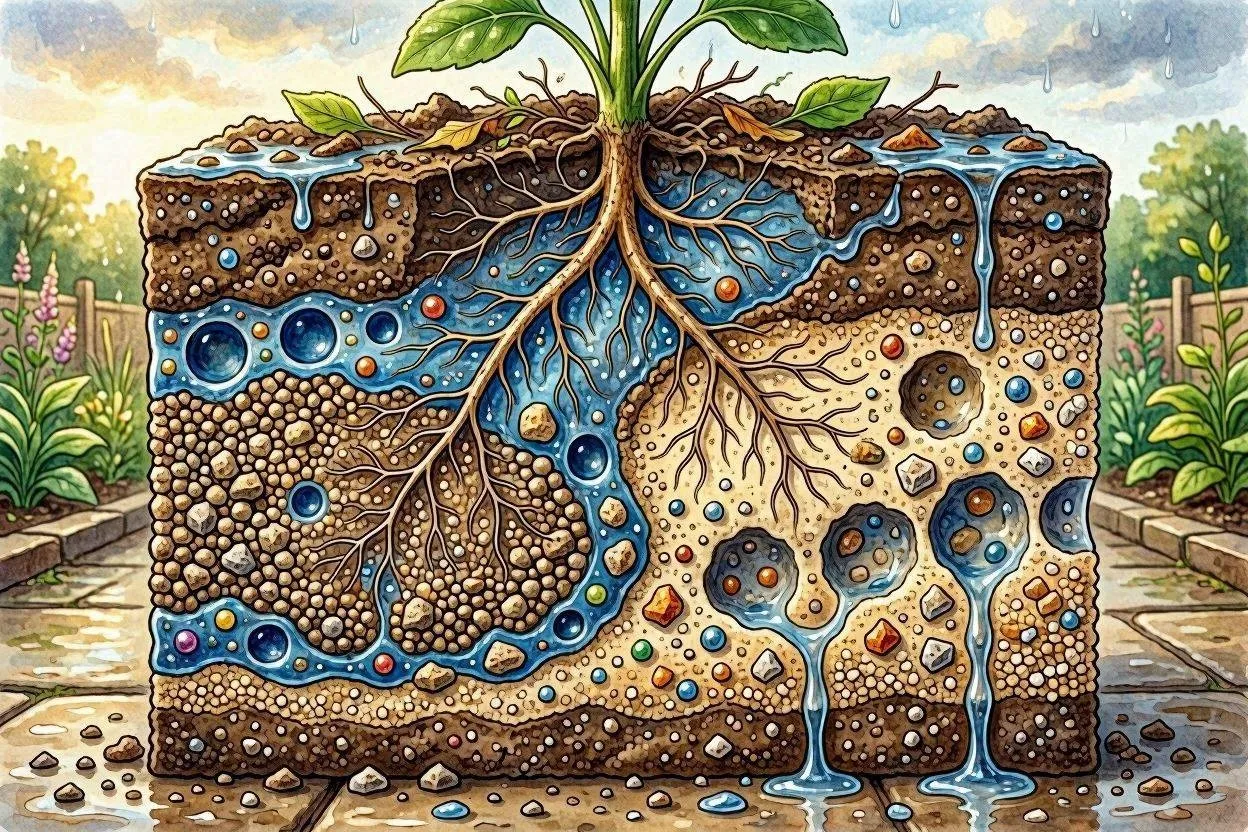
Nothing in soil moves without water. Minerals and organic matter can hold every nutrient a plant needs, but without water to dissolve and transport those nutrients to the roots, none of it matters. Water typically fills 20% to 30% of soil volume in healthy conditions.
How much water soil holds depends almost entirely on texture. Clay-heavy soil holds water the longest, sometimes too long, which raises the risk of root rot in wet climates. Sandy soil drains so fast that plants can dry out within a day or two during summer heat. Loam again strikes the balance, retaining enough moisture to get plants through dry stretches without drowning the roots.
Air: The Component Everyone Forgets
Ask someone what’s in soil and air rarely makes the list, yet it occupies roughly the same volume as water — another 20% to 30%. Roots need oxygen to respire, just like every other living part of a plant, and the microorganisms living in soil need it too.
Compacted soil is where air content collapses. Heavy foot traffic, vehicle weight, or repeated tilling without adding organic material can press soil particles so tightly together that air pockets disappear. Aeration — whether through a core aerator, a garden fork, or simply mixing in compost — reopens that space and lets oxygen back in.
The Living Layer: Microorganisms
A single teaspoon of healthy soil holds somewhere between 100 million and 1 billion microorganisms. Bacteria, fungi, protozoa, nematodes, and earthworms all live in that space, breaking down organic matter and converting it into forms plants can actually absorb.
Earthworms in particular do more than most people realize. As they move through soil, they create tunnels that improve drainage and airflow, and their castings are one of the richest natural fertilizers available. Soil without a healthy population of these organisms tends to rely far more heavily on synthetic fertilizer just to keep plants alive.
Soil pH: The Factor Most Guides Skip
Most articles on soil composition stop at minerals, organic matter, water, and air. But pH deserves a place in this conversation because it controls whether plants can actually use the nutrients sitting in the ground.
Soil pH is measured on a scale from 0 to 14, with most plants preferring a range between 6.0 and 7.0 — slightly acidic to neutral. Outside that window, nutrients like nitrogen, phosphorus, and potassium become chemically locked and unavailable to roots, even if the soil technically contains plenty of them. Lime raises pH, sulfur lowers it, and neither should be added without testing first.
Soil Layers: What’s Beneath the Surface
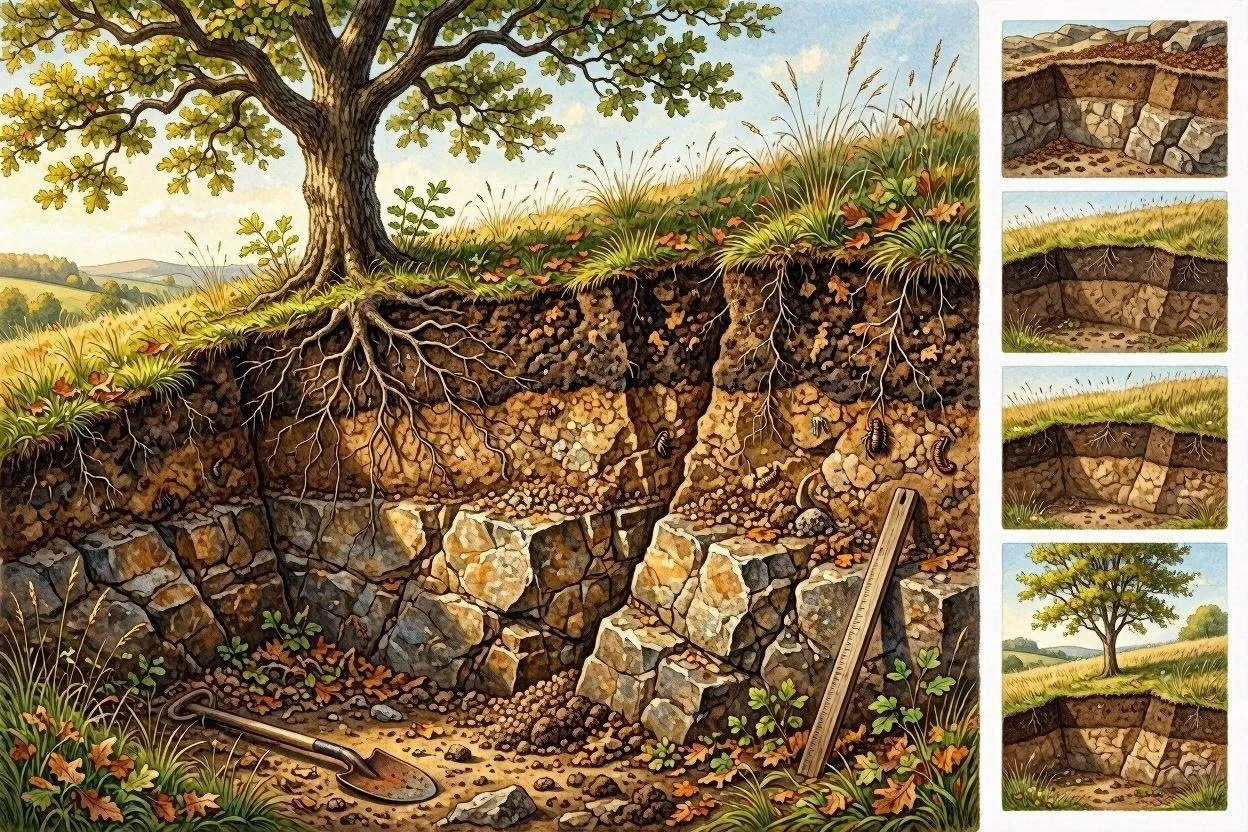
Slice through a cross-section of ground and you’ll find distinct layers, called horizons, stacked from the surface down to solid rock.
- Humus sits on top, made almost entirely of decomposed organic material
- Topsoil comes next, where most roots and seeds establish themselves
- The eluviation layer follows, stripped of nutrients by years of water leaching downward
- Subsoil holds dense concentrations of clay and minerals carried down from above
- Parent rock sits below that, partially broken down but not yet true soil
- Bedrock forms the base, solid and unweathered
Home gardeners and farmers mostly interact with the humus and topsoil layers. These are the layers that respond to compost, mulch, and tilling.
How Long Does It Take Soil to Form?

Soil forms through two ongoing processes: rock weathering and organic decomposition. Weathering slowly breaks parent rock into sand, silt, and clay through exposure to wind, water, and temperature swings. At the same time, dead plant and animal material builds up on the surface and works its way down, adding fertility as it decomposes.
This process is painfully slow. Soil forms at a rate of roughly 0.025 to 1 millimeter per year. That’s part of why conservation practices like no-till farming and cover cropping matter so much — soil lost to erosion in a single storm can take centuries to replace.
Testing Your Own Soil
You don’t need a lab to get a rough read on your soil. Grab a handful of moist soil and rub it between your fingers. Gritty means high sand content. Smooth and slippery points to silt. Sticky soil that holds a ribbon shape when pressed between your fingers signals heavy clay.
For pH, a basic testing kit or digital meter from a garden center will run you under $20 and give a reading in minutes. If you want a full nutrient breakdown, most state agricultural extension offices will test a soil sample for a small fee and return results within one to two weeks.
Frequently Asked Questions
What are the main components of soil?
Soil is made of minerals, organic matter, water, and air. Minerals form the largest share, followed by roughly equal parts water and air, with organic matter making up a small but critical portion.
Is clay or sandy soil better for gardening?
Neither is ideal on its own. Clay holds too much water and compacts easily, while sand drains too fast to retain nutrients. Loam, a mix of both plus silt, works best for most plants.
Why does organic matter matter so much if it’s only 5% of soil?
That small percentage feeds the microorganisms responsible for breaking down nutrients into forms plants can absorb. Without it, soil fertility drops fast regardless of mineral content.
How can I tell what type of soil I have?
Rub a moist handful between your fingers. Gritty means sandy, smooth means silty, and sticky means clay-heavy. A texture test like this takes seconds and needs no equipment.
Does soil pH really affect plant growth?
Yes. Outside the 6.0 to 7.0 range most plants prefer, nutrients already in the soil become chemically unavailable to roots, so even nutrient-rich soil can leave plants starving.
Conclusion
Soil looks simple from the surface, but it’s really a balance of four moving parts: minerals that give it structure, organic matter that feeds it, water that carries nutrients to roots, and air that keeps everything below the surface alive. Add pH and the layers beneath your feet into the picture, and it’s clear why two gardens a mile apart can produce completely different results with the same amount of care.
Once you know what your soil is actually made of, every decision after that gets easier — how much to water, what to amend, and what will actually grow well. That knowledge starts with a simple test, not a guess.