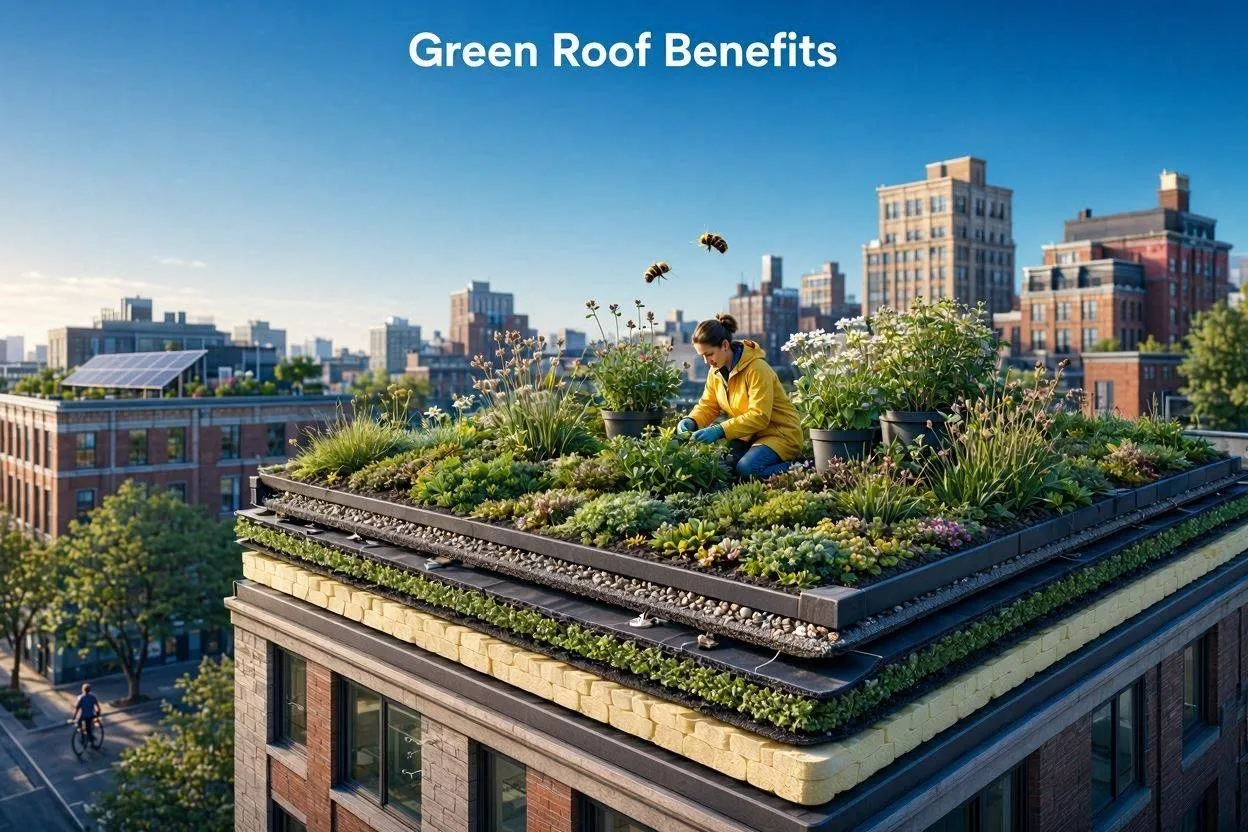
Green roofs cut building energy use, reduce stormwater runoff by up to 90%, and lower surrounding air temperatures by as much as 20°F (11°C). A green roof is a vegetated layer installed on top of a conventional roof deck, built over a waterproofing membrane, root barrier, drainage layer, and growing medium. Building owners install them for measurable reasons: lower utility bills, longer roof lifespan, cleaner air, and habitat for birds and pollinators.
This guide breaks down each benefit with hard numbers from the U.S. Environmental Protection Agency (EPA), industry case studies, and current building standards, then covers cost, return on investment, and climate-zone planning for U.S. properties.
What Is a Green Roof?
A green roof is a roofing system layered with living vegetation instead of asphalt, gravel, or metal. The standard build includes a waterproof membrane, a root-repellent barrier, a drainage layer, filter fabric, growing medium, and plants. Two main categories exist: extensive and intensive.
Extensive green roofs use a growing medium two to four inches deep and hold low, hardy plants such as sedum. They weigh less and need minimal upkeep. Intensive green roofs go much deeper, support trees and shrubs, and function like a rooftop park. A semi-intensive category sits between the two, with moderate depth and moderate maintenance demands.
Does a Green Roof Lower Energy Costs?
Yes. Green roofs reduce cooling loads by up to 70% and drop indoor air temperature by as much as 27°F (15°C) compared to conventional roofing, according to EPA research. The vegetation and growing medium act as insulation, blocking heat transfer through the roof deck in summer and retaining warmth in winter.
Annual savings run $0.15 to $0.57 per square foot for cooling and about $0.18 per square foot for heating, based on EPA figures. A 10,000-square-foot commercial roof could save $3,300 to $7,500 a year on climate control alone. Trent University testing found planted roofs run consistently cooler through every layer than unplanted equivalents, confirming the insulation effect holds up under real weather conditions, not just lab models.
How Much Stormwater Do Green Roofs Absorb?

Green roofs cut stormwater runoff by 60% to 90%, depending on rainfall intensity and growing medium depth. Water gets absorbed into the substrate and plant material, then released back into the atmosphere through evaporation and transpiration instead of flowing straight into storm drains.
This matters most in cities with combined sewer systems, where heavy rain overwhelms pipes and triggers overflow events. Chicago, New York, and Philadelphia have all cited stormwater relief as a driver behind municipal green roof incentive programs. A rooftop with a four-inch growing medium can retain nearly all rainfall during a typical summer storm and roughly 20% during winter, when soil saturation runs higher.
What Is the Urban Heat Island Effect, and How Do Green Roofs Reduce It?
The urban heat island effect describes the temperature gap between built-up city areas and surrounding rural land, caused by dark, heat-absorbing surfaces like asphalt and conventional roofing. Green roofs counter this by replacing heat-absorbing material with vegetation that reflects sunlight and releases moisture through evapotranspiration.
EPA data shows green roof surface temperatures run up to 56°F (13°C) cooler than standard roofing, and nearby air temperatures drop by as much as 20°F (11°C). Kansas City, Missouri, offers a documented example: over 700,000 square feet of green roofs installed between 1999 and 2020 produced avoided emissions of 384 pounds of nitrogen oxide, 734 pounds of sulfur dioxide, and 269 tons of carbon dioxide in a single year, translating to $35,500 to $80,500 in monetized health benefits for residents.
Do Green Roofs Improve Air Quality?
Green roofs reduce sulfur dioxide by up to 37%, nitrous acid by up to 21%, and trap roughly 0.2 kilograms (0.44 pounds) of dust per square meter annually. Plants absorb these pollutants through their leaves and root systems, then filter them into the substrate rather than letting them circulate in city air.
Lower air conditioning demand adds a secondary benefit. Less electricity draw means fewer emissions from power plants, which cuts the carbon dioxide tied to building operations even further. Buildings account for a large share of total emissions in most U.S. metro areas, so rooftop-level reductions compound across a city block instead of staying isolated to one structure.
Do Green Roofs Support Wildlife and Biodiversity?
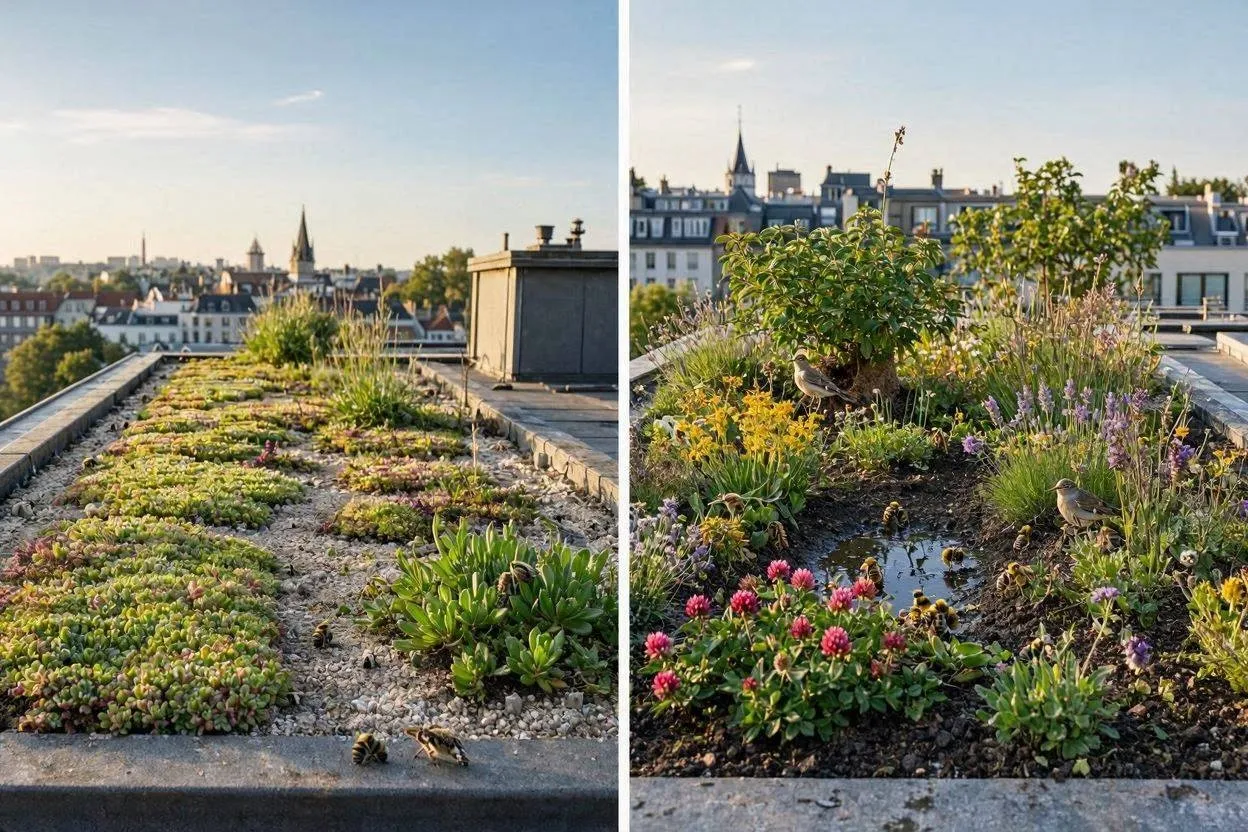
Green roofs create habitat for birds, insects, and pollinators in areas where ground-level green space has disappeared. A Swiss study of eleven green roofs recorded 172 separate species living across those rooftops, spanning insects, birds, and plant varieties.
Extensive roofs support fewer species because the shallow substrate limits plant diversity. Intensive roofs, with deeper soil and a wider plant mix, sustain far more complex ecosystems. Building owners pursuing Leadership in Energy and Environmental Design (LEED) certification can earn points directly tied to habitat creation and biodiversity metrics under current green building standards.
How Much Longer Do Green Roofs Last Than Conventional Roofs?
Green roofs extend roof lifespan to roughly 50 years, compared to about 15 years for a standard flat roof. The vegetation layer shields the waterproofing membrane from ultraviolet radiation, temperature swings, and physical wear, which are the three main causes of membrane failure on exposed roofs.
Cutting UV exposure alone can extend membrane service life by 10% to 100%. That range depends on membrane type and how well the root barrier performs over time. Fewer replacement cycles mean lower long-term capital costs, even though the upfront installation runs higher than conventional roofing.
Do Green Roofs Reduce Noise?
Yes. Green roofs reduce reflected sound by up to 8 decibels through the combined mass of substrate, vegetation, and trapped air. This works best near airports, highways, and industrial zones, where ambient noise runs constantly high.
The substrate layer absorbs sound waves before they reach the building interior. Occupants in buildings under flight paths or near rail lines report noticeably quieter indoor conditions after installation, a benefit rarely captured in standard energy audits but confirmed through post-installation acoustic testing.
What Does a Green Roof Cost, and What Is the Payback Period?
Extensive green roofs cost $10 to $25 per square foot to install; intensive green roofs run $25 to $50 per square foot, including structural reinforcement. A 5,000-square-foot extensive roof runs $50,000 to $125,000 before incentives, while an intensive roof of the same size runs $125,000 to $250,000.
Payback periods vary by climate zone, energy costs, and available incentives. Combined energy savings, reduced stormwater fees, and extended roof lifespan typically return the initial investment within 10 to 15 years for commercial buildings in high-utility-cost regions. Municipal incentive programs shorten that timeline directly. The District of Columbia’s RiverSmart Rooftops rebate program and Philadelphia’s Green Roof Tax Credit Program both offset installation costs for qualifying properties, and several other U.S. cities run comparable rebate structures tied to stormwater management goals.
What Standards Govern Green Roof Design in the United States?
ASTM E2400 is the primary U.S. standard guide for selecting, designing, and constructing vegetative roof systems. It covers structural load requirements, drainage specifications, and growing medium composition for buildings across different climate zones.
Many U.S. designers also reference the FLL Guidelines, a German green roof standard (Forschungsgesellschaft Landschaftsentwicklung Landschaftsbau) adopted widely across North America as a technical benchmark for waterproofing and root-barrier performance. Projects that meet both ASTM E2400 and FLL specifications typically pass structural review faster, since they align with what most municipal building departments already recognize.
How Does Climate Zone Affect Green Roof Plant Selection?
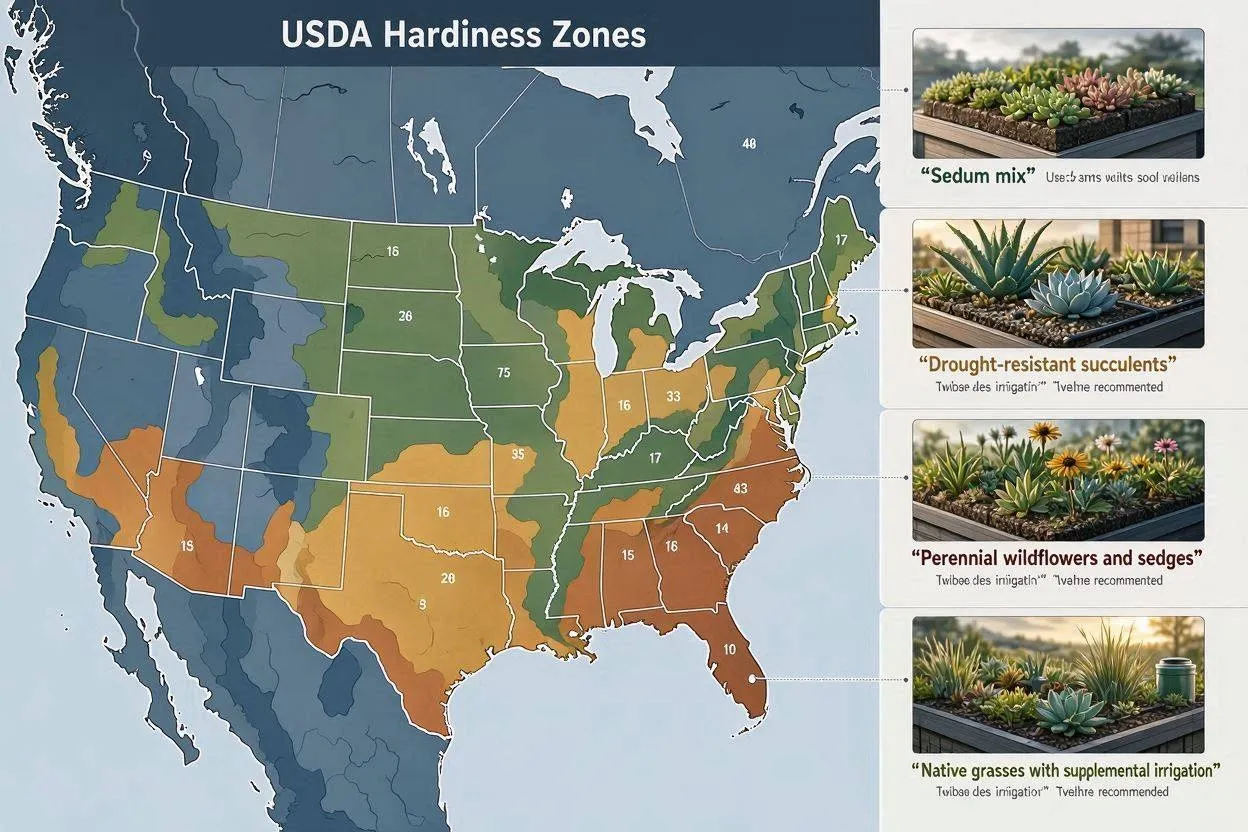
Plant selection depends on the United States Department of Agriculture (USDA) hardiness zone, since drought tolerance and cold hardiness vary sharply by region. A sedum mix that thrives in the Pacific Northwest may fail in a Zone 9 desert climate without supplemental irrigation.
Southwest installations need drought-resistant succulents and native grasses capable of surviving extended dry periods. Northeast and Midwest roofs need cold-hardy perennials that can handle freeze-thaw cycles without root damage. Skipping this step is the most common cause of green roof plant failure in the first two years after installation.
FAQs
Do green roofs increase property value?
Yes. Green roofs raise property value through lower operating costs, extended roof lifespan, and aesthetic appeal, though exact figures vary by market and building type.
What is the difference between extensive and intensive green roofs?
Extensive use of shallow substrates and low-maintenance plants like sedum. Intensive roofs use deeper soil, support trees, and function as usable rooftop parks.
Can a green roof be installed on any building?
No. Structural capacity determines feasibility. A structural engineer must confirm the roof deck can support the added weight, typically 50 to 200 kilograms per square metre (10 to 41 pounds per square foot).
How much maintenance does a green roof need?
Extensive roofs need minimal upkeep: seasonal weeding and occasional irrigation. Intensive roofs require regular watering, fertilizing, and pruning similar to a ground-level garden.
Do green roofs reduce fire risk?
Some studies suggest reduced fire risk in temperate climates, though results depend on plant moisture content and system design. This benefit remains under continued research.
Conclusion
Green roof benefits go beyond aesthetics: measurable energy savings, stormwater reduction up to 90%, a roof lifespan extended to roughly 50 years, and quantifiable air quality improvements all show up in EPA data and U.S. case studies. For property owners weighing the investment, the combination of municipal incentives, long-term operating savings, and compliance with ASTM E2400 and FLL standards makes 2026 a practical year to move from research to installation.