To remove moss from a lawn, scarify or rake out the existing growth, treat the area with an iron-based moss killer, then fix whatever’s causing it, whether that’s shade, compacted soil, or poor drainage. Moss doesn’t invade healthy turf. It moves in where grass is already losing ground. Skip the root cause, and it’s back within a season, often thicker than before.
This guide walks through five concrete steps, the best months to treat moss in both the UK and the US, and the long-term habits that actually keep it from returning.
What Causes Moss to Grow in a Lawn
Moss grows in lawns because of four main conditions: excessive shade, compacted soil, poor drainage, and acidic soil with a pH below 6.0. Grass struggles in each of these. Moss doesn’t. It needs almost no light and even less in the way of nutrients, so the moment turfgrass thins out anywhere, moss fills the space.
| Condition | Why It Favors Moss Over Grass | Quick Check |
| Excessive shade | Grass needs 4+ hours of direct sun daily; moss needs almost none | Fewer than 4 hours of sun on the affected area |
| Compacted soil | Squeezes out air pockets grass roots need; drains poorly | Screwdriver won’t push in past 1-2 in (2.5-5 cm) |
| Poor drainage | Creates the standing moisture moss depends on | Puddles remain 24+ hours after rain |
| Acidic soil (pH below 6.0) | Grass can’t absorb nutrients; moss is largely pH-indifferent | Soil test reads below 6.0 |
Shade is the one gardeners run into most. A lawn under mature trees, or pressed against a north-facing wall, simply doesn’t get enough direct sun for grass to stay dense. Blades thin, small gaps open, and moss spores, carried easily on wind and rain, settle into them within weeks.
Then there’s compaction, which does its damage more quietly. Heavy foot traffic, a car parked on the grass now and then, kids and dogs running the same route every day: all of it presses soil particles together and squeezes out the air pockets roots rely on. Compacted ground also drains badly, so it stays damp longer, which suits moss just fine. A screwdriver test is a fast way to check this. Push one into the soil; if it won’t go past an inch or two (2.5 to 5 cm), compaction is likely part of the problem.
Acidic soil piles onto both of these. Turfgrass does best between pH 6.0 and 7.0. Fall below that range and grass roots can’t take up nutrients properly, no matter how much fertilizer goes down. Moss, on the other hand, barely notices soil pH and happily colonizes the acidic patches grass has already given up on.
Cutting grass too short closes the loop. Mow below 2.5 inches (6.3 cm) and the root system weakens while the canopy opens up, letting light and moisture reach bare soil, exactly where moss spores need to land to get started. Add in a wetter-than-average winter, and even a well-kept lawn can develop a moss problem within a single season.
How to Remove Moss From Lawn: Step-by-Step Process
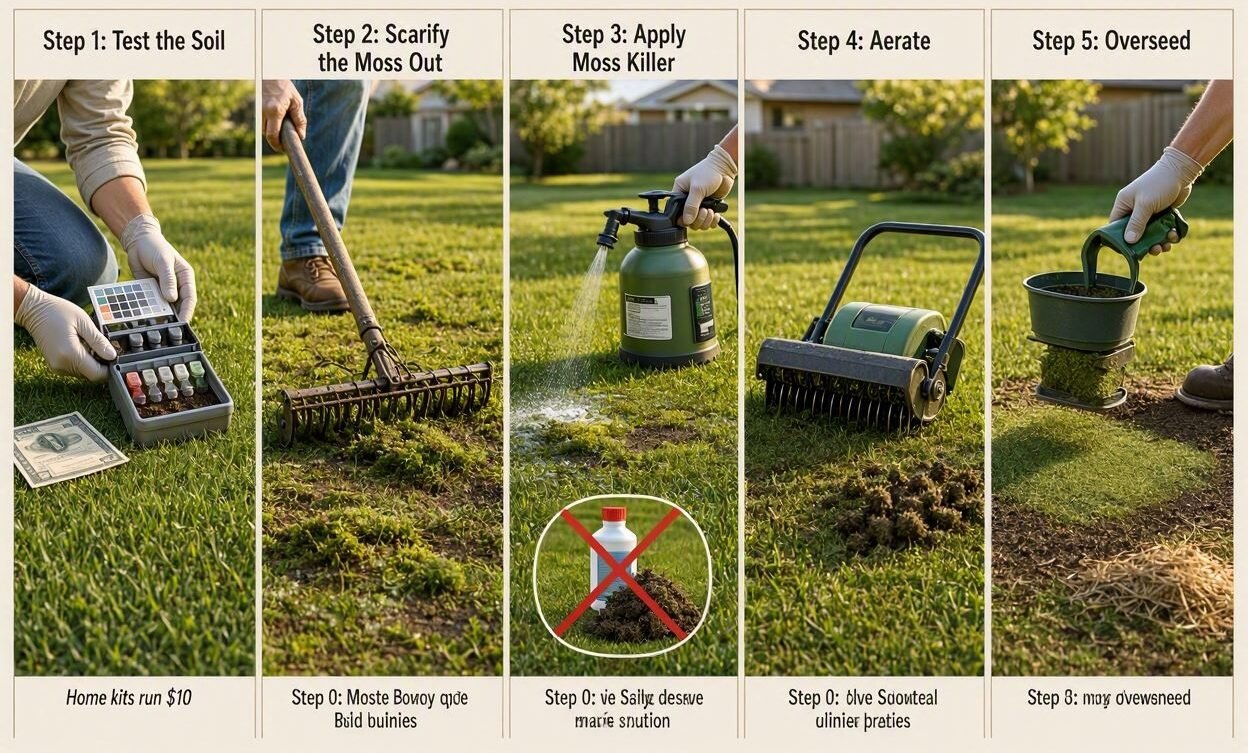
To remove moss from lawn areas effectively, follow five steps in order: test the soil, scarify the moss out, apply a moss killer, aerate, then overseed. Skip the order, especially by applying moss killer before scarifying, and product gets wasted while dead moss just sits on top of the grass.
Step 1: Test the Soil
A soil test tells you the exact pH and nutrient levels before you spend money on treatment. Home kits run $10 to $25 (£8 to £20) and give a reading in minutes. Want lab-grade accuracy instead? Send a sample to a university extension office in the US, or a soil testing lab in the UK. Anything below pH 6.0 means lime needs to go down before grass stands a real chance against moss.
Step 2: Scarify or Rake Out the Moss
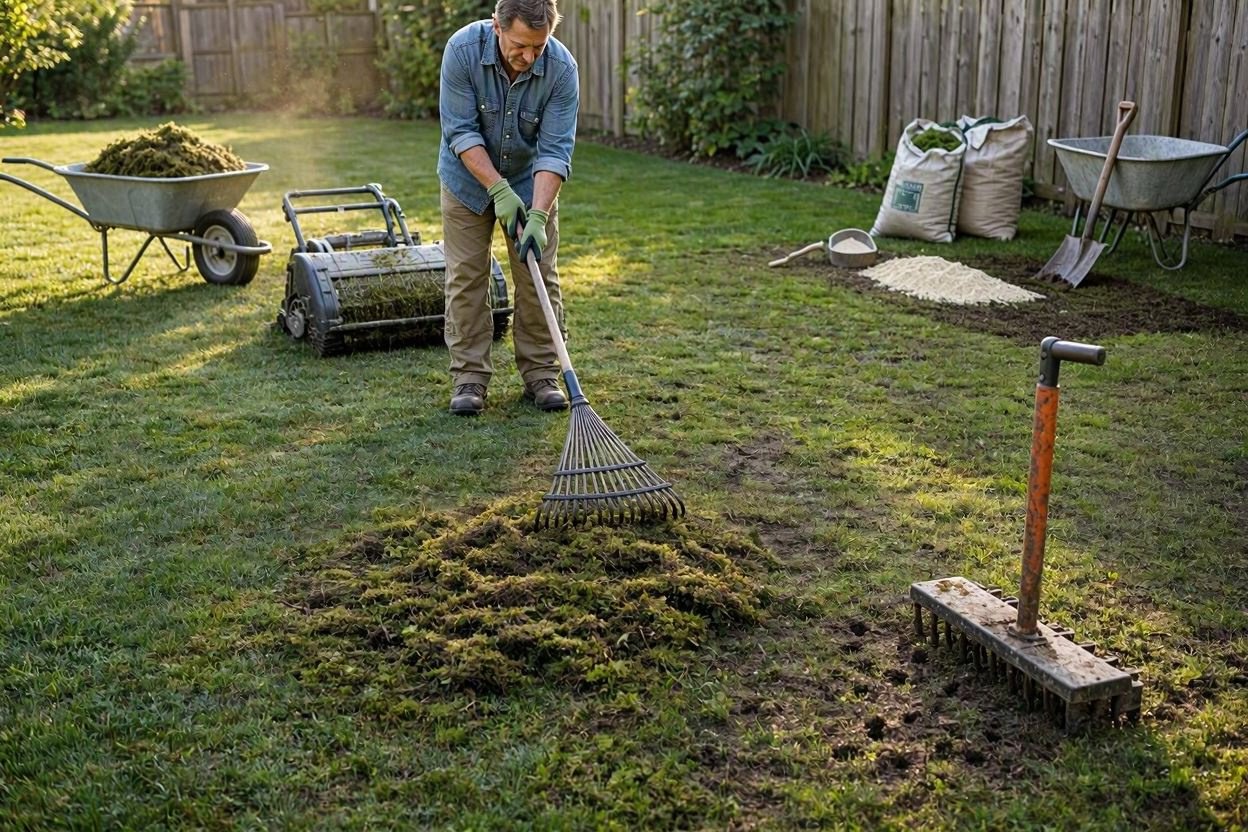
Scarifying pulls dead and living moss, along with built-up thatch, out of the lawn using a rake with sharp, angled tines. Lawns under 500 square feet (46 square meters) can usually be handled with a spring-tine rake and some elbow grease. Anything bigger calls for a mechanical scarifier, either rented for the day or run as a dethatching blade attachment on a mower.
Work the lawn in one direction, then go over it again at a right angle to the first pass. Two directions pull out noticeably more debris than one. The lawn will look rough right after, patchy, torn up, thinner than before. That’s expected. It’s the moss and dead thatch finally coming up where you can see it.
Step 3: Apply a Moss Killer
Iron sulfate, sold as ferrous sulfate or iron sulphate, kills moss by drying it out until it turns black within 24 to 72 hours. Granular formulas cover large lawns evenly with a broadcast spreader. Liquid concentrates work faster on smaller, targeted patches and go on with a garden sprayer. Stick to the rate printed on the label; too much can scorch the grass and leave a rust-colored stain on concrete or paving that’s genuinely hard to shift.
Give it 10 to 14 days before scarifying the dead moss out a second time. That gap lets the iron kill the root structure fully, not just the visible growth on top.
Step 4: Aerate the Lawn
Aeration relieves soil compaction by pulling small plugs of soil out of the ground, opening channels for air, water, and nutrients to reach grass roots. A hollow-tine aerator handles small lawns on its own. Larger properties do better with a rented core aerator, or a professional aeration service if the budget allows. Fall and early spring are when grass bounces back from this fastest.
Step 5: Overseed Bare Patches
Overseeding fills the gaps moss left behind with fresh grass seed before spores get another chance to settle in. Pick a shade-tolerant blend if the area gets under four hours of direct sun a day, fine fescue tends to do well in the US, while UK gardeners often go with a dwarf ryegrass mix. Rake the seed lightly into the soil, water daily for two weeks, and hold off mowing until the new growth hits at least 3 inches (7.6 cm).
Best Time of Year to Remove Moss From a Lawn
Fall is the best time to remove moss from a lawn in most US and UK climates, because cooler temperatures between 50°F and 65°F (10°C to 18°C) let grass recover quickly while moss is still actively growing and vulnerable to treatment. Spring is the backup window, especially for lawns that picked up heavy moss cover over winter.
Summer’s a different story. Heat stress on grass doesn’t pair well with the disruption of scarifying, and moss tends to go semi-dormant in hot, dry weather anyway, so treatment does less. Winter isn’t much better; growth slows to a crawl, and any seed put down won’t fill in before spring arrives.
Climate matters here too. Gardeners in the Pacific Northwest, or anywhere with similar year-round dampness, often need two treatment rounds annually, once in fall and again in early spring, since near-constant moisture keeps moss pressure high almost all year. Regions seeing wetter winters than a decade ago are increasingly falling into that same pattern.
Chemical vs. Natural Moss Killers
Chemical moss killers, mainly iron sulfate products, kill moss within 24 to 72 hours and are the faster, more reliable option for lawns with heavy or established moss cover. Natural alternatives, baking soda chief among them, take longer and suit light infestations or hard surfaces better than turf.
Baking soda, mixed at roughly 1 tablespoon per gallon of water (about 15 grams per 4 liters) with a splash of liquid soap as a sticking agent, dries out moss the same way iron sulfate does. It just takes longer, often a week or more. It’s genuinely gentler around edible plants and won’t stain concrete, but it isn’t tested or registered for large-scale lawn use the way commercial iron products are, and coverage on grass can be patchy compared to a hard surface like a patio.
Whichever route you go, keep pets and kids off the treated area until it’s fully dry: about 24 hours for chemical treatments, less for baking soda.
Why Regular Weedkiller Won’t Touch Moss
No, glyphosate-based weedkillers such as Roundup do not kill moss, because moss is a non-vascular plant without the internal tissue systemic herbicides need to travel through. Roundup works by moving through a plant’s vascular system down to the roots. Moss has no roots in the conventional sense, only rhizoids, thread-like structures that anchor it to the surface without carrying nutrients the way roots do. Spray a weedkiller on moss and it might look wilted for a day or two, but it grows right back. Iron-based moss killers work differently, drawing moisture out of the plant’s cell structure directly, which is why they’re the product category that actually gets results.
How to Prevent Moss From Coming Back
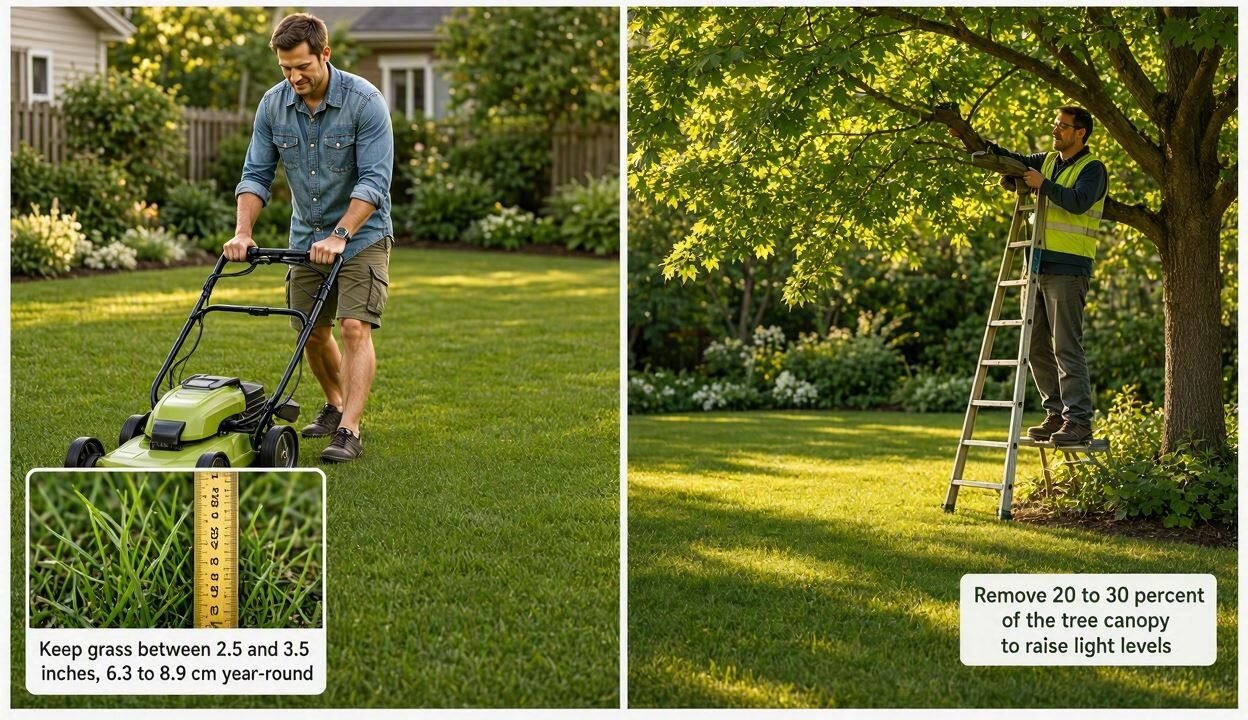
Preventing moss from returning means keeping grass thick and healthy enough that moss never finds an opening. Four habits make the biggest difference.
- Mow at the correct height. Keep grass between 2.5 and 3.5 inches (6.3 to 8.9 cm) year-round; cutting shorter stresses roots and thins the canopy.
- Prune overhanging branches. Removing even 20 to 30 percent of a tree’s canopy can raise light levels enough to tip a shaded lawn back in grass’s favor.
- Feed the lawn on a schedule. A balanced fertilizer applied in spring and fall keeps grass competitive against moss, which needs almost no nutrients to survive.
- Improve drainage where water pools. Regrading low spots or installing a simple French drain removes the standing moisture moss depends on.
Aerate once a year on most lawns, twice on heavy clay soil, and compaction won’t have a chance to build back up between treatments.
Moss as a Lawn Alternative
Some homeowners skip removal altogether and let moss take over as a low-maintenance ground cover, particularly in deep shade where grass never really stood a chance. No mowing, no fertilizer, and it stays green through most of the year in temperate climates.
The catch is durability. Moss doesn’t handle foot traffic well, so stepping stones or a defined path usually need to go in wherever people actually walk. Soil pH has to run acidic too, typically 5.0 to 6.0, for transplanted moss to take hold, which often means adding sulfur if the existing soil sits closer to neutral.
Cost of Removing Lawn Moss: DIY vs. Professional
DIY moss removal for an average 5,000-square-foot (465-square-meter) lawn costs between $40 and $120 (£35 to £95), covering a moss killer product, a rake or scarifier rental, and grass seed. A professional lawn care service charges $150 to $400 (£120 to £320) for the same area, and that usually includes scarifying, treatment, aeration, and overseeding all in one visit.
For lawns with a permanent cause, deep shade or a drainage problem that isn’t going away, an annual service contract often ends up cheaper than repeating DIY treatments every year, since a professional will typically diagnose the underlying issue rather than just treating what’s visible.
Common Mistakes When Removing Lawn Moss
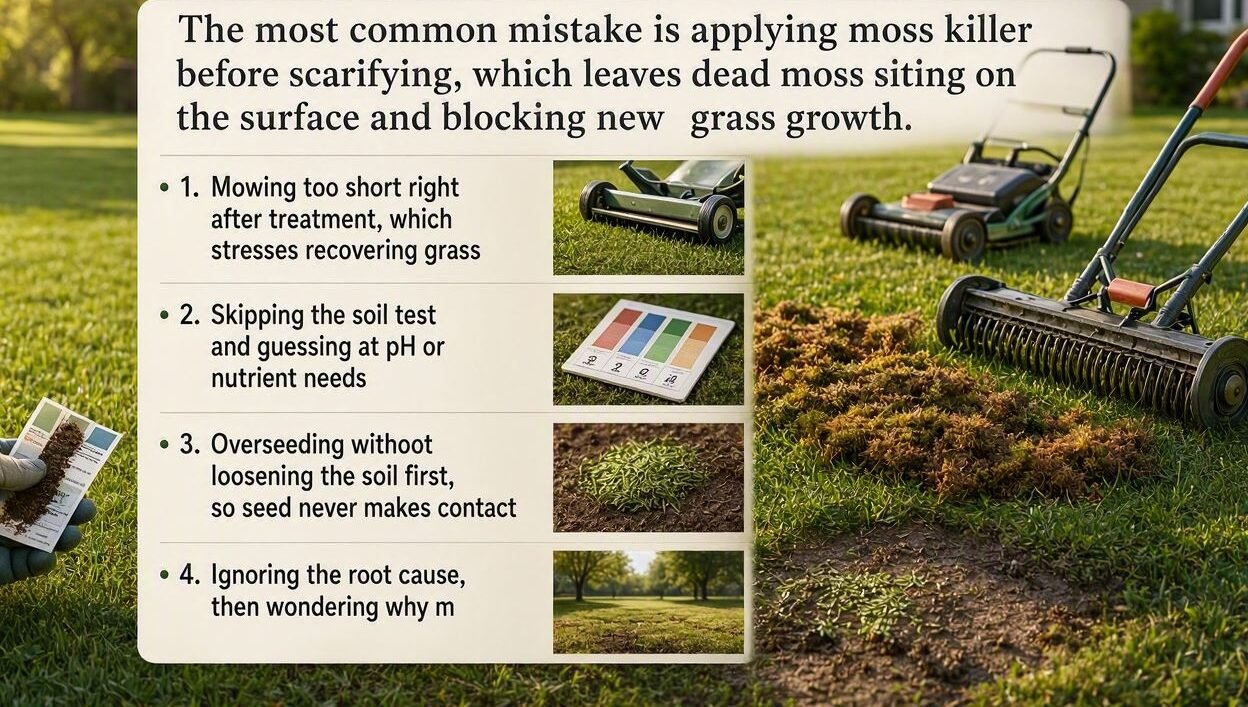
The most common mistake is applying moss killer before scarifying, which leaves dead moss sitting on the surface and blocking new grass growth. Four other errors show up again and again.
- Mowing too short right after treatment, which stresses recovering grass
- Skipping the soil test and guessing at pH or nutrient needs
- Overseeding without loosening the soil first, so seed never makes contact
- Ignoring the root cause, then wondering why moss is back within months
Any one of these turns a straightforward fix into a repeat job, and usually a more expensive one.
Frequently Asked Questions
Does vinegar kill moss on a lawn?
No. Vinegar scorches grass right along with the moss, since it doesn’t discriminate between plants. Iron sulfate or a diluted baking soda solution works better on turf specifically.
How long does it take moss to die after treatment?
Iron-based products turn moss black within 24 to 72 hours. Full die-off, and it being safe to rake out, usually takes 10 to 14 days.
Will moss grow back after scarifying?
Yes, unless the underlying cause, shade, compaction, or acidic soil, gets fixed too. Scarifying alone only clears out what’s already there.
Can I walk on my lawn after applying moss killer?
Wait until it’s fully dry, typically 24 hours, before letting pets or kids back onto the treated area.
Is moss bad for my lawn’s health?
Not directly. It’s a symptom of poor growing conditions rather than the cause, though a thick enough mat can smother grass that’s already struggling underneath.
Conclusion
Moss shows up where grass is already losing ground, whether that’s shade, compacted soil, poor drainage, or soil pH pulling turf down. Getting rid of it takes more than one product or a single weekend. Test the soil, scarify, treat with an iron-based killer, aerate, then overseed, and fix whatever let moss get a foothold in the first place. Do that in the right order, at the right time of year, and a lawn stays clear for seasons, not just a few weeks.