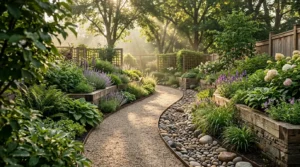
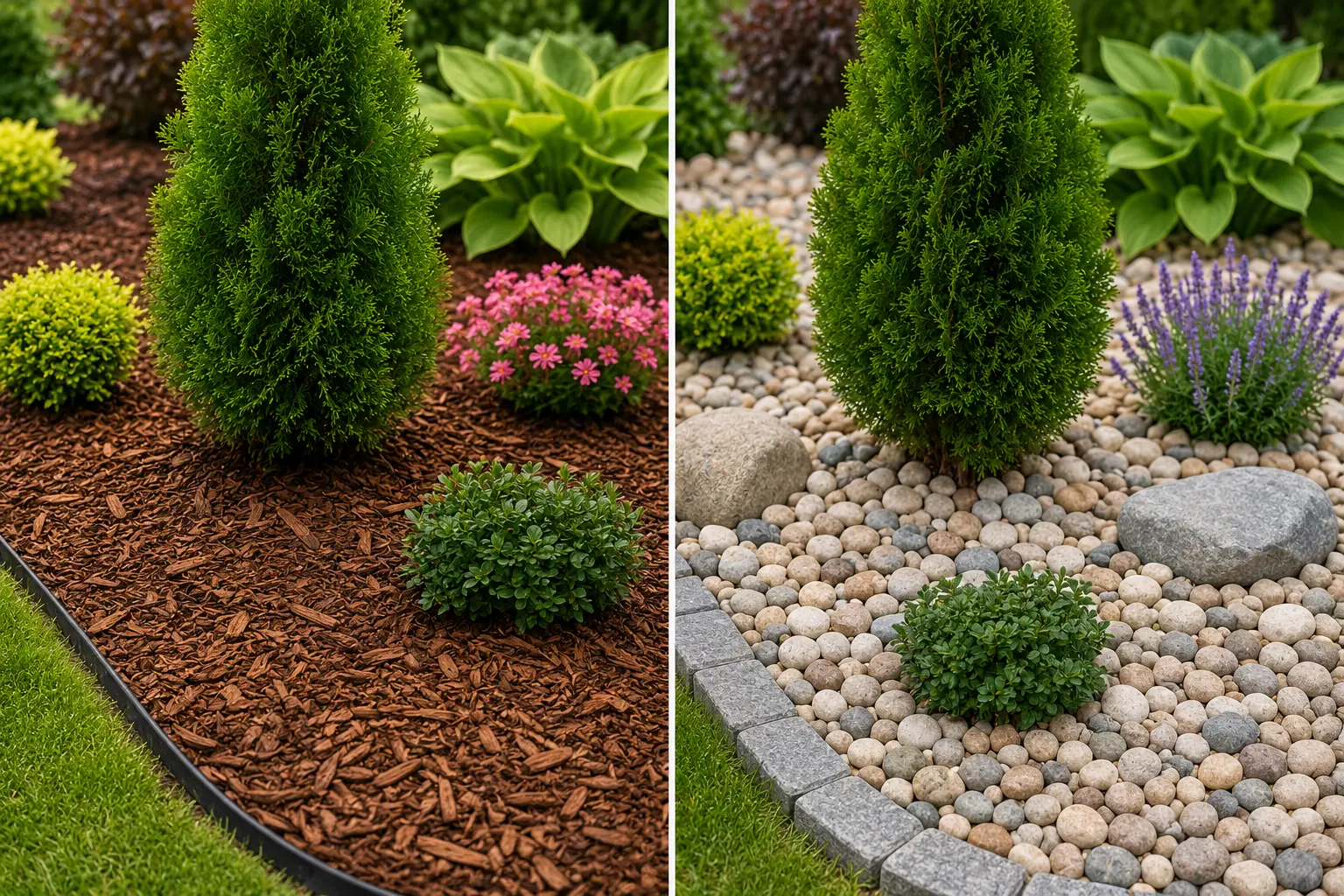
Mulch and rocks both cover garden beds, suppress weeds, and improve curb appeal. Beyond that, they work in completely opposite ways. Mulch feeds your soil and keeps roots cool. Rocks last decades but raise soil temperature and add zero nutrients. Picking the wrong one for your plants, climate, or maintenance schedule creates real problems — stressed plants, higher water bills, and difficult removal work down the line.
This guide covers every practical difference between mulch and rocks — cost, heat impact, weed control, drainage, soil health, and which one fits each specific garden situation. By the end, you will know exactly what to choose for your yard in 2026.
Mulch vs Rocks: The Quick Answer
Use mulch for plant beds, vegetable gardens, trees, and shrubs where soil health and root protection matter. Use rocks for low-maintenance zones, pathways, drainage areas, xeriscapes, and wildfire-prone properties.
Rocks are not mulch substitutes for most garden plants. Rocks around trees and flowering shrubs raise soil temperature, increase watering needs, and provide zero nutrition as they sit in place for decades. Mulch around plants almost always produces better plant health results. Rocks win on longevity, fire resistance, and zero-maintenance permanence in the right zones.
What Is Mulch?
Mulch is any material spread over soil as a protective surface layer. Organic mulches — wood chips, shredded bark, straw, shredded leaves, compost — decompose over 1 to 3 years, feeding soil as they break down. Inorganic mulches — gravel, rubber chips, landscape fabric — do not decompose and provide no soil nutrition.
Organic wood mulch is what most gardeners mean when they say “mulch.” Shredded hardwood, cedar bark, and pine bark are the most widely available types. A 2 cubic foot (0.06 cubic meter) bag of bagged mulch costs $4 to $8. Bulk mulch from a landscaping supplier costs $20 to $45 per cubic yard (0.76 cubic meters), covering roughly 100 square feet (9.3 square meters) at 3 inches (8 cm) deep.
Davey Tree research found mulch can nearly double how fast trees and plants grow by improving soil water storage, reducing evaporation, and moderating root zone temperature. That result does not apply to rocks.
What Are Landscaping Rocks?
Landscaping rocks are inorganic ground cover materials — pea gravel, river rock, crushed stone, decomposed granite, lava rock, and decorative boulders. Rocks do not decompose, do not need replacing, and stay exactly where placed for years or decades with minimal intervention.
Landscaping rock costs $45 to $140 per cubic yard depending on type. Pea gravel is cheapest at $45 to $75 per cubic yard. Decorative river rock runs $80 to $140 per cubic yard. Decomposed granite costs $35 to $70 per cubic yard and is popular for xeriscape and desert-style gardens.
The upfront cost of rocks is 2 to 4 times higher than mulch. Over 10 years, rocks become cost-effective because they require no annual replacement. Mulch replaced every 2 years at $85 per cubic yard costs $425 over 10 years for the same area rocks cover once at $90 to $140.
8 Key Differences Between Mulch and Rocks
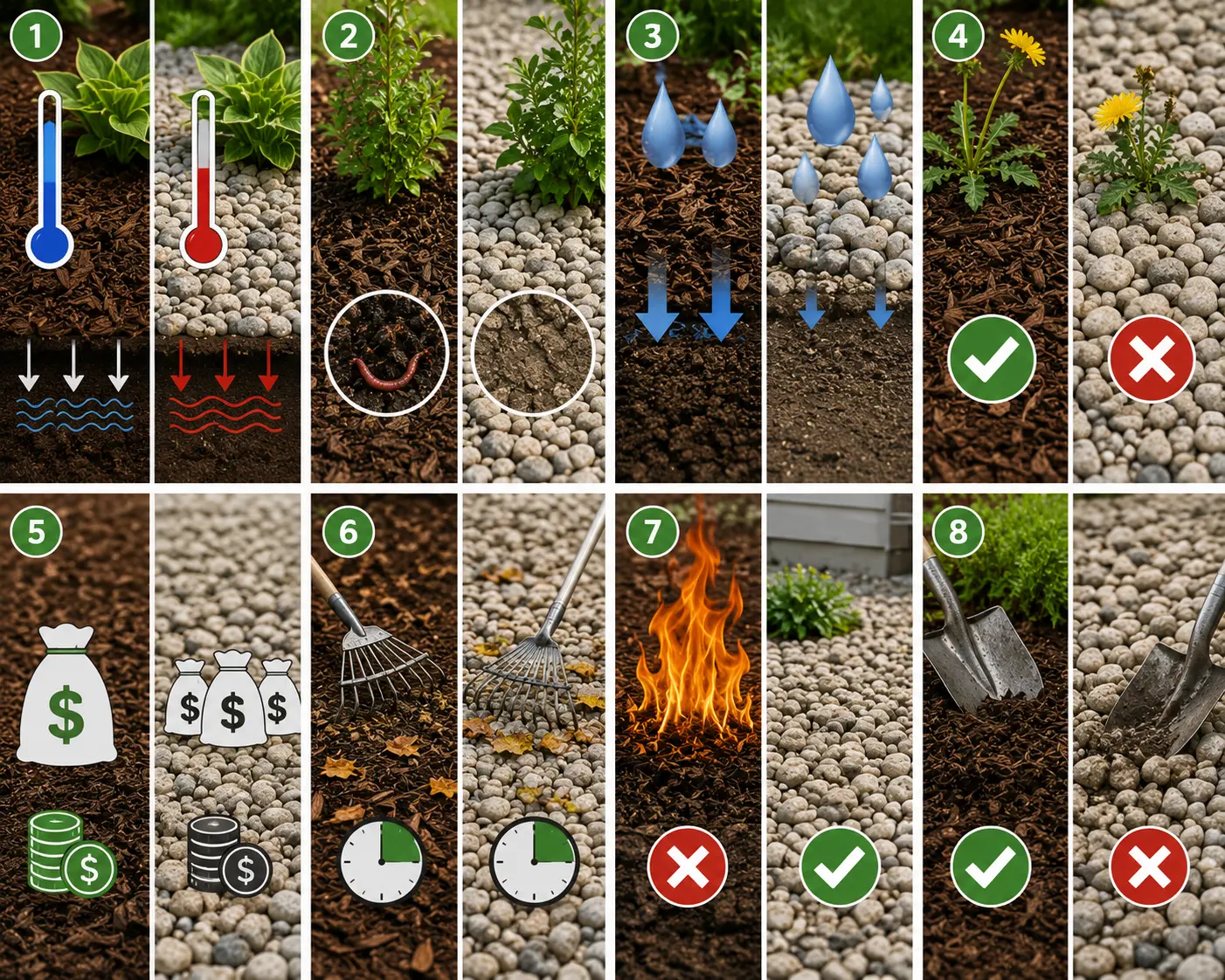
These 8 factors determine which material fits your garden correctly.
1. Soil temperature
This is rocks’ biggest weakness in plant beds. Dark rocks absorb heat during the day and radiate it back after sunset — raising root zone temperature well above comfortable growing conditions for most plants. Light-colored rocks reflect heat onto foliage and stems. Both effects stress plants, increase evaporation, and raise watering needs significantly in summer. Mulch does the opposite: organic mulch keeps soil 10 to 18°F (5 to 10°C) cooler than bare soil or rock-covered ground at peak midday heat. For any planted garden bed, mulch protects roots. Rocks stress them.
2. Soil health and nutrition
Mulch wins completely. Organic wood mulch decomposes over 2 to 3 years, adding humus, organic matter, and nutrients that feed soil microorganisms and earthworms. This improves soil structure, drainage, and water-holding capacity over time. Rocks add nothing. After 10 years of rock ground cover, the soil beneath is no more fertile than the day the rocks went down — often less, because soil life diminishes without organic inputs.
3. Moisture retention
Mulch retains moisture significantly better than rocks. A 3-inch (8 cm) layer of wood mulch reduces soil moisture evaporation by up to 70%, cutting summer watering frequency from daily to 2 to 3 times per week. Rocks do not retain moisture. Rock-covered soil dries faster than mulched soil because rocks absorb and radiate heat, accelerating evaporation from soil surfaces between and beneath stones. If water conservation matters, mulch is the clear choice.
4. Weed control
Both suppress weeds but in different ways. Mulch blocks light from reaching weed seeds in the soil, preventing germination. Rocks also block light but create small gaps where wind-blown seeds land on rock surfaces, germinate, and root through to soil beneath. Over time, rocks become harder to weed than mulch because removing weeds from between stones requires digging them out individually. Weeds growing in mulch pull out easily by hand. Rocks installed over landscape fabric control weeds better initially but fabric breaks down in 3 to 5 years, and removing degraded fabric from under rocks is difficult, messy work.
5. Cost over time
Rocks are cheaper long-term. Mulch at $85 per cubic yard, replaced every 2 years, costs $425 over 10 years per cubic yard of coverage. Rocks at $90 to $140 per cubic yard, installed once, cost less over the same period. The break-even point is typically 3 to 5 years. Upfront, mulch costs significantly less — an important factor for new gardens covering large areas. For established, permanent landscape zones, rocks pay off over time.
6. Maintenance
Rocks require less annual maintenance. No replacement, no replenishment, no decomposition to manage. Rocks do require occasional raking to redistribute displaced stones and removal of leaves and debris that accumulate between stones — organic material that blows in still creates weed opportunities. Mulch requires annual or biennial replenishment as it decomposes. Replenishing mulch takes 1 to 2 hours per 100 square feet (9.3 square meters). Rocks require about 30 minutes per 100 square feet annually for debris cleanup.
7. Fire resistance
Rocks are fireproof. In wildfire-prone regions — California, Colorado, Oregon, and the Southwest US — rocks create defensible space around structures. Organic mulch burns. The National Fire Protection Association (NFPA) recommends using rock, gravel, or decomposed granite within the first 5 feet (1.5 meters) of any structure in high fire risk zones. Rubber mulch, despite being inorganic, also burns and is not recommended in fire-prone areas.
8. Flexibility and removal
Mulch is far easier to change. Mulch decomposes naturally, and switching plant selections or replanting areas requires no extra effort — dig, plant, re-mulch. Removing rocks for replanting is heavy, labor-intensive work. A cubic yard of pea gravel weighs approximately 2,800 lbs (1,270 kg). Moving rock ground cover for a garden redesign takes significantly more time and physical effort than changing mulch. If your garden evolves frequently, mulch gives you far more flexibility.
For plants that need careful root zone temperature management, our chrysanthemum growing guide covers soil and mulch recommendations for perennial beds that experience temperature swings.
When to Choose Mulch
Mulch is the right choice in these 6 situations.
Around trees and shrubs
Apply a ring of wood chip mulch 3 to 6 feet (90 to 180 cm) in diameter around tree bases. Mulch protects roots from heat, retains moisture, prevents mower damage to bark, and feeds soil as it decomposes. Rocks around trees raise root zone temperature and starve soil of organic matter — both reduce long-term tree health.
Vegetable and flower gardens
Vegetable roots and flowering perennial roots need cool, moist soil. Mulch delivers both. Apply 2 to 3 inches (5 to 8 cm) of shredded wood or straw between rows and around plants. This also prevents soil-borne disease spores from splashing onto foliage during rain or watering.
New plantings
Newly planted trees, shrubs, and perennials establish faster under mulch than under rocks. Mulch conserves soil moisture during the critical first growing season, moderates root zone temperature, and reduces transplant stress. Rocks increase heat stress on young roots exactly when plants are most vulnerable.
Cold climates — USDA Zones 3 to 6
Mulch insulates roots against hard frosts. Apply 3 to 4 inches (8 to 10 cm) of wood chips or shredded leaves around perennial root zones in late autumn before the first hard freeze. This slows ground freeze and protects roots through winter cold snaps. Rocks provide minimal frost insulation.
Soil building priority
If your soil is compacted, sandy, or nutrient-poor, mulch builds it passively every season. Decomposing organic mulch adds humus, feeds soil microorganisms, improves drainage in clay soil, and improves moisture retention in sandy soil. Rocks cannot improve poor soil under any circumstances.
Budget-limited new garden installations
For new gardens covering large areas, mulch costs 2 to 4 times less upfront than rocks. A 1,000 square foot (93 square meter) new garden bed costs $600 to $900 to mulch at 3 inches deep with bulk hardwood. The same area in pea gravel costs $1,800 to $2,800. Start with mulch, convert permanent low-traffic zones to rock later if desired.
When to Choose Rocks
Rocks are the right choice in these 6 situations.
Xeriscape and drought-tolerant gardens
Succulents, ornamental grasses, lavender, rosemary, agave, and cacti perform better in rock ground cover than in wood mulch. These plants are adapted to hot, dry, rocky environments. Mulch around drought-tolerant plants retains too much moisture at the root crown, causing rot. Decomposed granite or pea gravel around these plants replicates their natural habitat.
Wildfire-prone zones
In high fire-risk areas — defined as within 5 feet (1.5 meters) of any structure — use rock, gravel, or decomposed granite. NFPA fire-safe landscaping guidelines specifically recommend noncombustible ground cover in this zone. All organic mulch — wood chips, bark, straw — is combustible. Rock in this zone can slow fire spread toward structures.
Pathways and high-traffic areas
Pea gravel, decomposed granite, and crushed stone make excellent pathway surfaces. They compact underfoot, allow drainage, and require no annual replacement. Wood mulch on pathways compresses quickly, gets tracked indoors, and needs topping up every year. For any walking surface, rock or gravel outperforms mulch.
Drainage problem areas
Rocky or gravelly ground cover in drainage channels, around downspouts, and in rain garden overflow zones prevents erosion and allows water to move freely. Wood mulch in drainage areas floats, washes away, and clogs drainage channels. River rock or 1.5 to 2 inch (4 to 5 cm) crushed stone handles water flow without displacement.
Zero-maintenance permanent zones
For landscape areas you never intend to replant — permanent foundation plantings, established rock gardens, utility areas along fences — rocks are ideal. Install once, clean out debris once a year, and the zone stays functional for a decade or more with no replenishment.
Modern or desert aesthetic
Rock ground cover suits contemporary, minimalist, and desert-inspired landscape designs. Decomposed granite in warm tones, white river rock in modern beds, and black lava rock in architectural settings create strong visual statements that wood mulch cannot match. If your design intent is clean-lined and permanent, rocks deliver that look consistently.
For plants that thrive in gravel or rocky soil conditions, our Lagerstroemia floribunda care guide covers planting and ground cover strategy for heat-tolerant flowering trees.
5 Common Landscaping Rock Types and When to Use Each
Not all rocks work the same way. Choosing the right rock type matters as much as choosing rocks over mulch.
Pea gravel
Small, smooth, rounded stones measuring 3/8 inch (1 cm) in diameter. Cost: $45 to $75 per cubic yard. Best for pathways, garden bed borders, and play areas. Pea gravel shifts underfoot and migrates over time, requiring occasional raking to redistribute. Avoid on steep slopes — pea gravel rolls.
River rock
Smooth, rounded stones measuring 1 to 3 inches (2.5 to 8 cm) in diameter. Cost: $80 to $140 per cubic yard. Best for drainage channels, dry creek beds, and decorative accent zones. Heavy enough to stay in place on moderate slopes. Leaves and debris accumulate between stones and require seasonal cleanup.
Decomposed granite (DG)
Finely crushed granite with a gritty, sand-like texture. Cost: $35 to $70 per cubic yard. Best for xeriscape gardens, pathways, and desert-style planting beds. Compacts firmly, drains well, and suits drought-tolerant plants. Avoid in wet climates — DG can harden into a concrete-like crust that blocks water penetration.
Lava rock
Lightweight, porous volcanic rock in red, black, or brown tones. Cost: $75 to $110 per cubic yard. Best for ornamental beds and xeriscape. Lava rock is porous enough to allow some air and water movement, making it slightly more plant-friendly than solid stone. Still retains heat — not ideal around heat-sensitive plants.
Crushed stone
Angular, mechanically crushed limestone, granite, or basalt in sizes from 3/4 inch (2 cm) to 1.5 inches (4 cm). Cost: $35 to $65 per cubic yard. Best for driveways, utility areas, drainage, and base layers under paver paths. Sharp edges lock together and resist shifting better than rounded stones.
Can You Use Both Mulch and Rocks in the Same Garden?
Yes — and strategic mixing produces the best results. Most well-designed residential landscapes use both materials in different zones based on function.
A practical split used by many experienced gardeners: wood mulch in all planted beds, around trees, and in the vegetable garden; rocks or gravel in pathways, drainage zones, foundation edges, and utility areas where plants do not grow.
One specific combination that works well: put a 6 to 12 inch (15 to 30 cm) ring of pea gravel or decomposed granite directly against the house foundation, then transition to wood mulch in the planting beds beyond that ring. The rock zone keeps moisture away from the foundation wall. The mulch zone feeds plant roots. Both materials do their best work.
Do not mix rocks and organic mulch in the same bed zone. Rocks over mulch trap moisture unevenly and create a messy, hard-to-maintain surface. Organic material that blows in between rocks creates weed opportunities that are much harder to manage than weeds in straight mulch.
For plants that benefit from strategic mulch placement around their root zone, our bush peony growing guide covers how mulch depth and timing affect long-lived perennials season after season.
5 Common Mulch and Rock Mistakes to Avoid
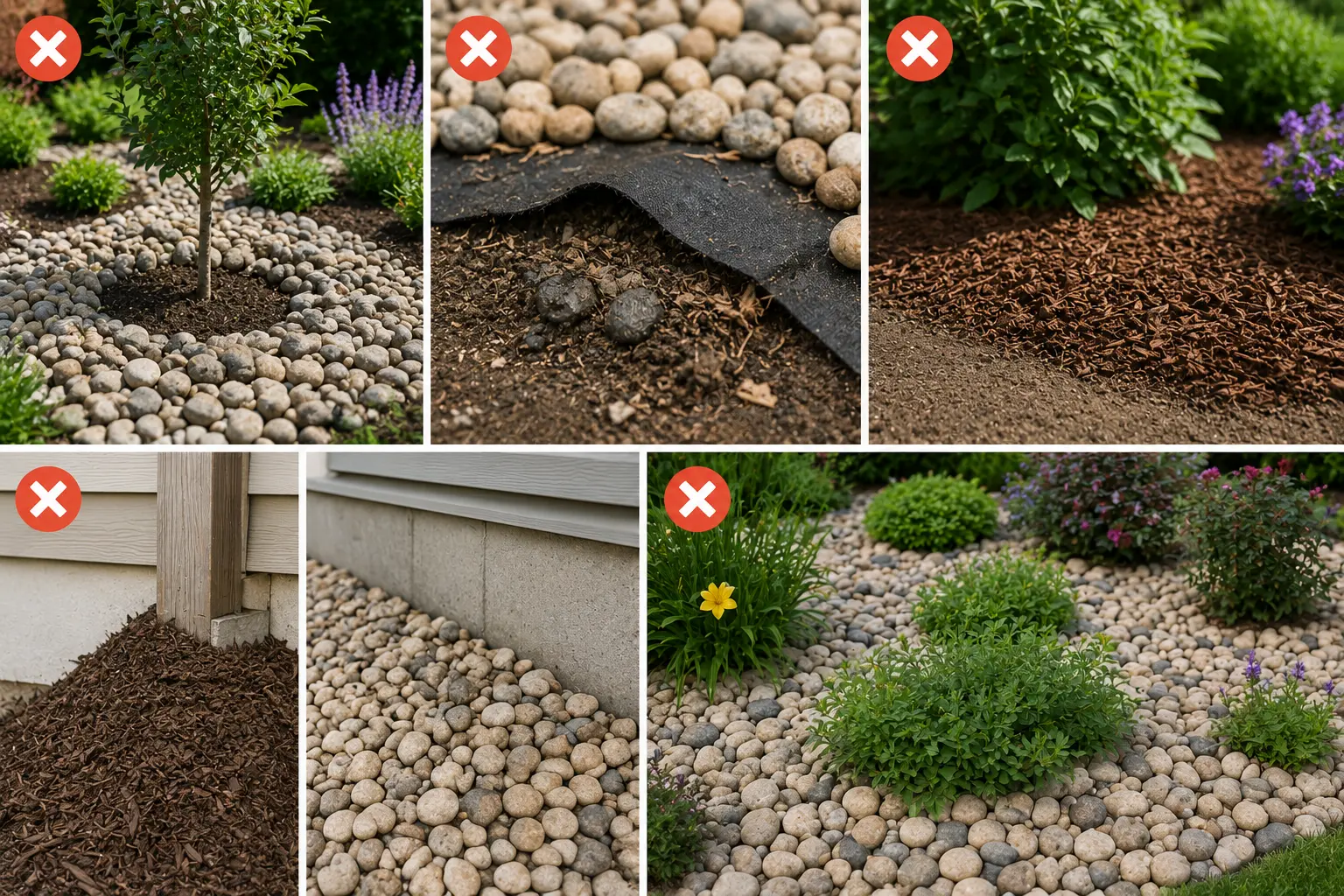
Using rocks around new plantings
Rocks around freshly planted trees, shrubs, or perennials stress roots during the most critical establishment period. Heat radiating from rock raises root zone temperature when roots need cool, moist conditions to establish. Use wood mulch for the first 2 to 3 years around any new planting, then convert to rock if desired once roots are fully established.
Installing landscape fabric under rocks
Landscape fabric under rocks seems logical but creates a long-term problem. Fabric breaks down in 3 to 5 years. Rocks sink through degraded fabric into soil. Organic debris accumulates on top, creating a weed-friendly layer. Removing degraded fabric from under rocks is one of the hardest landscape renovation jobs there is. If weed control is the goal, use a 4-inch (10 cm) rock layer without fabric — depth alone suppresses weeds effectively.
Applying mulch too shallow
Mulch at 1 inch (2.5 cm) deep provides almost no weed suppression and dries out within days in summer heat. Apply 2 to 3 inches (5 to 8 cm) for effective moisture retention and weed control. Do not exceed 4 inches (10 cm) — excessive depth blocks oxygen and water penetration.
Piling rock or mulch against structures
Both rock and mulch piled against house foundations, fence posts, or deck structures trap moisture against wood and concrete. This accelerates rot, attracts termites, and causes structural damage over time. Keep all ground cover — mulch and rock — at least 6 inches (15 cm) clear of any wooden structure and 2 to 3 inches (5 to 8 cm) clear of concrete foundations.
Choosing rock for aesthetic reasons in plant-heavy beds
Rock looks great in photos. It performs poorly in beds filled with flowering perennials, shrubs, or trees that need healthy soil. Homeowners who choose rock for appearance in planted beds end up with higher water bills, stressed plants, and a difficult removal project when they decide to fix it. Match material to function first. Aesthetics follow.
For plants that are particularly sensitive to root zone conditions, see our Aralia Fabian care guide for a detailed look at how soil moisture and mulch interact for tropical species.
Frequently Asked Questions
Do rocks or mulch add more value to a home?
Mulch adds more value in most markets. Healthy planted beds with fresh mulch signal a well-maintained property to buyers. Rock in planting beds can raise concerns about soil health and plant viability. Rock adds value in drought-prone regions like the Southwest US, where water-wise xeriscape is actively desirable. In most other regions, mulched planted beds outperform rock in perceived landscape value.
Does rock attract more bugs than mulch?
No — mulch attracts more insects than rock. Wood-based mulches retain moisture and decomposing organic matter, which draws ants, beetles, and occasionally termites. Rocks do not attract pests in the same way. However, rocks create stable hiding spots underneath for spiders, centipedes, and earwigs. Neither is a major pest concern in well-maintained landscapes, but mulch carries more insect activity than rock.
Can I switch from rocks to mulch?
Yes, but it is labor-intensive. Remove rocks by hand or with a flat shovel, separating them from soil. A cubic yard of pea gravel weighs 2,800 lbs (1,270 kg) — plan for heavy lifting or rental equipment for large areas. After removing rocks, amend soil with compost before applying mulch, since soil under rock coverage for several years typically needs organic matter replenishment.
Which lasts longer — mulch or rocks?
Rocks last indefinitely. Inorganic rock does not decompose, fade significantly, or break down. Organic wood mulch lasts 2 to 3 years before needing replacement. Dyed wood mulch fades in 1 season. For pure longevity, rocks have no competitor.
Is gravel the same as rock mulch?
Yes — gravel, pea gravel, crushed stone, and river rock are all forms of rock mulch. The term rock mulch covers any inorganic stone material used as ground cover. Different types vary in size, shape, drainage characteristics, and appearance, but all function as permanent, non-decomposing ground cover.
Which is better for drainage — mulch or rocks?
Rocks drain better than mulch. Water moves freely through gaps between stones. Dense wood mulch can slow water penetration if applied too thick or if it becomes hydrophobic when fully dry. For drainage channels, rain garden overflows, and areas with standing water, rock and gravel are the correct choice.
Final Verdict
For planted garden beds, trees, shrubs, and vegetable gardens — mulch wins. Mulch feeds soil, protects roots, retains moisture, and supports healthy plant growth that rocks simply cannot match.
For pathways, xeriscapes, drainage zones, wildfire-prone foundation areas, and permanent low-maintenance landscape sections — rocks win. Rocks last decades, cost less over time, and perform better in environments where soil enrichment is not the goal.
The most effective landscapes use both. Mulch in planting zones. Rock or gravel in structural, drainage, and utility zones. Each material in the place it performs best.
The worst outcome is using rocks in planted beds because they look good in photos. Root heat stress, increased watering costs, and a very difficult removal project follow. Match material to function. The garden does the rest.