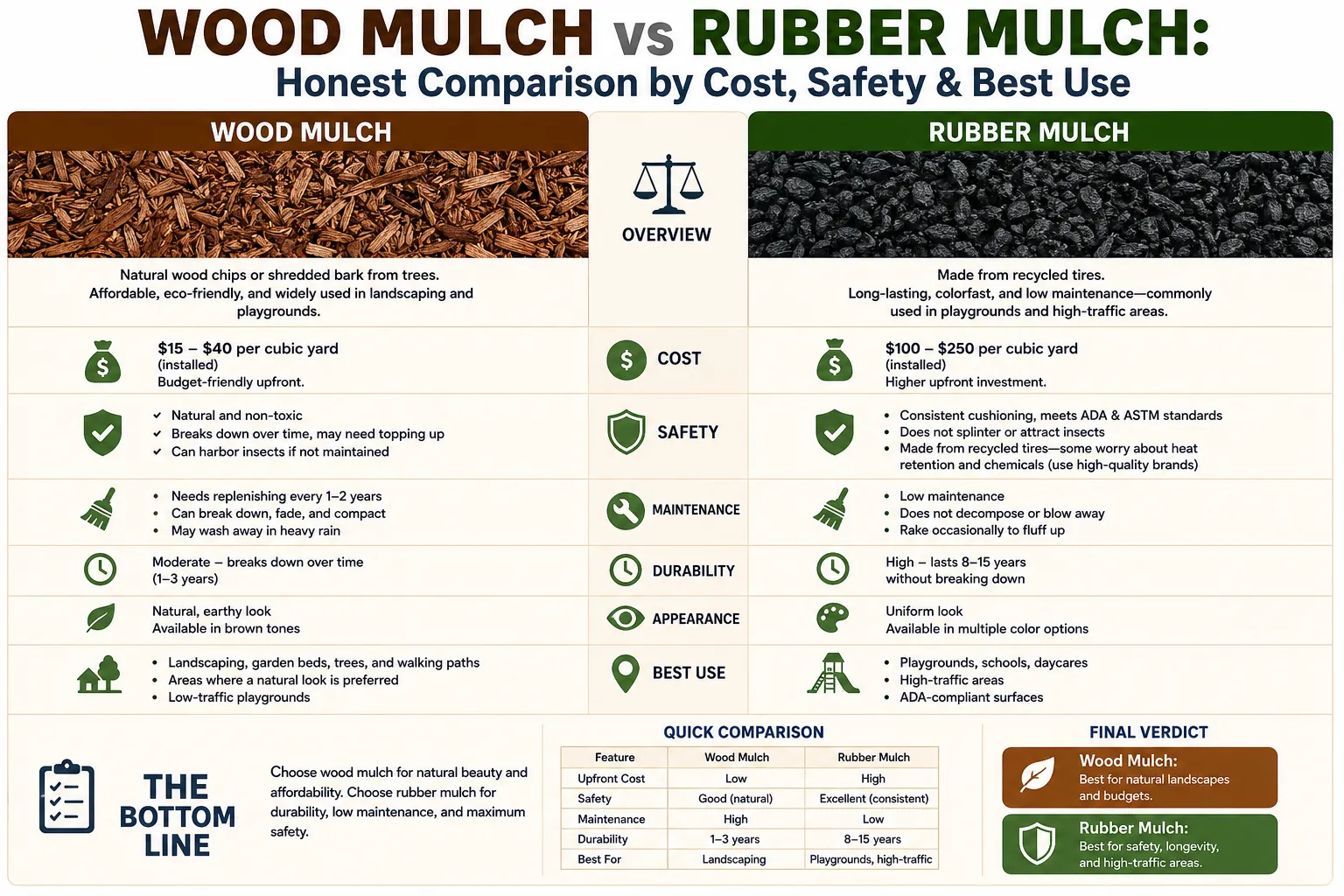
The mulch aisle at any garden center tells you rubber mulch is premium, long-lasting, and low-maintenance. The packaging makes it sound like a clear upgrade over wood.
The full picture is messier. Rubber mulch lasts longer and requires less topping up — that part is true. But rubber adds nothing to soil, can reach surface temperatures above 160°F (71°C) in direct sun, contains chemicals that leach into soil and groundwater over time, and costs 3–4x more upfront than wood.
This guide compares wood mulch and rubber mulch across 9 factors: cost over 10 years, soil impact, safety, fire risk, environmental concerns, maintenance, and specific use cases where each genuinely wins.
What Is Wood Mulch and What Is Rubber Mulch?
Wood Mulch
Wood mulch is organic material — shredded bark, wood chips, or sawdust — that decomposes over 1–5 years, adding organic matter to soil as it breaks down. Sources include hardwood bark, cedar, cypress, pine, and recycled wood products.
Types of wood mulch available:
- Hardwood bark mulch: Dense, slow-decomposing, rich brown color. Lasts 2–3 years. Best for perennial beds and formal landscapes.
- Wood chips: Larger pieces, coarser texture. Lasts 3–5 years. Best for paths, tree rings, and large beds.
- Cedar mulch: Natural oils repel insects. Lasts 3–4 years. Slightly acidic — good for acid-loving plants.
- Cypress mulch: Water-resistant, slow to decompose. Lasts 3–4 years. Note: some cypress mulch comes from clear-cut wetland forests — check sourcing.
- Dyed wood mulch: Color-treated chips in red, black, or brown. Same decomposition rate as untreated. Dyes are generally iron oxide-based and considered safe, but avoid mulch made from CCA (chromated copper arsenate)-treated lumber — CCA contains arsenic.
Rubber Mulch
Rubber mulch is ground or shredded recycled tires — an inorganic, synthetic material that does not decompose. The United States generates approximately 300 million scrap tires annually, and rubber mulch represents one use for this waste stream.
Rubber mulch comes in 3 main forms:
- Nugget rubber mulch: Larger pieces, similar size to wood nuggets. Most common for landscaping and garden beds.
- Crumb rubber (shredded): Finer texture, often used for playground fall zones and athletic surfaces.
- Colored rubber mulch: Dyed in red, brown, black, or green. Color holds longer than dyed wood mulch — 3–5 years before fading.
Wood Mulch vs Rubber Mulch: Side-by-Side Comparison
| Factor | Wood Mulch | Rubber Mulch | Winner |
| Upfront cost (per cu yd) | $30–80 | $100–200 | Wood |
| 10-year total cost | $150–400 (4–5 replacements) | $100–200 (1 purchase) | Rubber (long-term) |
| Lifespan | 1–5 years (type-dependent) | 10–15 years | Rubber |
| Soil fertility benefit | High — adds organic matter | None | Wood |
| Moisture retention | High | Low — does not absorb water | Wood |
| Weed suppression | Good | Excellent | Rubber |
| Pest resistance | Moderate — can harbor termites | High — no food source for insects | Rubber |
| Fire risk | Moderate — burns, self-extinguishes | High — burns hot, hard to extinguish, toxic smoke | Wood |
| Chemical safety | Safe (untreated), avoid CCA wood | Zinc, PAHs, VOCs leach over time | Wood |
| Surface temperature | Stays near ambient temperature | Reaches 160°F+ (71°C+) in direct sun | Wood |
| Soil microbe impact | Positive — feeds microbes and earthworms | Negative — starves microbes over time | Wood |
| Environmental impact | Biodegradable, renewable | Non-biodegradable, leaches into groundwater | Wood |
| Playground safety (fall zone) | Good (shredded wood chips: ASTM F1292) | Excellent (crumb rubber: top-rated shock absorption) | Rubber |
| Maintenance effort | Annual topping up needed | Rake debris, occasional power wash | Rubber |
| Appearance longevity | Fades in 6–12 months | Holds color 3–5 years | Rubber |
Real Cost Comparison: Wood Mulch vs Rubber Mulch Over 10 Years
The upfront cost difference is significant. The 10-year cost comparison is where rubber mulch gains ground — but only in specific scenarios.
Wood Mulch: 10-Year Cost
Wood mulch costs $30–80 per cubic yard. A standard 500 sq ft (46.5 m²) bed mulched at 3 inches depth needs 4.6 cubic yards — a $140–370 initial investment.
Wood mulch requires replenishment every 1–3 years. Over 10 years, a 500 sq ft bed costs:
- Hardwood bark: $140–370 x 4 applications = $560–1,480 total
- Cedar or cypress: $180–450 x 3 applications = $540–1,350 total
- Wood chips: $100–280 x 2–3 applications = $200–840 total
Add annual labor — 2–3 hours per application at average landscaping rates of $40–60 per hour — and the 10-year total climbs further.
Rubber Mulch: 10-Year Cost
Rubber mulch costs $100–200 per cubic yard. The same 500 sq ft bed at 3-inch depth needs 4.6 cubic yards — a $460–920 initial investment. With a lifespan of 10–15 years, that is typically a one-time purchase.
Maintenance costs are minimal: occasional raking and debris removal. No annual replenishment. Over 10 years, rubber mulch costs $460–920 total for the same bed.
Rubber mulch reaches cost parity with wood mulch around year 3–5 for most homeowners. After that, rubber mulch costs less overall. This math only holds for non-garden decorative beds. For vegetable gardens and planting beds, the soil fertility benefit of wood mulch has monetary value that the comparison ignores.
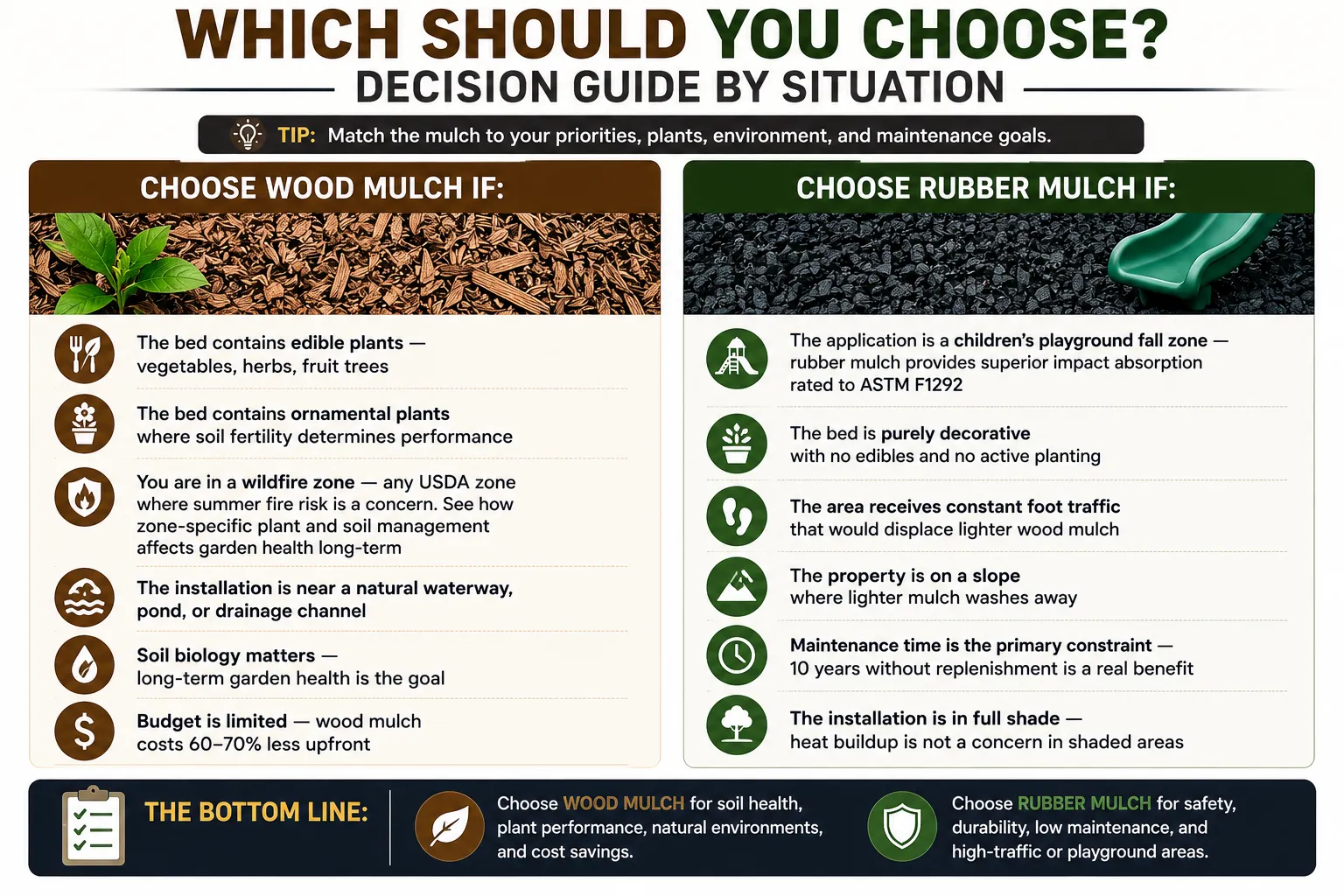
Soil Impact: The Biggest Difference Between the Two
Wood Mulch — Builds Soil Over Time
Wood mulch feeds the soil biology that makes plants grow. As wood decomposes, beneficial bacteria and fungi break down organic carbon into humus — stable organic matter that improves soil structure, water retention, and nutrient availability.
Earthworm populations under wood mulch beds increase 3–5x compared to bare soil. Earthworms aerate soil, improve drainage, and produce castings that increase plant-available nutrients by 5–10x compared to surrounding soil.
For beds containing flowering plants and perennials that rely on rich organic soil for root development and bloom performance, wood mulch is not just cosmetic — it actively builds the growing environment season by season.
Rubber Mulch — Starves Soil Biology
Rubber mulch provides zero organic matter to soil. No decomposition means no carbon input, no food for soil microbes, and no habitat for earthworms. Over time, soil under permanent rubber mulch develops reduced biological activity — compacts more easily, drains less effectively, and requires increasing amounts of synthetic fertilizer to maintain plant health.
WSU Extension research noted that earthworms and soil microbes require decomposing organic matter as a food source. Without this input, soil structure collapses over years of rubber mulch coverage. The USDA Agricultural Research Service specifically concluded that ground or chipped tire material should not be used on agricultural or garden soils.
This is the core reason rubber mulch belongs in non-planting areas — playgrounds, pathways, decorative tree rings far from roots — and not in active garden beds.
Chemical Safety: What the Research Actually Shows
This is the most contested part of the wood mulch vs rubber mulch debate. Here is what the current research says, without spin from either side.
Rubber Mulch Chemical Composition
Recycled tires contain zinc, lead, cadmium, chromium, PAHs (polycyclic aromatic hydrocarbons), and VOCs (volatile organic compounds) including benzene and toluene. These compounds do not disappear during recycling into mulch.
Key findings from research:
- Zinc is the primary concern. Zinc constitutes up to 2% of total tire mass. A USDA researcher who studied zinc in soils for over 20 years concluded ground rubber should not be used in any garden soil or composting medium due to zinc toxicity to plants and soil organisms.
- Leaching increases with heat. Chemical release rates from rubber mulch increase significantly in warm, acidic conditions — which describes most garden beds in summer. Surface temperatures above 100°F (38°C) accelerate VOC off-gassing.
- 6PPD-quinone is a newly identified concern. This compound forms when a common tire preservative meets atmospheric ozone. It is demonstrably lethal to coho salmon at very low concentrations and has been confirmed in rubber mulch leachate. Its full environmental impact is still being studied.
- Leachate toxicity increases over time. Research showed that rubber mulch leachate became more toxic at the 2-year mark than at the study’s start — meaning older rubber mulch is not necessarily safer.
- EPA 2024 study on playgrounds: Found that exposure levels during typical play activity appear limited and below levels associated with significant health risk for most chemicals studied. However, the same study noted that 6PPD-quinone and other emerging compounds require further investigation.
The honest summary: rubber mulch is not acutely toxic to humans at normal exposure levels for playground use. However, it does leach chemicals into soil and groundwater over time, and the USDA and WSU Extension advise against use in garden soil areas. The risk profile for playgrounds with healthy children is different from the risk profile for edible gardens.
Wood Mulch Chemical Concerns
Untreated, sustainably sourced wood mulch is chemically safe. The main wood mulch concern is CCA (chromated copper arsenate)-treated lumber, used in older pressure-treated wood and some recycled construction lumber.
- CCA contains arsenic, which leaches into soil and can be absorbed by edible plants — never use wood mulch made from CCA-treated lumber in vegetable gardens
- Fresh wood chips from tree services are safe — confirm they come from untreated trees
- Look for mulch certified by the Mulch & Soil Council (MSC) — certification confirms testing for chemical contaminants and consistent quality
- Dyed wood mulch uses iron oxide or carbon-based colorants — these are generally considered safe, but confirm the base wood is untreated
Fire Risk: A Factor Most Comparisons Ignore
Rubber mulch is significantly more flammable than wood mulch — and significantly more dangerous when it burns.
Wood mulch burns when ignited but self-extinguishes relatively easily. Rubber mulch burns hotter and faster than wood, produces dense toxic smoke containing hydrogen cyanide and sulfur dioxide, and is extremely difficult to extinguish once fully ignited. Standard water application is ineffective — rubber fires require foam or dry chemical suppression.
In wildfire-prone regions — USDA zones 9–10 in California, Oregon, Arizona, Colorado — rubber mulch against or near structures creates a serious ignition and spread risk. Multiple fire departments in Western states advise against rubber mulch within 30 feet (9 m) of any structure.
Wood mulch close to structures also presents fire risk, but the fire behavior is far more manageable. Maintain a 12-inch (30 cm) clearance between any mulch and wood siding, and keep mulch depth under 3 inches to reduce smolder risk.
Surface Temperature: Rubber Mulch Gets Dangerously Hot
Rubber mulch in direct summer sun reaches surface temperatures of 150–170°F (65–77°C) — hot enough to cause burns on bare skin and scorch exposed plant crowns and shallow roots.
Research at Penn State University measured playground rubber mulch at 160°F (71°C) on an 80°F (27°C) day. For comparison, wood mulch under identical conditions reached 105°F (40°C).
- Children’s playgrounds: inspect rubber mulch surface temperature before allowing children to play on hot days — use a hand to test before bare feet or knees contact the surface
- For plants like chrysanthemums and other shallow-rooted perennials sensitive to root zone heat, rubber mulch in direct sun can damage root systems even without chemical exposure
- Rubber mulch in partial or full shade significantly reduces heat buildup — shaded installation is safer for both plants and people
Where Each Mulch Wins: 8 Specific Use Cases
| Use Case | Best Choice | Reason |
| Vegetable garden | Wood mulch only | Rubber leaches chemicals; food safety concern. Wood builds soil and is safe. |
| Flower beds (perennials) | Wood mulch | Soil fertility needed; wood feeds roots long-term. Rubber starves soil biology. |
| Children’s playground fall zone | Rubber mulch (crumb) | Superior shock absorption; rated to ASTM F1292. Best fall protection available. |
| Decorative landscape beds (no edibles) | Either — rubber for low maintenance | Rubber: zero upkeep for 10+ years. Wood: better aesthetics, improves soil. |
| Tree rings and base mulching | Wood chips | Wood feeds tree roots. Rubber restricts soil biology; heat buildup risks fine surface roots. |
| Garden paths and walkways | Either — rubber preferred | Rubber stays in place, handles foot traffic, no decomposition. Wood needs topping up. |
| Slopes and erosion-prone areas | Rubber mulch | Heavier weight — stays put in rain and wind better than lightweight wood. |
| Wildfire-prone areas | Wood mulch only | Rubber burns hotter, harder to extinguish, produces toxic smoke. Wood is far safer. |
Choosing the Right Wood Mulch Type
Not all wood mulch performs the same. 5 variables determine which type suits your application.
| Wood Mulch Type | Cost (per cu yd) | Lifespan | Soil Benefit | Best Application |
| Hardwood bark | $30–50 | 2–3 years | High | Perennial beds, formal landscapes |
| Wood chips (arborist) | $0–20 (often free) | 3–5 years | High | Trees, large beds, paths |
| Cedar mulch | $40–70 | 3–4 years | Moderate | Insect deterrence, acid-loving plants |
| Cypress mulch | $60–110 | 3–4 years | Moderate | Wet climates, moisture-prone beds |
| Shredded leaves | Free | 1 season | Very high | Vegetable gardens, annual beds |
| Dyed wood mulch | $35–60 | 1–2 years (color) | Moderate | Curb appeal, decorative beds |
For beds with flowering plants where root zone health drives annual performance, hardwood bark or arborist wood chips deliver the best combination of weed suppression and long-term soil building.
Maintenance Comparison: What Each Requires Year to Year
Wood Mulch Maintenance
Annual maintenance for wood mulch takes 2–4 hours per 500 sq ft (46.5 m²) bed. The tasks are straightforward:
- Check depth each spring. Wood mulch compresses and decomposes — replenish when depth drops below 2 inches (5 cm).
- Rake to refresh appearance. Wood mulch grays and flattens over winter. Raking fluffs it and restores color temporarily.
- Pull any weeds that penetrate — mulch slows weeds but does not eliminate them.
- Top up mid-season if heavy rain has displaced or compressed the layer.
Rubber Mulch Maintenance
Rubber mulch requires less annual effort but is harder to keep clean than wood mulch.
- Rake debris — leaves, sticks, and soil contamination are harder to remove from rubber than from wood because rubber grips organic material.
- Power wash annually to restore color and remove embedded dirt. Use mild detergent for playground surfaces — kills bacteria and germs.
- Check for soil migration — over years, soil blows onto rubber mulch from surrounding beds and begins filling gaps, eventually promoting weed germination.
- Inspect depth every 3–4 years. Rubber does not decompose but can be displaced by heavy foot traffic and rain on slopes.
- Replace at 10–15 years when rubber begins fragmenting into small particles.
Environmental Impact: The Honest Comparison
Wood Mulch Environmental Profile
Well-sourced wood mulch is carbon-neutral to slightly carbon-negative. Wood sequesters carbon during tree growth, and mulch returns that carbon to soil as organic matter during decomposition. Arborist wood chips — the byproduct of routine tree trimming — are often available free and redirect waste material into productive use.
The environmental concern for wood mulch is sourcing. Some cypress mulch comes from wetland forests cleared specifically for mulch production. Some wood mulch contains recycled construction lumber that may include CCA-treated wood. Choose mulch certified by the Mulch & Soil Council or sourced from local arborists.
Rubber Mulch Environmental Profile
Rubber mulch diverts scrap tires from landfills — the US disposes of approximately 300 million tires annually, and rubber mulch represents one productive use of this stream.
The environmental liability: rubber mulch does not biodegrade. Chemicals leach from rubber into soil and groundwater over its lifespan. The newly identified compound 6PPD-quinone — a tire preservative byproduct — is lethal to coho salmon at concentrations as low as 0.8 micrograms per liter and has been confirmed in stormwater runoff from rubber mulch installations near waterways.
For properties near streams, ponds, or drainage channels that flow to natural water bodies, rubber mulch poses a meaningful aquatic toxicity risk. Wood mulch is the better environmental choice in these locations.
Which Should You Choose? Decision Guide by Situation
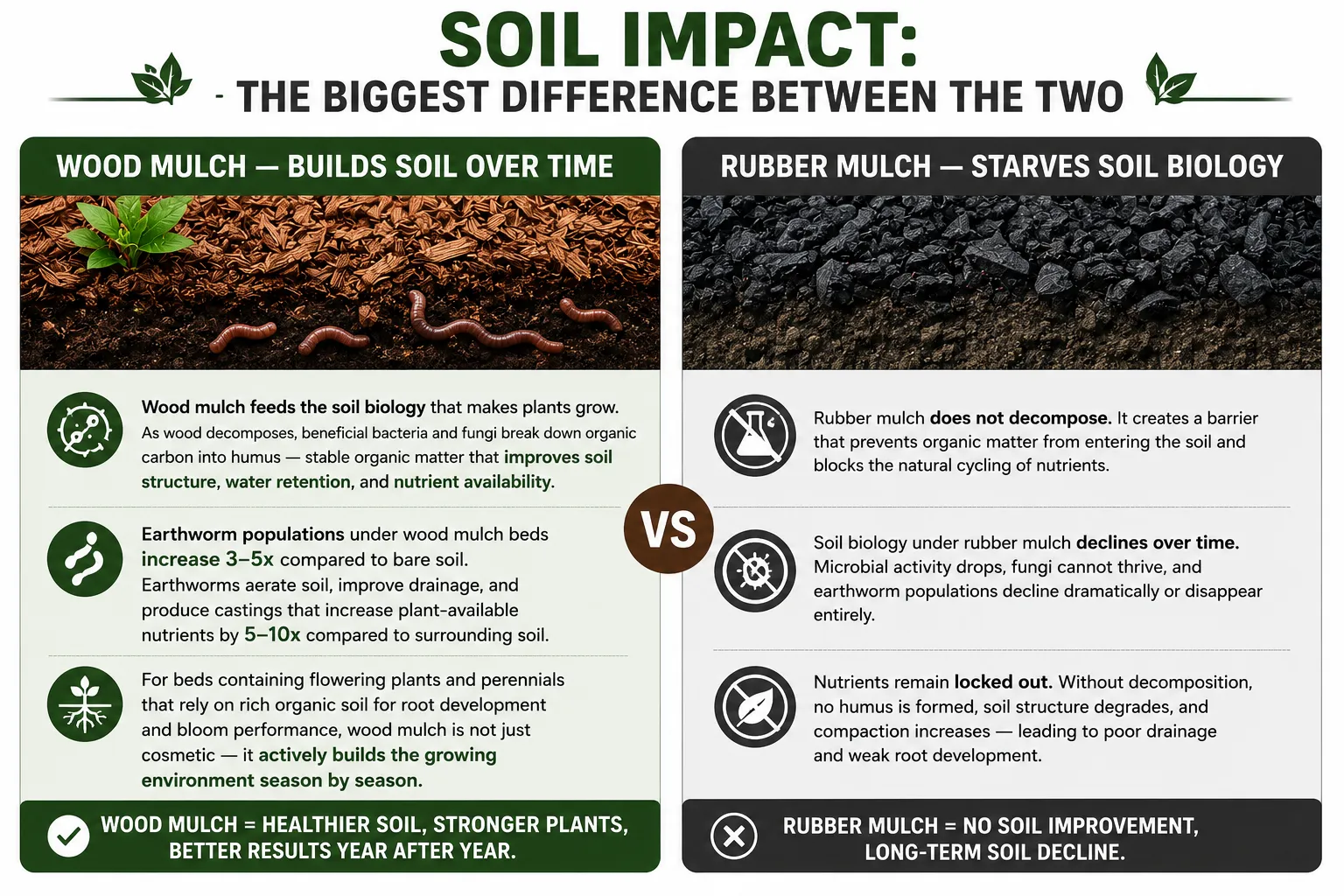
Choose wood mulch if:
- The bed contains edible plants — vegetables, herbs, fruit trees
- The bed contains ornamental plants where soil fertility determines performance
- You are in a wildfire zone — any USDA zone where summer fire risk is a concern. See how zone-specific plant and soil management affects garden health long-term
- The installation is near a natural waterway, pond, or drainage channel
- Soil biology matters — long-term garden health is the goal
- Budget is limited — wood mulch costs 60–70% less upfront
Choose rubber mulch if:
- The application is a children’s playground fall zone — rubber mulch provides superior impact absorption rated to ASTM F1292
- The bed is purely decorative with no edibles and no active planting
- The area receives constant foot traffic that would displace lighter wood mulch
- The property is on a slope where lighter mulch washes away
- Maintenance time is the primary constraint — 10 years without replenishment is a real benefit
- The installation is in full shade — heat buildup is not a concern in shaded areas
Frequently Asked Questions
Is rubber mulch safe for vegetable gardens?
No — rubber mulch is not recommended for vegetable gardens. Zinc and other compounds leach from rubber mulch into soil, where food crops can absorb them. The USDA Agricultural Research Service concluded that ground tire material should not be used on garden soils. Use wood mulch, straw, or compost for any bed growing edible plants.
How long does rubber mulch last compared to wood mulch?
Rubber mulch lasts 10–15 years. Wood mulch lasts 1–5 years depending on type: wood chips 3–5 years, hardwood bark 2–3 years, shredded leaves 1 season. Rubber mulch requires no annual replenishment — that durability is its strongest practical advantage.
Does rubber mulch get hot?
Yes — rubber mulch in direct sun reaches 150–170°F (65–77°C) on warm days, compared to 95–110°F (35–43°C) for wood mulch under identical conditions. This heat can scorch plant crowns, burn bare skin on contact, and accelerate chemical off-gassing. Rubber mulch in shade stays much cooler and is safer for both plants and children.
Which mulch is better for playgrounds — wood or rubber?
Rubber mulch (crumb rubber) provides better fall protection than wood mulch and meets ASTM F1292 and CPSC guidelines for playground fall zones at standard installation depths. Wood chips also meet safety standards when applied at adequate depth (typically 9–12 inches / 23–30 cm). Rubber requires less replenishment but gets hotter — check surface temperature on warm days before allowing children to play.
Is wood mulch better for plants than rubber mulch?
Yes, wood mulch is significantly better for plant health than rubber mulch. Wood mulch retains moisture, regulates soil temperature, feeds soil microbes and earthworms, and adds organic matter that improves soil structure over time. Rubber mulch does none of these things. For any bed containing growing plants, wood mulch is the correct choice.
Does rubber mulch attract pests?
No — rubber mulch does not attract termites, ants, or other insects because it provides no food source. Wood mulch can harbor termites and slugs, particularly when kept too thick or too close to foundations. Maintain 12 inches (30 cm) clearance between wood mulch and any wood structure to reduce termite risk.
What is the cheapest mulch option long-term?
Arborist wood chips are the cheapest mulch option — many tree services provide them free or at minimal cost. Over 10 years, free wood chips cost only labor to apply. Shredded leaves cost nothing for property owners with deciduous trees. Rubber mulch wins on convenience but not on total cost when free organic alternatives are available.
Can I switch from rubber mulch to wood mulch?
Yes, but rubber mulch removal is labor-intensive. Rubber mulch mixes with soil over years and does not rake cleanly. Removal typically requires hand-sorting or sieving — a time-consuming process. Before installing rubber mulch in any bed, consider whether future removal would be practical. In beds where plant composition may change, wood mulch offers more flexibility.
The Bottom Line
Wood mulch is the right choice for any bed containing plants. Rubber mulch is the right choice for high-traffic non-planting areas — playgrounds, paths, and decorative installations where maintenance reduction and durability matter more than soil health.
The 10-year cost argument for rubber mulch is real — but it applies only to decorative, non-growing spaces. For plant beds, the soil fertility value of wood mulch cannot be replicated by any synthetic alternative, and rubber’s chemical leaching creates concerns that grow over time, not diminish.
Use wood mulch where things grow. Use rubber mulch where things are played on, walked on, or displayed.