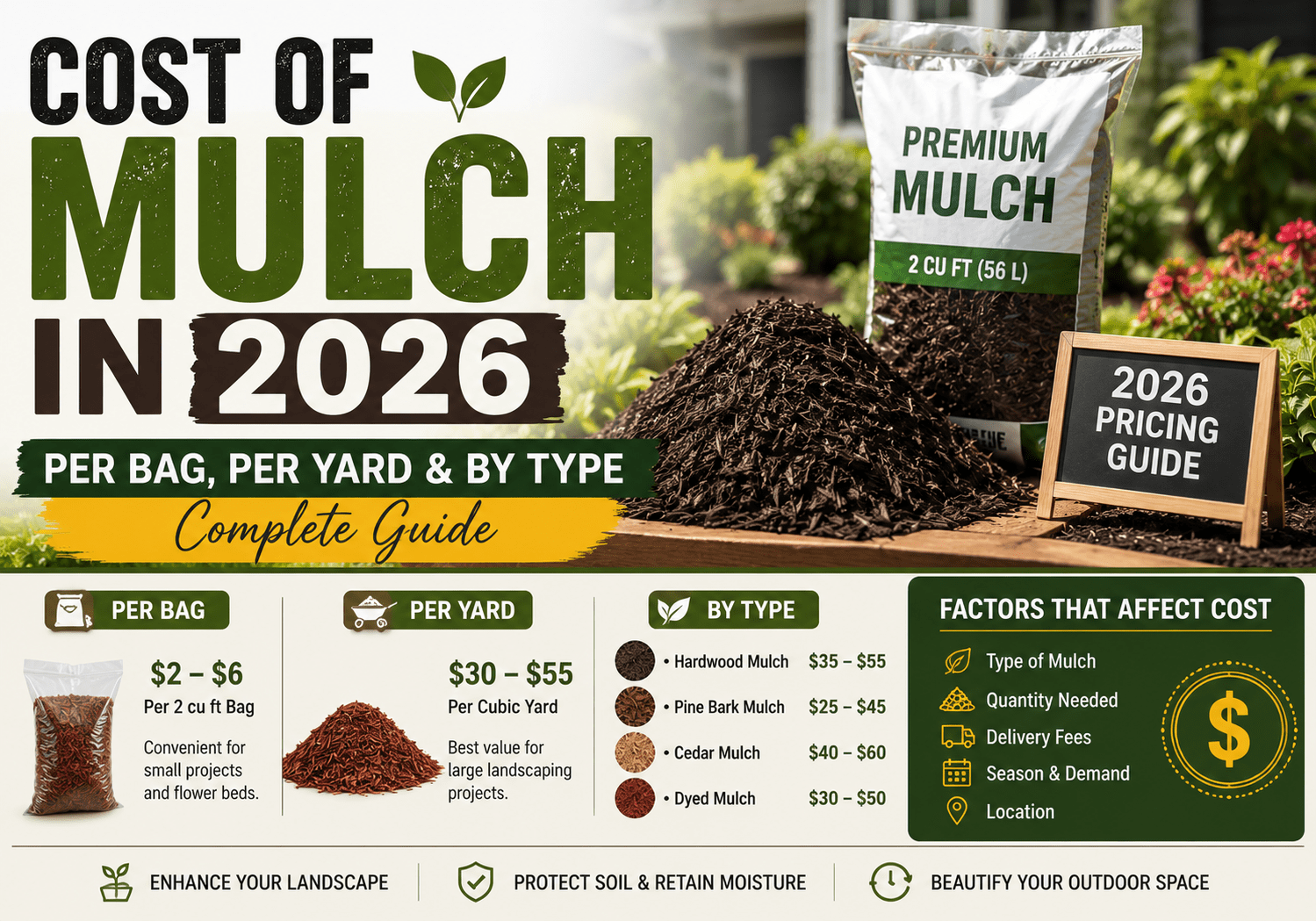
Mulch costs $2–$13 per bag or $25–$135 per cubic yard (cu yd) for materials alone. Professional installation adds $22–$55 per cu yd in labor, plus $50–$140 for delivery. Most homeowners pay $72–$94 per cu yd fully installed. One cu yd covers 162 sq ft at 2 inches (5 cm) deep or 108 sq ft at 3 inches (7.6 cm) deep.
| Metric | 2026 Price |
| Bagged mulch (per bag) | $2–$13 |
| Bulk mulch (per cu yd, materials only) | $25–$135 |
| Professionally installed (per cu yd) | $72–$94 |
| Delivery fee | $50–$140 |
| Labor only (per cu yd) | $22–$55 |
| Full project (typical front yard) | $250–$750 |
Sources: Angi 2026, LawnStarter 2026, LawnLove 2026, HomeGuide 2026
Mulch Cost Per Bag vs Per Cubic Yard

Bagged mulch costs $2–$13 per bag. Bulk mulch costs $25–$135 per cu yd. Buying bagged is convenient for small beds under 50 sq ft — for anything larger, bulk almost always saves money.
One standard bag holds 2 cubic feet (cu ft). A cu yd equals 27 cu ft, so you need 13.5 bags to equal 1 cu yd. Buying 13.5 bags at $4.50 each costs $60.75 per yard equivalent — versus $30–$55 per yard buying bulk.
Bagged Mulch: When It Makes Sense
Bagged mulch works for 3 specific situations: small accent beds under 50 sq ft, quick top-ups where you need less than half a yard, and projects where you lack a vehicle to haul bulk.
| Bag Size | Coverage at 2″ (5 cm) | Coverage at 3″ (7.6 cm) | Avg Price |
| 1 cu ft bag | 6 sq ft | 4 sq ft | $2–$5 |
| 2 cu ft bag (standard) | 12 sq ft | 8 sq ft | $3–$8 |
| 3 cu ft bag | 18 sq ft | 12 sq ft | $6–$13 |
Bulk Mulch: When It Makes Sense
Bulk mulch saves 15–35% per yard equivalent versus buying bags for the same volume. For any project over 2 cu yd — roughly 300 sq ft at 3 inches (7.6 cm) — bulk is the smarter financial choice.
Bulk comes in 2 formats: pickup truck loads (1–3 cu yd per load) and full truckloads (10–15 cu yd). A standard pickup truck carries about 2–3 cu yd, or 1,500–2,500 lbs (680–1,134 kg). Full truckload delivery costs $400–$1,500 for materials, not including spreading labor.
Mulch Cost by Type in 2026
The type of mulch is the second biggest cost factor after volume. Prices below are bulk rates from landscape supply yards — bagged versions from home improvement stores run 30–60% higher per yard equivalent.
| Mulch Type | Cost Per Cu Yd (Bulk) | Lifespan | Best Use |
| Standard hardwood (shredded) | $25–$45 | 1–2 years | Garden beds, tree rings |
| Cedar bark | $40–$60 | 2–3 years | Flower beds, pathways |
| Cypress | $35–$55 | 2–3 years | Moisture-sensitive plants |
| Pine bark nuggets | $30–$50 | 2–3 years | Acid-loving plants |
| Pine straw | $20–$40 per bale | 1–2 years | Slopes, woodland gardens |
| Dyed hardwood (black/red/brown) | $35–$65 | 1–2 years | Decorative landscape beds |
| Cocoa hull mulch | $50–$80 | 1 year | Ornamental beds |
| Rubber mulch (shredded tires) | $80–$180 | 10–15 years | Playgrounds, high-traffic areas |
| Gravel / river rock | $40–$100+ | Permanent | Xeriscape, drainage areas |
| Landscape fabric + mulch | $50–$120 combined | Varies | Weed-heavy beds |
Organic Mulch Cost Breakdown
Organic mulch costs $20–$80 per cu yd and breaks down over 1–3 years, adding nutrients to your soil. The 4 most popular organic types each have a different price point and purpose.
- Hardwood mulch ($25–$45/cu yd): Most common, neutral pH, good for most garden beds. Double-shredded costs $5–$10 more per yard but compacts less.
- Cedar mulch ($40–$60/cu yd): Natural oils repel insects including termites. Lasts 2–3 years, making it cheaper over time than hardwood per application cycle.
- Pine bark ($30–$50/cu yd): Acidic pH suits blueberries, azaleas, rhododendrons, and hollies. Use 3 inches (7.6 cm) for best moisture retention.
- Pine straw ($20–$40/bale): 1 bale covers 35–45 sq ft at 3 inches. Ideal for sloped beds where heavier mulch washes away.
For vegetable beds, see our guide on the best mulch for vegetable gardens to match mulch type to your specific crops.
Rubber Mulch Cost
Rubber mulch costs $120–$180 per cu yd for bulk and $200–$250 per cu yd for bagged. That is 3–5x more than hardwood upfront.
Rubber mulch lasts 10–15 years without replacement. Over a 10-year period on a 500 sq ft bed, rubber mulch costs $600–$900 once versus $200–$400 for organic mulch every 1–2 years, totaling $1,000–$2,000. For playgrounds and high-traffic zones, rubber saves money long-term.
Rubber mulch also provides fall height protection — up to 16 feet (4.9 m) at correct depths — making it the standard for playground safety surfacing in schools and parks.
Colored Mulch Cost
Colored mulch runs $35–$65 per cu yd for dyed hardwood in black, red, or brown. Dye adds $5–$15 per yard over undyed hardwood pricing.
Black mulch absorbs more heat than lighter colors, breaking down 15–20% faster and needing more frequent replacement in hot climates. Red mulch fades in direct sun in 4–6 months. Brown dyed mulch holds color longest of the 3. All dyed mulches use either iron oxide (brown/red) or carbon black dye — both are considered non-toxic by the EPA.
How Much Mulch Do You Need? (Calculator Formula)
Use this formula: Length (ft) x Width (ft) x Depth (in) ÷ 324 = cubic yards needed. For depth in cm, multiply cm by 0.394 to convert to inches first.
Round up to the nearest 0.5 cu yd to account for uneven beds, settling, and edges.
| Bed Area | At 2″ (5 cm) depth | At 3″ (7.6 cm) depth | Bags needed (2 cu ft bags) at 3″ |
| 100 sq ft (9.3 m²) | 0.6 cu yd | 0.9 cu yd | 12 bags |
| 250 sq ft (23.2 m²) | 1.5 cu yd | 2.3 cu yd | 31 bags |
| 500 sq ft (46.5 m²) | 3.1 cu yd | 4.6 cu yd | 62 bags |
| 1,000 sq ft (92.9 m²) | 6.2 cu yd | 9.3 cu yd | 125 bags |
| 2,000 sq ft (185.8 m²) | 12.4 cu yd | 18.5 cu yd | 250 bags |
Use our free Garden Area Calculator to measure irregular beds and get your exact square footage before ordering.
How Deep Should Mulch Be?
3 inches (7.6 cm) is the ideal depth for most garden beds. This depth suppresses 80–90% of weed germination while retaining soil moisture effectively.
- Under 2 inches (5 cm): minimal weed suppression, moisture evaporates faster
- 2–3 inches (5–7.6 cm): standard for annual flower beds and vegetable gardens
- 3–4 inches (7.6–10 cm): best for weed-heavy beds and moisture-stressed soils
- Over 4 inches (10 cm): can suffocate roots and trap moisture against plant stems causing crown rot
For topping off existing mulch, measure current depth first. Add only enough to bring the total back to 3 inches. Adding over old mulch wastes money and risks piling too deep.
Mulch Delivery Cost
Mulch delivery costs $50–$140 for most residential orders. Some suppliers charge flat fees; others charge by mile or by minimum order size.
| Delivery Type | Cost Range | Notes |
| Standard local delivery | $50–$100 | Most residential orders, within 10 miles |
| Long-distance delivery (10–25 miles) | $100–$140 | Price per mile added above flat fee |
| Bulk truckload delivery | $75–$200 | 10–15 cu yd, single drop |
| Same-day or urgent delivery | $150–$250 | Premium rate, limited availability |
| Free delivery threshold | 0 | Usually at 5–10 cu yd order minimum |
Save $70–$140 on delivery by picking up bulk mulch yourself with a pickup truck. A standard pickup carries 2–3 cu yd (2,700–4,050 lbs / 1,225–1,837 kg) safely within payload limits.
If your order is close to a free delivery threshold — say you need 4 cu yd but free delivery starts at 5 — ordering the extra yard is almost always worth it. The extra mulch saves future delivery fees and stores well when dry.
Mulch Installation Cost: DIY vs Professional
DIY mulch installation costs $25–$135 per cu yd for materials only. Professional installation runs $72–$94 per cu yd all-in, including materials, delivery, and labor.
| Option | Material Cost | Labor Cost | Delivery | Total Per Cu Yd |
| DIY — bags from store | $47–$81/yd equiv. | $0 | $0 (self-transport) | $47–$81 |
| DIY — bulk delivered | $25–$55 | $0 | $50–$140 flat | $30–$60 avg |
| Pro — installed | $25–$55 | $22–$55 | Included | $72–$94 |
DIY Mulching: Tools and Time Required
DIY mulching is physically demanding. Budget 1 hour per cu yd for spreading and cleanup — a 5 cu yd project takes a full day including loading, hauling, and spreading.
4 tools needed for a complete DIY mulch job:
- Wheelbarrow: moves 2–3 cu ft per load from pile to bed
- Garden rake: spreads mulch evenly to correct depth
- Edging tool or flat spade: defines bed borders and prevents mulch migration
- Heavy-duty gloves: bulk mulch splinters, and dyed mulch stains skin
Professional Mulching: What the Cost Covers
Professional mulching labor costs $20–$55 per cu yd or $55–$95 per hour depending on the company and region. Urban areas and metro markets charge 15–25% more than rural rates.
A professional crew handles: site prep and edge cleanup, delivery coordination, correct depth application (verified by measuring), and debris hauling if removing old mulch first. For beds with slopes, narrow gates, or complex layouts, professional labor is worth the cost — improper depth wastes materials and costs more to fix.
Removing old mulch before adding fresh adds $50–$75 per hour plus $50–$100 in disposal fees. Skip removal if existing mulch is under 1 inch (2.5 cm) deep, not matted or moldy, and has not harbored fungal growth.
Mulch Cost by Project Type
Total project cost depends on bed size, mulch type, and whether you hire a crew. Here are 4 real-world project estimates for 2026:
| Project | Bed Size | Mulch Needed | DIY Cost | Pro Cost |
| Small front garden bed | 100 sq ft (9.3 m²) | ~1 cu yd | $35–$60 | $80–$120 |
| Standard front yard refresh | 400 sq ft (37.2 m²) | ~4 cu yd | $120–$220 | $290–$380 |
| Full backyard landscaping | 1,000 sq ft (92.9 m²) | ~9–10 cu yd | $270–$550 | $650–$950 |
| Tree ring (single, 4 ft radius) | ~50 sq ft (4.6 m²) | ~0.5 cu yd | $20–$40 | $50–$80 |
| Vegetable garden beds (4 raised beds) | ~200 sq ft (18.6 m²) | ~2 cu yd | $50–$110 | $150–$220 |
When Is the Cheapest Time to Buy Mulch?

March–April has the best mulch selection. January–February offers the lowest prices from suppliers willing to clear winter inventory. October–November is the second-cheapest window after spring peak ends.
| Month | Price Level | Selection | Best For |
| January–February | Lowest (10–20% below peak) | Limited | Pre-booking for spring jobs |
| March–April | Peak pricing, peak demand | Best selection | Buying when you need it |
| May–June | High | Good | Summer bed prep |
| July–August | Moderate | Moderate | Mid-season refresh |
| September–October | Below average | Good clearance | Fall application, winter prep |
| November–December | Low | Limited | Bulk pre-purchase for next year |
Spring mulch prices rise 10–20% in April and May when demand peaks for Memorial Day yard prep. Buying in January and pre-paying for a spring delivery locks in off-season pricing at some suppliers — ask specifically about pre-season booking discounts.
For timing mulch application to your planting zone, see our USDA hardiness zone guide — mulching timing differs by 4–6 weeks between Zone 4 and Zone 9.
Bulk Mulch vs Bagged Mulch: Full Cost Comparison
Bulk mulch is cheaper for orders over 2 cu yd — always. The break-even point sits at roughly 2 yards: below that, bags save on delivery fees; above that, bulk wins on per-yard cost.
| Factor | Bagged Mulch | Bulk Mulch |
| Cost per cu yd equivalent | $47–$81 | $25–$55 |
| Minimum purchase | 1 bag | Usually 1–2 cu yd |
| Delivery | Self-transport or store pickup | $50–$140 flat fee |
| Quality | Consistent (sealed bags) | Variable by supplier |
| Storage | Easy (sealed bags) | Needs to be used quickly or covered |
| Best for | Under 50 sq ft jobs | Any project over 2 cu yd |
| Savings vs bags (5 cu yd project) | Baseline | $60–$130 cheaper |
Does Mulch Attract Termites?
Yes, some wood mulches can shelter termites — but mulch does not attract termites from outside your property. Termites already present in soil will use mulch as cover. 5 practices minimize this risk:
- Keep mulch 6 inches (15 cm) away from foundation walls and wood siding
- Choose cedar or cypress mulch — natural oils deter termites
- Avoid piling mulch deeper than 3 inches (7.6 cm)
- Ensure beds drain properly; standing moisture increases termite activity
- Inspect mulch beds annually for mud tubes or hollowed wood
Rubber mulch, gravel, and river rock carry zero termite risk. See our full guide on organic vs inorganic mulch for gardens to choose based on your specific conditions.
How to Save Money on Mulch

6 strategies cut mulch costs by 20–50% without reducing quality:
- Buy in bulk for projects over 2 cu yd — saves $15–$35 per yard versus bagged equivalent.
- Pre-book in January or February — off-season booking discounts run 10–20% at many supply yards.
- Order at the free delivery threshold — adding 1 cu yd to hit a 5-yard free delivery minimum saves $70–$140.
- Top off, don’t fully replace — if existing mulch is 1–2 inches (2.5–5 cm) deep and not decomposed, adding 1–2 inches on top uses 50–60% less material.
- Make free mulch from yard waste — shredded leaves, grass clippings, and wood chip compost from tree trimming services cost nothing and improve soil as they break down.
- Choose cedar over hardwood for long-term value — cedar lasts 2–3 years versus 1–2 years for hardwood. Over 5 years, cedar saves 1–2 full applications, reducing total cost despite higher per-yard price.
Related Guides on ZonedGarden.com
Choosing the right mulch type matters as much as knowing the cost. These resources help you pick based on your plants, climate zone, and garden goals:
- Garden Area Calculator — measure your beds in seconds before ordering
- Best Mulch for Vegetable Gardens — organic options that improve soil as they break down
- Organic vs Inorganic Mulch — full comparison for home gardeners
- USDA Hardiness Zone Guide — match mulch timing to your planting zone
- How to Improve Garden Soil — mulch is step one in the process
Frequently Asked Questions
How many bags of mulch equal 1 cubic yard?
13.5 bags of standard 2 cu ft bags equal 1 cu yd. Smaller 1 cu ft bags need 27; larger 3 cu ft bags need 9. Divide 27 (cu ft in a yard) by your bag size to get the exact count.
Is bulk mulch cheaper than bagged?
Yes, bulk mulch is 15–35% cheaper per yard equivalent than buying bagged for the same volume. For projects under 1 cu yd (roughly 13 bags), bagged is more practical since delivery fees make bulk less economical at small quantities.
How often should you replace mulch?
Replace organic mulch every 1–2 years when it has thinned to under 1 inch (2.5 cm) or turned gray and matted. Cedar and cypress last 2–3 years. Rubber and stone mulch last 10+ years with no scheduled replacement.
What is the cheapest type of mulch?
Standard shredded hardwood is cheapest at $25–$45 per cu yd. Pine straw ($20–$40/bale) is cheaper per bale but covers less area per dollar on large beds. Free options include shredded leaves, grass clippings, and wood chips from local tree services.
How deep should mulch be around trees?
2–4 inches (5–10 cm) deep in a donut ring, keeping mulch 6 inches (15 cm) away from the trunk. Piling mulch against tree bark — called volcano mulching — traps moisture, invites disease, and causes long-term trunk decay. Keep the root flare exposed.
Does colored mulch cost more?
Yes, dyed mulch costs $5–$15 per cu yd more than natural hardwood. Black and red dyed mulch run $35–$65 per cu yd. The dye is iron oxide or carbon black — both are safe for gardens. Color fades in 4–8 months in full sun.
Can I put new mulch over old mulch?
Yes, if existing mulch is under 2 inches (5 cm) deep, not matted, and not growing fungi. Rake the old mulch to loosen it, then add new mulch on top to bring total depth to 3 inches. Full removal is only necessary if the old layer is compacted, diseased, or harboring pests.
What is the most cost-effective mulch for vegetable gardens?
Straw and shredded leaves are cheapest at $0–$15 per bale and improve soil fertility as they decompose. Pine bark works well for acid-loving edibles like blueberries at $30–$50 per cu yd. Avoid dyed mulches and rubber near edible plants.
Conclusion: The Bottom Line on Mulch Costs
Mulch costs $2–$13 per bag for small jobs or $25–$135 per cu yd in bulk — most homeowners spend $250–$750 for a full front or backyard refresh including delivery and installation.
The type you choose changes the long-term cost picture. Standard hardwood is cheapest upfront at $25–$45 per cu yd, but cedar and cypress cost less over 5 years because they need replacing half as often. Rubber mulch costs the most upfront but becomes the cheapest option over a 10–15 year window for high-traffic areas.
3 decisions cut your total cost significantly: buy bulk over 2 cu yd, order in January or February to lock in off-season pricing, and top off existing mulch rather than fully replacing it when depth allows.
Before you order, use our Garden Area Calculator to get your exact square footage — guessing on mulch quantities is the most common way homeowners either overspend or run short mid-project.
Get 3 quotes from local suppliers before committing — pricing varies by 30–50% between suppliers in the same zip code depending on their overhead, material source, and seasonal demand.