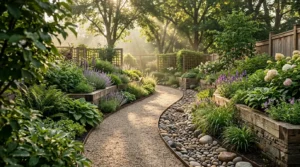
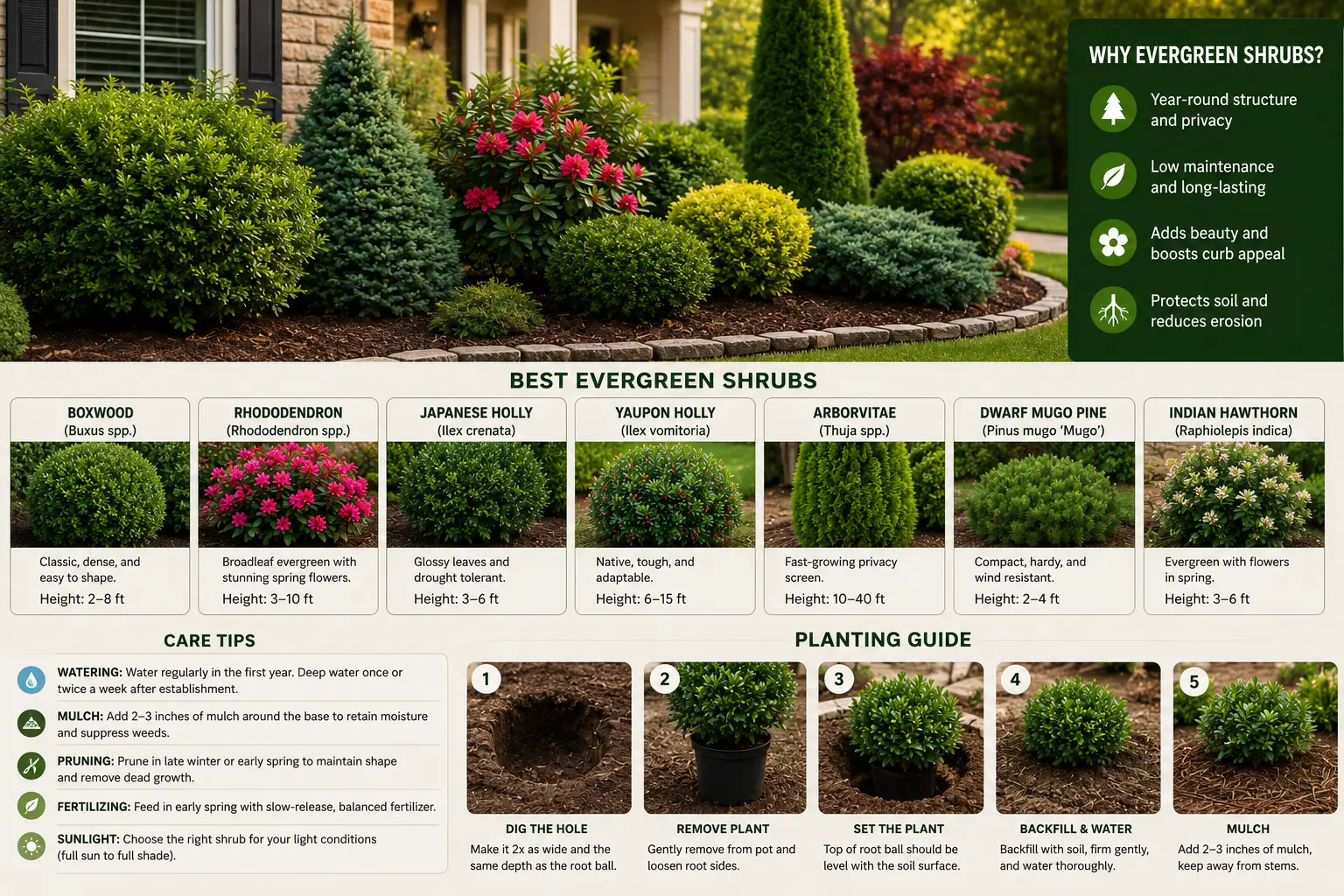
Evergreen shrubs keep their leaves all 12 months of the year, giving your garden structure, color, and coverage even in the depths of winter when everything else is bare. They split into 2 main groups: broadleaf evergreens, which carry wide flat leaves year-round, and needled evergreens (conifers), which carry needles or scale-like foliage.
This guide covers the best varieties by zone and purpose, how to plant them, when to prune them, and what kills them. No guessing — just what works.
What Makes a Shrub Evergreen?
An evergreen shrub holds its foliage through all 4 seasons instead of dropping leaves in fall. The leaves still cycle — most broadleaf evergreens replace their foliage gradually over 2–3 years rather than all at once. You won’t notice because new leaves grow before old ones drop.
Some shrubs are classed as semi-evergreen — they keep most leaves in mild winters but drop them in zone 5 or colder. Abelia and nandina behave this way. Plan for their bare patches if you garden in colder zones.
3 reasons gardeners choose evergreens over deciduous shrubs:
- Year-round privacy — deciduous hedges are bare from November through April
- Low maintenance — no raking, no fallen-leaf cleanup, structure with minimal effort
- Winter interest — keeps the garden alive when perennials and deciduous shrubs are dormant
2 Types of Evergreen Shrubs
Every evergreen shrub falls into one of 2 categories:
- Broadleaf evergreens — carry flat, wide leaves. Examples: boxwood, holly, rhododendron, camellia, azalea, mahonia
- Needled evergreens (conifers) — carry needles or scale-like foliage. Examples: juniper, arborvitae, yew, mugo pine, false cypress, dwarf spruce
Broadleaf evergreens are more sensitive to winter wind and dry cold. Conifers handle cold winters better and rarely need winter protection in their rated zones.
15 Best Evergreen Shrubs — By Use
Best Evergreen Shrubs for Privacy and Hedges
Dense, fast-filling shrubs that form solid screens:
- Arborvitae ‘Emerald Green’ — 12–15 ft (3.6–4.5 m) tall, 3–4 ft (0.9–1.2 m) wide. Narrow pyramidal shape. Gains 6–9 inches (15–23 cm) per year. Zones 2–7. Full sun. No pruning needed.
- Cherry Laurel (Prunus laurocerasus) — 10–18 ft (3–5.5 m) tall. Glossy dark leaves, very dense. Grows 24 inches (60 cm) per year in ideal conditions. Zones 6–9. Full sun to partial shade.
- Wax Myrtle (Morella cerifera) — 10–25 ft (3–7.5 m). Fastest evergreen for warm climates. Gains 3–5 ft (0.9–1.5 m) per year in zones 6–10. Salt and drought tolerant once established.
- Nellie Stevens Holly — 15–25 ft (4.5–7.5 m). Self-fruitful, no male required. Spiny leaves deter intruders. Zones 6–9.
- Skip Laurel (Prunus laurocerasus ‘Schipkaensis’) — 10–18 ft tall. More cold-hardy than cherry laurel. Zones 5–9.
For a privacy screen that also blooms, pair arborvitae with flowering shrubs like bush peonies in the foreground for spring color against evergreen structure.
Best Evergreen Shrubs for Foundation Planting
Foundation plants sit against the house. They need to stay in scale, never blocking windows or pressing against siding.
- Boxwood (Buxus spp.) — 2–4 ft (0.6–1.2 m) for most dwarf varieties. Dense, clippable, slow-growing. Zones 4–9. The standard foundation shrub for 300+ years.
- Inkberry Holly (Ilex glabra) — 5–8 ft (1.5–2.4 m). Native, deer resistant, wet-soil tolerant. Zones 4–9.
- Compact Japanese Holly (Ilex crenata) — 3–4 ft (0.9–1.2 m). Boxwood replacement where boxwood blight is a problem. Zones 5–9.
- Dwarf Mugo Pine (Pinus mugo ‘Mops’) — 3–5 ft (0.9–1.5 m) over 10 years. Extremely slow growing. Zones 2–8.
- Hicks Yew (Taxus × media ‘Hicksii’) — 6–12 ft if unpruned. Holds any shape. Deep shade tolerant. Zones 4–7.
Best Evergreen Shrubs for Shade
Most evergreens need sun. These 5 grow well in full to partial shade:
- Rhododendron — 4–8 ft (1.2–2.4 m). Prefers dappled or afternoon shade in zones 5–9. Large spring bloom clusters. Needs acidic soil (pH 4.5–6.0).
- Mountain Laurel (Kalmia latifolia) — 7–15 ft (2.1–4.5 m). Native to eastern woodland edges. Late-spring flowers in pink, white, or bi-color. Zones 4–9.
- Mahonia (Oregon Grape) — 3–10 ft. Spiky holly-like leaves, yellow winter flowers, blue spring berries. Deep shade tolerant. Zones 5–9.
- Leucothoe — 3–6 ft (0.9–1.8 m). Arching stems, wine-red fall color even in deep shade. Zones 4–7.
- Japanese Pieris (Pieris japonica) — 6–8 ft. Red new growth in spring, white lily-of-the-valley flowers. Zones 5–8. Partial shade preferred.
Shade-loving evergreens pair well with ferns as ground-level companions. The rabbit foot fern grows naturally under rhododendrons and mountain laurel in dappled woodland light.
Best Evergreen Shrubs for Full Sun
- Juniper (Juniperus spp.) — 1–15 ft depending on variety. Needs full sun, hates wet soil. Extremely drought tolerant once established. Zones 3–9.
- Rosemary (Salvia rosmarinus) — 3–5 ft (0.9–1.5 m). Edible, fragrant, drought tolerant. Blue flowers attract pollinators. Zones 7–10 outdoors.
- Loropetalum (Chinese Fringe Flower) — 4–10 ft. Burgundy or green foliage, pink fringe flowers in spring. Full sun intensifies leaf color. Zones 7–10.
- Nandina (Heavenly Bamboo) — 3–8 ft. Red winter berries, fine-textured foliage turns red-orange in sun. Zones 6–9.
- Aucuba japonica — 6–10 ft. Grows in full sun to full shade. Tolerates pollution — excellent city garden shrub. Zones 7–10.
Best Dwarf Evergreen Shrubs
Compact varieties for small gardens, borders, and containers:
- Tater Tot Arborvitae — 2–3 ft (60–90 cm) round globe. Zero pruning. Zones 4–8.
- Sprinter Boxwood — 3–4 ft. 3× faster than standard boxwood. Keeps dense habit. Zones 5–9.
- Soft Touch Holly (Ilex crenata) — 2–3 ft. Smooth, non-prickly leaves. Works in containers. Zones 6–9.
- Dwarf Alberta Spruce — perfectly conical. Gains only 2–4 inches (5–10 cm) per year. Zones 3–8.
- Firepower Nandina — 2 ft. Dwarf, intense red winter color without setting fruit. Zones 6–9.
- Little Henry Sweetspire (Itea virginica) — 2–3 ft. Semi-evergreen in zone 5, fully evergreen in zones 7–9. Fragrant white flowers, red fall color.
Best Evergreen Shrubs by USDA Hardiness Zone
Zones 2–4 — Cold Hardy Evergreens
Surviving -40°F (-40°C) and colder requires conifers and the toughest broadleaf varieties:
- Common Juniper (Juniperus communis) — Zone 2. Ground-hugging to 12 ft. Survives arctic conditions.
- Dwarf Mugo Pine — Zone 2. Slow growing, globe-shaped, nearly indestructible.
- Emerald Green Arborvitae — Zone 2. Narrow, 15 ft tall, classic screen.
- Gold Mop False Cypress — Zone 4. 5 ft, bright golden thread-like foliage.
- Densiformis Yew — Zone 4. Spreading, shade tolerant, 4 ft tall × 6 ft wide.
Zones 5–6 — Moderate Climate Evergreens
Most popular landscape evergreens thrive here:
- Boxwood — Zones 4–9. The classic hedge and border plant.
- Rhododendron — Zones 5–9. Needs acidic, well-drained, organically rich soil.
- Holly (Ilex × meserveae ‘Blue Princess’) — Zone 4. Striking blue-green leaves, red berries with male pollinator nearby.
- Skip Laurel — Zone 5. Fast, dense, fragrant white spring flowers.
- Mountain Laurel — Zone 4. Native, shade tolerant, spectacular bloomer.
- Japanese Pieris — Zone 5. Red new growth resembles flower display.
Zone 5–6 gardens also do well with crape myrtle (Lagerstroemia) as a deciduous companion that fills the summer bloom gap while evergreens hold structure.
Zones 7–9 — Warm Climate Evergreens
- Camellia — Zones 6–10. October–March blooms, glossy foliage. Plant in afternoon shade in zone 9.
- Gardenia — Zones 7–11. Intensely fragrant white flowers. Needs acidic soil (pH 5.0–6.0).
- Loropetalum — Zones 7–10. Fast growing, burgundy foliage, magenta fringe flowers.
- Cherry Laurel — Zones 6–9. Dense, 2 ft per year, excellent privacy hedge.
- Wax Myrtle — Zones 6–10. Native to southeastern US, extremely adaptable.
- Southern Magnolia ‘Little Gem’ — Zones 7–9. Compact form, 20 ft. White flowers all summer. Technically a tree but behaves as large shrub when young.
Zones 9–11 — Tropical/Sub-tropical Evergreens
- Bougainvillea — shrub/vine. Brilliant flower-like bracts in red, orange, pink. Zones 9–11.
- Plumbago — 6 ft. Continuous blue flowers spring through fall. Drought tolerant. Zones 8–11.
- Ixora — 4–8 ft. Red, orange, or yellow flower clusters year-round in zones 10–11.
- Pittosporum — 6–15 ft. Variegated or dark purple foliage, honey-scented spring flowers. Zones 8–11.
Evergreen Shrubs for Specific Landscape Problems
Evergreen Shrubs for Wet or Clay Soil
Most evergreens fail in waterlogged ground. These 4 survive:
- Inkberry Holly — native to bogs and swamps. Zones 4–9.
- Leucothoe — streamside native in the wild. Zones 4–7.
- Aronia (Chokeberry) — technically deciduous but often listed for wet sites. Semi-evergreen in zone 7+
- Sweetbay Magnolia — semi-evergreen in zones 5–6, fully evergreen in zones 7–9. Handles wet feet well.
Deer Resistant Evergreen Shrubs
No shrub is deer-proof in a severe winter. These are consistently avoided:
- Boxwood — bitter taste. Reliable deer resistance.
- Juniper — deer dislike the prickly, aromatic foliage.
- Leucothoe — generally unpalatable to deer.
- Mahonia — spiny leaves deter browsing.
- Russian Sage — aromatic, deer rarely touch it. Semi-evergreen in zones 5–6.
Evergreen Shrubs for Slopes and Erosion Control
- Creeping Juniper (Juniperus horizontalis) — 1–2 ft tall, spreads 4–8 ft. Roots stabilize soil. Zones 3–9.
- Shore Juniper (Juniperus conferta) — salt tolerant, 12–18 inches tall, 6–9 ft spread. Zones 5–9.
- Wintercreeper (Euonymus fortunei) — very vigorous ground-covering evergreen. Check invasive status in your region.
- Cotoneaster dammeri — low, dense, red berries. Zones 5–8.
How to Plant Evergreen Shrubs
Best Time to Plant
Spring (March–May) and fall (September–October) are the 2 best planting windows for evergreen shrubs. Fall planting in zones 5–9 gives roots 6–8 weeks to establish before winter. Spring planting works equally well — just water consistently through the first summer.
Avoid planting in July and August in zones 5–9. Heat stress plus transplant shock kills more evergreens than any disease.
Step-by-Step Planting — 7 Steps
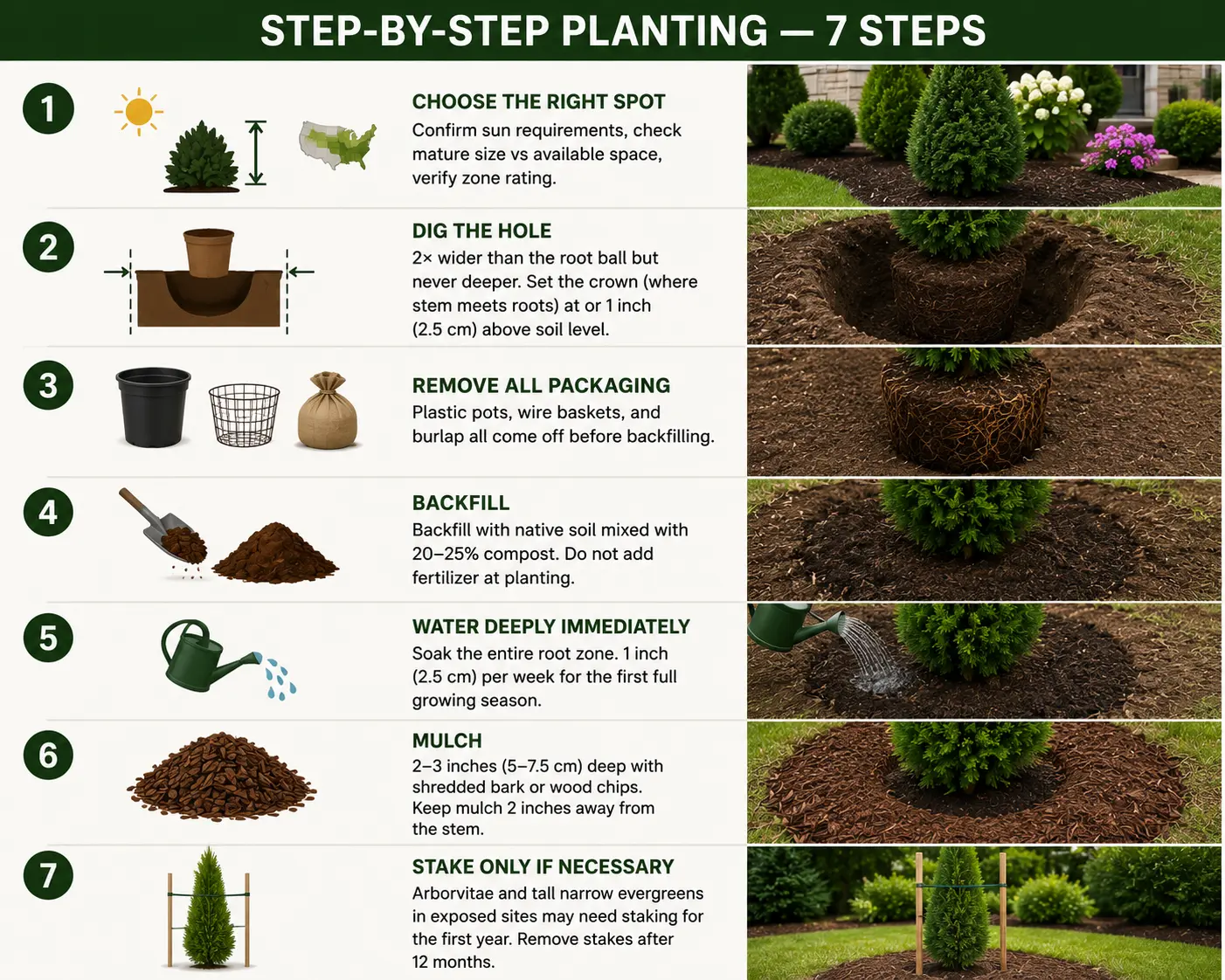
- Choose the right spot — confirm sun requirements, check mature size vs available space, verify zone rating.
- Dig the hole 2× wider than the root ball but never deeper. Set the crown (where stem meets roots) at or 1 inch (2.5 cm) above soil level.
- Remove all packaging — plastic pots, wire baskets, and burlap all come off before backfilling.
- Backfill with native soil mixed with 20–25% compost. Do not add fertilizer at planting.
- Water deeply immediately — soak the entire root zone. 1 inch (2.5 cm) per week for the first full growing season.
- Mulch 2–3 inches (5–7.5 cm) deep with shredded bark or wood chips. Keep mulch 2 inches away from the stem.
- Stake only if necessary — arborvitae and tall narrow evergreens in exposed sites may need staking for the first year. Remove stakes after 12 months.
Caring for Evergreen Shrubs
Watering
Deep, infrequent watering beats shallow daily watering for evergreen shrubs. Established evergreens in zones 4–7 rarely need supplemental water after the first 2 years. In zones 8–11, water during summer drought periods (every 7–14 days when no rainfall).
The biggest watering mistake: overwatering. Root rot from waterlogged soil kills more boxwood, juniper, and arborvitae than any disease or pest.
Fertilizing
Fertilize evergreen shrubs once per year in early spring before new growth begins. Use a balanced slow-release granular fertilizer — 10-10-10 for general shrubs, or an acid-specific formula (like Holly-tone) for rhododendron, azalea, camellia, and gardenia.
Do not fertilize after August 1 in zones 4–7. Late fertilizing pushes soft new growth that winter cold will kill back.
Pruning Evergreen Shrubs
Prune most evergreen shrubs in late winter or early spring before new growth flushes, or immediately after flowering for spring-blooming types.
3 pruning rules by shrub type:
- Non-flowering conifers (juniper, arborvitae, yew) — prune lightly in early spring or after midsummer to shape. Never cut back into bare brown wood — conifers don’t regenerate from old wood.
- Spring-flowering broadleaf evergreens (azalea, rhododendron, camellia) — prune immediately after flowering ends. Prune later and you cut off next year’s buds.
- Non-flowering broadleaf evergreens (boxwood, holly, laurel) — prune in late winter. Shear formal hedges in late spring after new growth hardens.
Remove no more than ⅓ of any evergreen shrub in a single season. Harder cuts stress the plant and invite disease.
Pruning timing connects to seasonal plant rhythms. Learn how chrysanthemums follow similar timed-pruning rules — pinch mums in spring when you prune your spring-blooming evergreens.
Winter Protection
Broadleaf evergreens in zones 4–6 face 2 winter problems: desiccation (drying out) and freeze-thaw damage to foliage.
4 ways to protect evergreens in winter:
- Anti-desiccant spray — apply in late November to rhododendron, holly, and boxwood in zones 4–6. Coat the foliage to reduce moisture loss.
- Burlap windbreaks — wrap boxwood and yew in exposed corners. Don’t wrap tightly — air circulation prevents fungal disease.
- Water before freeze — give evergreens a deep soak in late October or early November before the ground freezes. A hydrated plant survives winter better.
- Avoid planting in wind tunnels — winter wind causes more damage than cold temperatures in most zones.
Common Evergreen Shrub Problems
Boxwood Blight
Boxwood blight (Calonectria pseudonaviculata) kills boxwood fast — brown spots on leaves, black stem streaks, complete defoliation within weeks. It spreads via contaminated tools, clothing, and water splash.
No chemical cure exists once established. Resistant alternatives: Japanese holly (Ilex crenata), Korean boxwood (Buxus sinica insularis ‘Wintergreen’), or Better Boxwood disease-resistant cultivars.
Winter Burn
Winter burn appears as brown foliage on the windward side of evergreens in late winter, caused by water loss through leaves when roots are frozen. Most common on arborvitae, yew, and rhododendron.
Affected foliage won’t recover, but the plant usually pushes new growth in spring that hides the damage. Apply anti-desiccant spray in November to prevent.
Root Rot
Root rot (Phytophthora) kills evergreens that sit in wet or poorly drained soil. Symptoms: yellowing foliage, decline, death from the inside out. No cure once advanced.
Prevention: plant in raised beds or on slight slopes if drainage is poor, never plant deeper than the nursery container, and avoid overwatering.
Scale Insects
Euonymus scale and pine needle scale affect euonymus, pachysandra, and conifers. Look for white or brown waxy bumps on stems and leaf undersides. Treat with horticultural oil spray in early spring before new growth.
Spider Mites on Conifers
Spruce mites attack arborvitae, false cypress, and junipers in hot, dry conditions, causing stippled, bronze-colored foliage. A strong spray of water weekly interrupts their cycle. Miticide spray if severe.
Dealing with plant pests across the garden? Check our chrysanthemum problems guide for a proven system to spot, identify, and fix common garden pests before they spread.
Evergreen Shrubs in Containers
Yes, evergreen shrubs grow in containers — with conditions. Containers expose roots to more freeze-thaw cycles than in-ground planting. Move pots to an unheated garage or shed in zones 5 and colder when temperatures drop below 20°F (-7°C).
4 rules for evergreens in containers:
- Use containers at least 18 inches (45 cm) wide and deep — smaller pots dry out too fast in summer and freeze solid in winter.
- Use well-draining potting mix — never garden soil in containers. It compacts and stops draining.
- Water more frequently — containers dry out 2–3× faster than in-ground planting. Check daily in summer.
- Repot every 2–3 years — roots circle and strangle in pots over time. Move up one container size or root-prune and replace with fresh mix.
Best dwarf evergreens for containers: Tater Tot Arborvitae, Dwarf Alberta Spruce, Soft Touch Holly, Blue Star Juniper, and Sprinter Boxwood.
How to Choose the Right Evergreen Shrub — 5 Questions
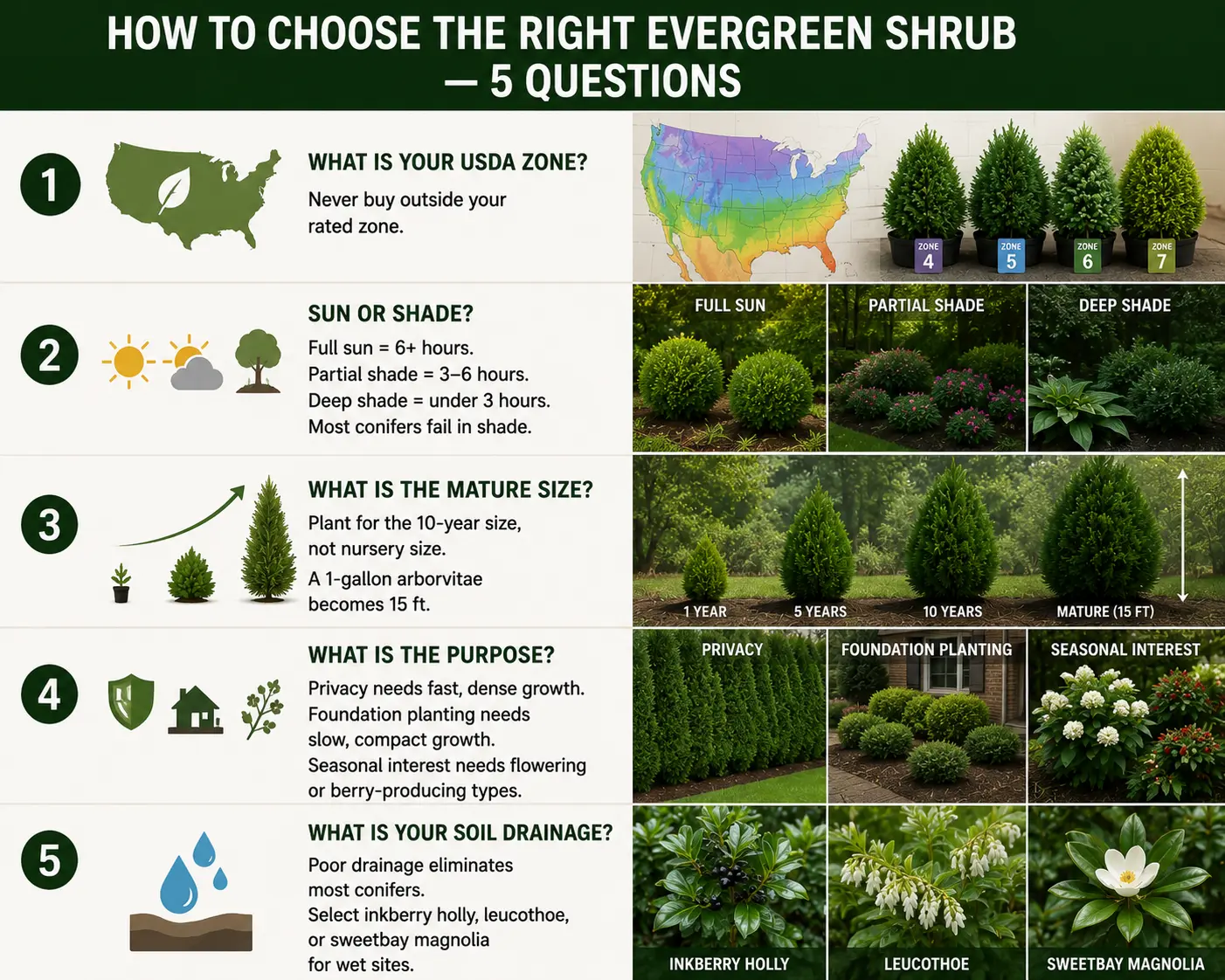
- What is your USDA zone? Never buy outside your rated zone.
- Sun or shade? Full sun = 6+ hours. Partial shade = 3–6 hours. Deep shade = under 3 hours. Most conifers fail in shade.
- What is the mature size? Plant for the 10-year size, not nursery size. A 1-gallon arborvitae becomes 15 ft.
- What is the purpose? Privacy needs fast, dense growth. Foundation planting needs slow, compact growth. Seasonal interest needs flowering or berry-producing types.
- What is your soil drainage? Poor drainage eliminates most conifers. Select inkberry holly, leucothoe, or sweetbay magnolia for wet sites.
Frequently Asked Questions
What is the fastest growing evergreen shrub for privacy?
Wax myrtle gains 3–5 ft (0.9–1.5 m) per year in zones 6–10. Cherry laurel gains up to 24 inches (60 cm) per year in zones 6–9. For zones 2–7, Arborvitae ‘Green Giant’ gains 3–5 ft per year and is the top privacy choice.
Do evergreen shrubs lose leaves?
Yes — gradually. Most broadleaf evergreens replace their foliage over 2–3 years without becoming bare. Older inner leaves yellow and drop in fall, which is normal. Rapid or significant leaf drop signals a problem: drought stress, root rot, or scale insects.
What evergreen shrubs grow in full shade?
Mahonia, leucothoe, yew, and aucuba all grow in full to deep shade. Rhododendron and mountain laurel prefer dappled shade. Most conifers (juniper, arborvitae) require at least 4 hours of sun — they thin out and die in deep shade.
Can I plant evergreen shrubs in fall?
Yes — fall is one of the 2 best planting times for evergreens. Plant at least 6 weeks before the ground freezes to give roots time to establish. Water well at planting and once more before the ground hardens.
What is the difference between a broadleaf evergreen and a conifer?
Broadleaf evergreens carry flat, wide leaves; conifers carry needles or scale-like foliage. Both stay green year-round. Broadleaf evergreens include boxwood, holly, and rhododendron. Conifers include juniper, arborvitae, and yew.
How far apart should I plant evergreen shrubs for a hedge?
Plant most hedge shrubs 2–3 ft (60–90 cm) apart for faster fill, or 4–5 ft (1.2–1.5 m) apart for a more natural look. Arborvitae privacy screens work at 3–4 ft spacing. Ask the nursery for the specific variety’s spread at maturity.
Final Thoughts
Evergreen shrubs are the most dependable plants in the garden. Get the zone, sun, and drainage right and they’ll outlive every annual, most perennials, and many trees. The payoff is structure and color 365 days a year with minimal work once established.
Pick for purpose first — privacy, foundation planting, shade, or flowering interest — then filter by zone and mature size. Everything else falls into place.
Build your garden from the ground up with our full plant guides at ZonedGarden, covering everything from shrubs and trees to perennials and indoor plants.