
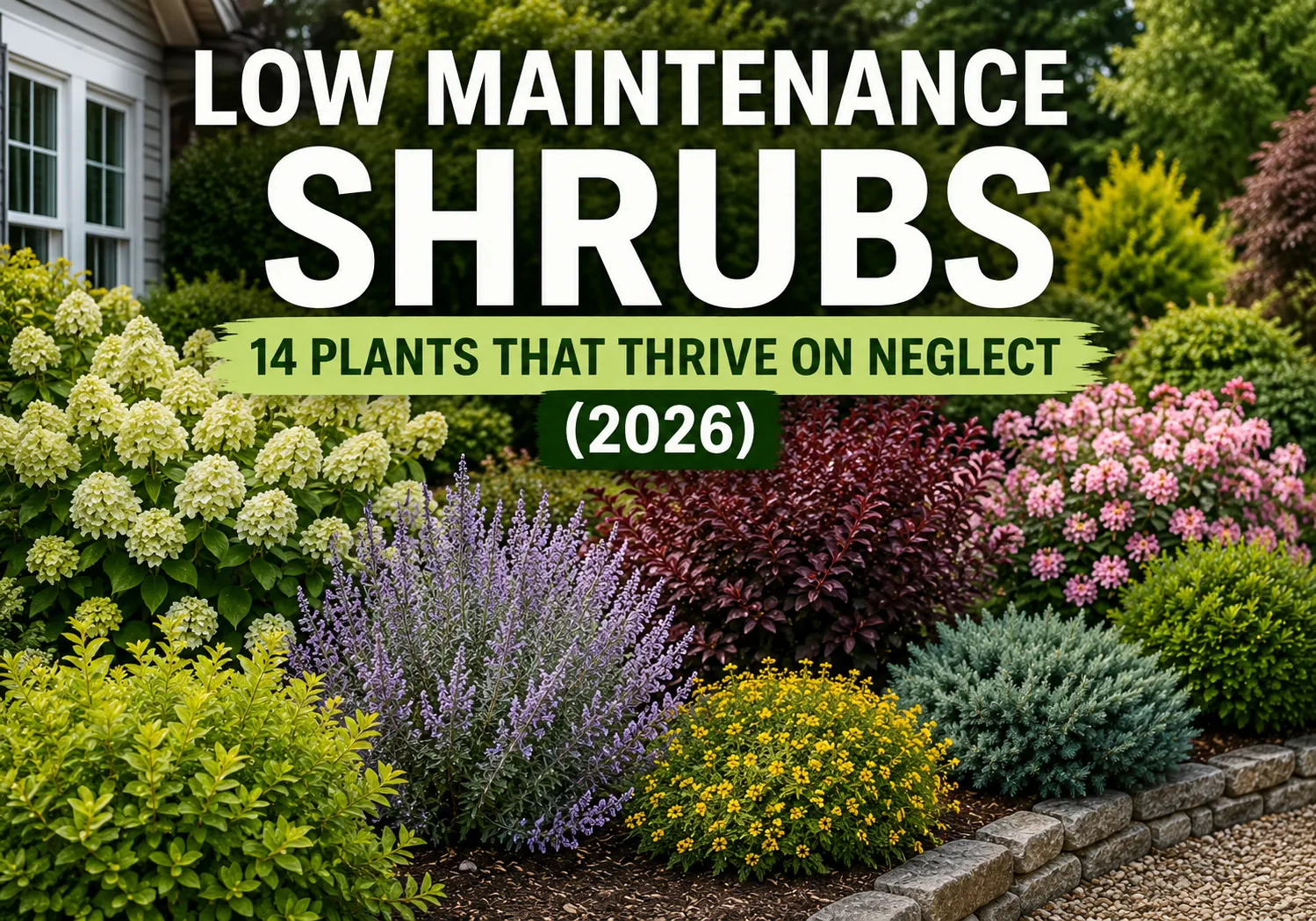
Most shrubs are low maintenance. Planted in the wrong spot, every shrub becomes high maintenance.
That is the one thing every competitor article misses. They list plants and call them easy. They skip the part that actually determines whether a shrub thrives or struggles — matching the plant to the site.
This guide covers 14 shrubs that genuinely need minimal care once established, organized by what your yard actually has: sun, shade, wet soil, dry soil, or a cold zone. Each pick includes mature size in feet and meters, zone range, and the single biggest care mistake to avoid.
What Actually Makes a Shrub Low Maintenance
4 traits define a truly low-maintenance shrub. A plant that checks all 4 asks almost nothing from you after the first growing season.
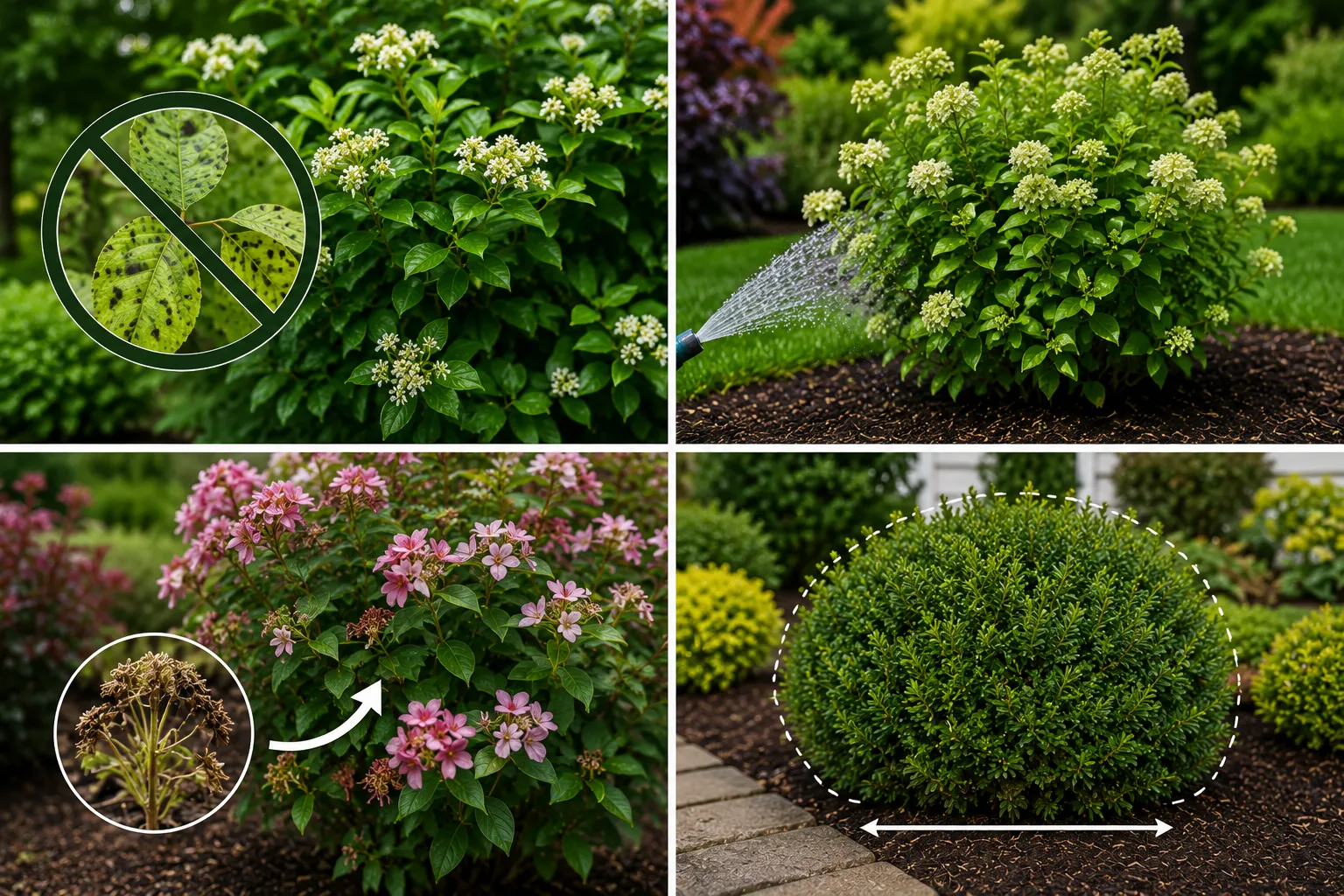
Disease resistance. A shrub that gets black spot, powdery mildew, or fire blight every year is not low maintenance — it is a problem plant. Genuinely easy shrubs carry built-in resistance to the diseases common in their region.
Drought tolerance once established. The first summer after planting, every shrub needs regular water to build its root system. After that first year, a low-maintenance shrub survives on natural rainfall in most US climates without supplemental irrigation.
Self-cleaning or no deadheading required. Deadheading — removing spent flowers — is time-consuming. The best low-maintenance shrubs drop their spent blooms on their own or produce berries and seedheads that add winter interest instead of making a mess.
Slow to moderate growth rate. Fast-growing shrubs need constant pruning to stay in bounds. A shrub that adds 6 to 12 inches (15 to 30 cm) per year fits its space without weekly trimming. Check the mature size before you plant — not the size it is at the nursery.
Best Low Maintenance Shrubs for Full Sun
Full sun means 6 or more hours of direct sunlight daily. These 5 shrubs thrive in full sun, tolerate summer heat, and ask for little in return.
1. Knockout Rose (Rosa ‘Radrazz’) — Zones 5–9
Knockout Rose is the most maintenance-free flowering shrub available in the USA. It blooms continuously for 6 to 7 months — late spring through the first hard frost — without deadheading, without fungicide sprays, and without complicated pruning.
Mature size: 3 to 4 feet tall (0.9 to 1.2 m), 3 to 4 feet wide (0.9 to 1.2 m).
Biggest care mistake: Skipping the annual late-winter cut. Cut Knockout Rose back by one-third to one-half in late February or early March. That single task takes 10 minutes and drives the most vigorous bloom season of the year.
2. Spirea (Spiraea japonica) — Zones 3–8
Spirea is one of the toughest shrubs in cultivation. It grows in poor soil, tolerates drought after establishment, and blooms reliably every summer without care. Cut it back hard in late winter and it rewards with the strongest bloom of the season. Skip the cut entirely and it still blooms — just less heavily.
Mature size: 2 to 4 feet tall (0.6 to 1.2 m), 2 to 4 feet wide (0.6 to 1.2 m) depending on variety.
Best varieties: ‘Little Princess’ for compact 2-foot (0.6 m) mounds. ‘Goldflame’ for copper-orange spring foliage shifting to gold in summer with pink blooms.
3. Potentilla (Potentilla fruticosa) — Zones 2–7
Potentilla is one of the most cold-hardy flowering shrubs in North America, surviving Zone 2 winters that reach -50°F (-46°C). It blooms from late spring through fall — a 4 to 5 month bloom season — in yellow, white, orange, or pink.
Mature size: 2 to 4 feet tall (0.6 to 1.2 m), 2 to 4 feet wide (0.6 to 1.2 m).
Biggest care mistake: Over-pruning. Potentilla needs nothing more than removing dead wood in spring. Heavy shearing ruins its natural mounded form and reduces bloom count.
4. Caryopteris / Blue Mist Shrub (Caryopteris × clandonensis) — Zones 5–9
Caryopteris blooms in late summer and fall when most flowering shrubs have finished. The blue-purple flowers attract pollinators — particularly bees and monarch butterflies — at a time when other nectar sources are scarce. It is deer resistant, drought tolerant, and thrives in poor, well-drained soil.
Mature size: 2 to 3 feet tall (0.6 to 0.9 m), 2 to 3 feet wide (0.6 to 0.9 m).
Care: Cut to 6 inches (15 cm) above the ground in late winter. New growth emerges in late spring. No other care needed.
5. Smokebush (Cotinus coggygria) — Zones 4–8
Smokebush earns its name from the wispy, smoke-like seedheads that cover the plant in summer. The foliage — purple, burgundy, or chartreuse depending on variety — provides 3-season color. It is drought tolerant once established, requires no deadheading, and best left unpruned for the fullest smoke effect.
Mature size: 10 to 15 feet tall (3 to 4.6 m), 10 to 15 feet wide (3 to 4.6 m) unpruned. Hard-prune annually to keep at 4 to 6 feet (1.2 to 1.8 m).
Best varieties: ‘Royal Purple’ for deep burgundy-to-black foliage. ‘Limelight’ for chartreuse foliage shifting gold and red in fall.
Best Low Maintenance Shrubs for Part Shade
Part shade means 3 to 6 hours of direct sunlight daily. These 3 shrubs perform in dappled light, under tall deciduous trees, or on the north or east side of a building.
6. Oakleaf Hydrangea (Hydrangea quercifolia) — Zones 5–9
Oakleaf Hydrangea delivers 4-season interest with almost no effort. Large white cone-shaped blooms open in early summer and age through cream, pink, and burgundy. The oak-shaped leaves turn deep red in fall. Cinnamon-colored exfoliating bark provides winter texture. It is one of the few flowering shrubs that prefers shade over sun.
Mature size: 4 to 6 feet tall (1.2 to 1.8 m), 4 to 6 feet wide (1.2 to 1.8 m).
Biggest care mistake: Pruning in fall or winter. Oakleaf hydrangea blooms on old wood — last year’s growth. Pruning in fall removes all flower buds. Prune only immediately after bloom in midsummer, if needed at all.
7. Weigela (Weigela florida) — Zones 4–8
Weigela is one of the most underused low-maintenance shrubs in the USA. It produces trumpet-shaped flowers in red, pink, or white that hummingbirds feed on heavily in late spring. Modern compact varieties stay 3 to 4 feet (0.9 to 1.2 m) without pruning.
The foliage color on newer cultivars rivals any ornamental plant in the landscape — ‘Wine & Roses’ has deep burgundy leaves that hold color through summer. No deadheading required. Prune lightly after the first bloom flush to encourage a second flush in midsummer.
Best compact varieties: ‘Spilled Wine’ at 2 to 3 feet (0.6 to 0.9 m). ‘Midnight Wine’ at 18 to 24 inches (45 to 60 cm) for tight foundation spots.
8. Witch Hazel (Hamamelis × intermedia) — Zones 4–8
Witch hazel blooms in January and February — bare branches covered with spidery yellow, orange, or red flowers while the ground is still frozen. No other flowering shrub provides color at that time of year. The fragrance carries 20 to 30 feet (6 to 9 m) in still air.
Mature size: 8 to 15 feet tall (2.4 to 4.6 m), 8 to 15 feet wide (2.4 to 4.6 m). Allow full spread — pruning removes the branches that will carry next season’s flowers.
Care: Plant it and leave it. Witch hazel is virtually pest-free, disease-free, and needs no pruning. It is the definition of plant-and-forget.
Best Low Maintenance Shrubs for Dry or Poor Soil
9. Dwarf Mugo Pine (Pinus mugo ‘Mops’) — Zones 2–7
Dwarf Mugo Pine is the most genuinely care-free shrub on this list. It produces no flowers to deadhead, no fruit to clean up, no significant pest or disease pressure, and grows only 3 to 6 inches (7.5 to 15 cm) per year. Plant it and it takes care of itself for decades.
Mature size: 3 to 5 feet tall (0.9 to 1.5 m), 3 to 5 feet wide (0.9 to 1.5 m) at 10 years.
Ideal for: Rocky slopes, sandy soil, exposed windy sites, and any location where other plants struggle. Tolerates road salt — useful near driveways and sidewalks in northern states.
10. Indian Hawthorn (Rhaphiolepis indica) — Zones 7–11
Indian Hawthorn is the best low-maintenance evergreen shrub for warm climates. It produces pink or white flowers in spring, dark blue-black berries in fall that birds feed on through winter, and holds its deep green foliage year-round. It resists drought, heat, salt spray, and most pests.
Mature size: 3 to 5 feet tall (0.9 to 1.5 m), 3 to 5 feet wide (0.9 to 1.5 m). Stays compact without pruning.
Biggest care mistake: Planting in clay or poorly drained soil. Indian Hawthorn develops root rot in wet feet. Plant in well-drained or slightly elevated beds only.
11. Abelia (Abelia × grandiflora) — Zones 5–9
Abelia blooms from late spring through fall — one of the longest bloom seasons of any landscape shrub. The small tubular white or pink flowers attract bees and butterflies consistently. Foliage on many varieties turns bronze-orange in fall before holding through mild winters in Zones 7 and above.
Mature size: 3 to 6 feet tall (0.9 to 1.8 m), 3 to 6 feet wide (0.9 to 1.8 m) depending on variety.
Best compact variety: ‘Kaleidoscope’ reaches 2.5 feet (0.75 m) with gold and green variegated foliage that turns orange-red in fall.
Best Low Maintenance Shrubs for Wet or Clay Soil
12. Red Twig Dogwood (Cornus sericea) — Zones 2–7
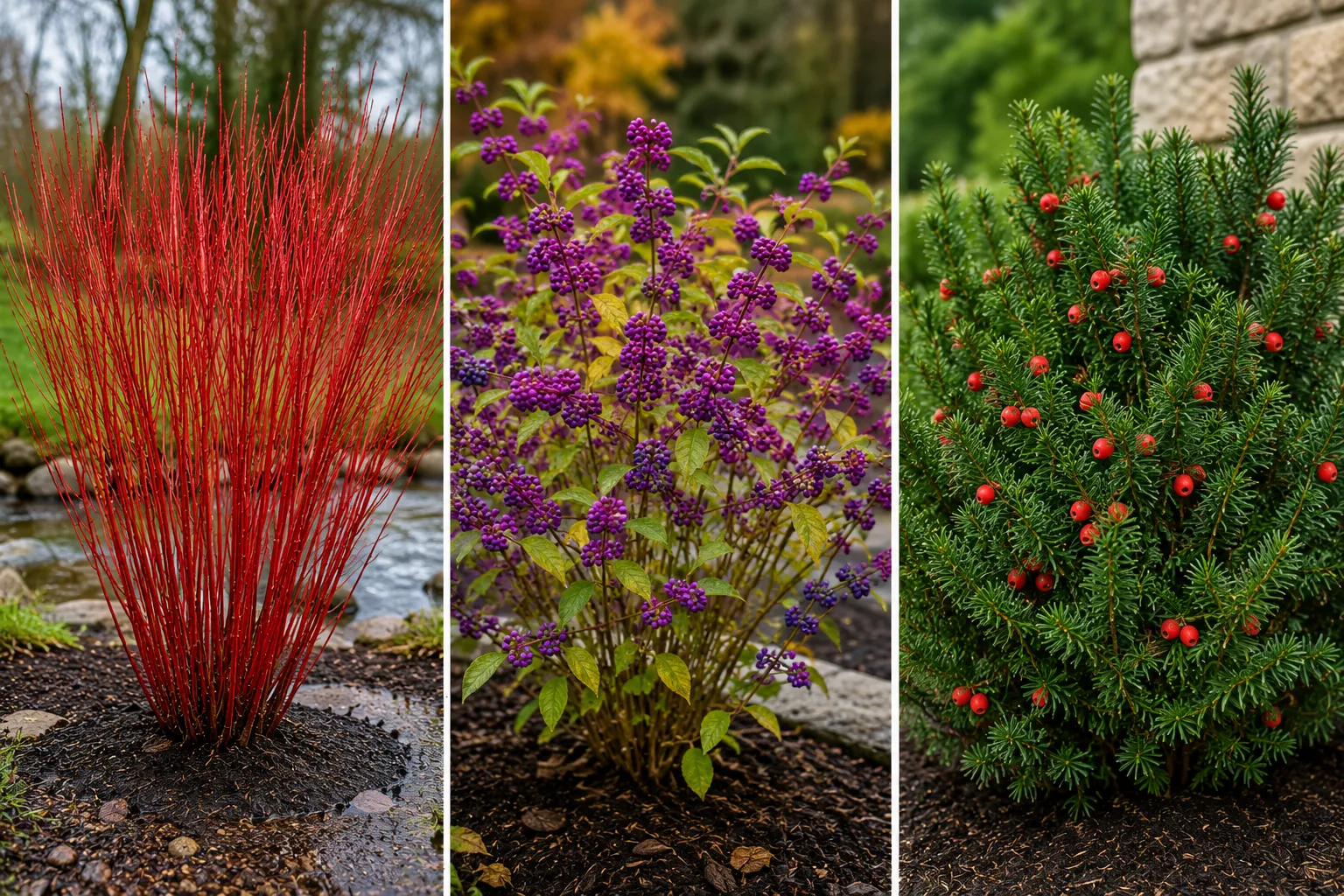
Red Twig Dogwood earns its place with 4-season interest: white flower clusters in spring, white berries in summer that birds eat immediately, yellow fall foliage, and — the main event — brilliant red stems that glow against snow through winter. The stem color is brightest on young wood, so cut one-third of the oldest stems to the ground each spring.
Mature size: 6 to 9 feet tall (1.8 to 2.7 m), 6 to 9 feet wide (1.8 to 2.7 m). Spreads by suckers — manageable with annual removal.
Ideal for: Wet areas, rain gardens, stream banks, and spots where most shrubs rot. One of the few ornamental shrubs that thrives in consistently moist soil.
13. Beautyberry (Callicarpa americana) — Zones 5–10
Beautyberry produces the most electric fall color of any American native shrub. Clusters of vivid violet-purple berries — technically magenta — line every stem from September through November. Birds strip them by December. The plant then goes dormant and returns reliably each spring.
Mature size: 4 to 6 feet tall (1.2 to 1.8 m), 4 to 6 feet wide (1.2 to 1.8 m).
Care: Cut to 12 inches (30 cm) above the ground in late winter. Beautyberry blooms and fruits on new growth — hard pruning maximizes the berry display. Skip it and you still get berries, just fewer.
14. Yew (Taxus × media) — Zones 4–7
Yew grows in full sun, full shade, and everything in between — a flexibility no other evergreen shrub matches. It tolerates heavy pruning, recovers from being cut back hard, and holds its dark green needled foliage year-round. Female plants produce red berries in fall that persist through winter.
Mature size: Varies widely by cultivar. ‘Densiformis’ reaches 3 to 4 feet (0.9 to 1.2 m). ‘Hicksii’ reaches 10 to 12 feet (3 to 3.6 m) for hedging.
Critical note: All parts of yew are toxic to humans and livestock except the red berry flesh. Plant away from areas where children play and do not use as livestock fencing.
Quick Reference: 14 Low Maintenance Shrubs
| Shrub | Zones | Mature Size | Sun | Soil | Bloom Season |
| Knockout Rose | 5–9 | 3–4 ft (0.9–1.2 m) | Full sun | Well-drained | Late spring – frost |
| Spirea | 3–8 | 2–4 ft (0.6–1.2 m) | Full sun | Any | Late spring – summer |
| Potentilla | 2–7 | 2–4 ft (0.6–1.2 m) | Full sun | Poor/well-drained | Spring – fall |
| Caryopteris | 5–9 | 2–3 ft (0.6–0.9 m) | Full sun | Poor/dry | Late summer – fall |
| Smokebush | 4–8 | 10–15 ft (3–4.6 m) | Full sun | Well-drained | Foliage/seedheads |
| Oakleaf Hydrangea | 5–9 | 4–6 ft (1.2–1.8 m) | Part shade | Moist/well-drained | Early summer |
| Weigela | 4–8 | 3–4 ft (0.9–1.2 m) | Full/part | Well-drained | Late spring, rebloom |
| Witch Hazel | 4–8 | 8–15 ft (2.4–4.6 m) | Part shade | Well-drained | January – February |
| Dwarf Mugo Pine | 2–7 | 3–5 ft (0.9–1.5 m) | Full sun | Rocky/sandy | Evergreen, no bloom |
| Indian Hawthorn | 7–11 | 3–5 ft (0.9–1.5 m) | Full sun | Well-drained | Spring |
| Abelia | 5–9 | 3–6 ft (0.9–1.8 m) | Full/part | Well-drained | Late spring – fall |
| Red Twig Dogwood | 2–7 | 6–9 ft (1.8–2.7 m) | Full/part | Wet/clay | Spring; winter stems |
| Beautyberry | 5–10 | 4–6 ft (1.2–1.8 m) | Full/part | Moist/well-drained | Fall berries |
| Yew | 4–7 | 3–12 ft (0.9–3.6 m) | Full sun–shade | Any except wet | Evergreen; fall berries |
The One Year Rule: How to Establish Any Shrub With Minimal Effort
Every low-maintenance shrub on this list earns that label after the first growing season. Year one is different — and competitors never explain this clearly.
During the first 12 months after planting, any shrub — even the toughest on this list — needs consistent moisture to develop its root system. Roots grow fastest in warm soil (65 to 75°F / 18 to 24°C), which means late summer and fall planting in most US climates gives roots a full warm season underground before the first hard freeze.
Follow this 3-step establishment schedule for every shrub you plant:
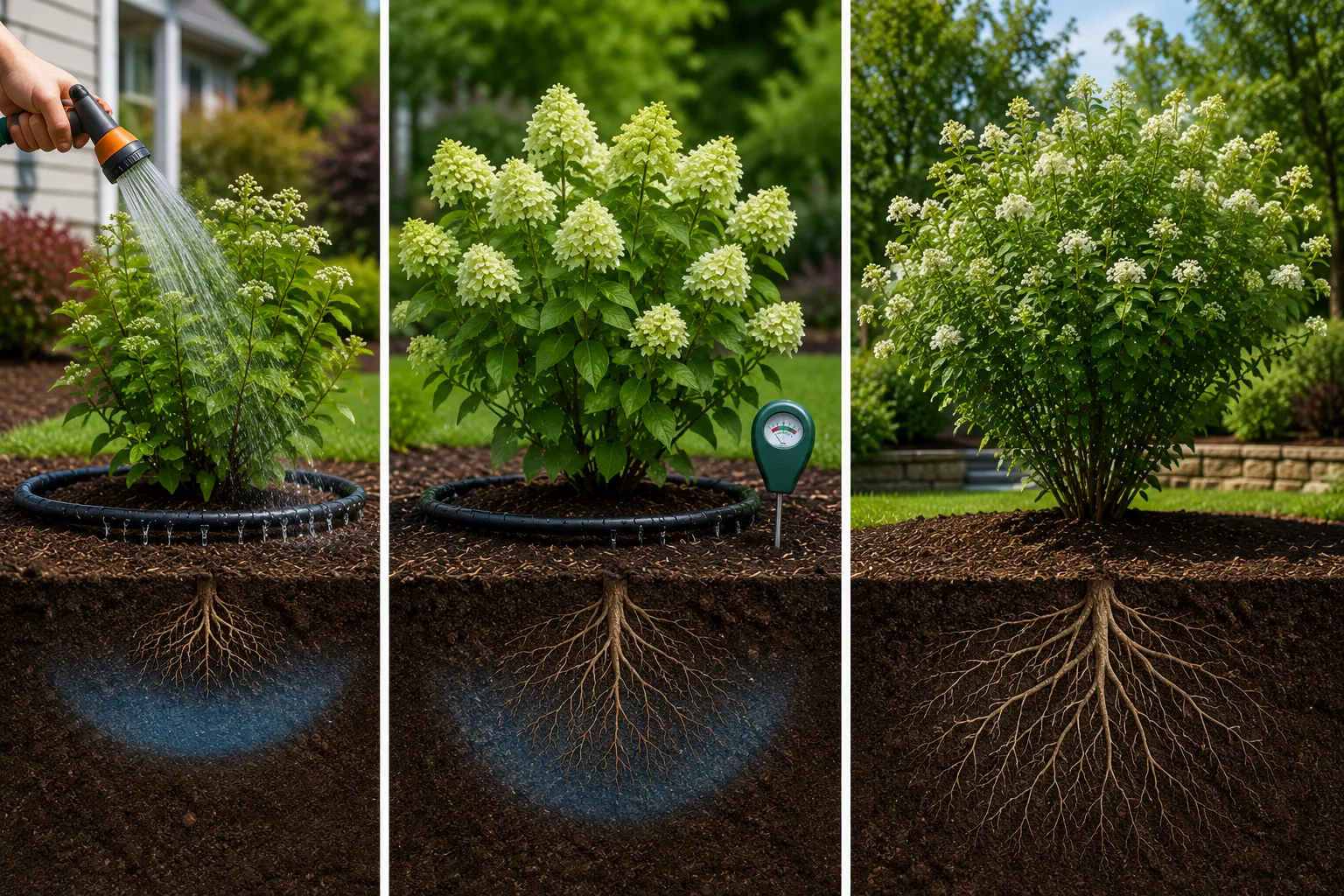
- Weeks 1–4: Water deeply twice per week. Deep means slow — soak the root zone for 20 to 30 minutes, not a quick spray.
- Months 2–6: Water deeply once per week during dry periods. Check soil 3 inches (7.5 cm) deep before watering — skip it if the soil is still moist.
- Year 2 onward: Stop supplemental watering for every shrub on this list except in drought conditions (no rain for 3 or more weeks in summer).
Apply 2 to 3 inches (5 to 7.5 cm) of wood chip mulch around each shrub, starting 3 inches (7.5 cm) from the stem and extending 18 to 24 inches (45 to 60 cm) outward. Mulch cuts establishment watering needs by 30 to 40 percent and suppresses weeds that compete with new roots.
Pruning Calendar: When to Prune Each Shrub
The single most common maintenance mistake is pruning at the wrong time. These are the correct windows for the 14 shrubs above.
| Shrub | When to Prune | How Much | Why |
| Knockout Rose | Late February – early March | Cut back by 1/3 to 1/2 | Blooms on new wood |
| Spirea | Late winter | Cut to 6 in (15 cm) | Blooms on new wood |
| Potentilla | Early spring | Remove dead wood only | Minimal pruning needed |
| Caryopteris | Late winter | Cut to 6 in (15 cm) | Blooms on new wood |
| Smokebush | Late winter (if pruning) | Cut hard or leave unpruned | Old wood = best smoke |
| Oakleaf Hydrangea | Immediately after bloom | Remove dead or crossing stems | Blooms on old wood |
| Weigela | After first bloom flush | Remove 1/3 oldest stems | Encourages rebloom |
| Witch Hazel | Do not prune | None needed | Blooms on old wood Jan–Feb |
| Dwarf Mugo Pine | Do not prune | None needed | Naturally compact |
| Indian Hawthorn | After spring bloom | Shape lightly only | Maintain natural form |
| Abelia | Late winter | Remove 1/3 oldest stems | Keeps foliage fresh |
| Red Twig Dogwood | Early spring | Cut 1/3 oldest stems to ground | Keeps stem color bright |
| Beautyberry | Late winter | Cut to 12 in (30 cm) | Fruits on new wood |
| Yew | Any time except late summer | Tolerates heavy pruning | Reliable regrowth |
Frequently Asked Questions
What is the lowest maintenance shrub you can plant?
Dwarf Mugo Pine is the lowest-maintenance shrub in landscape use. It needs no pruning, no deadheading, no fertilizing, and produces no leaf litter to clean up. Plant it in full sun in well-drained soil and it grows 3 to 6 inches (7.5 to 15 cm) per year with zero intervention required.
Do low maintenance shrubs still need water after planting?
Yes, for the first 12 months. Every shrub on this list needs consistent moisture during its first growing season to build an established root system. After that first year, all 14 shrubs on this list survive on natural rainfall in most US climates without supplemental watering.
Which low maintenance shrubs work in full shade?
Yew is the top choice for full shade — it grows in less than 3 hours of direct sunlight and holds dark green evergreen foliage year-round. Oakleaf Hydrangea and Witch Hazel both tolerate deep shade and still flower. Beautyberry produces fewer berries in full shade but still performs.
Are low maintenance shrubs deer resistant?
Not all of them. Caryopteris, Potentilla, Indian Hawthorn, and Dwarf Mugo Pine show strong deer resistance. Knockout Rose, Spirea, and Beautyberry are moderately resistant. Yew, Arborvitae, and Oakleaf Hydrangea are frequently browsed in areas with high deer pressure. In heavy deer areas, spray all new plantings with a commercial deer repellent during the first 2 growing seasons.
What is the best low maintenance shrub for cold climates?
Potentilla is the best flowering shrub for extreme cold — it survives Zone 2 winters reaching -50°F (-46°C). Red Twig Dogwood and Dwarf Mugo Pine are both Zone 2 hardy. For Zones 3 to 4, Spirea, Weigela, and Witch Hazel all perform reliably without winter protection.
Choose the Right Shrub and Your Yard Takes Care of Itself
Every shrub on this list delivers years of reliable performance — once it is planted in the right spot. Match the plant to your sun exposure, soil drainage, and USDA zone, give it one good establishment season, and it handles the rest.
The difference between a low-maintenance yard and a high-maintenance one is almost always plant selection — not how much effort you put in after planting.
| Ready to find the right low-maintenance plants for your specific zone? Browse zone-specific plant guides and care calendars at ZonedGarden.com. Every guide is written for real conditions — not ideal ones. |