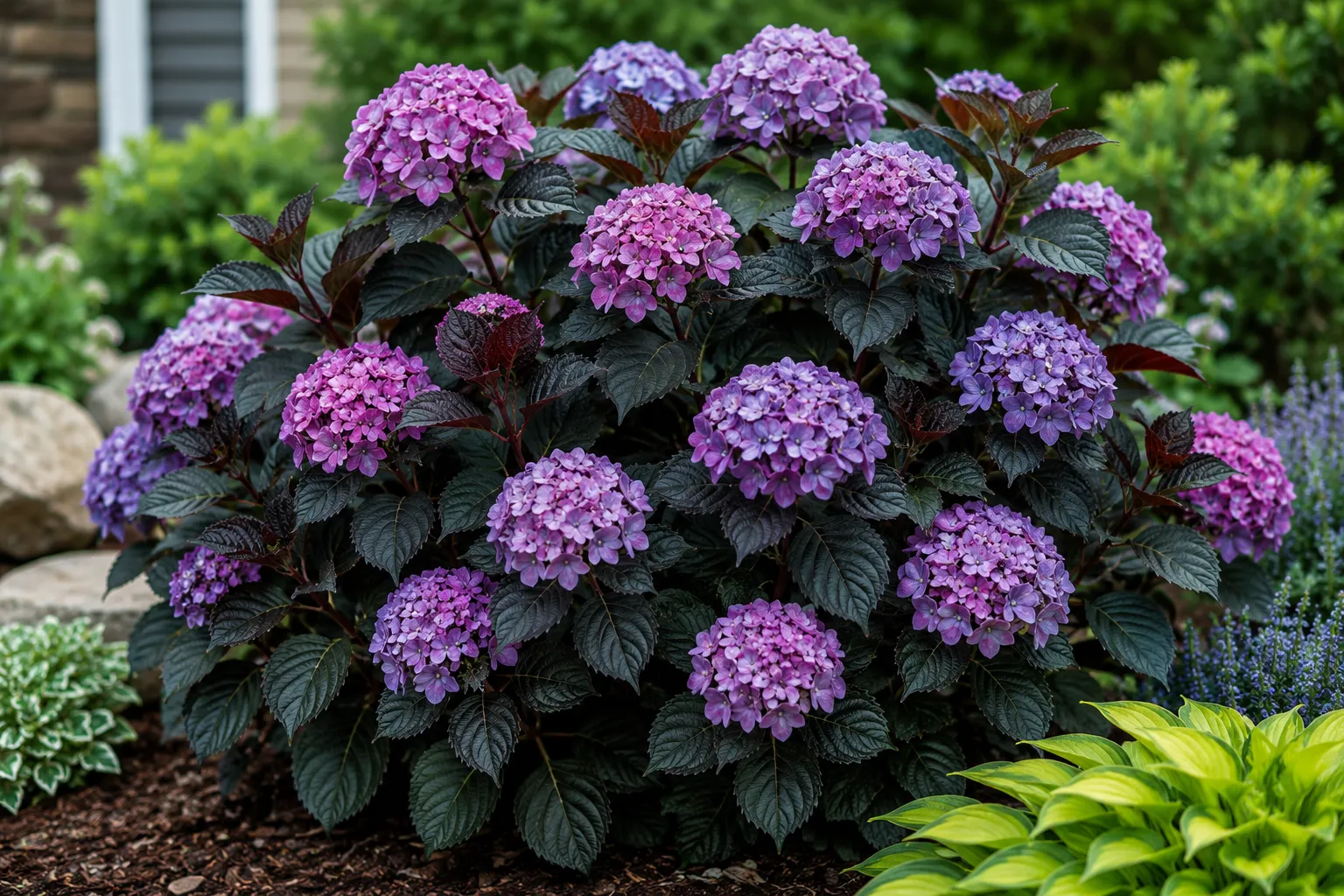
Eclipse hydrangea (Hydrangea macrophylla ‘Bailmacseven’) thrives in morning sun with afternoon shade, moist well-draining soil with a pH of 4.5–6.0, and USDA Zones 5–9. It is the first bigleaf hydrangea to hold dark purple foliage all season — even in summer heat — and it reblooms on both old and new wood. Prune only after the first flush of flowers fades in summer, and never cut stems after mid-June or in fall.
This guide covers everything no competitor does in one place: dark foliage color science, bloom color control by soil pH, zone-by-zone care adjustments, a seasonal calendar, winter protection steps by zone, and a troubleshooting section for the 4 most common Eclipse problems.
What Makes Eclipse Hydrangea Different
Eclipse hydrangea stands apart from every other bigleaf hydrangea on 3 specific traits that no other cultivar combined before its 2020 commercial release.
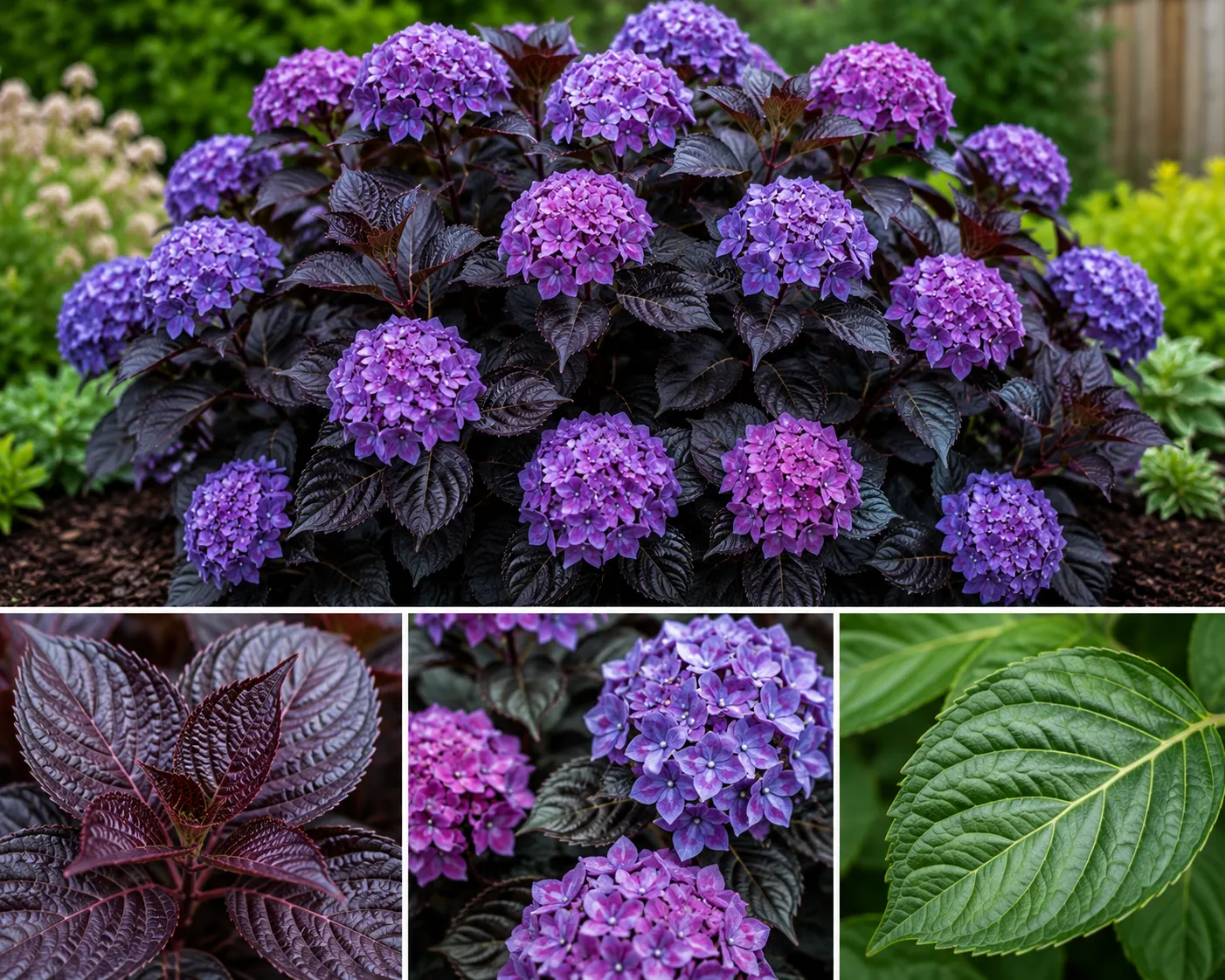
Trait 1 — Permanent dark purple foliage. Standard bigleaf hydrangeas produce green leaves that may show hints of bronze only in full sun. Eclipse holds deep purple-black foliage from spring through fall, even in warm climates. Bailey Nurseries (the breeder) spent 8 years — from 2017 to 2024 — selecting for this trait specifically because earlier dark-leaved hydrangea seedlings lost their color by midsummer in southern heat.
Trait 2 — Reblooming on old and new wood. Most bigleaf hydrangeas bloom only on old wood — stems from the previous season. Eclipse sets buds on both old wood and current-season new wood. This means a late frost that kills old-wood buds in Zone 5 does not eliminate the entire bloom season — new wood carries a second flush of flowers in late summer.
Trait 3 — Improved disease resistance. Eclipse carries documented resistance to powdery mildew and Cercospora leaf spot — the 2 most common fungal diseases in bigleaf hydrangeas. This resistance holds across the USDA Zones 5–9 growing range without fungicide treatment under normal growing conditions.
Eclipse Hydrangea — Quick Facts
| Feature | Detail |
| Botanical Name | Hydrangea macrophylla ‘Bailmacseven’ PP34,544 |
| Brand | First Editions® by Bailey Nurseries |
| Plant Type | Deciduous mophead bigleaf hydrangea |
| USDA Zones | 5–9 |
| Mature Height | 3–5 ft (0.9–1.5 m) |
| Mature Width | 3–5 ft (0.9–1.5 m) |
| Bloom Time | Late spring through summer — reblooms into fall |
| Bloom Color | Cranberry-red (alkaline soil) or amethyst-purple (acidic soil) |
| Foliage Color | Deep purple-black, holds all season |
| Bloom Type | Old wood + new wood (reblooming) |
| Sun | Morning sun, afternoon shade — part shade |
| Soil pH | 4.5–6.0 (slightly to moderately acidic) |
| Disease Resistance | Powdery mildew + Cercospora leaf spot resistant |
| Container Suitable | Yes — minimum 15-gallon (57-liter) container |
| Deer Resistance | Low — deer will browse bigleaf hydrangeas |
Understanding Eclipse’s Dark Foliage — And How to Keep It
Eclipse foliage fades from deep purple-black toward green when the plant receives too little light or too much nitrogen fertilizer. The dark pigmentation comes from anthocyanin — a natural plant pigment that requires adequate sun exposure to maintain intensity. Without 4+ hours of direct morning sun, anthocyanin production slows and green chlorophyll dominates leaf color.
3 conditions cause foliage color fade:
- Too little light: Deep shade below 3 hours of direct sun causes leaves to shift toward olive-green by midsummer. Move to a site with 4–6 hours of morning sun to restore intensity the following season.
- High-nitrogen fertilizer: Nitrogen drives rapid green vegetative growth. Applications of high-N fertilizers (first number above 10) suppress anthocyanin production. Use balanced or phosphorus-forward fertilizers — 10-10-10 or 15-30-15 N-P-K — to support foliage color.
- Extreme heat without moisture: Consistent soil moisture in summer heat maintains foliage health. Wilting stress from underwatering causes leaves to develop pale patches before eventually browning at edges, which reduces perceived foliage darkness.
Keep foliage dark by planting in morning sun with afternoon shade, watering consistently, and using phosphorus-forward fertilizer (15-30-15) rather than nitrogen-heavy lawn-type products.
Bloom Color — Cranberry vs. Amethyst
Eclipse produces cranberry-red blooms in neutral to alkaline soil (pH 6.5 and above) and amethyst-purple blooms in acidic soil (pH 4.5–5.5). This color shift works through aluminum availability: acidic soil releases aluminum ions that the plant absorbs, shifting pigment expression toward purple. Alkaline soil locks aluminum out of plant uptake and blooms stay red.
| Soil pH | Bloom Color | Amendment to Achieve | Timing |
| 4.5–5.5 | Amethyst / deep purple | Aluminum sulfate — 1 tbsp (15 ml) per gallon of water, applied 3x in spring | Apply March–April before buds swell |
| 5.5–6.5 | Mixed purple-pink transition | No amendment needed — natural mid-range | Test pH annually and adjust |
| 6.5+ | Cranberry-red / deep pink | Agricultural lime — 1 cup (237 ml) per plant, worked into soil | Apply fall or early spring before new growth |
Note: Bloom color change takes 1–2 full growing seasons after pH adjustment. Soil pH does not shift in days. Test with a soil pH meter each spring and amend incrementally — over-acidifying soil below 4.5 damages roots.
Sun Requirements
Eclipse hydrangea grows best in part shade — 4–6 hours of direct morning sun followed by dappled or full afternoon shade. Morning sun drives anthocyanin production for dark foliage and fuels flower bud development. Afternoon shade prevents leaf scorch in Zones 7–9, where afternoon temperatures regularly exceed 90°F (32°C) from June through August.
Full sun performance varies by zone:
- Zones 5–6: Eclipse tolerates full sun sites with consistent watering. Foliage may show slightly more bronze than deep purple in direct full sun all day, but plant health remains strong.
- Zones 7–8: Part shade is the correct placement. Full-day sun in these zones causes visible leaf scorch by July — brown crispy edges on the large foliage. Recovery takes the rest of the season.
- Zone 9: Full afternoon shade is non-negotiable. In Zone 9 summer heat, even 2 hours of direct afternoon sun wilts foliage that is not supported by twice-weekly deep watering.
Deep shade — under a dense tree canopy or on a north-facing wall receiving less than 3 hours of light — reduces bloom count and causes foliage to lose dark color by midsummer. Eclipse needs light to maintain its defining traits.
Soil Requirements
Plant Eclipse hydrangea in slightly to moderately acidic, well-draining soil with a pH of 4.5–6.0. Soil above pH 6.5 locks aluminum out of availability, which shifts bloom color toward red and can limit nutrient uptake for dark foliage pigmentation.
Soil texture matters as much as pH. Heavy clay soil holds water around roots and causes root rot within 1–2 seasons. Sandy soil drains too fast and stresses the plant during dry stretches. The ideal texture — loamy with good structure — retains consistent moisture without pooling.
To correct clay soil: Work 3–4 inches (7.5–10 cm) of finished compost into the top 12 inches (30 cm) before planting. Add perlite or coarse sand at 20% of soil volume to open drainage channels.
To correct sandy soil: Work 4–5 inches (10–12.5 cm) of finished compost into the planting area. Add coir fiber or aged leaf mold to increase water retention around the root zone.
Mulch application after planting is the most reliable soil moisture stabilizer available. A 2–3 inch (5–7.5 cm) layer reduces evaporation by up to 70% and moderates soil temperature swings. Read the complete mulch selection and depth guide to match mulch type to your zone.
How to Plant Eclipse Hydrangea
Plant in spring or fall. Avoid summer planting — heat stress on a newly disturbed root system slows establishment by 4–6 weeks. Fall planting in Zones 5–7 gives roots 8–10 weeks to anchor before dormancy. Spring planting in all zones works with consistent first-season watering.
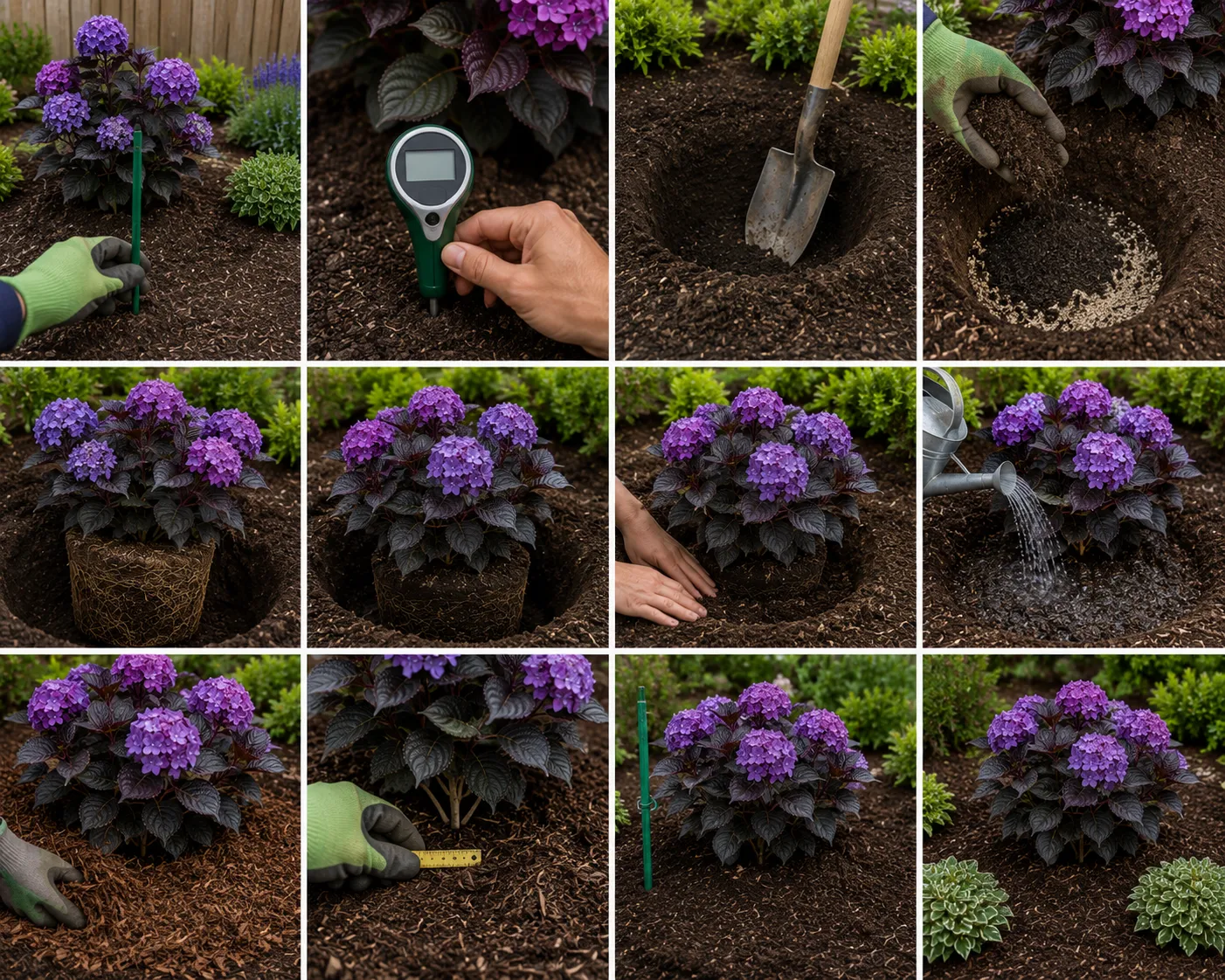
8-Step Planting Guide
- Choose the site: Confirm 4–6 hours of morning sun, afternoon shade, good drainage, and air circulation. Mark the site in morning to verify actual sun and shade patterns before digging.
- Test soil pH: Use a soil pH meter before digging the hole. Record the reading and plan amendments before the plant goes in the ground.
- Dig the hole: Dig 2–3 times wider than the root ball and equal to root ball depth. Never dig deeper — planting too deep causes crown rot. A slightly raised planting position improves drainage.
- Amend the soil: Mix 1 part finished compost with 2 parts native soil. If targeting amethyst blooms, mix aluminum sulfate into the backfill at the rate specified on the product label.
- Set the plant: Place the root ball so the top sits at or 1–2 inches (2.5–5 cm) above surrounding soil grade. This elevated position moves the crown above water runoff level.
- Backfill and firm: Fill with amended soil in 3-inch (7.5 cm) layers, pressing gently to eliminate air pockets after each layer. Do not stomp — compress with hands only.
- Water in: Apply 2–3 gallons (7.5–11.5 liters) immediately after planting to settle soil and saturate the root zone. This first watering is critical for root-to-soil contact.
- Apply mulch: Spread 2–3 inches (5–7.5 cm) of shredded bark or shredded leaf mulch over the root zone. Keep mulch 2–3 inches (5–7.5 cm) away from the main stem to prevent stem rot.
Spacing: Space Eclipse plants 4–5 feet (1.2–1.5 m) apart center-to-center. Tighter spacing restricts air circulation between plants and increases powdery mildew risk during humid summers.
Watering Eclipse Hydrangea
Water newly planted Eclipse hydrangea 2–3 times per week during the first growing season, applying 1–2 gallons (3.8–7.5 liters) per session. The root system at planting is confined to the original root ball volume. Consistent moisture keeps the root zone damp while roots extend outward into surrounding soil.
Established Eclipse plants — 2 or more years in the ground — need watering only when rainfall totals less than 1 inch (2.5 cm) per week. Apply 2 gallons (7.5 liters) per plant in a single deep session rather than multiple shallow ones. Deep watering trains roots to grow downward where moisture is more stable.
3 Watering Rules for Eclipse
- Water at the base only. Overhead watering wets the large mophead leaves and creates ideal conditions for Cercospora leaf spot. A soaker hose or drip line at the root zone delivers water without touching foliage.
- Check before watering. Insert a finger 2 inches (5 cm) into soil. Water only when soil at that depth feels dry. Eclipse wilts dramatically when underwatered — but overwatering causes root rot that kills the plant silently over weeks.
- Increase frequency in heat, not volume. In Zones 8–9 during July and August, increase to 3 sessions per week for established plants during heat waves above 95°F (35°C). Keep each session at 1.5–2 gallons (5.7–7.5 liters) — more frequent, not larger volumes per session.
Container-grown Eclipse plants dry out 2–3 times faster than ground-planted specimens. In summer, a 15-gallon (57-liter) container in Zones 7–9 may need daily watering. Check by lifting the container — if it feels light, water immediately.
Fertilizing Eclipse Hydrangea
Fertilize once in early spring with a high-phosphorus slow-release fertilizer — 15-30-15 N-P-K — applied at 1 cup (237 ml) per plant around the drip line. High phosphorus encourages flower bud formation on both old and new wood, which directly increases Eclipse’s rebloom frequency.
Eclipse has 4 fertilizing rules that differ from standard shrub care:
- Apply only at the drip line. The drip line — the outer edge of the canopy — sits above active feeder roots. Applying fertilizer against the main stem delivers nutrients to structural roots that cannot absorb them efficiently.
- Never fertilize after July 1. Late nitrogen pushes new soft growth that hardens incompletely before first frost. This underdeveloped growth carries poorly formed bud tissue that winter cold kills. The result is reduced old-wood bloom the following spring.
- Water thoroughly after every application. Granular fertilizer sitting on dry soil burns roots. Apply 1 gallon (3.8 liters) of water immediately after spreading fertilizer to dissolve granules and move nutrients into the root zone.
- Compost replaces fertilizer in rich soil. In soil already rich in organic matter, an annual spring top-dressing of 2 inches (5 cm) of finished compost around the root zone provides all needed nutrients without risk of over-fertilizing. Apply compost first — fertilize only if plant growth or bloom count is visibly poor after 2 full seasons.
Pruning Eclipse Hydrangea
Prune Eclipse hydrangea immediately after the first flush of flowers fades in summer — typically late July or early August. Eclipse blooms on both old wood and new wood, but the primary first flush of flowers comes from old-wood buds set the previous fall. Cutting before those buds open in spring removes the first and largest bloom set.
Pruning Rules — 4 Non-Negotiables
- Never prune after mid-June. The official breeder recommendation from White Flower Farm and First Editions Plants is no pruning after mid-June. Flower buds for next year begin forming on new wood as early as late July. Cuts after mid-June remove developing buds and reduce the following year’s first flush.
- Never prune in fall or winter. Fall and winter cuts remove old-wood buds already set for spring. Eclipse looks dormant from October onward but carries fully formed bud tissue on every stem. Any fall cut eliminates spring blooms.
- Never remove more than 1/3 of total growth. Removing more than 1/3 of the plant stresses the root system and reduces both foliage density and bloom count the following season. Eclipse’s moderate 3–5 foot (0.9–1.5 m) size rarely requires severe cutting.
- Spring pruning: dead wood only. In early spring, once buds begin to swell visibly, remove only dead, diseased, or crossing branches. Wait for bud swell before cutting — stems that look dead in March may carry live buds by April. Cut only confirmed dead wood.
How to Prune — Step by Step
- Confirm bloom fade: Prune only after the mophead flowers have shifted from cranberry or amethyst to a dull, papery brown-tan. Green or pink flowers still contain live florets and seed energy — do not cut yet.
- Identify the cut point: Locate a healthy outward-facing bud node on the stem below the spent flower. Cut 1/4 inch (0.6 cm) above that node at a 45-degree angle, slanting away from the bud.
- Use bypass pruners only: Bypass pruning shears make clean scissor-style cuts that heal faster than the crushing cuts of anvil-type blades. Crushed stem tissue invites fungal disease entry.
- Deadhead for rebloom: Remove spent mophead flowers by cutting just below the flower cluster down to the first set of healthy leaves. Deadheading redirects energy from seed formation into developing the next flush of new-wood buds.
- Disinfect between plants: Wipe both pruner blades with a cloth soaked in 10% bleach (sodium hypochlorite) solution between plants. One plant with Cercospora leaf spot contaminates every subsequent cut made with the same blade.
The same old-wood pruning principle that protects Eclipse blooms applies to crape myrtles — see why wrong pruning timing permanently damages flowering wood.
USDA Zone Growing Guide — Zones 5–9
Eclipse hydrangea grows in USDA Zones 5–9. Zone 5 is the cold limit — plants survive but require winter stem protection to preserve old-wood buds. Zone 9 is the heat limit — plants survive but need full afternoon shade and supplemental watering to maintain foliage quality and bloom count.
| Zone | Min Temp | Key Care Adjustments | Winter Protection Needed |
| Zone 5 | -20°F (-29°C) | Plant in sheltered south-facing site. Full sun tolerated with consistent water. Mulch crown 3–4 in (7.5–10 cm) before frost. | Apply 12 in (30 cm) straw or leaf mulch over stems. Wrap with burlap to protect buds from freeze-thaw cycles. Remove in March. |
| Zone 6 | -10°F (-23°C) | Standard care. Part shade preferred. Fall planting recommended for establishment. | Apply 3–4 in (7.5–10 cm) mulch over root zone. Burlap wrap optional in exposed sites. |
| Zone 7 | 0°F (-18°C) | Ideal zone. Morning sun + afternoon shade produces peak foliage and bloom quality. | 2–3 in (5–7.5 cm) root zone mulch is sufficient. No stem wrap needed. |
| Zone 8 | 10°F (-7°C) | Increase afternoon shade. Water 2x weekly in summer. Improve drainage before planting. | Light mulch only. Stems do not require protection — winters rarely cold enough to damage buds. |
| Zone 9 | 20°F (-7°C) | Full afternoon shade required. Water up to 3x weekly in July–August heat. Select sheltered spots with north or east exposure. | No winter protection needed. Summer heat management is the primary concern in Zone 9. |
Winter Care and Bud Protection
Winter bud protection is the single most important annual task for Eclipse hydrangea in Zones 5–6. Eclipse blooms primarily on old wood — the stems standing through winter carry spring bloom buds. Any temperature that kills those stems eliminates the first and largest flush of flowers the following year.
Zone 5–6 Winter Protection Steps
- Continue watering until hard freeze: Water every 7–10 days until the ground freezes solid. Well-hydrated root tissue tolerates freeze-thaw stress better than dry tissue. The most common cause of Zone 5 winter bud loss is root dehydration, not air temperature.
- Apply heavy mulch after first hard frost: Once the ground freezes solid — typically November in Zone 5, December in Zone 6 — spread 3–4 inches (7.5–10 cm) of straw, shredded oak leaves, or pine needles over the entire root zone. Oak leaves are the recommended material from First Editions Plants because they decompose slowly and maintain air pockets that insulate roots.
- Wrap stems with burlap in Zone 5: Loosely wrap all stems as a bundle with burlap fabric. Do not use plastic — plastic traps moisture inside and promotes fungal growth on stems through winter. Burlap breathes and reduces wind chill on bud tissue by 10–15°F (5–8°C).
- Remove protection in March: Pull back mulch and unwrap burlap once nighttime temperatures consistently stay above 20°F (-7°C). Leaving protection in place too long traps emerging shoots and delays leafing out.
Zone 7–9 Winter Steps
In Zones 7–9, stems survive winter without protection. Apply only a standard 2–3 inch (5–7.5 cm) mulch layer over the root zone to moderate soil temperature fluctuations through mild winter cold snaps. No stem wrapping needed.
If your zone experiences unexpected late-season cold snaps, cover plants overnight with fleece or burlap when temperatures drop below 25°F (-4°C). How to propagate and protect shrubs through cold events for additional cold-event management strategies.
Seasonal Care Calendar
Spring (March–May)
- Wait for bud swell before any pruning. Eclipse leafs out later than other shrubs — stems that appear dead in March often carry live buds by mid-April.
- Remove dead wood only after buds swell visibly. Cut confirmed dead stems to the base.
- Pull back winter mulch as soil warms. Remove burlap wrap when nighttime lows stay above 20°F (-7°C). Apply fresh 2–3 in (5–7.5 cm) mulch layer after removal.
- Test soil pH. Adjust with aluminum sulfate (for amethyst blooms) or agricultural lime (for cranberry blooms) if needed. Allow 1 full season for color shift.
- Apply 15-30-15 slow-release fertilizer once at the drip line. Do not fertilize again until next spring.
Summer (June–August)
- Water 1–2 times weekly if rainfall totals less than 1 inch (2.5 cm) per week. Apply 1.5–2 gallons (5.7–7.5 liters) per session at the root zone.
- Stop all pruning after mid-June. Flower buds for next year begin forming on new wood from late July onward.
- Deadhead spent mophead flowers after first flush fades — cut just below the flower cluster to the first set of healthy leaves. This triggers new-wood bud development for the second flush.
- Monitor foliage color. If leaves shift toward green, evaluate light levels and fertilizer type. Switch to phosphorus-forward fertilizer (15-30-15) if nitrogen-heavy products were used.
- Scout for aphids on new growth tips and two-spotted spider mites on leaf undersides. Treat aphids with insecticidal soap spray (2 tsp / 10 ml per quart of water). Treat spider mites with neem oil solution (2 tbsp / 30 ml per gallon of water).
Fall (September–November)
- Do not prune. Every stem carries old-wood buds for next spring’s first bloom flush.
- Continue watering in Zone 5–7 until the ground freezes. Deep hydration before freeze protects root tissue through winter.
- Rake and dispose of fallen foliage in household trash — not compost. Even with Eclipse’s disease resistance, infected leaf debris overwintering in the soil increases pathogen pressure the following spring.
- Apply winter mulch and burlap wrap in Zones 5–6 after the first hard freeze. Apply standard root-zone mulch in Zones 7–9.
Winter (December–February)
- In Zone 9 only: Water monthly if winter rainfall is minimal. Stems need hydration even in mild winters to support live bud tissue.
- Do not disturb stems or attempt pruning. Bud tissue is dormant but present on every stem from September onward.
- In Zone 5: Check burlap wrap integrity after heavy snow or ice storms. Reset any sections that have blown loose or compressed against stems.
Common Problems and Solutions
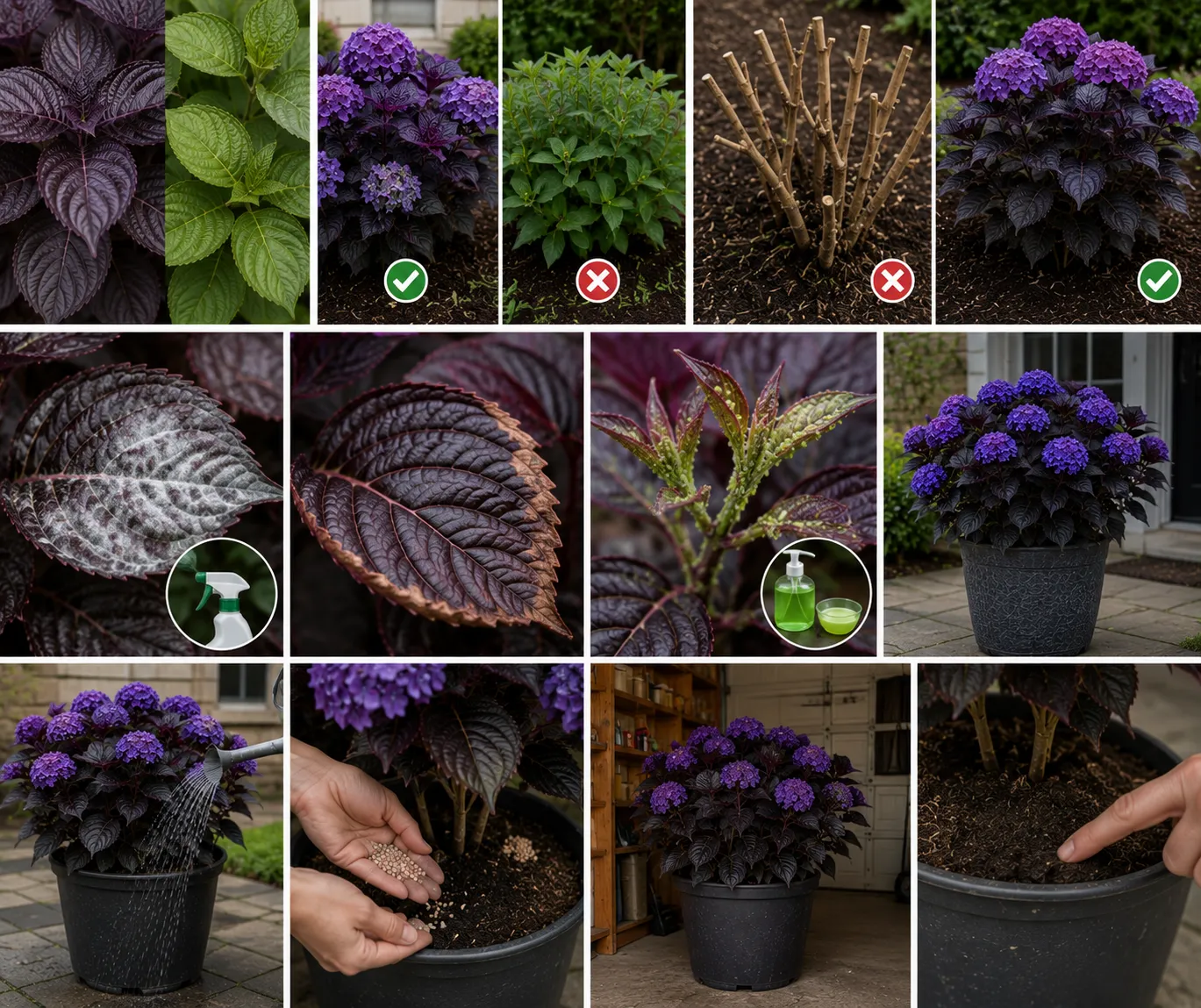
Foliage Fading to Green
Eclipse foliage shifts from dark purple toward green when the plant receives fewer than 4 hours of direct light per day, or when fertilized with high-nitrogen products. Evaluate site light first — track sun hours on the actual spot where the plant sits, not just the general garden area. Correct by relocating to a site with 4–6 hours of morning sun, or switch fertilizer to a phosphorus-forward product (15-30-15).
No Blooms (or Fewer Blooms Than Expected)
The most common cause of Eclipse bloom failure is fall or winter pruning that removed old-wood buds. Confirm pruning timing first — this accounts for 80% of non-blooming cases in bigleaf hydrangeas. Secondary causes: Zone 5 winter cold that killed unprotected stems, late frost in spring after buds broke dormancy, deep shade, or fertilizer applied after July 1 that pushed soft growth instead of bud development.
Powdery Mildew
Eclipse carries improved mildew resistance but is not immune in high-humidity sites with poor air circulation. If white powdery patches appear on leaf surfaces, increase plant spacing to improve airflow. Treat with neem oil spray (2 tbsp / 30 ml per gallon) applied every 7 days for 3 weeks. Never water overhead — wet leaves in humid conditions create ideal mildew conditions even on resistant varieties.
Leaf Scorch (Brown Crispy Edges)
Brown leaf edges on Eclipse indicate afternoon sun exposure in Zones 7–9, or severe underwatering during heat waves. Move the plant to a spot with afternoon shade if the site receives direct afternoon sun. If the site is already shaded, increase watering frequency to 3 times per week during sustained temperatures above 90°F (32°C). Scorched leaves do not recover — evaluate the cause to prevent the same damage next season.
Aphids on New Growth
Aphids cluster on soft new growth tips and produce sticky honeydew that attracts sooty mold. Spray affected tips with insecticidal soap solution at 2 tsp (10 ml) per quart (liter) of water, coating both sides of leaves. Repeat every 3–4 days for 2 weeks. Avoid broad-spectrum insecticides — they kill beneficial predators including ladybugs and lacewings that provide natural aphid control.
Eclipse Hydrangea in Containers
Yes — Eclipse grows successfully in containers with a minimum 15-gallon (57-liter) volume and at least 2 drainage holes. Container growing has 3 specific advantages: it allows gardeners in marginal zones to overwinter plants indoors, it gives direct control over soil pH for targeted bloom color, and it moves dramatic dark foliage to high-visibility spots like front entries and patios.
Container care differs from ground planting in 3 key ways:
- Watering frequency doubles. Container soil dries 2–3 times faster than ground soil. In summer heat in Zones 7–9, daily watering is required. Lift the container — if it feels light, water immediately.
- Fertilize twice per season. Container plants leach nutrients through drainage holes with every watering. Apply slow-release fertilizer (15-30-15) once in spring and once in early June. Stop all fertilizing by July 1.
- Overwinter containers in Zone 5–6. Move containers to an unheated garage, shed, or basement once temperatures drop below 20°F (-7°C) consistently. Container roots are above-ground and freeze at temperatures that in-ground roots survive easily. Water monthly through winter to prevent complete desiccation.
Do’s and Don’ts — Quick Reference
| ✔ Do | ✘ Don’t |
| Plant in morning sun + afternoon shade (4–6 hrs) | Plant in full afternoon sun in Zones 7–9 |
| Maintain soil pH at 4.5–6.0 for best foliage and bloom | Let soil pH rise above 6.5 without correcting it |
| Water at root zone with soaker hose or drip line | Water overhead — increases leaf spot and mildew |
| Prune after first bloom flush, before mid-June | Prune after mid-June, in fall, or in winter |
| Deadhead spent mopheads to trigger reblooming flush | Leave spent flowers on the plant all season without deadheading |
| Apply 15-30-15 fertilizer once in early spring | Fertilize after July 1 or use high-nitrogen products |
| Wrap Zone 5 stems with burlap before hard freeze | Use plastic wrap — it traps moisture and causes stem rot |
| Space plants 4–5 ft (1.2–1.5 m) for air circulation | Plant closer than 4 ft — restricted airflow promotes disease |
| Dispose of fallen diseased leaves in household trash | Compost fallen foliage — pathogens survive composting |
| Continue watering until ground freezes in Zone 5–6 | Stop watering at first frost — root dehydration kills bud wood |
5 Frequently Asked Questions
Why is my Eclipse hydrangea not staying dark purple?
Eclipse foliage fades toward green when it receives fewer than 4 hours of direct morning sun, or when fed with high-nitrogen fertilizer. Anthocyanin — the pigment responsible for dark color — requires adequate light to maintain production. Check sun hours on the actual plant location first. If the site already gets 4–6 hours of morning sun, switch fertilizer from a lawn-type nitrogen product to 15-30-15 high-phosphorus formulation.
When is the best time to prune Eclipse hydrangea?
Prune Eclipse immediately after the first flush of mophead flowers fades — typically late July or early August — and stop all pruning by mid-June the following year. Eclipse blooms on old wood for the primary spring flush and on new wood for the rebloom. Pruning after mid-June removes developing new-wood buds. Fall and winter cuts remove old-wood buds for next spring. Both are bloom-eliminating mistakes.
How do I get cranberry blooms vs. purple blooms?
Cranberry-red blooms develop in neutral to alkaline soil (pH 6.5+); amethyst-purple blooms develop in acidic soil (pH 4.5–5.5). To shift toward purple, apply aluminum sulfate at 1 tbsp (15 ml) per gallon of water three times in early spring. To shift toward cranberry, work agricultural lime into the soil in fall. Color change takes 1–2 full growing seasons — soil pH does not shift immediately.
Is Eclipse hydrangea deer resistant?
No — Eclipse hydrangea is not deer resistant. Deer browse all bigleaf hydrangeas (H. macrophylla) readily, with particular damage to flower buds and new spring growth. Protect with physical barriers such as wire mesh cages (minimum 4 feet / 1.2 m tall) in areas with known deer pressure. Deer-repellent sprays require reapplication after every rainfall and provide incomplete protection on high-value landscape plants.
Can Eclipse hydrangea grow in full shade?
No — full shade produces fewer blooms, green (not dark purple) foliage, and increased disease pressure. The minimum light requirement is 3 hours of direct sun, with 4–6 hours of morning sun as the optimal range. Sites receiving less than 3 hours of light produce a visibly different plant: pale olive foliage, sparse mophead clusters, and stems susceptible to powdery mildew from poor air movement. Eclipse’s defining traits depend on adequate light.
Grow Eclipse Hydrangea Successfully Starting This Season
Plant in 4–6 hours of morning sun with afternoon shade, maintain soil pH at 4.5–6.0, water at the root zone, fertilize once in early spring with 15-30-15, and never cut stems after mid-June or in fall. Those 5 rules cover the full range of success and failure with Eclipse hydrangea in every zone.
Eclipse is a 20–30 year landscape investment when placed correctly. The dark foliage, reblooming habit, and disease resistance make it one of the most distinctive flowering shrubs available in the current market — but only if pruning timing and winter protection are managed correctly in colder zones.