
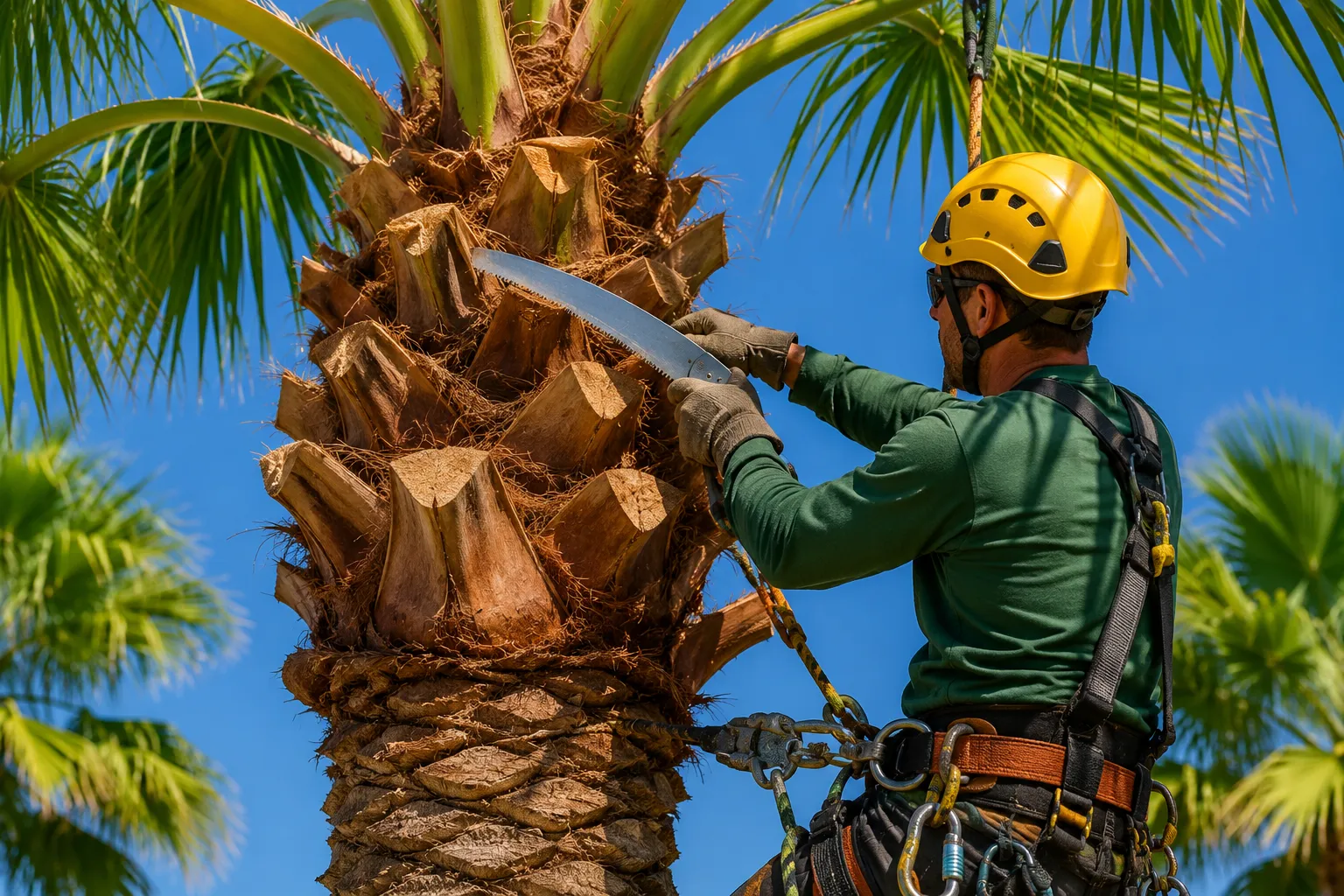
Prune palm trees once a year — remove only fully brown, dead fronds and spent flower stalks. Leave every green frond in place. That single rule prevents the most common, most damaging mistake in palm care: over-pruning.
Most homeowners prune palms too often and cut too much. The tree ends up stripped, stressed, and vulnerable to disease. Done correctly, pruning takes under an hour, costs nothing beyond basic tools, and keeps your palm healthy for decades.
This guide covers the right timing, the right tools, and the 4 mistakes that permanently damage palms — including the one technique that kills trees and still gets recommended by low-quality landscaping services.
Do All Palm Trees Actually Need Pruning?
No. Several palm species are self-cleaning — dead fronds detach naturally and fall without any help. If you own one of these, leave the tree alone entirely.
3 common self-cleaning species:
- Royal Palm (Roystonea regia)
- Christmas Palm (Adonidia merrillii)
- Chinese Fan Palm (Livistona chinensis)
If you own a Queen Palm (Syagrus romanzoffiana), Date Palm (Phoenix dactylifera), Sabal Palmetto, or Windmill Palm — you need to prune periodically. The rest of this guide applies to those species.
Not sure what type of palm you own? Your local county extension office can ID it from a photo within 24–48 hours at no cost.
When to Prune Palm Trees
Prune once per year, in late spring — between late April and early June. This window gives the tree maximum time to recover before winter. Palms entering active growth season close wounds faster and push out new fronds more quickly.
Season-by-Season Timing Guide
| Season | What to Do | Notes |
| Late Spring (Apr–Jun) | Full annual prune — dead fronds + flower stalks | Best timing — active growth |
| Summer (Jul–Aug) | Skip — palms are at peak stress | Heat + open wounds = disease risk |
| Fall (Sep–Oct) | Emergency only — storm damage, hazardous fronds | Limit cuts |
| Winter (Nov–Mar) | Avoid in zones 7–8 where freeze risk exists | Zones 9–11 can prune with care |
In USDA hardiness zones 9–11 (Florida, Southern California, Texas Gulf Coast, Hawaii), palms grow year-round. Late spring pruning still gives the best results. In zones 7–8 (edges of palm range, like coastal Georgia or the Carolinas), avoid pruning after September — open cuts before a cold snap increase cold damage significantly.
The #1 Mistake: Over-Pruning (Hurricane Cutting)
Walk through any Florida or California neighborhood and you will see it — palms cut down to a tiny tuft of fronds at the top, looking like a feather duster on a pole. The industry calls this “hurricane cutting” or “lion-tailing.” Contractors charge for it. Homeowners request it. It causes serious, lasting damage.
Every green frond produces energy through photosynthesis. Strip those fronds away and the palm raids its internal nutrient reserves just to survive. The tree goes into stress mode — and stays there.
Over-pruning causes 5 documented problems:
- Pencil-pointing: the trunk narrows where over-pruning occurred — this structural weakness is permanent
- Nutrient deficiency: potassium and magnesium deficiencies show as yellowing and necrosis in new growth
- Pest vulnerability: stressed palms attract palm weevils and ambrosia beetles at 3× the normal rate
- Fungal infection: open wounds invite Fusarium wilt and Ganoderma butt rot, both of which are fatal to palms
- Apical meristem exposure: the single growing bud at the crown — if damaged, the palm dies. There is no backup bud
Never remove fronds above the 9 o’clock to 3 o’clock line (imagining the canopy as a clock face). Any frond pointing outward or upward stays on the tree.
This same principle applies across all woody plants. Our guide on how to prune shrubs covers why cutting beyond dead material always creates more problems than it solves.
5 Essential Tools for Palm Tree Pruning
Use sharp, clean tools only. Dull blades tear tissue rather than cut it, leaving ragged wounds that take 3–4× longer to close. Dirty tools spread Fusarium wilt between trees — the pathogen survives on cutting edges for up to 72 hours.
| Tool | Best For | Key Spec |
| Hand pruners | Fronds under 1 inch (2.5 cm) thick at base | Bypass blade, not anvil |
| Pruning saw | Fronds 1–3 inches (2.5–7.5 cm) at base | Curved blade, 12+ teeth/inch |
| Pole pruner | Fronds up to 12 feet (3.6 m) overhead | Carbon steel blade |
| Chainsaw | Large palms — fronds over 3 inches (7.5 cm) thick | Professional use only |
| Isopropyl alcohol | Sterilize tools between trees | 70% concentration minimum |
Never use spiked climbing shoes on palm trunks. Each spike puncture is a permanent entry point for bacteria and fungi. Any reputable tree service uses a ladder or bucket truck instead.
How to Prune a Palm Tree: Step-by-Step
Complete the full process in one session. Starting and stopping mid-prune leaves open wounds exposed longer than necessary.
Step 1: Inspect Before You Cut
Walk around the tree from all angles. Identify every frond that is fully brown — no green remaining anywhere on the blade or at the base. Also identify any flower stalks or developing fruit clusters.
If a frond is yellow but still has any green tissue — leave it. Yellow fronds are still photosynthesizing and removing them accelerates nutrient deficiency.
Step 2: Sterilize Your Tools
Wipe all cutting edges with 70% isopropyl alcohol before starting and again between each tree you work on. This step takes 30 seconds and eliminates the primary transmission route for Fusarium wilt.
Step 3: Remove Dead Fronds
Cut each dead frond close to the trunk — leave a 2–4 inch (5–10 cm) stub rather than cutting flush. Flush cuts damage the trunk’s outer tissue and leave a larger wound. The stub dries and drops naturally within 4–8 weeks.
Work from the bottom of the canopy upward. Do not reach into the crown. Remove only fronds below the 9 o’clock to 3 o’clock line.
Step 4: Remove Flower Stalks and Fruit Clusters
On Queen Palms, remove flower stalks before they develop into fruit clusters. Each cluster drops hundreds of seeds and creates significant cleanup. On Date Palms, remove fruit stalks unless you are harvesting dates commercially.
Step 5: Check the Frond Skirt (Washingtonia Palms Only)
Washingtonia palms (Mexican Fan Palms, California Fan Palms) develop a dense skirt of dead fronds clinging to the trunk. Remove this skirt only if it presents a fire hazard — dry frond skirts ignite rapidly. In California fire zones and Texas, annual skirt removal is required by many municipalities.
Step 6: Do Not Apply Wound Sealant
Skip the pruning paint, tar, or wound sealant. Research from the University of Florida IFAS Extension confirms that wound sealants do not reduce infection rates and can trap moisture that accelerates fungal growth. Leave the cut surfaces exposed.
4 Mistakes That Damage Palms
Most palm damage happens from 4 repeated errors. Each one is avoidable.
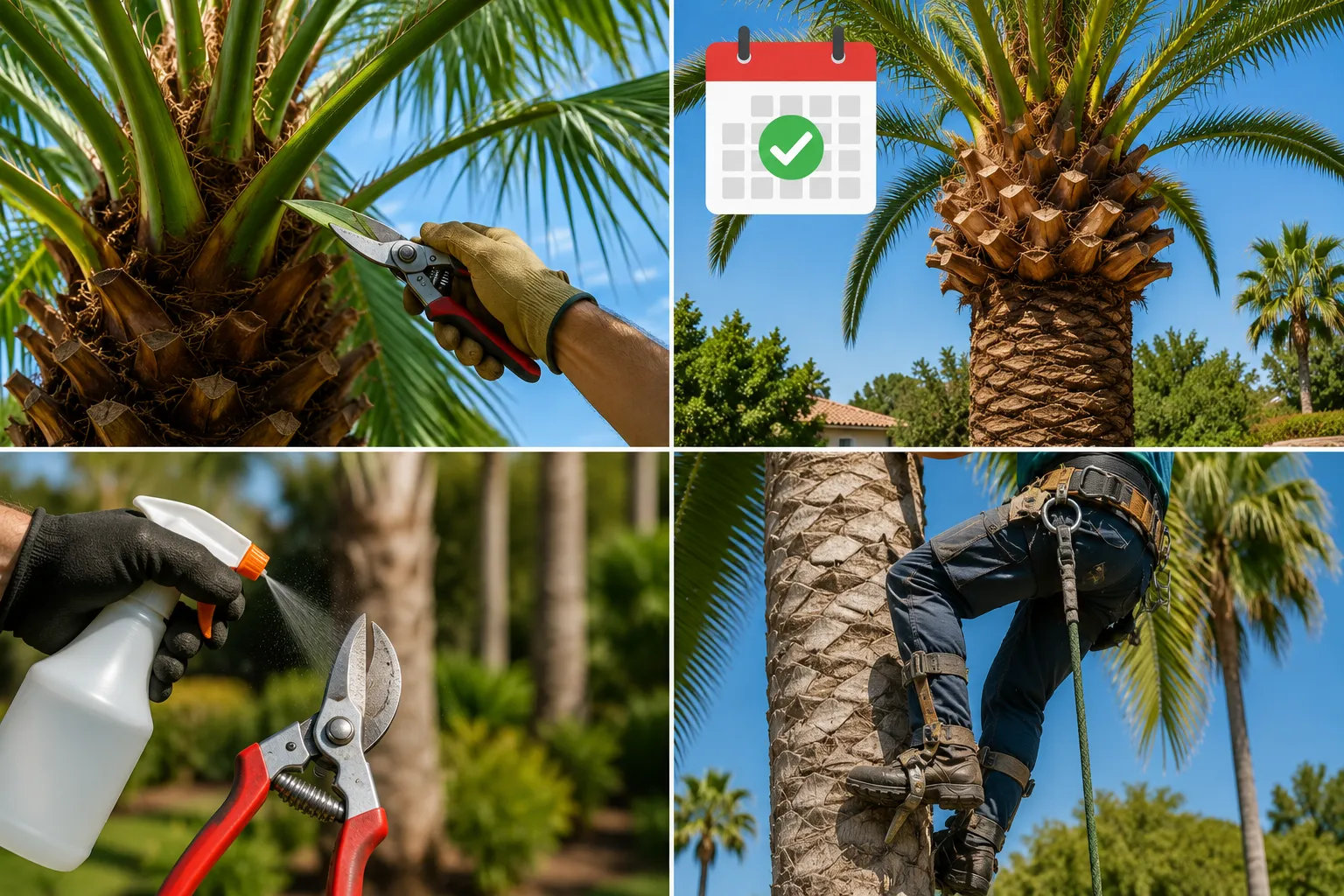
Mistake 1: Pruning Green Fronds
Every green frond is an active solar panel. Removing green fronds reduces the tree’s energy production — the equivalent of unplugging a portion of its power supply. Palms have no reserve fronds stored internally. What gets cut does not regenerate.
Mistake 2: Pruning More Than Once Per Year
Once per year is the correct frequency. Twice yearly pruning keeps palms in a state of chronic stress. Each pruning session forces the tree to redirect resources to wound response — resources that would otherwise go toward growth, disease resistance, and root development.
Mistake 3: Using Dirty Tools Between Trees
Fusarium wilt spreads on cutting edges. The pathogen — Fusarium oxysporum — kills Canary Island Date Palms reliably and affects Queen Palms and other species. A single contaminated cut introduces the disease. There is no treatment once infection establishes.
Mistake 4: Hiring Contractors Who Spike Climb
Spike shoes punch 20–50 holes per climb into the trunk. Each hole is a permanent scar and an entry point for wood-rot fungi. Ask any contractor you hire whether they use spikes. If the answer is yes — or if they hesitate — find someone else.
The same principle applies when pruning any woody plant. Our guide on crape myrtle pruning covers parallel mistakes that landscapers make with crape myrtles — including topping, which causes the same structural damage as over-pruning palms.
Palm Pruning by USDA Zone
Pruning timing shifts based on your climate zone. The core rule — remove only dead fronds, once per year — stays constant. The timing window adjusts.
| USDA Zone | Region Examples | Best Pruning Window |
| Zone 7b–8a | Coastal GA, SC, NC edges | May only — avoid fall pruning before first frost |
| Zone 8b–9a | Houston TX, Central FL, Coastal CA | Late April – early June (primary); light cleanup in Oct |
| Zone 9b–10a | Miami FL, Phoenix AZ, LA CA | Late April – June; avoid July–August heat stress window |
| Zone 10b–11 | South Florida, Hawaii | Year-round possible — late spring still optimal |
Not sure of your USDA zone? The Zoned Garden zone finder tool gives your zone instantly from your zip code — no guessing required.
Nutrient Deficiencies That Look Like Pruning Problems
Several palm health problems produce symptoms that homeowners misread as a signal to prune. Cutting in response to these symptoms accelerates the damage.
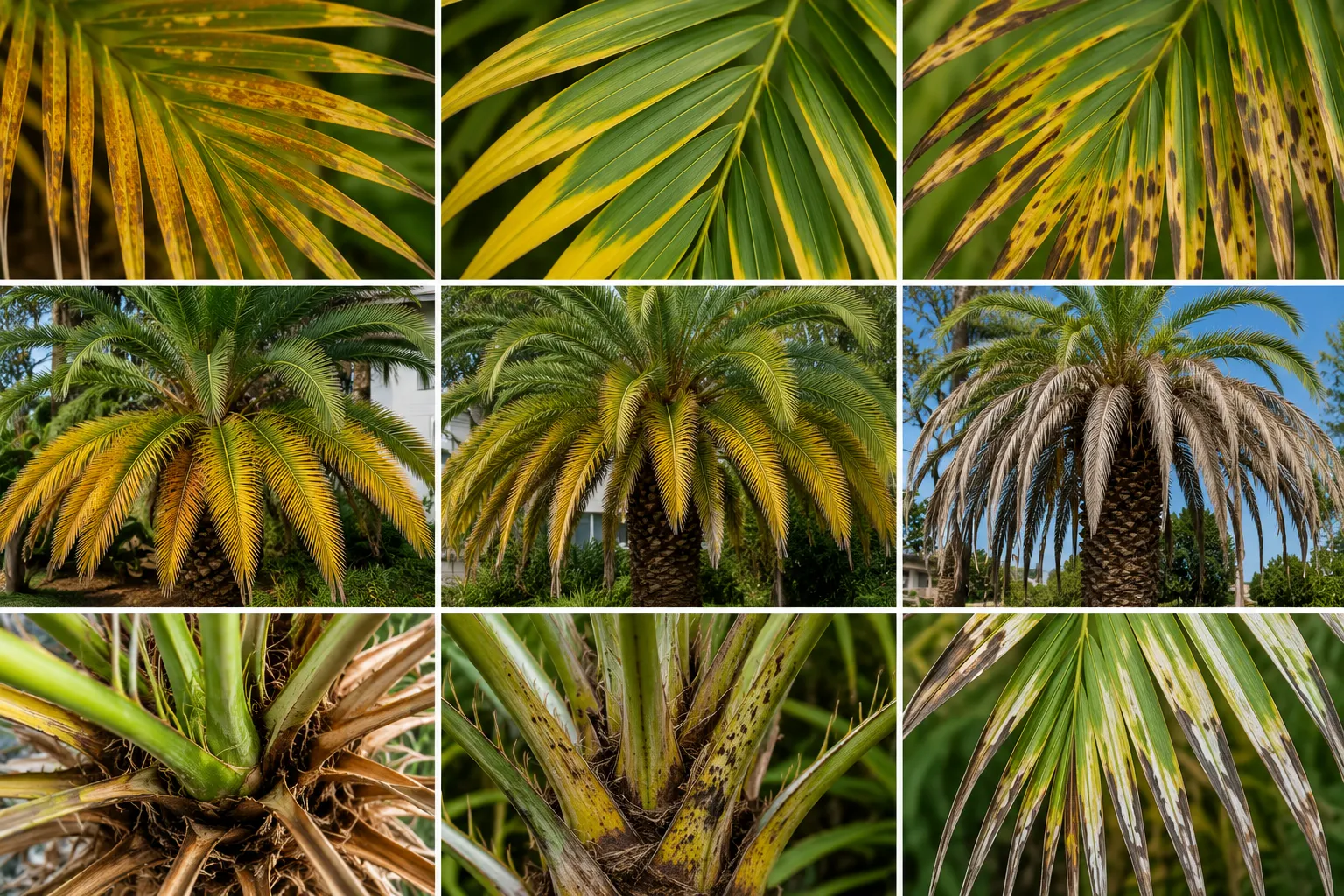
Potassium Deficiency
Symptom: Translucent orange or tan spotting on older (lower) fronds, progressing upward.
Response: Do not remove spotting fronds — they are still photosynthesizing. Apply a palm-specific slow-release fertilizer with an 8-2-12 (N-P-K) ratio plus magnesium. Results appear in 2–4 months.
Magnesium Deficiency
Symptom: Broad yellow band along the margins of older fronds, with green remaining at the center.
Response: Apply magnesium sulfate (Epsom salt) at 2–4 lbs (0.9–1.8 kg) per tree, broadcast over the root zone. Do not cut these fronds.
Manganese Deficiency
Symptom: New fronds emerge frizzled, reduced, and pale — called “frizzle top.” This affects the newest growth, not old fronds.
Response: Soil drench with manganese sulfate. This deficiency is common in high-pH soils in Florida and Arizona. Cutting fronds does not help.
Nutrient deficiencies are the leading cause of unnecessary palm pruning. Before cutting a frond that looks unhealthy, check whether the problem starts at old growth (nutrient issue) or new growth (also possibly nutrient issue). Pruning neither treats nor slows a nutrient deficiency.
When to Call a Certified Arborist
Handle annual maintenance yourself. Call a professional for these 5 situations:
- Tree height over 15 feet (4.5 m): working at height on a palm with no solid branching structure is a fall risk. Professionals use bucket trucks or ladders rated for the height.
- Signs of Ganoderma butt rot: white or brown shelf-shaped fungal conks at the base of the trunk indicate Ganoderma zonatum. This disease is fatal and has no treatment. An arborist can assess whether removal is necessary before the tree becomes a hazard.
- Leaning trunk: a palm that has developed a lean after storms or root damage may be structurally compromised. An ISA Certified Arborist can assess root integrity.
- Unidentified canopy problem: if new fronds emerge deformed, discolored, or reduced and fertilizer has not resolved the issue within 6 weeks, a certified arborist can take a tissue sample for laboratory diagnosis.
- Pre-storm preparation: in hurricane-prone areas (Florida, Gulf Coast, Hawaii), a licensed arborist can assess whether any dead fronds or heavy fruit clusters present wind-load hazards before major storms.
Working on other trees in your yard at the same time? Our raspberry pruning guide covers the specific timing for cane fruits, which differ significantly from tree pruning schedules.
Palm Tree Pruning Cost (2026)
Professional palm pruning costs vary by tree height and location. These are 2026 averages across Florida, California, and Texas:
| Tree Height | DIY Cost | Pro Cost (USD) | Notes |
| Under 10 ft (3 m) | $0–$20 tools | $45–$75 | DIY easy at this height |
| 10–20 ft (3–6 m) | $20–$60 pole saw | $75–$150 | Pole pruner handles most fronds |
| 20–40 ft (6–12 m) | Not recommended | $150–$300 | Bucket truck often needed |
| Over 40 ft (12 m) | Not recommended | $300–$600+ | Licensed arborist only |
Get at least 3 quotes before hiring. Ask specifically: do your crews use spiked climbing shoes? Any answer other than a clear “no” is a red flag.
Frequently Asked Questions
How often should palm trees be pruned?
Once per year is the correct frequency — in late spring for most US climate zones. More frequent pruning stresses the tree without producing any benefit. The only exception is emergency removal of fronds damaged in storms.
Can I prune a palm tree myself?
Yes, for palms under 15 feet (4.5 m) tall. A quality pole pruner handles fronds at that height safely from the ground. For palms above 15 feet, hire a licensed arborist with a bucket truck.
What happens if you don’t prune palm trees?
Self-cleaning palms drop fronds naturally — no pruning is needed or beneficial. Non-self-cleaning palms accumulate dead frond skirts that attract rodents, harbor insects, and pose a fire hazard in dry climates. One annual prune prevents those 3 problems.
Should I remove yellow fronds from a palm?
No — not unless the frond is entirely brown with no green remaining anywhere. Yellow fronds are still photosynthesizing. Removing them accelerates nutrient deficiency and stresses the tree.
Does pruning palm trees encourage growth?
No. Palms grow only from the single apical meristem (growing tip) at the crown. Pruning does not stimulate new growth the way it does in shrubs or deciduous trees. Correct pruning simply removes dead weight — it does not speed the tree up.
Final Word
Palm tree pruning is simpler than most guides make it seem. Remove dead fronds once per year in late spring. Leave every green frond on the tree. Use clean tools. Never let anyone spike-climb your palms.
Those 4 rules cover 95% of what you need to know. The remaining 5% — nutrient deficiencies, disease identification, tall-tree work — is where a certified arborist earns their fee. For everything else, a sharp pole pruner and an hour of your time in May is sufficient.
Pruning other plants in your garden this season? Our guide on how to prune shrubs covers the step-by-step process for the most common woody shrubs in US home gardens, and our shrubs category has zone-specific picks for every part of your yard.