Beautiful rare plants are not just unusual — they are living art. A single Monstera Albo or Philodendron Gloriosum stops every visitor in their tracks. The rare plant market has grown into a multi-million dollar collector’s world, with single cuttings selling for $1,500 to $19,000. This guide covers 15 of the most stunning specimens, their care requirements, where to source them safely, and how to keep them alive long-term.
Whether you garden in USDA Zone 4 or Zone 10, whether you have a bright south-facing window or a basement with grow lights — there is a beautiful rare plant suited to your conditions. Read on to find yours.
What Makes a Plant Rare? The 4 Key Factors

A plant is rare for 4 specific reasons — not just one:
- Limited geographic range: Many rare plants grow in only one region. Philodendron Spiritus Sancti has fewer than 6 known wild specimens left in Espírito Santo, Brazil.
- Slow or difficult propagation: Variegated Monsteras cannot be grown true-to-type from seed. Each cutting requires months to root, keeping supply low against high demand.
- Genetic mutations: Variegation — white, cream, or pink patches on leaves — is a chlorophyll mutation. Without the gene, the plant reverts to solid green. This instability makes stable specimens valuable.
- High collector demand: Trends drive rarity. The Aroid family (Monstera, Philodendron, Alocasia) exploded in popularity after 2020, turning previously common plants into collector items overnight.
Understanding rarity helps you spot fair prices and avoid scams. A “Monstera Variegata seed” sold cheaply online is always fake — variegation does not breed true from seed.
15 Beautiful Rare Plants Worth Adding to Your Collection
Each plant below includes its native habitat, 3 core care requirements, propagation method, and a realistic price range as of 2025. Plants are grouped by care difficulty.
Beginner-Friendly Rare Plants (Moderate Care)
1. Monstera Albo (Monstera deliciosa ‘Albo Variegata’)
The Monstera Albo is the most recognized beautiful rare plant in the collector world. Its large green leaves carry irregular white sectors — sometimes half a leaf turns pure white. Native to southern Mexico and Central America, it thrives in USDA Zones 10–12 outdoors but performs well as an indoor plant nationwide.
- Light: Bright indirect light for 8–12 hours daily. Direct sun bleaches the white portions.
- Watering: Water when the top 2 inches (5 cm) of soil dry out. Root rot is the #1 killer.
- Humidity: Maintain 60–80% humidity. A hygrometer keeps you honest.
- Soil: Chunky aroid mix — orchid bark, perlite, and coco coir in equal parts.
- Price range: $80–$400 for a rooted cutting; $500+ for a multi-leaf plant with strong variegation.
- Propagation: Node cuttings rooted in water or sphagnum moss. Success rate: 85% in 4–8 weeks.
ZonedGarden tip: The white leaf sections have no chlorophyll and cannot photosynthesize. Keep indirect light consistent — too low and the plant starves. Too high and the white burns. An east-facing window at 3–5 feet from the glass is the sweet spot. For more on creating the right indoor environment, see our indoor plant care guide.
2. Pink Princess Philodendron (Philodendron erubescens ‘Pink Princess’)
The Pink Princess Philodendron produces deep green leaves splashed with hot pink variegation. No two leaves match. It originates from Colombia and became one of the most searched houseplants after 2019. High demand and unstable variegation keep prices high.
- Light: Bright indirect light is required to maintain pink coloration. Low light produces all-green leaves.
- Watering: Allow top 2 inches to dry between waterings. Water every 7–10 days in summer, every 14 days in winter.
- Temperature: Keep between 65–85°F (18–29°C). Below 60°F halts growth.
- Fertilizer: Balanced 20-20-20 liquid fertilizer diluted to half strength, monthly during growing season.
- Price range: $30–$150 for small plants; heavily variegated specimens reach $300+.
- Propagation: Stem cuttings with at least 1 node. Root in water in 3–5 weeks.
3. Philodendron Gloriosum
Philodendron Gloriosum has large, heart-shaped velvety leaves with brilliant white veining. Unlike climbing Philodendrons, it crawls along the soil surface — give it a wide, low pot rather than a tall one. Growers in Holland and Belgium are increasing supply, but demand remains high.
- Light: Medium to bright indirect light. Velvety leaves scorch in direct sun.
- Soil: Well-draining aroid mix with extra perlite for aeration.
- Humidity: Prefers 70%+ humidity. Brown leaf edges signal dry air.
- Growth habit: Crawling, not climbing. Use a wide, shallow pot at least 12 inches (30 cm) across.
- Price range: $40–$200 depending on leaf size and maturity.
4. Bromeliad Neoregelia
Bromeliad Neoregelia produces striking red or purple rosette leaves and blooms exactly once in its lifetime. It is one of the most beginner-friendly beautiful rare plants — pet-safe, low-maintenance, and easy to propagate via pups (offsets). Native to South American rainforests, it adapts well to indoor conditions.
- Light: Medium to bright indirect light. Tolerates lower light better than most rare plants.
- Watering: Fill the central cup with water. Flush the cup weekly to prevent rot and mosquito larvae.
- Fertilizer: Use a diluted bromeliad fertilizer (quarter strength) in the central cup, not the soil.
- Propagation: Remove pups when they reach 4–6 inches (10–15 cm) tall. Root success rate: 95%.
- Price range: $15–$60. One of the most affordable rare plants with high visual impact.
5. Ficus Elastica ‘Ruby’ (Variegated Rubber Tree)
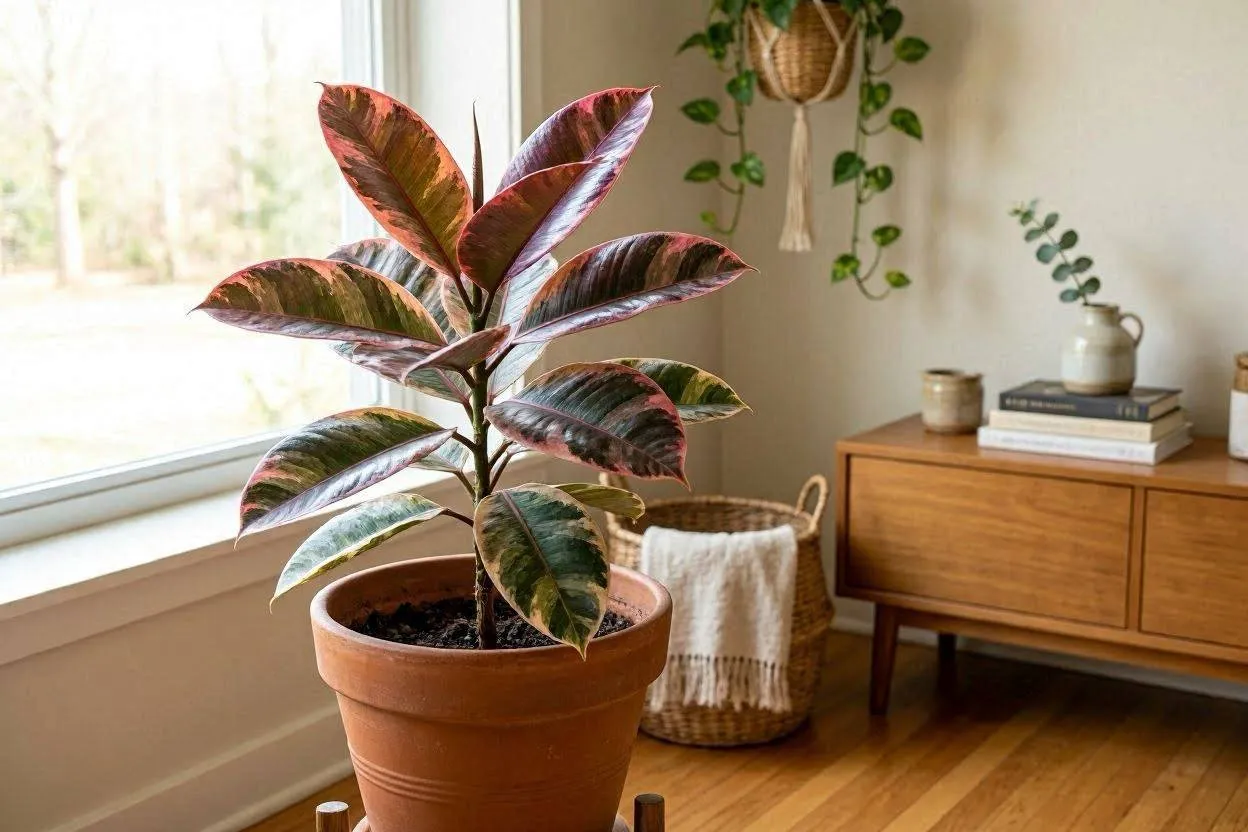
The Ruby Rubber Tree is the most colorful of all Ficus varieties. Its leaves display 3 colors simultaneously — dark green, cream, and deep pink — making it a statement plant in any room. It tolerates average home humidity (40–60%), setting it apart from most tropical rarities.
- Light: Medium to bright indirect light. Stronger light intensifies the pink coloration.
- Watering: Once weekly in summer; once every 2 weeks in winter. Yellow leaves = overwatering.
- Humidity: 40–60% — normal home humidity is sufficient.
- Temperature: 60–85°F (15–29°C). Protect from drafts.
- Price range: $25–$80 for a standard potted plant.
Internal link: For pruning and shaping tips on Ficus varieties, read our complete guide to making rubber plants bushy at Zoned Garden.
Intermediate Rare Plants (Specific Care Needed)
6. Alocasia ‘Dragon Scale’ (Alocasia baginda)
Alocasia Dragon Scale has silver-green leaves with deeply embossed dark veining that genuinely resembles reptile scales. Native to Borneo rainforests, it demands high humidity and dislikes temperature fluctuations. It is one of 7 Alocasia species considered high-priority collector items in 2025.
- Light: Bright indirect light. Never direct sun — leaf scorch appears within 2 hours.
- Humidity: 70–80% minimum. Use a humidifier; misting alone is insufficient.
- Watering: Every 7–10 days in summer, every 14–21 days in winter. Allow the top inch to dry.
- Dormancy: Alocasias go semi-dormant in winter. Reduce watering by 50%. Do not fertilize.
- Pests: Spider mites are the #1 threat. Check leaf undersides weekly.
- Price range: $30–$120 for a healthy potted specimen.
7. Alocasia Azlanii (‘Red Secret’)
The Alocasia Azlanii — called ‘Red Secret’ — produces metallic, iridescent leaves with contrasting veins in green, red, deep purple, and salmon pink. First propagated commercially in 2016, it remains scarce. Native to Borneo, its slow propagation rate keeps supply consistently below demand.
- Light: Medium indirect light. Iridescent coloring intensifies in lower light conditions.
- Humidity: 65–75%. Dry air causes leaf edge curl within days.
- Soil: 50% orchid bark, 30% perlite, 20% potting mix for maximum drainage.
- Price range: $40–$180. Expect prices to drop as propagation catches up with demand.
8. Anthurium Crystallinum
Anthurium Crystallinum has large, velvety dark green leaves with crystalline white veining that appears to glow under light. Native to humid Panamanian rainforests, it grows at elevation — meaning it tolerates slightly cooler temperatures than most tropicals, down to 60°F (15°C).
- Light: Low to medium indirect light. One of the few rare plants that thrives in low-light rooms.
- Humidity: 70–90%. The most humidity-demanding plant on this list.
- Watering: Keep soil consistently moist but never waterlogged. Water every 5–7 days.
- Fertilizer: Quarter-strength balanced liquid fertilizer every 2 weeks in spring and summer.
- Price range: $50–$250 depending on leaf size.
9. Hoya Kerrii ‘Variegata’ (Variegated Sweetheart Hoya)
Hoya Kerrii ‘Variegata’ produces thick, waxy heart-shaped leaves with cream or white margins on dark green centers. Slower growing than regular Hoya Kerrii, but its variegation makes each leaf unique. A well-established vine becomes a statement piece after 2–3 years of growth.
- Light: Bright indirect light for 6–8 hours. More light = stronger variegation.
- Watering: Water sparingly — every 10–14 days in summer, every 3–4 weeks in winter.
- Important: A single leaf cutting without a node will never grow into a plant. Always buy rooted cuttings with at least 1 node.
- Price range: $20–$90 for a rooted multi-leaf cutting.
10. String of Turtles (Peperomia prostrata)
String of Turtles is a compact trailing Peperomia with tiny round leaves patterned like turtle shells. Native to Brazilian rainforests, it grows as an epiphyte — meaning regular potting mix holds too much moisture. Use a cactus or orchid mix. Despite its delicate appearance, it tolerates more neglect than most rare plants.
- Light: Indirect light. Tolerates lower light than most; avoid deep shade.
- Watering: Sparingly — water when the soil dries completely. Every 10–14 days typically.
- Flowers: Small upright white spikes appear in autumn and early winter. The leaves are the main attraction.
- Price range: $12–$40. One of the most affordable beautiful rare plants.
Advanced Collector Rarities (Demanding Care)
11. Monstera Obliqua
Monstera Obliqua is the rarest Monstera in cultivation — its leaves are 80–90% holes, with more fenestration than solid leaf material. Native to Central and South America, it requires humidity above 80% to prevent the delicate leaf tissue from drying out. Widely misidentified: most plants sold as ‘Obliqua’ are actually the easier Monstera Adansonii.
- Light: Medium indirect light — never direct sun on those fragile leaves.
- Humidity: 80%+ is non-negotiable. A glass cabinet or greenhouse terrarium is ideal.
- Watering: Keep the substrate consistently moist. Dry periods cause irreversible leaf damage.
- Verification: True Obliqua leaves have more holes than leaf tissue. Adansonii has more solid leaf than holes.
- Price range: $500–$5,000+ for confirmed Obliqua. Be skeptical of cheap offers.
12. Philodendron Spiritus Sancti
Philodendron Spiritus Sancti is the most endangered Philodendron in existence — fewer than 6 wild specimens survive in Espírito Santo, Brazil. Its long, sword-shaped leaves grow nearly vertical, each reaching up to 24 inches (60 cm) in maturity. Cuttings sell for $2,000–$10,000. Only buy from verified sellers with provenance documentation.
- Light: Bright indirect light for 10–12 hours. A full-spectrum grow light is ideal in low-light homes.
- Temperature: 65–85°F (18–29°C). Keep stable — drafts and cold spikes trigger leaf drop.
- Soil: Custom blend of orchid bark, perlite, and organic matter. Repot only when root-bound.
- Watering: Allow top 2 inches to dry. Overwatering at this price point is an expensive mistake.
- Price range: $2,000–$10,000 for a rooted cutting with verified genetics.
13. Variegated Monstera Thai Constellation
Monstera Thai Constellation is a tissue-culture-produced variegated Monstera with stable, speckled cream and green patterning that resembles a star map. Unlike Monstera Albo, its variegation is genetically stable — every leaf carries the pattern reliably. Originally developed in Thailand, it is now propagated in labs worldwide, making it more available than other variegated Monsteras.
- Light: Bright indirect light. Cream sections need strong light to prevent reversion to green.
- Watering: Weekly in summer; every 10–14 days in winter.
- Fertilizer: Monthly during growing season. Cream variegation is fragile — avoid over-fertilizing.
- Price range: $60–$300. More affordable than Monstera Albo due to stable tissue culture propagation.
14. Begonia Maculata (Polka Dot Begonia)
Begonia Maculata produces olive-green leaves dotted with silver-white spots and vivid pink-red undersides. It is one of the most visually dramatic beautiful rare plants per dollar — widely available compared to collector aroids, yet still turns heads in every room. Native to Brazil’s Atlantic Forest.
- Light: Bright indirect light. More light = more silver spot brilliance.
- Watering: Allow top inch to dry between waterings. Root rot develops quickly in dense soil.
- Pruning: Pinch leggy stems to encourage bushy, dense growth.
- Propagation: Stem cuttings root in water within 2–3 weeks. One of the easiest rare plants to propagate.
- Price range: $15–$60 for a healthy potted plant.
15. Rhaphidophora Tetrasperma Variegata
Rhaphidophora Tetrasperma Variegata — called ‘Mini Monstera Variegata’ — became the world’s most expensive houseplant sold on a public auction site when one sold for $19,297 in New Zealand in 2021. Its split leaves carry cream, white, or light yellow variegation. Each leaf is genetically unique. Availability has improved since 2022 but genuine specimens remain scarce.
- Light: Bright indirect light. Low light causes reversion to all-green growth.
- Climbing support: Provide a moss pole or trellis. Climbing triggers larger, more fenestrated leaves.
- Watering: Let top inch dry before watering — every 7–10 days in summer.
- Price range: $100–$1,500. Prices vary enormously by variegation quality.
Universal Care Rules for Beautiful Rare Plants
All 15 plants above share 5 core care requirements. Master these and your rare plant collection will thrive regardless of species.
Light: Bright Indirect Is the Standard
Most beautiful rare plants originate from tropical rainforests where sunlight filters through a dense canopy. Replicate this indoors with an east- or north-facing window, or place plants 3–5 feet from a south-facing window. Provide 8–12 hours of bright indirect light daily. A full-spectrum grow light at 10 hours per day is a reliable substitute in low-light homes.
Humidity: 60–80% for Most Species
Low humidity is the leading cause of rare plant decline indoors. Standard home air runs at 30–50% humidity — far below the 60–80% most tropicals require. Use these 3 methods to raise humidity effectively:
- A dedicated ultrasonic humidifier near the plant shelf — most reliable method.
- Grouping 5+ plants together creates a shared humid microclimate.
- A pebble tray with water beneath pots adds 5–10% local humidity.
Track humidity with a digital hygrometer. Reading below 55%? Run the humidifier. Above 85%? Improve air circulation to prevent fungal issues.
Soil: Aroid Mix Outperforms Standard Potting Mix
Standard potting mix retains too much moisture for most rare tropicals. Mix your own aroid substrate: 40% orchid bark + 30% perlite + 20% coco coir + 10% worm castings. This gives roots the air pockets they need while retaining just enough moisture. Repot every 12–18 months or when roots circle the bottom drainage hole.
Watering: Less Is More — Root Rot Kills More Rare Plants Than Drought
Water when the top 2 inches (5 cm) of soil feel dry. Push your finger or a wooden chopstick into the soil — if it comes out with moist soil attached, wait. If it comes out dry, water thoroughly until drainage flows from the bottom holes. Never let pots sit in standing water. In winter, reduce watering frequency by 30–50% as growth slows.
Fertilizer: Feed Lightly During Active Growth Only
Apply a balanced liquid fertilizer (20-20-20 or 10-10-10) at half the recommended strength every 4 weeks from March through September. Stop fertilizing completely from October through February. Over-fertilizing burns roots and causes leaf tip browning — a common mistake among new rare plant collectors.
How to Buy Beautiful Rare Plants Safely: 5 Rules
The rare plant market has 3 types of sellers: reputable specialists, uninformed resellers, and outright scammers. These 5 rules protect your investment:
- Buy rooted cuttings, not unrooted nodes: Unrooted cuttings look cheap but carry high failure risk. A rooted cutting at 3× the price is the better value.
- Demand clear photos of the actual plant: Stock images are a red flag. Every legitimate rare plant seller photographs the exact plant being sold.
- Verify the seller’s reviews across 3+ platforms: Cross-check Etsy, Facebook plant groups, and Instagram. Scammers fake reviews on single platforms.
- Understand that variegated Monsteras do not grow from seeds: Any seller offering ‘variegated Monstera seeds’ is selling regular Monstera seeds. The mutation cannot be seed-propagated.
- Quarantine new arrivals for 2 weeks: Even reputable sellers occasionally ship plants with hidden pest eggs. Isolate new plants before placing them near your collection.
Growing Beautiful Rare Plants by USDA Zone
Most beautiful rare plants are tropical — native to USDA Zones 10–12. Growing them in Zones 4–9 requires indoor cultivation or protective strategies. Here is what works by zone:
- Zones 4–6 (cold winters): Grow all rare tropicals as permanent indoor plants. A south-facing window with a grow light supplement handles 95% of species. Move no plant outdoors — one frost night kills tropical rarities.
- Zones 7–9 (mild winters): Most rare plants thrive outdoors in summer (May–September) in bright shade. Bring indoors before first frost. Alocasias and Monsteras can overwinter in a cool (55°F / 13°C) garage if needed.
- Zones 10–12 (frost-free): Grow most rare plants outdoors year-round in bright shade or dappled light. Protect from direct afternoon sun above 90°F (32°C). Water more frequently — outdoor pots dry out 3× faster than indoor pots.
Not sure which USDA zone you are in? Zoned Garden covers all USDA Zones 4–9 with specific growing strategies for each climate.
7 Mistakes That Kill Beautiful Rare Plants (And How to Avoid Them)

- Overwatering: Root rot destroys more rare plants than any other cause. Check soil moisture before every single watering, without exception.
- Low humidity in winter: Heating systems drop home humidity to 20–30% in winter. Run a humidifier October through March.
- Using tap water on sensitive species: Chlorine and fluoride in tap water cause leaf tip burn on Anthuriums and Alocasias. Use filtered or rainwater.
- Placing variegated plants in low light: White and pink leaf sections lack chlorophyll. Low light starves the plant. Bright indirect light is non-negotiable for variegated specimens.
- Repotting too frequently: Rare plants are sensitive to root disturbance. Repot only when roots circle the drainage holes — roughly every 12–18 months.
- Skipping pest prevention: Inspect leaf undersides weekly. Five spider mites become 5,000 in a month. Weekly wipe-downs with diluted neem oil prevent most infestations.
- Buying unverified plants from social media: The rare plant scam market is significant. Never pay large sums without seeing photos of the actual rooted plant, seller reviews, and return policy.
More Plant Care Guides at Zoned Garden
These related guides at ZonedGarden.com provide deeper coverage of specific indoor plants mentioned in this article:
- How to Make a Rubber Plant Bushy — Proven Growing Tips
- Aralia Fabian Stump Plant Care — Complete Indoor Guide
- Peony Colors: Pink to Purple — Complete Guide
- Chrysanthemum Flowers — Complete Growing Guide
Frequently Asked Questions About Beautiful Rare Plants
What is the rarest houseplant in the world?
The Philodendron Spiritus Sancti is the rarest Philodendron in cultivation, with fewer than 6 known wild specimens surviving in Brazil. In the broader plant world, the Shenzhen Nongke Orchid — a lab-created cultivar — sold for $200,000 USD in 2005, making it the most expensive ornamental plant ever auctioned.
Are rare plants hard to care for?
No — most beautiful rare plants are not harder to care for than common tropicals. Rarity refers to limited availability and collector demand, not care difficulty. Begonia Maculata, Bromeliad Neoregelia, and String of Turtles are all rare and visually striking, yet require minimal attention. The challenge is acquiring them, not maintaining them.
Why do variegated plants cost more?
Variegated plants cost more for 3 reasons: the mutation reduces chlorophyll, making growth slower; variegation cannot be reproduced from seed reliably; and collector demand consistently outpaces the slow propagation supply. A standard Monstera deliciosa grows 3× faster than its variegated counterpart.
Can I grow rare tropical plants outdoors?
Yes, in USDA Zones 10–12. In Zones 4–9, most beautiful rare plants grow outdoors in bright shade during summer (May–September) but require indoor overwintering before the first frost. A single night below 32°F (0°C) kills most tropical rarities permanently.
Where is the best place to buy rare plants?
The 4 safest sources for purchasing beautiful rare plants are: specialist online nurseries with verified buyer reviews; established Etsy sellers with 200+ positive ratings; local rare plant swaps and collector societies; and botanical garden sales. Avoid unverified social media sellers, especially for plants priced above $100.