
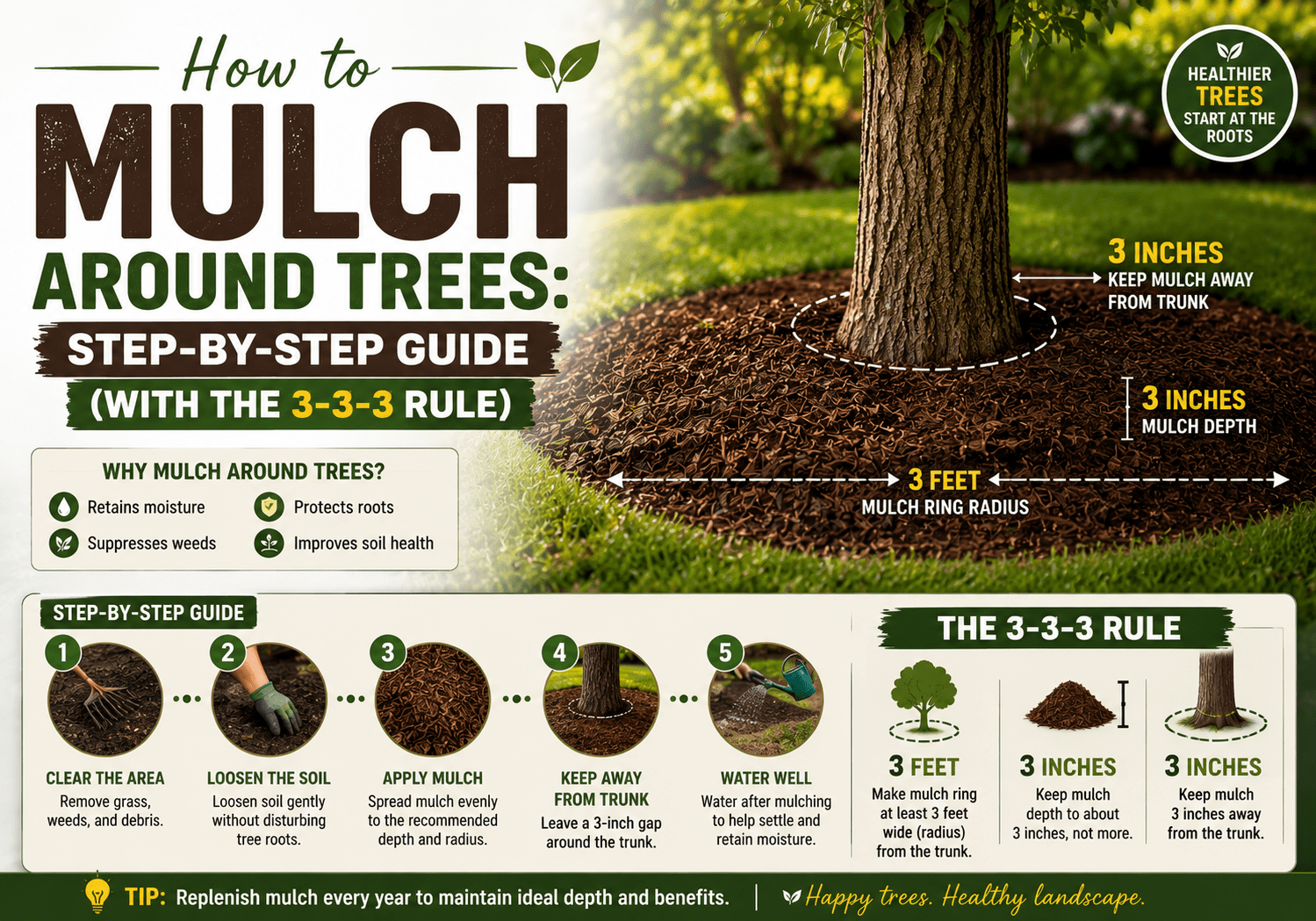
To mulch around trees correctly: apply 2–4 inches (5–10 cm) of organic mulch in a donut ring, keep 3–6 inches (7.6–15 cm) of trunk completely clear, and extend the ring out to the drip line — or at minimum 3–4 feet (0.9–1.2 m) from the trunk. Never pile mulch against the bark. Volcano mulching — the practice of mounding mulch against the trunk — causes root suffocation, bark decay, and girdling roots that slowly kill trees over years. Proper mulching improves soil moisture retention by up to 25% and moderates soil temperature by 10–15°F (5.5–8.3°C), according to ISA (International Society of Arboriculture) data.
| Rule | Correct Measurement | Common Mistake |
| Distance from trunk | 3–6 inches (7.6–15 cm) clear gap | Mulch touching or against bark |
| Mulch depth | 2–4 inches (5–10 cm) | 6–12 inch volcano piles |
| Ring radius (minimum) | 3–4 feet (0.9–1.2 m) from trunk | Tiny 1-foot ring around base only |
| Ring radius (ideal) | To the drip line (canopy edge) | Stopping before the feeder root zone |
| Best mulch type | Organic — wood chips, shredded bark | Dyed mulch, rubber, fresh wood chips on saplings |
Why Mulching Around Trees Matters
Properly mulched trees survive at a 30–50% higher rate in their first 5 years versus unmulched trees, according to research from the University of Minnesota and UC Davis. Mulch addresses 3 silent killers of urban landscape trees that homeowners rarely see until damage is done:
1. Soil Compaction
Tree roots need oxygen to grow and absorb water and nutrients. Foot traffic, vehicle movement, and rainfall compact the soil surface, sealing the pore spaces where oxygen diffuses. Organic mulch absorbs the impact of rain and foot traffic, keeping soil loose and allowing roots to breathe. Without this protection, compaction builds year after year in urban yards.
2. Root Zone Competition From Grass and Weeds
Grass growing up to the trunk directly competes with young trees for water, nitrogen, and phosphorus. A 4-foot (1.2 m) diameter mulch ring eliminates this competition for at least 80% of the tree’s critical root zone. Young trees — especially in the first 3 years after planting — are most vulnerable to this competition. Removing grass from the root zone consistently produces faster establishment and stronger growth than fertilization alone.
3. Mechanical Damage From Mowers and String Trimmers
Lawnmowers and string trimmers strike tree trunks 12–17 times per growing season on average in unmaintained areas. Each strike creates a wound in the bark — an entry point for pathogens like Armillaria root rot and boring insects like the bronze birch borer. A well-maintained mulch ring acts as a physical buffer, keeping equipment away from the trunk entirely.
Additional benefits documented by ISA include: soil moisture retention improved by 25%, soil temperature moderated by 10–15°F (5.5–8.3°C), improved soil structure as mulch decomposes, and increased beneficial fungi and earthworm activity under the mulch ring. See our guide to improving garden soil for how mulching fits into a broader soil health strategy.
The 3-3-3 Rule for Mulching Trees
The 3-3-3 rule is the simplest framework for correct tree mulching: 3 inches deep, 3 feet out from the trunk minimum, and 3–6 inches of clear gap at the trunk base.
| The 3-3-3 Rule | Measurement | Why It Matters |
| 3 inches deep | 2–4 inches (5–10 cm) | Suppresses weeds, retains moisture without suffocating roots |
| 3 feet out | 3 ft (0.9 m) radius minimum from trunk | Covers critical feeder root zone, reduces grass competition |
| 3–6 inches clear at trunk | No mulch within 3–6 inches (7.6–15 cm) of bark | Prevents bark decay, rot, rodent nesting, and girdling roots |
The drip line — the circle on the ground directly beneath the outermost branch tips — is the ideal outer boundary for a mulch ring. In most yards this is not practical for full coverage, but extending the ring as far toward the drip line as possible delivers the most benefit. A mature oak with a 40-foot (12 m) canopy spread has feeder roots extending 40–80 feet (12–24 m) from the trunk — the drip line marks the minimum, not the maximum, of the root zone.
Step-by-Step: How to Mulch Around Trees
This process takes 30–60 minutes for a standard tree with a 3-foot (0.9 m) mulch ring. For trees extending to the drip line, budget 1–2 hours depending on ring size.
Step 1: Gather Your Materials
4 tools and materials for the job:
- Organic mulch: Wood chips, shredded bark, or pine straw. Quantity: use the formula below to calculate exact cubic yards needed.
- Garden rake: Spreads mulch evenly and levels the ring.
- Flat spade or edging tool: Creates a clean circular edge around the ring.
- Measuring tape or string: Confirms correct radius and trunk clearance distance.
Step 2: Calculate How Much Mulch You Need
Use this formula for a circular mulch ring: Area = π × (outer radius² − inner radius²). Multiply the area in square feet by your depth in feet to get cubic feet, then divide by 27 for cubic yards.
| Ring Size | Depth | Mulch Needed | Bags (2 cu ft bags) |
| 3 ft radius ring (28 sq ft) | 3 inches (7.6 cm) | ~0.26 cu yd | 4 bags |
| 4 ft radius ring (50 sq ft) | 3 inches (7.6 cm) | ~0.46 cu yd | 7 bags |
| 6 ft radius ring (113 sq ft) | 3 inches (7.6 cm) | ~1.05 cu yd | 15 bags |
| 8 ft radius ring (201 sq ft) | 3 inches (7.6 cm) | ~1.86 cu yd | 26 bags |
| 10 ft radius ring (314 sq ft) | 3 inches (7.6 cm) | ~2.91 cu yd | 40 bags |
For irregular shapes or multiple trees, use the free Garden Area Calculator on ZonedGarden.com to get accurate square footage before ordering.
Step 3: Expose the Root Flare
The root flare — also called the root collar — is where the trunk visibly widens as it meets the primary roots. This area must stay completely above the mulch line at all times.
Check the root flare before mulching:
- If the trunk visibly widens at soil level and you can see the top of major surface roots — the flare is exposed. Proceed to Step 4.
- If the trunk goes straight into the ground like a telephone pole with no visible widening — the root flare is buried. This is a serious problem and must be fixed before mulching adds more depth.
To excavate a buried root flare:
- Use a hand trowel to gently remove soil in a circle around the trunk base.
- Work outward, digging 2–4 inches deep, until the trunk begins to widen.
- Remove soil until the top of the major lateral roots are clearly visible.
- If roots are buried more than 6 inches (15 cm) deep, contact a certified arborist. An air spade — a compressed air tool — removes compacted soil without cutting roots and is the correct professional solution for severely buried root flares.
Step 4: Remove Existing Weeds and Old Mulch
Pull all weeds around the base of the tree, including roots. Hand-pull near the trunk — avoid using string trimmers within the mulch ring.
Check existing mulch depth before adding more. If old mulch measures over 2 inches (5 cm) after settling, rake it back and remove the excess before applying fresh material. Layering new mulch over old without checking depth is the most common way homeowners accidentally build a volcano without realizing it.
Remove any matted or decomposed mulch that has turned into a thin soil layer — this compacted layer blocks water infiltration and can harbor disease.
Step 5: Mark the Ring Boundary
For a precise circular ring: tie one end of a string to the trunk and extend it to your target radius. Walk around the tree while holding the string taut, using a flat spade to cut the edge as you go. This creates a clean, consistent circle.
Remove sod and grass within the ring using a flat spade or sod cutter. Leaving grass under the mulch allows it to continue competing with tree roots for the first 1–2 seasons.
Step 6: Apply the Mulch
Start from the outer edge of the ring and work toward the trunk — not the other way around. Working inward naturally keeps you from accidentally piling mulch at the base.
- Dump or shovel mulch at the outer edge of the ring in several piles.
- Rake evenly across the ring to 2–4 inches (5–10 cm) depth. Check depth with a ruler or marked stake.
- Taper the mulch down to zero as you approach the trunk gap — the ring should look like a donut, not a volcano.
- Verify the trunk gap: At least 3–6 inches (7.6–15 cm) of bare soil around the full circumference of the trunk. No mulch should be touching bark at any point.
- Taper the outer edge so the ring blends naturally into the surrounding lawn or landscape.
Step 7: Water the Ring
Water the freshly mulched ring thoroughly after application. This settles the mulch, prevents it from blowing, and begins the moisture-conservation cycle that makes mulching effective. Watering also activates the decomposition process in organic mulch, which starts improving soil biology within weeks.
Best Mulch for Trees: Type-by-Type Comparison
Wood-based organic mulches are the best choice for trees, according to Kansas State University Extension. They resist pests, improve soil as they decompose, and provide all 5 key benefits that inorganic mulches cannot match.
| Mulch Type | Best For Trees? | Depth | Lifespan | Notes |
| Aged wood chips | Excellent | 3–4 in (7.6–10 cm) | 2–3 years | Best overall: feeds soil, resists compaction, low cost |
| Shredded hardwood bark | Excellent | 2–3 in (5–7.6 cm) | 1–2 years | Clean appearance, good moisture retention |
| Cedar / cypress bark | Very Good | 2–3 in (5–7.6 cm) | 2–3 years | Natural oils add minor insect deterrence |
| Pine bark nuggets | Good | 3–4 in (7.6–10 cm) | 2–3 years | Larger gaps need deeper application |
| Pine straw | Good | 3–4 in (7.6–10 cm) | 1–2 years | Best on slopes; acidic pH suits pines and oaks |
| Shredded leaves | Good | 2–3 in (5–7.6 cm) | 1 year | Free, improves soil well; shred to prevent matting |
| Fresh wood chips (saplings) | Avoid for young trees | — | — | High carbon temporarily pulls nitrogen from soil |
| Dyed wood mulch | Acceptable | 2–3 in (5–7.6 cm) | 1–2 years | Safe dyes (iron oxide); fades faster in full sun |
| Rubber mulch | Not recommended | — | — | No soil benefit; retains heat; not suited to tree roots |
| Gravel / stone | Not recommended | — | — | Reflects heat onto bark; impedes soil gas exchange |
| Landscape fabric | Avoid | — | — | Blocks organic matter transfer; degrades in 3–5 years |
Fresh Wood Chips vs Aged Wood Chips for Trees
Aged wood chips are better than fresh chips for newly planted trees. Fresh wood chips have high carbon content that temporarily depletes nitrogen from the soil surface during decomposition — this is called nitrogen drawdown. For established trees with deep root systems, fresh chips are fine. For saplings whose feeder roots depend on nitrogen in the top few inches of soil, use aged or composted chips only.
Aged chips are brown or gray throughout — not white or blonde inside. Ask your supplier whether chips have been composted or aged for at least 3–6 months. Free wood chips from tree services are almost always fresh — pile them and let them age for one season before using around young trees.
Volcano Mulching: What It Is and Why It Kills Trees
Volcano mulching means piling mulch in a cone shape against the tree trunk — the opposite of the donut ring approach. Penn State Extension calls it one of the most widespread and damaging landscape mistakes in the US. Problems develop slowly under the surface, making it hard to connect the eventual tree decline to the cause.
| Problem Caused by Volcano Mulching | Mechanism | Timeline |
| Bark decay and rot | Constant moisture against bark breaks down protective outer layers | 1–3 years |
| Root suffocation | Excess mulch blocks oxygen from reaching soil and root zone | 2–4 years |
| Girdling roots | Roots grow upward into mulch and circle the trunk, eventually strangling it | 3–10 years |
| Fungal disease entry | Decaying bark creates wounds where Armillaria and other pathogens enter | 2–5 years |
| Rodent nesting | Deep mulch against trunk provides cover for voles and mice that chew bark | 1–2 years |
| Phloem damage | Inner bark (phloem) carrying sugars from leaves to roots is disrupted | 3–8 years |
The biggest danger of volcano mulching is that trees continue to look healthy above ground for years while dying below. By the time visible symptoms appear — yellowing leaves, die-back of upper branches, bark cracks — significant root damage has already occurred. Some trees recover if the volcano is corrected early. Many do not.
How to Fix an Existing Volcano Mulch

3 steps to correct a mulch volcano:
- Pull mulch back from the trunk immediately. Use a garden rake to move all mulch at least 3–6 inches (7.6–15 cm) away from the bark. Do this carefully — the bark in contact with mulch is likely already softened.
- Check total mulch depth. If the layer exceeds 4 inches (10 cm) after removal from the trunk, remove the excess entirely before adding any new mulch. Rake old mulch outward to thin it uniformly.
- Inspect the trunk base for damage. Look for discolored or soft bark, white fungal growth, or tunneling from insects. If you find signs of disease or bark damage, consult a certified arborist — they can assess whether treatment is possible or whether decline is irreversible.
How Wide Should the Mulch Ring Be?
Bigger is always better for tree mulch rings. Most homeowners make rings too small — a 2-foot ring around a 40-foot oak covers less than 1% of its root zone.
| Tree Size | Minimum Ring Radius | Ideal Ring Radius | Ring Area |
| Newly planted (1–2 inch trunk) | 3 ft (0.9 m) | 5–6 ft (1.5–1.8 m) | ~28–113 sq ft |
| Young tree (2–4 inch trunk) | 4 ft (1.2 m) | To drip line | ~50 sq ft minimum |
| Medium tree (4–8 inch trunk) | 5–6 ft (1.5–1.8 m) | To drip line | ~78–113 sq ft minimum |
| Large tree (8+ inch trunk) | 6–8 ft (1.8–2.4 m) | To drip line | ~113–201 sq ft minimum |
| Mature tree (full canopy) | To drip line | To drip line | Varies by species |
For newly planted trees, mulching out beyond just the root ball is critical. The goal is to encourage roots to grow outward into the mulched zone rather than circling in the planting hole. A wide mulch ring signals to roots that the surrounding soil is hospitable — no competing grass, consistent moisture, and good oxygen levels.
Mulching Newly Planted Trees vs Established Trees
Young trees need wider, more carefully applied mulch rings than established trees. The 2 situations have different priorities:
Newly Planted Trees (First 3 Years)
Mulching is more important to young tree establishment than fertilization, according to Kansas State University Extension research. Newly planted trees have limited root systems and cannot buffer water stress or temperature swings without help.
- Ring size: Start at 3 feet (0.9 m) radius minimum — expand by 1 foot per year as the tree establishes
- Depth: 2–3 inches (5–7.6 cm) — do not exceed 3 inches for saplings
- Mulch type: Aged wood chips or shredded bark only — avoid fresh chips (nitrogen drawdown risk)
- Trunk clearance: 4–6 inches (10–15 cm) clear gap — young bark is more vulnerable to moisture damage than mature bark
- Frequency: Check depth monthly for the first season — young tree rings thin faster as mulch settles
Established and Mature Trees
Established trees benefit most from large rings that extend toward or to the drip line. The root system is already extensive — the goal shifts from establishment support to long-term soil health, weed control, and eliminating mower damage.
- Ring size: Extend to drip line when possible — at minimum, 5–8 feet (1.5–2.4 m) radius
- Depth: 2–4 inches (5–10 cm) — the full range is safe for established trees with deep root systems
- Mulch type: Any organic mulch — fresh wood chips are fine for mature trees
- Frequency: Top off annually each spring before the growing season
How to Mulch Around Fruit Trees
Fruit trees need the same donut-ring approach as ornamental trees — trunk clearance, correct depth, and organic materials. 3 differences apply specifically to fruit trees:
- Keep mulch 8–12 inches (20–30 cm) from the trunk: Fruit trees are more susceptible to crown rot from moisture contact than most ornamentals. Increase trunk clearance beyond the standard 3–6 inches.
- Avoid nitrogen-rich mulch directly around base: Grass clippings or fresh compost right at the tree base push excessive vegetative growth at the expense of fruit production. Keep these materials in the outer ring only.
- Pull mulch back entirely in late fall in cold climates: Mulch around fruit trees in USDA Zones 4–6 can insulate the crown into early winter and delay hardening off. Pull it back after the ground freezes and reapply in spring.
For zone-specific fruit tree care guidance, see our USDA hardiness zone guide to find the right mulching window for your region.
Seasonal Mulching Guide for Trees
| Season | Action | Notes |
| Early spring (before bud break) | Apply fresh mulch ring for the season | Best timing — suppresses spring weeds, retains spring moisture |
| Late spring / early summer | Check depth, top off if under 2 inches | Mulch compresses after winter; refresh before summer heat |
| Midsummer | Rake to prevent compaction; check trunk gap | Rain and foot traffic compress mulch; re-loosen if matted |
| Fall (before ground freeze) | Light top-off if thinning | Mulch protects roots from freeze-thaw cycles over winter |
| Winter (Zones 4–6) | Pull back from fruit trees after ground freezes | Prevents insulation from delaying hardening off |
| Late winter / early spring | Rake and refresh before growth resumes | Remove any matted or moldy areas; restore correct depth |
How Often to Replenish Mulch Around Trees

Replenish tree mulch once a year — twice in hot climates where organic material breaks down faster. Check depth before adding new material. The correct process prevents the accidental volcano buildup that happens when mulch is simply topped off year after year without measuring.
3-step replenishment process:
- Pull all mulch back from the trunk. Check the bark for softness, discoloration, or fungal growth before putting anything back.
- Measure remaining depth. If existing mulch measures 2 inches (5 cm) or less, add enough new material to bring the total to 3 inches. If it measures 3 inches or more already, rake and refresh the appearance without adding more volume.
- Top off and re-establish the correct trunk gap. Work from the outer edge inward and confirm 3–6 inches (7.6–15 cm) of clear trunk exposure when finished.

Finely shredded mulches decompose and thin faster than coarse wood chips. Triple-shredded hardwood may need top-off every 6–12 months in warm, humid climates. Coarse bark nuggets hold depth for 18–24 months. For cost-effective annual mulching, see our complete guide to mulch costs — bulk ordering saves 15–35% per yard versus buying bags for annual replenishment.
Common Tree Mulching Mistakes to Avoid
| Mistake | Problem Caused | Correct Practice |
| Volcano mulching | Bark rot, girdling roots, root suffocation | Donut ring with 3–6 in trunk clearance |
| Mulch too deep (over 4 inches) | Root oxygen deprivation, standing water | 2–4 inches maximum depth |
| Mulch too shallow (under 2 inches) | Weed growth, poor moisture retention | Minimum 2 inches; ideal 3 inches |
| Ring too small (under 3 ft radius) | Grass competes with roots, minimal benefit | 3 ft minimum; drip line ideal |
| Layering new over old annually | Gradual depth increase builds volcano over time | Measure depth first; remove excess before topping off |
| Using fresh wood chips on saplings | Nitrogen drawdown harms young feeder roots | Use aged chips for trees under 3 years old |
| Using rubber or stone mulch | No soil benefit; rubber retains excess heat | Organic materials only for tree health |
| Mulching over existing weeds | Perennial weeds push through; grass regrows | Remove all grass and weeds before applying mulch |
| Letting mulch contact trunk in winter | Rodents nest in mulch and chew bark in cold months | Maintain trunk gap year-round without exception |
Frequently Asked Questions
How far from the trunk should mulch be?
Keep mulch 3–6 inches (7.6–15 cm) away from the trunk at all times. For young trees and fruit trees, increase this gap to 6–8 inches (15–20 cm). Mulch touching bark traps moisture, promotes fungal disease, and creates conditions for bark rot. The trunk gap is the single most important rule in tree mulching — more critical than depth or ring size.
How deep should mulch be around trees?
2–4 inches (5–10 cm) is the correct depth range. Apply 2 inches for fine-textured mulches like triple-shred or compost. Apply 3–4 inches for coarse bark nuggets or wood chips where larger particle size creates more light gaps. Never exceed 4 inches in any planted bed — deeper mulch suffocates roots by blocking soil oxygen exchange.
What is volcano mulching?
Volcano mulching is piling mulch in a cone or mound shape against the tree trunk — the opposite of the correct donut ring technique. It is the most widespread tree care mistake in residential landscaping, identified and named by Penn State Extension. Volcano mulching causes bark decay, root suffocation, girdling roots, and fungal disease entry — often killing trees slowly over 3–10 years.
What is the best mulch for trees?
Aged wood chips are the best mulch for trees for long-term health. Shredded hardwood bark is the best for clean appearance and moisture retention. Both decompose to improve soil structure, support beneficial fungi, and feed soil biology. Kansas State University Extension confirms wood-based mulches outperform all inorganic alternatives for tree health. Rubber mulch and gravel provide no soil benefit and are not suitable for tree rings.
How wide should a mulch ring be around a tree?
The minimum is 3 feet (0.9 m) radius from the trunk — the ideal is to the drip line (canopy edge). For a young tree, start at 3 feet and expand the ring by 1 foot per year as the tree grows. For established trees, the larger the ring the better — a small ring around a large tree covers almost none of the actual feeder root zone where the tree needs the most support.
Should I remove old mulch before adding new mulch?
Yes — check depth before adding new mulch every time. Pull old mulch back from the trunk first, measure the remaining depth, then add only enough new material to bring the total to 3 inches. Adding new mulch without measuring and removing excess builds a volcano over multiple seasons without any single application looking obviously wrong.
Can mulch kill a tree?
Yes — improper mulching kills trees. Volcano mulching, excessive depth, and mulch against bark all cause progressive harm that is difficult to reverse. Root suffocation from over-mulching reduces oxygen in the root zone, blocking water and nutrient uptake. Bark decay from mulch contact creates entry points for fatal pathogens. The damage develops underground and inside bark before any visible decline appears — sometimes years before the tree looks unwell.
When is the best time to mulch around trees?
Early spring before bud break is the best time — mulch applied then suppresses spring weeds, retains spring moisture, and protects roots as temperatures rise. Fall is the second-best window — mulch insulates roots from freeze-thaw cycles over winter. In USDA Zones 4–6, apply or refresh mulch in April. In Zones 7–9, late February to March is ideal. Avoid mulching when soil is frozen — mulch traps cold in the soil and delays spring root activity.
Conclusion: Mulching Trees the Right Way
The 3-3-3 rule covers everything: 3 inches deep, 3 feet out minimum, 3–6 inches clear at the trunk. Get these 3 numbers right and your mulch ring delivers every benefit — moisture retention, weed suppression, temperature moderation, soil improvement — without creating the problems that come from doing it wrong.
The trunk gap is non-negotiable. Mulch touching bark is the starting point for bark decay, root suffocation, girdling, and eventually tree death. Keep the root flare visible and exposed in every season of the year without exception.
Wider is always better for ring size. Most homeowners mulch too close to the trunk and too small in radius. Extend your ring outward toward the drip line every year as the tree grows. The feeder roots doing the actual work of absorbing water and nutrients are not at the trunk — they are at the outer edge of the canopy and beyond.
Replenish mulch annually, but always measure first. Layering new over old without checking depth creates a volcano gradually — one inch per year adds up to a dangerous 6-inch mound in 6 seasons.
Before ordering mulch for your trees this season, use the Garden Area Calculator on ZonedGarden.com to calculate the exact cubic yards needed for each ring — sized correctly by radius and depth. And for help choosing the right mulch type for your specific trees and soil, see our guide on the best mulch for garden beds and trees.