
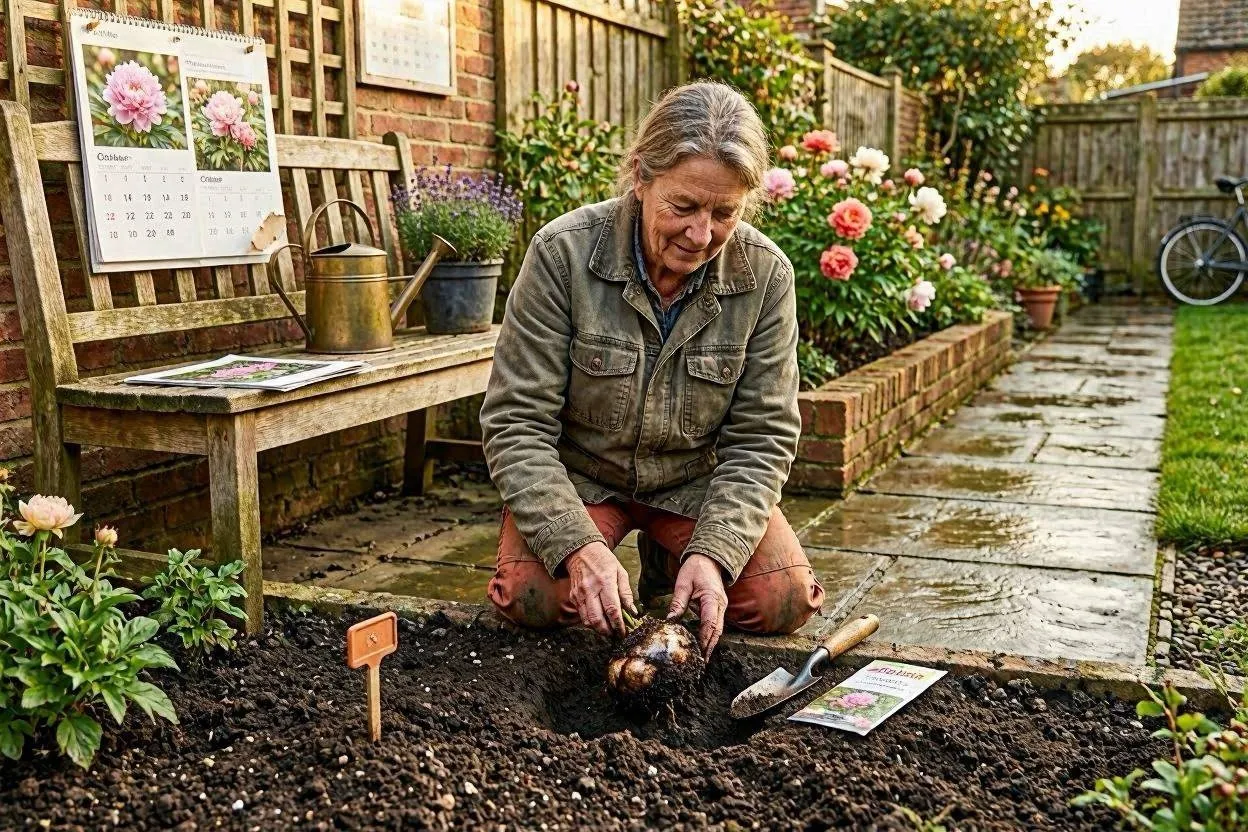
Plant peonies in fall — late September through October — for the strongest roots and best first-year blooms. Spring planting works with container-grown peonies, but fall-planted peonies produce blooms roughly one full year sooner.
Peonies (genus Paeonia, family Paeoniaceae) are cold-hardy perennials that survive for 50 to 100 years in the right location. Getting peony when to plant right is the single most important decision you make for long-term bloom performance.
Peony When to Plant: Fall vs. Spring Compared
Fall planting gives bare root peonies 4 to 6 weeks to establish new feeder roots before the ground freezes. Those established roots push up stronger red shoots in spring and often produce flowers in year 1 or year 2. Spring planting delays that process by an entire season.
Spring-planted peonies — whether bare root or container — generally lag one full year behind fall-planted specimens in first bloom production. Most horticulture experts, including Extension educators at the University of Nebraska, confirm this timing difference.
Why Fall Planting Produces Earlier Blooms
To produce flower buds, peonies need a chilling period: sustained temperatures below 40°F (4°C) for 6 to 8 weeks. Fall-planted roots experience this cold period immediately after root establishment. Spring-planted roots skip one entire chilling cycle, delaying bud set by one season.
Bare root tubers (also called rhizomes) with 3 to 5 eyes — the pink or red growth buds — go into the ground most effectively in fall. Eyes are the pink-red nubs on the crown of the root division. Each eye becomes a stem the following spring.
When Spring Planting Makes Sense
To plant peonies in spring, choose container-grown plants rather than bare root tubers. Container-grown peonies in garden centers are already actively growing and tolerate spring planting. Wait until the soil reaches 50°F (10°C) before planting — typically mid-March through mid-April in Zones 5–6.
Never plant bare root tubers in late spring. By April, bare root rhizomes start breaking dormancy. Planting them once shoots emerge damages fragile new growth and stresses the root system severely.
Peony When to Plant by USDA Hardiness Zone
The USDA Plant Hardiness Zone Map divides the United States into 13 zones based on average annual minimum temperatures. Your zone determines your exact fall planting window for peonies.
Herbaceous peonies (Paeonia lactiflora) grow in Zones 3 through 8. Zones 9 and 10 lack the chilling hours peonies need, so the plants either fail to bloom or die within a few seasons in those climates.

- Zones 3–4 (Minnesota, North Dakota, Maine): Plant in early to mid-September. Ground freezes hard by November. Give roots 6 weeks minimum before freeze.
- Zone 5 (Chicago, Kansas City, Denver): Plant in mid-September through October. First hard freeze typically arrives in late October.
- Zone 6 (St. Louis, Philadelphia, Portland OR): Plant in late September through October. Aim for 6 weeks before your first frost date.
- Zone 7 (Oklahoma City, Northern California, Washington DC): Plant in October through November. Winters are mild — plant closer to the frost date.
- Zone 8 (Atlanta, Houston, Seattle): Plant in November. Choose early-blooming varieties and plant eyes only 1 inch (2.5 cm) deep to maximize chilling exposure.
Check out the bush peony growing guide for zone-specific variety recommendations matched to your local growing conditions.
Planting Times for 3 Types of Peonies
Three distinct types of peonies exist in cultivation: herbaceous peonies, tree peonies, and intersectional (Itoh) peonies. Each type has specific timing and depth requirements.
Herbaceous Peonies — Most Common Type
To plant herbaceous peonies (including varieties like ‘Sarah Bernhardt,’ ‘Festiva Maxima,’ and ‘Red Charm’), set bare roots in the ground from late August through October. Place the eyes no more than 2 inches (5 cm) below the soil surface in Zones 3–6. In Zones 7–8, plant the eyes just 1 inch (2.5 cm) deep so they receive more winter chill through the soil profile.
Planting too deep is the number one reason herbaceous peonies grow lush foliage but never bloom. A root set at 4 inches (10 cm) deep may produce leaves for 3 years with zero flowers before you realize the problem.
Tree Peonies — Different Depth Rule
To plant tree peonies (woody-stemmed species that retain their canes year-round), bury the graft union — the point where the named variety joins the rootstock — 4 to 6 inches (10 to 15 cm) below the soil surface. This depth encourages the named variety to develop its own roots above the graft. Plant tree peonies in fall, September through October, the same window as herbaceous types.
Tree peonies bloom earlier than herbaceous types — typically in April in Zones 6–7 — and produce larger individual flowers. Varieties like ‘Shimane Sedai Nishiki’ and ‘Shimanishiki’ grow 4 to 7 feet (1.2 to 2.1 m) tall at maturity.
Itoh (Intersectional) Peonies — Hybrid Timing
To plant Itoh peonies — hybrids first created by Japanese botanist Dr. Toichi Itoh by crossing herbaceous peonies with tree peonies — follow the same fall timing as herbaceous types. Itoh peonies like ‘Bartzella’ and ‘Cora Louise’ produce eyes on both the crown and sometimes on woody stem remnants.
Set Itoh peony eyes 1 to 2 inches (2.5 to 5 cm) below the soil surface. Do not bury any visible woody stem sections below grade. Itoh peonies are hardy in Zones 3 through 8 and bloom in late May through June, after most herbaceous types peak.
Peony Planting Quick-Reference Table by Task
Use this table to schedule your exact planting tasks by peony type, timing, and method.
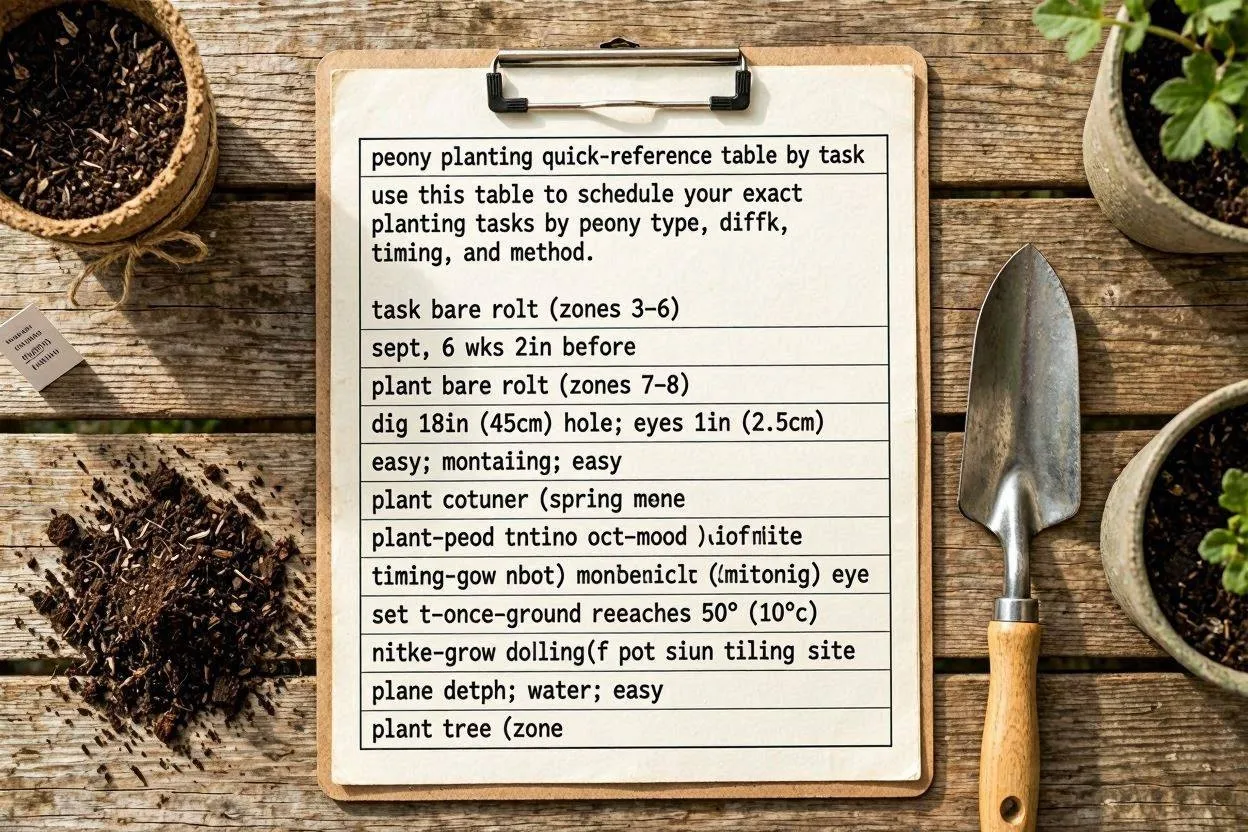
| Task | Timing | Method | Difficulty |
| Plant bare root (Zones 3–6) | Sept–Oct, 6 wks before freeze | Dig 18in (45cm) hole; eyes 2in (5cm) deep | Easy |
| Plant bare root (Zones 7–8) | Oct–Nov | Eyes 1in (2.5cm) deep; morning sun site | Easy |
| Plant container-grown (spring) | Once ground reaches 50°F (10°C) | Set at same depth as pot; water deeply | Easy |
| Plant tree peony (Zones 4–8) | Sept–Oct | Graft union 4–6in (10–15cm) below soil | Moderate |
| Plant Itoh/intersectional (Zones 3–8) | Sept–Oct | Eyes 1–2in (2.5–5cm) deep | Easy |
| Divide and replant mature roots | Late Sept–Oct after dieback | 3–5 eyes per division; replant immediately | Moderate |
| Store roots if ground frozen | Until ground thaws | Wrap in damp peat; refrigerate at 35–40°F (2–4°C) | Easy |
How to Prepare the Planting Site for Peonies
To prepare a peony planting site, choose a location with 6 to 8 hours of direct sunlight daily. Peonies in full shade produce weak stems and few flowers. In Zones 7–8, morning sun with light afternoon shade protects blooms from petal scorch.
Peonies require well-draining soil. Standing water around peony roots causes root rot and botrytis blight within one season. Sandy loam — a mixture of equal parts sand, clay, and compost — gives peonies the drainage and fertility they need.
Prepare the planting site 2 to 4 weeks before planting. Work the soil 18 to 24 inches (45 to 60 cm) deep. Incorporate organic matter such as compost or well-rotted manure throughout the planting zone. Add 1 cup (240 ml) of bone meal or superphosphate fertilizer per planting hole to support root development.
Test soil pH before planting. Peonies perform best in slightly acidic to neutral soil: pH 6.5 to 7.0. Add garden lime to raise pH if your soil tests below 6.5. Use elemental sulfur to lower pH if your soil tests above 7.0.
Space peony plants 3 to 4 feet (0.9 to 1.2 m) apart. Adequate spacing improves air circulation and reduces fungal disease risk. Keep peonies at least 3 feet (0.9 m) away from large tree and shrub root zones — peonies compete poorly for water and nutrients in crowded conditions.
How to Plant Peony Roots in 5 Steps
To plant bare root peonies, follow these 5 steps in order. Skipping step 4 — the depth check — causes the most common peony failure: foliage without flowers for years.

- Soak the roots. Submerge bare root divisions in room-temperature water for 2 to 4 hours before planting. Rehydration improves first-year establishment, especially for roots that arrived by mail.
- Dig the hole. Dig a hole 18 inches (45 cm) wide and 18 inches (45 cm) deep. Backfill the bottom 9 inches (23 cm) with amended soil — a 50/50 mix of native soil and compost — to create a firm platform for the root.
- Build the mound. Create a small mound of amended soil in the center of the hole. The mound positions the root so the crown (the flat top section with eyes) sits at the correct depth after backfilling.
- Position the root. Place the bare root on the mound with all eyes facing upward. Use a ruler to measure: eyes must sit 1 to 2 inches (2.5 to 5 cm) below the final soil surface in Zones 3–6. Check this measurement before adding any backfill.
- Backfill and water. Fill the hole with amended soil, gently tamping as you go to eliminate air pockets. Water thoroughly — 1 to 2 gallons (3.8 to 7.6 liters) — immediately after planting. Add 2 inches (5 cm) of mulch around the plant, keeping mulch 2 to 3 inches (5 to 7.6 cm) away from the crown to prevent rot.
The peony color varieties guide covers 14 peony colors with named variety recommendations to help you choose the right plants before you dig.
What Happens If You Plant Peonies at the Wrong Time
Planting bare root peonies too late in fall — after the ground freezes — prevents root establishment before winter. Frost heave then pushes unanchored roots to the soil surface. Roots exposed above grade die from cold and desiccation before spring arrives.
Planting too early in spring with active bare root shoots damages the fragile emerging growth. Broken or bruised shoots set the plant back by 4 to 8 weeks of growth. The peony recovers, but bloom timing shifts into the following season.
Planting in zones warmer than Zone 8 means peonies never receive enough chilling hours (below 40°F/4°C) for bud formation. The plants survive but produce only foliage. No chilling hours equals no flowers, regardless of soil quality or sun exposure.
Store roots that arrive after your ground freezes. Wrap bare roots in damp sphagnum peat moss, seal them in a plastic bag, and refrigerate at 35 to 40°F (2 to 4°C). Plant the stored roots as soon as the ground thaws in early spring — before new shoot growth exceeds 1 inch (2.5 cm).
Peony When to Plant: After-Planting Care for Fall-Planted Roots
Water newly planted peonies deeply if fall rainfall drops below 1 inch (2.5 cm) per week. The root needs consistent moisture for 4 to 6 weeks after planting to develop feeder roots before dormancy.
Do not apply heavy mulch over the crown of newly planted peonies in Zones 3–5. Mulch insulates the root from cold, and peonies need cold temperatures for bud formation. A loose 1-inch (2.5 cm) layer of straw protects against frost heave without blocking chilling.
Cut peony stems to ground level in fall after the first hard frost. Remove all cut foliage from the planting area — do not compost it. Botrytis blight (Botrytis paeoniae), the most common peony fungal disease, overwinters in infected plant debris. The winterize your garden guide includes exact cutback timing for peonies alongside other perennials.
Apply fertilizer in early spring as red shoots emerge — not at planting time. Use a low-nitrogen formula such as 5-10-10 at 1/4 cup (60 ml) per plant. High nitrogen in fall stimulates soft foliage growth that freezes in winter.
Expect your fall-planted peonies to bloom in year 2 or year 3 after planting. A peony that produces no bloom in year 1 is not a failure — the plant is building root mass. Year 3 through year 5 typically produces full flowering performance. After year 5, peonies bloom reliably for decades with minimal intervention.
Common Questions About Peony Planting Time
Can I plant peonies in spring?
Yes, you can plant peonies in spring using container-grown plants. Wait until the soil temperature reaches 50°F (10°C). Spring-planted peonies bloom approximately one year later than fall-planted peonies of the same variety.
Do peonies need a cold period to bloom?
Yes. Peonies require 6 to 8 weeks of temperatures below 40°F (4°C) to set flower buds. This chilling requirement is why peonies fail to bloom in USDA Zones 9 and 10 where winters stay warm.
How deep do you plant peony eyes?
1 to 2 inches (2.5 to 5 cm) below the soil surface in Zones 3–6. In Zones 7–8, plant eyes just 1 inch (2.5 cm) deep. Planting deeper than 2 inches is the most common reason peonies produce only foliage and never bloom.
How long does it take peonies to bloom after planting?
2 to 3 years for fall-planted bare root divisions. Container-grown transplants may bloom in year 2. Year 1 growth focuses entirely on root establishment — above-ground growth stays minimal and no blooms appear.
Should you mulch peonies after fall planting?
No, do not apply heavy mulch directly over peony crowns. Peonies need cold temperatures for bud formation, and thick mulch blocks that chilling. Apply a very light 1-inch (2.5 cm) layer of straw only in Zones 3–4 to prevent frost heave — then remove it fully in early spring.
Plant Peonies This Fall for Decades of Blooms
Fall is the best time to plant peonies. Set bare root divisions from late September through October in Zones 3–6, and from October through November in Zones 7–8. Position eyes 1 to 2 inches (2.5 to 5 cm) below the soil surface in well-draining, slightly acidic soil with a pH of 6.5 to 7.0.
Choose your planting site wisely. Peonies stay in the same location for 50 to 100 years — they resist transplanting and reward the gardener who gets placement right from the start. Full sun, good drainage, and adequate spacing of 3 to 4 feet (0.9 to 1.2 m) give you decades of flowering without intervention.