A thick, healthy lawn can still grow dandelions, crabgrass, and clover if the wrong removal method gets used at the wrong time. Most people grab a spray bottle before they’ve identified the weed, the grass underneath it, or the season. That’s backward. This guide covers the best way to remove weeds in your lawn: match the method to your weed, your grass, and your region. It starts with a weed identification table and ends with a season-by-season schedule you can follow today.
Do You Need to Remove Weeds in Your Lawn at All?
Sometimes not. The UK’s Royal Horticultural Society (RHS) takes a relaxed line on lawn weeds, and its point about biodiversity holds up even though its advice is written for British gardens. Clover feeds pollinators, and a few daisies in a back lawn hurt nobody. The RHS also leans toward non-chemical control first, which is worth borrowing.
If your goal is a weed-free lawn that looks uniform from the street, keep reading. If you only care that the grass is green and you can walk on it, tolerating a little clover may save you money and effort. Clover fixes nitrogen and handles drought better than most turf, so removing it is an aesthetic call, not an agronomic one.
What Counts as a Lawn Weed?
A lawn weed is any plant growing in your turf that you didn’t put there on purpose. Toxic, invasive, or just annoying, it counts.
Three Types of Lawn Weeds
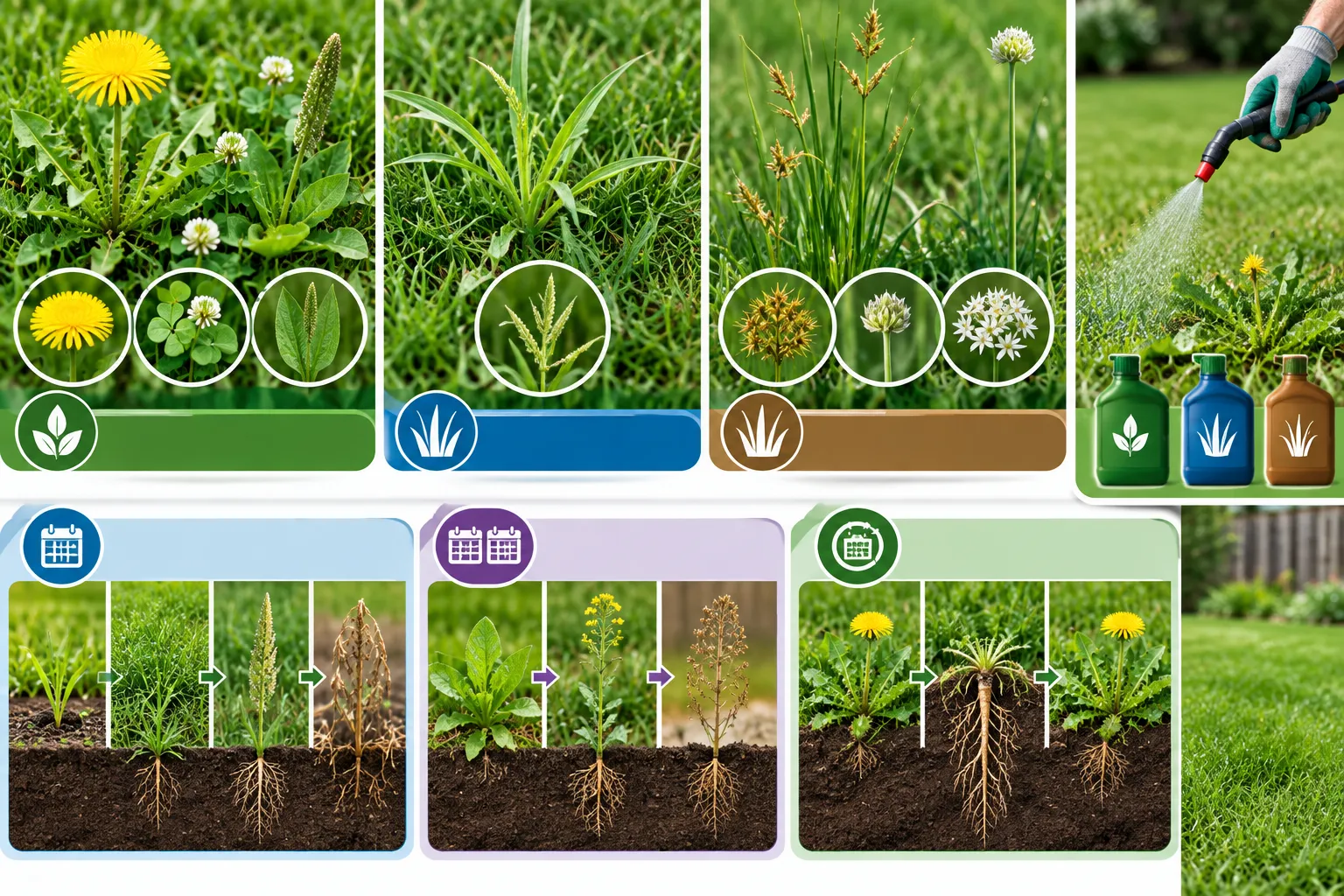
Weeds fall into three groups, and each group responds to a different removal method:
- Broadleaf: dandelion, clover, plantain
- Grassy: crabgrass
- Grasslike (sedges and alliums): nutsedge, wild onion, wild garlic
Mix these up and you’ll buy a product that does nothing. A broadleaf weed killer won’t touch crabgrass.
Annual, Biennial, and Perennial Weeds
Weeds also follow one of three life cycles. Annuals like crabgrass germinate, set seed, and die within a single season. Biennials build roots in year one and flower in year two. Perennials, including dandelions and ground ivy, come back from the same roots every year unless you destroy them. The life cycle sets your timing. An herbicide hitting a perennial’s roots in October works very differently from the same product hitting an annual seedling in April.
Lawn Weed Identification: Match the Weed to the Removal Method
Lawn weed identification is the step everyone skips, so here’s a cheat sheet for the weeds you’re most likely to find in a US lawn.
| Weed | Type | Life cycle | Best removal method |
| Dandelion | Broadleaf | Perennial | Dandelion weeder after rain, or post-emergent in fall |
| Plantain | Broadleaf | Perennial | Hand fork, then fix compaction |
| Clover | Broadleaf | Perennial | Tolerate it, or use a selective broadleaf killer |
| Ground ivy (creeping charlie) | Broadleaf | Perennial | Repeat fall treatments; dig small patches |
| Chickweed | Broadleaf | Winter annual | Pre-emergent in fall, or pull in cool weather |
| Crabgrass | Grassy | Annual | Crabgrass preventer in early spring |
| Yellow and purple nutsedge | Sedge | Perennial | Sedge-specific herbicide; dig tubers |
| Wild onion and wild garlic | Grasslike | Perennial | Dig bulbs; repeat post-emergent treatments |
Dandelions grow a taproot that can reach 6 to 18 inches (15 to 46 cm) into the soil. Pull only the top and it regrows within two to three weeks. Crabgrass works differently. It spreads by seed rather than deep roots and germinates once soil temperature holds at 55°F (13°C) for several days in spring.
Nutsedge: The Weed Everyone Mistakes for Grass
Nutsedge looks like grass, but it grows faster than turf, has a triangular stem instead of a flat blade, and spreads through underground tubers. Standard broadleaf herbicides don’t kill it, and most retail weed killers are built for broadleaf species. That’s why extension turf programs, including Penn State Extension and the University of Maryland’s turfgrass program, treat nutsedge as a special case. If your “grass” is yellow-green, shoots up a day after mowing, and pulls out with a small nut-like tuber, look for a sedge-specific herbicide (the label will name the sedges it controls).
Cool-Season vs. Warm-Season Grass: Why Your Region Decides the Method
Your grass type determines which herbicides are safe. The US transition zone runs roughly along Interstate 40. North of it you’ll find cool-season turf (fescue, Kentucky bluegrass, perennial ryegrass). South of it is warm-season turf (Bermuda, St. Augustine, zoysia, centipede).
| Attribute | Cool-season grass | Warm-season grass |
| Where | North of the transition zone | South of the transition zone |
| Common species | Fescue, Kentucky bluegrass, perennial ryegrass | Bermuda, St. Augustine, zoysia, centipede |
| Peak growth | Spring and fall | Late spring through summer |
| Herbicide tolerance | Handles most three-way broadleaf mixes (2,4-D, MCPP, dicamba) | St. Augustine and centipede burn easily; check the label |
| Mowing height | 3 to 3.5 inches (7.5 to 9 cm) | 2 to 2.5 inches (5 to 6.5 cm) |
St. Augustine is the most herbicide-sensitive of the group, and most three-way mixes will damage or kill it. Centipede reacts almost as badly. Put a fescue-safe product on a St. Augustine lawn in Charlotte, North Carolina, and you could have a brown yard within a week. Before you buy anything, check the label’s “safe for use on” list, not only its “kills” list.
How to Remove Weeds in Your Lawn by Hand
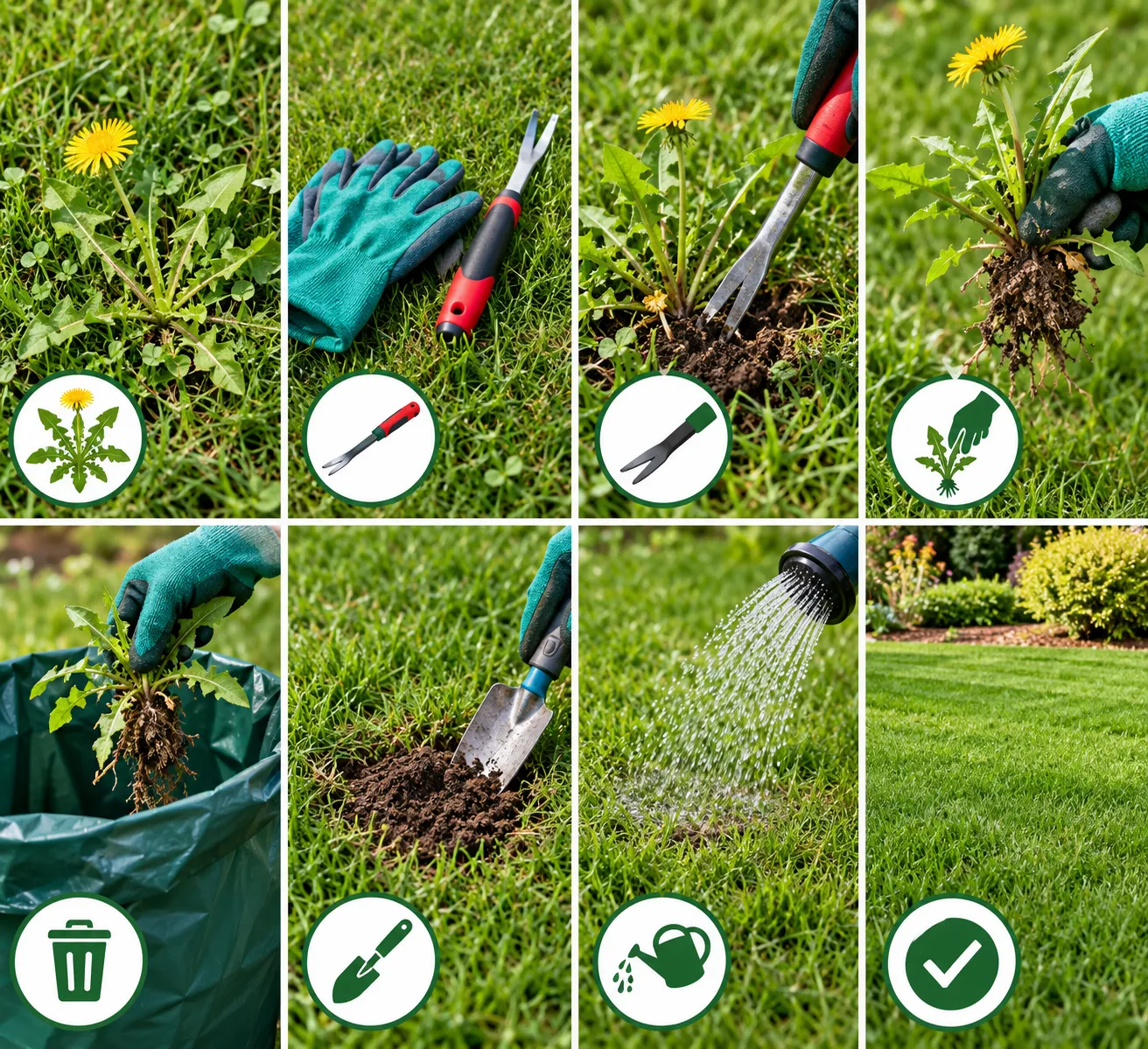
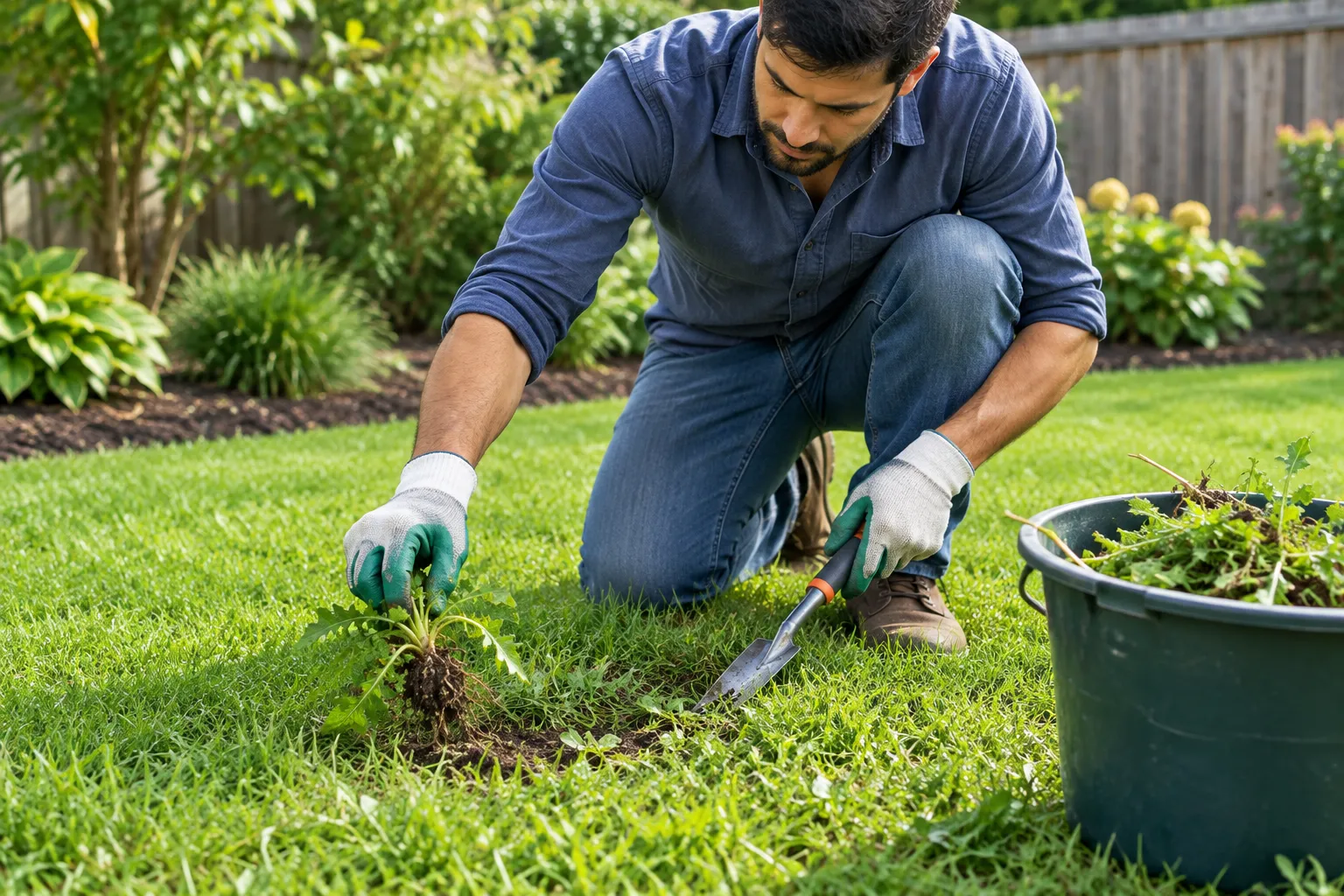
Hand-pulling works best on scattered weeds, and only if you get the entire root. For taproot weeds like dandelion, plantain, and dock, set a dandelion weeder or hand fork at a 45-degree angle beside the base. Push it 3 to 4 inches (7.5 to 10 cm) down, loosen the soil, and pull straight up.
Best Timing for Pulling Weeds
Timing matters more than technique. Pull within 24 hours of rain or irrigation, when the soil lets go of the root. In dry, compacted soil the taproot snaps around 2 inches (5 cm) down, and what’s left will regrow within a month. Someone pulling 40 dandelions out of dry clay might get the full root on half of them. In moist soil, it’s close to all of them.
When Hand-Pulling Stops Making Sense
Fewer than 20 weeds spread across the lawn? Pull them. Once weeds cover about 30% of a section, pulling stops being worth your Saturday, and spot treatment or a broadcast herbicide makes more sense.
Other Weeding Tools Worth Having
A few other tools earn their place:
- Trowel: for shallow-rooted weeds and digging out nutsedge tubers
- Cultivator: for loosening soil around clumps
- Hula hoe (stirrup hoe): great in beds and bare ground, too aggressive for healthy turf
- Tiller: only when you’re clearing a whole area to start over
How to Kill Weeds in Your Lawn With Herbicides
Herbicides are the fastest way to treat a large area, and the right type keeps you from killing the grass along with the weeds. Retail guides like Lowe’s (in a piece by Valerie Albarda) sort them along the same lines: selective or nonselective, systemic or contact, and pre-emergent or post-emergent.
Selective vs. Nonselective Herbicides
A selective weed killer targets certain plants, usually broadleaf weeds, and leaves the grass alone. It’s the standard choice for an established lawn. Nonselective herbicides, glyphosate products included, kill whatever they touch. Save them for clearing ground before new sod or a bare-patch renovation.
Systemic vs. Contact Herbicides
Systemic products travel down into the roots, so they suit perennials. Contact products burn only the tissue they land on, so they suit young annuals but often leave perennial roots alive to resprout.
Pre-Emergent vs. Post-Emergent Herbicides
Pre-emergent herbicides form a barrier in the soil that stops weed seeds from germinating, so they have to go down before weeds appear. Crabgrass preventer is the classic example, applied when soil holds at 55°F (13°C) for five straight days, which often lines up with forsythia or dogwood blooming. Post-emergent herbicides hit weeds that are already growing and work best on young, active plants between 60°F and 85°F (16°C and 29°C).
Weed and Feed Products
These combine fertilizer with a broadleaf herbicide, and brands like Scotts sell several versions. They save a trip, but the timing rarely suits both jobs at once, and they’re a risky pick for St. Augustine and centipede lawns. If you already know which weeds you have, a targeted broadleaf weed killer plus separate fertilizer gives you more control.
How to Apply Herbicide Safely
For a few weeds, a pump sprayer gives you spot treatment with almost no collateral damage. A hose-end sprayer covers more ground faster. Granular products go on with a spreader, and a drop spreader is more precise than a broadcast spreader, which throws farther but wanders. Skip application if rain is forecast within 24 to 48 hours. Avoid mowing for 48 hours before and after so the weeds keep enough leaf surface to absorb the product. Wait at least two weeks before reseeding a treated area.
The Glyphosate Question: What to Know Before You Spray
Glyphosate is the active ingredient in many nonselective weed killers, and it’s the most argued-over herbicide in the yard. In 2015 the World Health Organization’s cancer research agency classified it as probably carcinogenic to humans. The US Environmental Protection Agency (EPA) has maintained that it isn’t likely to cause cancer when used as labeled. In 2018 a California jury sided with Dewayne “Lee” Johnson, a school groundskeeper who sued Monsanto (now part of Bayer), and the award was later reduced on appeal. You don’t have to settle that debate to make a decision. For an established lawn you shouldn’t be using a nonselective product anyway, and for bare-ground clearing you can weigh the label directions against your comfort level.
Natural Weed Control Methods (and the Ones That Don’t Work)
Some natural weed control methods work well. Others are mostly internet folklore.
Natural Methods That Work
- Boiling water wilts weeds in driveway and patio cracks within 24 to 48 hours. It kills every root and soil organism it touches, earthworms included, so keep it out of garden beds and lawns.
- Mulch at 3 to 4 inches (7.5 to 10 cm) blocks light and stops most seeds from germinating in beds. A thin 1-inch (2.5 cm) layer fails within weeks. Organic mulches like shredded bark or “gorilla hair” (shredded redwood or cedar) also feed the soil as they break down. Cardboard or landscape fabric under mulch adds another barrier, though both are for beds, not turf.
- Solarizing means covering bare soil with clear or black plastic for six to eight weeks in full summer sun. It kills existing plants and part of the seed bank. A two-week cover only kills leafy growth.
- Dense planting and healthy turf crowd out seedlings by taking away the light and space they need.
- Corn gluten meal is sold as a natural pre-emergent. Results are inconsistent and timing is tricky, so treat it as a mild helper rather than a fix.
- Ammoniated soap of fatty acids is a contact killer that burns top growth. It works on young weeds and usually needs repeat applications.
- Goats (goatscaping) can clear overgrown patches, if your neighborhood allows them. Some lawn weeds, such as young dandelion leaves, are edible too, but only if you haven’t sprayed them.
DIY Recipes That Don’t Work
Kitchen vinegar (4% to 5% acidity) rarely kills mature roots and often needs three or more applications. Horticultural vinegar (20% to 30%) works faster, but it needs the same protective gear as a synthetic herbicide and etches concrete. Baking soda and dish-soap recipes show little effect on established roots. Lisa Bronner, who writes about natural cleaning and weed control and lives in San Diego County, has picked apart the viral vinegar-and-castile-soap recipes for exactly this reason. Soap helps a spray stick to leaves. It doesn’t kill roots.
How to Prevent Weeds From Coming Back
Weeds return because bare soil, thin turf, and short mowing hand weed seeds the open space and sunlight they need. Fixing those three things matters more than any single removal method. A perfectly pulled dandelion patch reseeds itself if the lawn around it stays thin. A healthy, thick lawn crowds out weeds on its own, and that’s the whole game.
Mow Tall
Keep cool-season grass at 3 to 3.5 inches (7.5 to 9 cm) and warm-season grass at 2 to 2.5 inches (5 to 6.5 cm). Taller turf shades the soil and blocks the light that crabgrass seeds need to germinate.
Water Deeply
Aim for 1 to 1.5 inches (2.5 to 3.75 cm) per week in one or two deep sessions. Daily sprinkling builds shallow roots that lose out to deep-rooted weeds.
Test and Improve Your Soil
Get a soil test through your state extension office. Soil pH runs on a 0 to 14 scale, and most turfgrass does best a little on the acidic side of neutral. If your soil is too acidic, lime raises the pH, and compost improves the structure and feeds the microbes. Compacted soil favors plantain and knotweed. Core aeration in the right season opens it up, and it pairs well with overseeding.
Overseed Bare Patches Every Fall
Do it every fall with a seed matched to your region. A quarter-acre lawn with 15% bare ground after a dry summer can close most of that gap with roughly 3 to 4 pounds (1.4 to 1.8 kg) of seed per 1,000 square feet (93 square meters), depending on the species. Early fall is ideal because soil is still warm enough to germinate seed while weed competition is fading.
Consider Drought-Tolerant Lawn Alternatives
In dry regions, drought-tolerant lawn alternatives like clover mixes, buffalograss, or creeping thyme can mean less watering and fewer weed problems.
Weed Removal Schedule by Season
There are three windows each year: early spring for pre-emergent, late spring through summer for spot treatment, and fall for perennials and overseeding.
Early Spring: Pre-Emergent Window
Put down a pre-emergent herbicide before soil holds at 55°F (13°C) for five days. In most of the country that means before forsythia blooms. Doing this on time is the whole point of the schedule.
Late Spring to Summer: Spot Treatment
Find the weeds that survived, then spot-treat them with a post-emergent product or pull them while temperatures stay between 60°F and 85°F (16°C and 29°C).
Fall: Perennial Weeds and Overseeding
This is the best time to hit perennial broadleaf weeds like dandelion and ground ivy, because they pull nutrients down into their roots as winter approaches and take the herbicide with them. Overseed bare patches at the same time.
Winter: Hand-Pull Only
Skip herbicide on dormant grass. Pull the big weeds by hand so they can’t set seed in spring.
Is It Weeds or Grubs?
Before you treat anything, make sure you’re fighting the right problem. Bare, thin, or brown patches get blamed on weeds all the time, but grubs cause a lot of them. Tug on the affected turf. If it peels back like a loose carpet with few roots holding it down, and you find C-shaped white grubs in the soil, you have a grub problem. A weed killer won’t help. Extension services usually treat grubs only when you find a handful per square foot or more, so count before you spray. If the turf holds firm and you can see actual weed leaves or stems, go back to the identification table above.
Is Herbicide Safe Around Children and Pets?
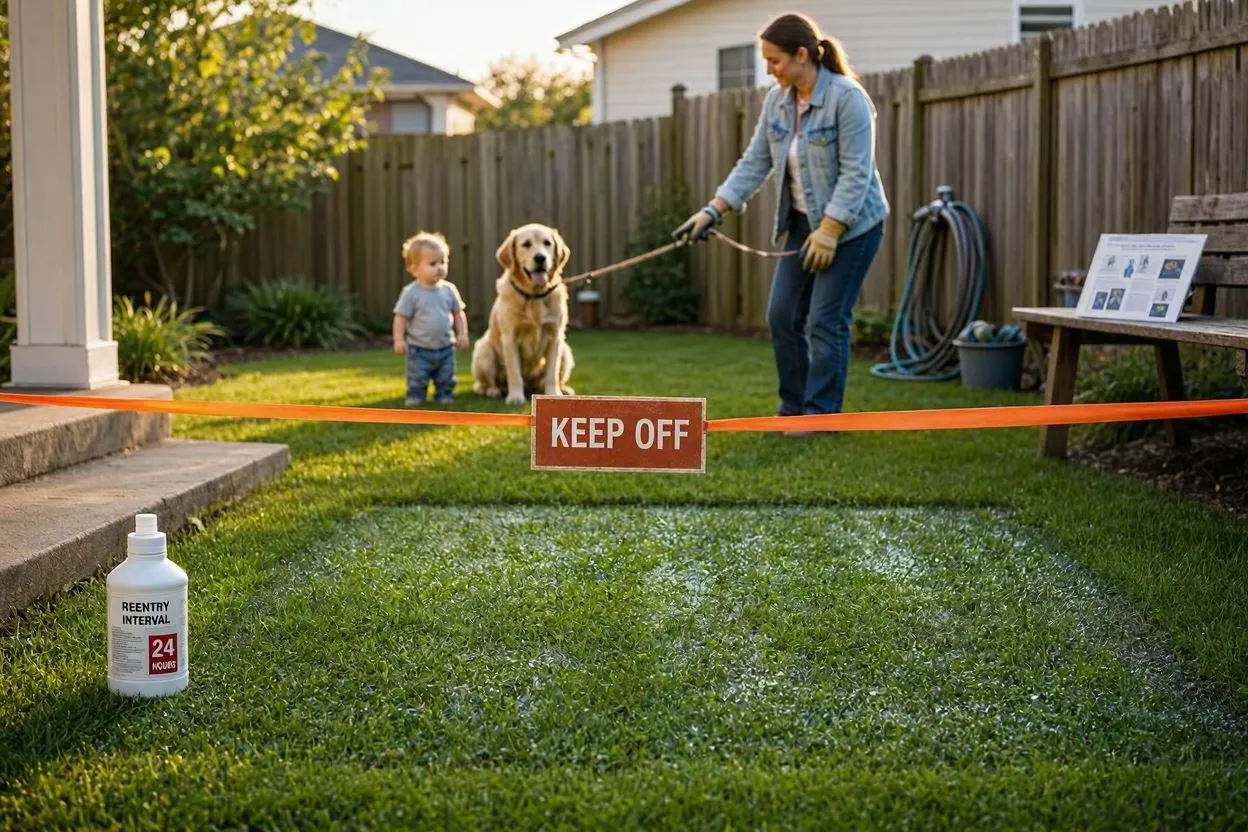
Not right away. Most labels tell you to keep kids and pets off the treated area until it dries, and some require 24 to 48 hours. The exact wording varies. Look for “reentry statement,” “re-entry interval (REI),” or similar language on the EPA-registered label, and treat that label as the rulebook. Some products only need the lawn to dry completely, usually 2 to 4 hours. Others demand a full 24-hour restriction.
Store all herbicide in a locked cabinet. Even small amounts can cause stomach upset in dogs and cats. If you need people or pets back on the lawn sooner than the label allows, spot-treat individual weeds instead of broadcasting across the whole yard. Less treated surface means less practical exposure. This is the same reason herbicide safety comes down to reading one label, once, before you open the bottle.
FAQs
How long does it take to remove weeds from a lawn?
Hand-pulling works immediately. Herbicide takes 7 to 14 days for visible wilting and 3 to 4 weeks for full root death, depending on the species and the temperature.
Can I remove weeds without killing my grass?
Yes. Selective herbicides and hand-pulling both work, as long as the label lists your grass species as safe.
Why do weeds keep growing back after I pull them?
Either part of the root stayed in the soil, or bare ground gave new seeds a place to sprout before the grass filled in.
What is the best time of year to remove lawn weeds?
Fall for perennials like dandelion, since they’re storing energy in their roots. Early spring for annuals like crabgrass, treated before they germinate.
Do I need different herbicides for different weed types?
Yes. Broadleaf herbicides don’t kill crabgrass or nutsedge, so match the product to the weed category.
Conclusion
Removing lawn weeds comes down to three decisions, in order: identify the weed and its life cycle, match the method to your grass and region, and time the treatment for when the weed is most vulnerable. A dandelion pulled from dry August soil will regrow within weeks. That same dandelion, treated in October while it’s storing energy for winter, often dies at the root on the first application. And if your lawn is thick, tall, and well-fed, you’ll be doing much less of all of this.